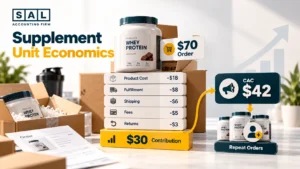
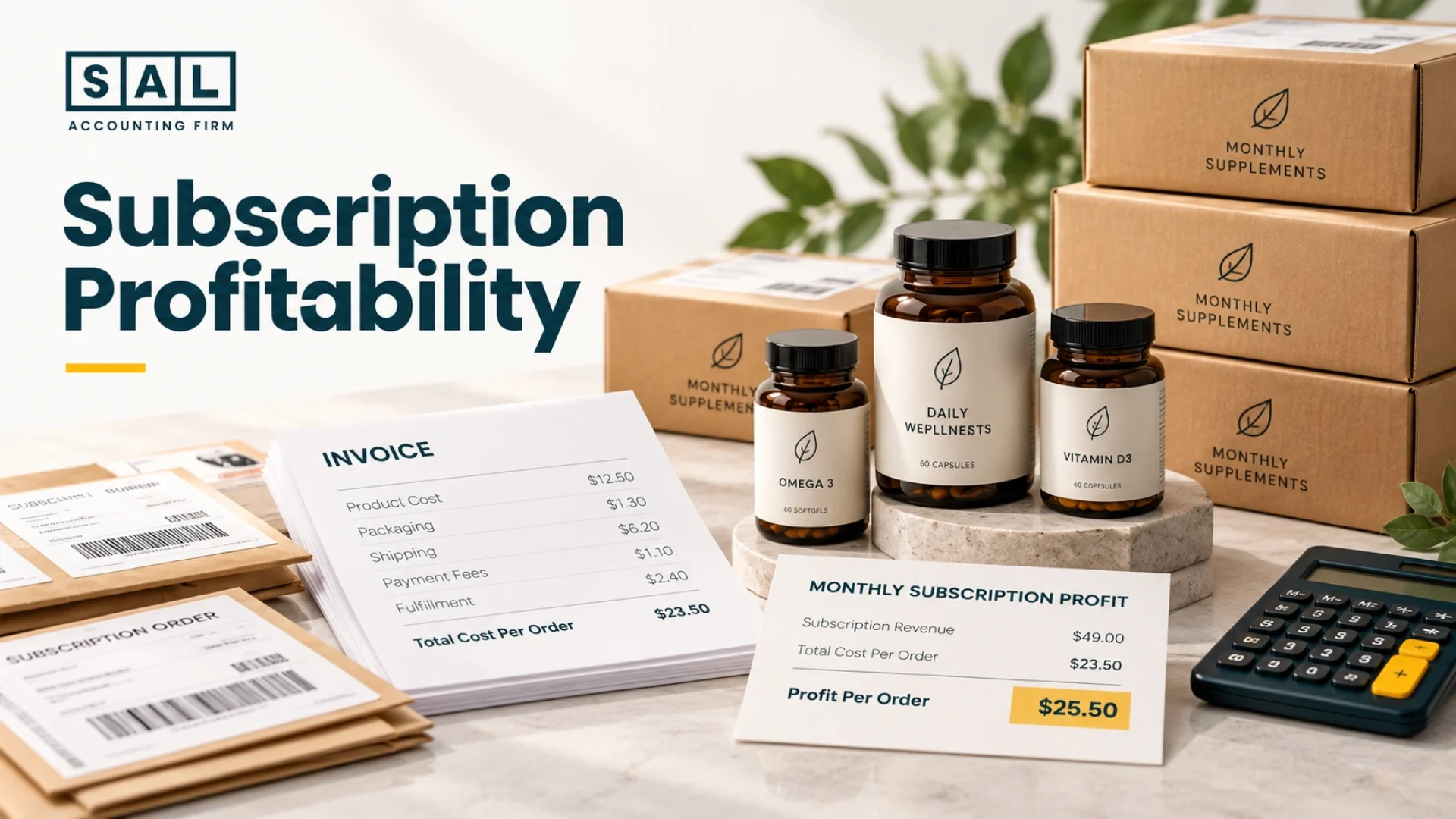
Are subscriptions profitable for a supplement brand? They can be, but only when each subscriber stays long enough for their repeat orders to pay back what you spent to win them. Recurring revenue is not the same as recurring profit.
The supplement founders who come to SAL Accounting often know their subscriber count by heart. Very few know their payback month. Keep reading, because that one number decides whether growth fills your bank account or drains it.
Every renewal pays a processing fee before it pays you. Plug your price into the Shopify Fee Calculator and see what each order keeps.
Quick Takeaways
- A subscriber is only valuable once their repeat orders cover what you paid to get them.
- Four numbers tell you if subscriptions work: CAC, contribution per order, retention, and payback period.
- Payback period = CAC ÷ monthly contribution per subscriber.
- Deep discounts can bring in sign-ups who cancel before you earn your money back.
- Longer payback means you need more cash to keep growing.
- Track subscribers by the month they joined, not as one big total.
Why Does Subscription Profitability Look Different From One-Time Sales?
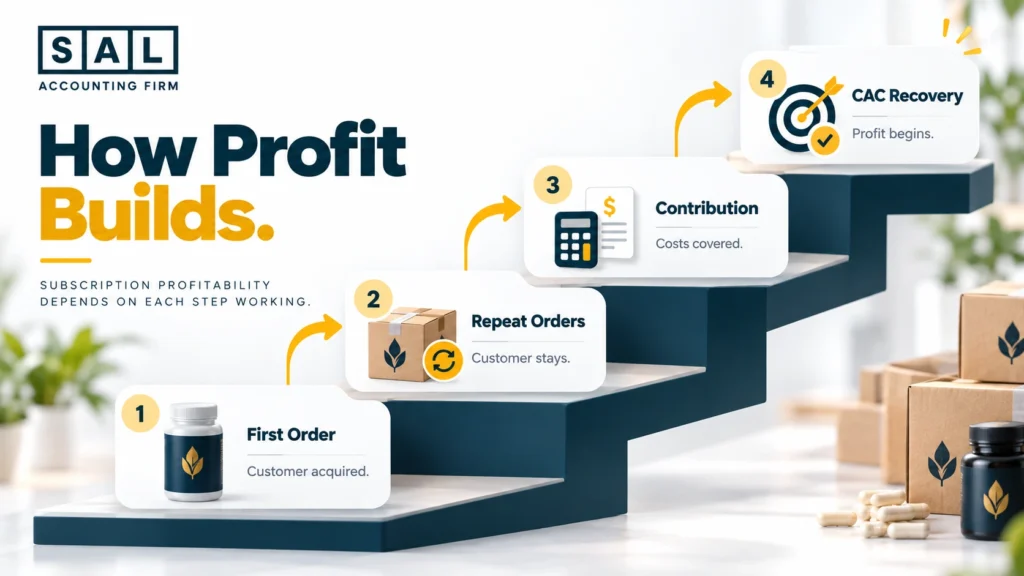
A one-time buyer has one shot to pay you back. If you spend $40 on ads to get a sale that leaves you $25, you lost $15. Done. A subscription changes the math. You can accept a weak first order, because more orders are supposed to follow. Here’s the chain:
First Order → Repeat Orders → Customer Contribution → CAC Recovery
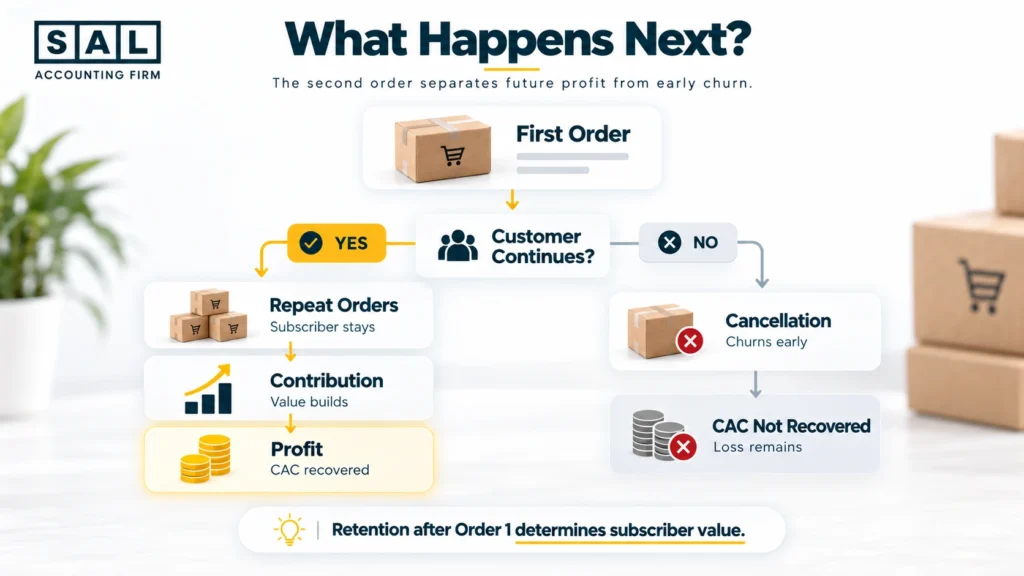
Each link has to hold. If customers leave after order one, the chain breaks and you’re left with the loss from that first sale.
Example: Think of a $55 monthly magnesium formula. On a one-time sale, you need that single order to cover your ad cost. On a subscription, you might lose money on month one and still come out ahead by month four. But only if the customer is still there in month four.
This is where a lot of brands get stuck. The dashboard shows monthly recurring revenue going up, so it feels like it’s working. Basically, though, revenue tells you what came in. It doesn’t tell you what stayed. That’s why accounting for an online supplement business starts with profit per customer, not sales per month.
Keep in mind, this article is about the economics. How you record renewals and prepaid plans in your books is a separate topic, covered in our guide to subscription accounting for supplement brands.
The point is simple. A subscription model is only worth it if customers stay long enough for future orders to fix the math.
What Numbers Determine Whether a Supplement Subscription Is Profitable?
Four numbers do most of the work. Get these right and the rest of the picture gets much clearer. The table below shows what each one measures and when it should worry you.
| Metric | What It Measures | What Goes Into It | Warning Sign |
|---|---|---|---|
| CAC | Cost to win one subscriber | Ads, influencers, affiliates, promo costs | Rising each month while sign-ups stay flat |
| Contribution per order | What one order leaves after direct costs | Price minus product, fulfilment, shipping, fees, discounts | Under $15 on a $50+ product |
| Retention | How long subscribers keep paying | Second-order rate, cancellations by month | Big drop after order 1 or 2 |
| Payback period | Months to recover CAC | CAC ÷ monthly contribution | Longer than your average subscriber stays |
Customer Acquisition Cost (CAC)
CAC is everything you spend to get one new subscriber. That includes paid ads, influencer fees, affiliate payouts, and promo costs like free samples.
Now, a lot of founders only count Meta or Google spend. That makes CAC look smaller than it is. Your ad platform and your store also report different numbers, which is why Meta, Shopify, and Triple Whale rarely agree. Use the money that left your bank, divided by the new subscribers you got.
Customer Contribution
Revenue is not enough. A $50 order doesn’t leave you $50. Take out:
- Product cost (what the tub or bottle cost you)
- Pick, pack, and packaging
- Shipping
- Payment processing fees
- Any subscription discount
What’s left is your contribution margin. Getting the product cost right is its own job, and our breakdown of COGS for supplement brands walks through what belongs in it. Small costs like inserts and scoops add up too, and they’re some of the hidden expenses that eat into ecommerce margins.
Retention
Retention is how long subscribers keep paying. It’s usually shown as the share of people who make a second order, a third order, and so on.
Payback Period
Payback is how many months it takes for a subscriber’s contribution to cover their CAC. After that month, they start making you money.
At the end of the day, these four numbers answer one question: does a subscriber earn back what they cost?
How Does CAC Affect Supplement Subscription Profitability?
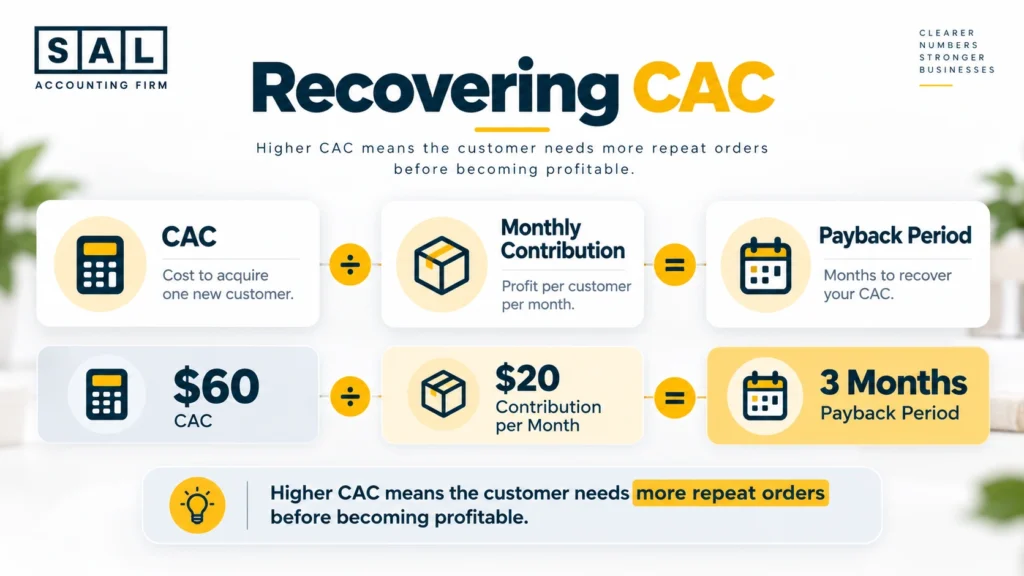
CAC sets the size of the hole each subscriber has to climb out of. The bigger the hole, the longer they need to stay. Here’s a simple comparison. Both brands sell a monthly vitamin and keep about the same contribution on each repeat order.
Brand A:
- CAC: $80
- First-order contribution: $25
- After order one, it’s still $55 short
- Needs about 4 orders to break even
Brand B:
- CAC: $40
- First-order contribution: $30
- After order one, it’s only $10 short
- Breaks even on order 2
Brand A isn’t doomed. But it needs every subscriber to stay at least four months. If half of them cancel after order two, Brand A loses money on that half, even while its subscriber count grows.
Technically, that’s the trap. You can add 500 subscribers a month and still be building a loss. Every new sign-up is a bet that they’ll stay long enough. When you spend more to acquire them than they’ll ever return, you’ve landed in negative contribution margin territory, just spread over several months so it’s harder to spot.
The point is, growing subscribers without knowing your CAC can create growth that loses money.
Why Does Retention Matter More Than the First Subscription Order?
The first order is a promise. The second order is proof. Most of the money in a subscription comes from orders two, three, four, and beyond. So the first order alone tells you very little. According to a well-known Harvard Business Review piece, winning a new customer can cost many times more than keeping one you already have.
For supplement brands, measure these six things:
- Second-order rate: what share of first-time subscribers get a second shipment
- Continuation by month: how many are still active at month 3, 6, and 12
- Cancellation timing: when people leave, not just how many
- Reorder frequency: do they skip or delay shipments?
- Behaviour after discounts end: does a price step-up trigger a wave of cancels?
- Failed payments: some cancels aren’t choices. An expired card can quietly end a subscription, which is why processors like Stripe offer automatic retries for failed renewals
Supplements behave differently by type:
- Daily vitamins: often steady, because people build a habit around them
- Protein powder: tends to follow gym routines, so cancels spike when routines change
- Daily wellness products (greens, sleep, gut health): can drop off fast if the customer doesn’t feel a result in the first few weeks
This is where it gets confusing. Your total active subscribers can stay flat while many people leave and many join. The total hides the churn.
Pro Tip: Group subscribers by the month they joined. Then track what share of each group is still active at month 1, 2, 3, and so on. This is called a cohort view. Shopify’s customer cohort analysis report is a good place to start, since it groups customers by their first order date.
Turning that data into a monthly view is part of good financial reporting for supplement businesses. And if you want it in front of you every month, it belongs in your management reporting pack.
How Do You Calculate Subscription Payback Period?
Here’s the main formula:
CAC ÷ Monthly Contribution per Subscriber = Payback Period (in months)
Example:
- CAC: $60
- Monthly contribution: $20
- Payback: $60 ÷ $20 = 3 months
So a subscriber who stays 3 months breaks even. Every month after that is profit. A subscriber who leaves after 2 months costs you $20.
Now compare payback to how long subscribers usually stay. If payback is 3 months and your average subscriber stays 7, the model works. If payback is 5 months and your average subscriber stays 4, you lose money on the average customer. Payback also shapes your cash:
- Short payback means cash comes back fast, so you can reinvest in more ads sooner
- Long payback means you pay for ads today and wait months to get that money back
That’s why a brand can be profitable on paper and still run short of cash. The gap between profit and cash flow gets wider as payback gets longer. Planning for that gap is what a supplement cash flow forecast is for. Some brands fill it with outside money, and it’s worth knowing the trade-offs of Shopify Capital and other funding options before you do.
This is the simple version. If your contribution changes after a discount ends or after a price increase, you’ll need to calculate payback order by order instead.
Case Study: How Priya’s Protein Brand in Leslieville, Toronto Finds Its Payback Month1
Priya runs a plant-based protein brand out of a shared kitchen space in Leslieville, in Toronto’s east end. She sells on Shopify, and most customers subscribe to a $65 tub every month. She has about 1,200 active subscribers. Growth comes from Instagram ads and a handful of fitness influencers with discount codes. Revenue is up 40% over the past year. But her bank balance looks about the same as it did twelve months ago, and she can’t figure out why.
The Problem
Priya thinks her CAC is $55, because that’s what her Meta dashboard shows. It leaves out the flat fees she pays influencers upfront and her affiliate payouts. Her full CAC is closer to $95. Each order leaves about $19 after product, packaging, shipping, fees, and her 10% subscriber discount. That’s a 5-month payback, and many subscribers cancel around month 3.
What We Do
We pull her ad spend, influencer invoices, and affiliate payouts into one CAC figure for each month. We rebuild contribution per order from her payout reports instead of top-line sales. Then we group subscribers by the month they joined, to see how many make it to order 5. This is the kind of work our ecommerce bookkeeping team in Toronto handles every month.
The Result
Priya sees that only about 4 in 10 subscribers reach their fifth order. She pauses the two influencer deals with the highest cost per subscriber. On her remaining channels, CAC sits near $60, so payback drops to just over 3 months. Her subscriber growth slows a little, but each new subscriber now earns back their cost well before most people cancel.
How Do Subscription Discounts Affect Profitability?
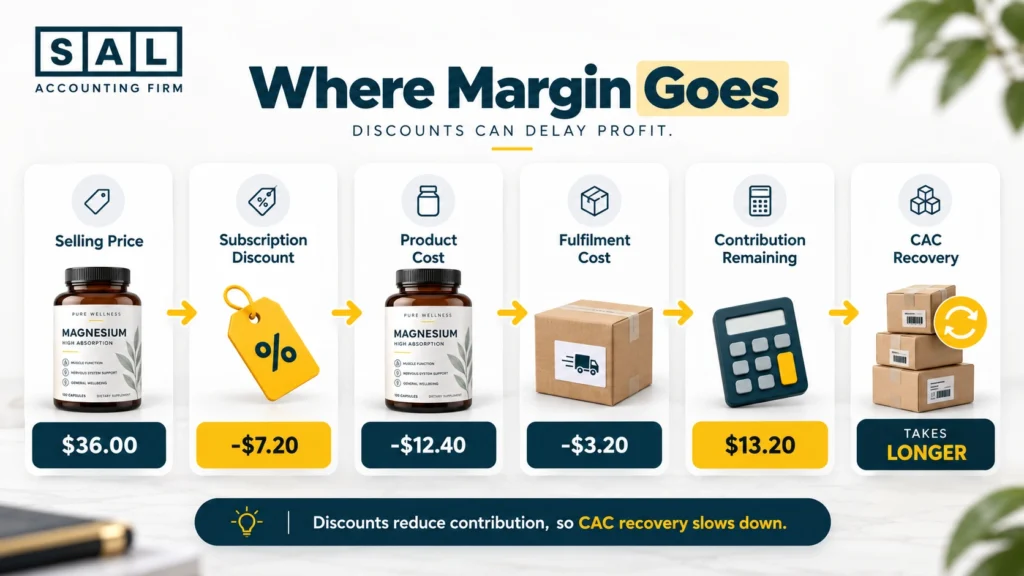
A discount is a trade. You give up margin on every order, hoping people stay longer. Common offers include:
- Subscribe-and-save (for example, 15% off every order)
- First-order discounts (for example, 30% off your first box)
- Free shipping on subscriptions
Here’s what that trade looks like. Say you sell a $50 supplement. Product costs $14, fulfilment is $4, shipping is $8, and payment fees run about 3%. CAC is $60.
| Offer | Price per Order | Contribution per Order | Orders to Recover $60 CAC |
|---|---|---|---|
| No discount | $50.00 | $22.50 | 3 orders |
| 15% subscribe-and-save | $42.50 | $15.25 | 4 orders |
| 25% subscribe-and-save | $37.50 | $10.40 | 6 orders |
Look at that jump. A 25% discount doubles the number of orders you need before a subscriber breaks even. So is a discount worth it? It depends on one thing: does it keep people around long enough to make up the difference?
- A discount works if it raises retention enough that total contribution per customer goes up
- A discount hurts if customers take it and cancel quickly
Free shipping deserves a close look, because shipping is often the biggest cost after product. Your carrier rates have a big effect here, and it’s worth comparing the best ecommerce shipping providers before you promise free delivery on every renewal. Discounts also stack on top of platform costs, which is why Shopify fees hit profit margins harder when prices are already cut.
Pro Tip: Before you raise a discount, write down the retention you need to justify it. If a 25% offer needs subscribers to stay 6 months, check whether your current subscribers actually stay that long.
- Also read: “Top Ecommerce Pricing Strategies”
Case Study: How Marcus’s Greens Powder Brand in Port Credit, Mississauga Tests Its Subscribe-and-Save Offer2
Marcus sells a daily greens powder from a small warehouse unit near Port Credit in Mississauga. His regular price is $60. To grow faster, he offers 30% off the first subscription order, then 15% off every order after that, plus free shipping. Sign-ups jump the month he launches the 30% offer. He’s thrilled, until he notices that cancellations jump the following month too.
The Problem
With the 30% discount, his first order leaves only about $12 after costs. His CAC is $50. Ongoing orders leave about $20. A subscriber needs to reach order 3 to break even. But a lot of people who joined on the 30% offer cancel right after their first box. Each of them leaves about $38 of CAC he never gets back.
What We Do
We split his subscribers into two groups: those who joined on the 30% offer and those who joined on the standard 15% offer. For each group, we compare the second-order rate, the share still active at month 6, and total contribution per subscriber over those 6 months.
The Result
About 45% of the 30%-offer group reach a second order, compared with about 70% of the 15%-offer group. Over 6 months, the 15% group brings in far more contribution per subscriber. Marcus drops the first-order offer to 15% and keeps free shipping. Sign-ups dip a bit, but far more of his new subscribers stick around long enough to pay for themselves.
Are Subscription Customers Always More Valuable Than One-Time Customers?
No. A subscriber isn’t valuable just because they clicked “subscribe.” A loyal one-time buyer who reorders every two months at full price can be worth more than a subscriber who joined on a deep discount and left after one box.
Here’s how strong and weak subscribers compare.
| Factor | Strong Subscriber | Weak Subscriber | Why It Matters |
|---|---|---|---|
| Acquisition cost | Reasonable, recovered in 2–3 orders | High, needs 6+ orders | Sets how long they must stay |
| Discount | Modest or none | Heavy first-order or ongoing cut | Shrinks every order’s contribution |
| Tenure | Stays many months | Cancels after 1–2 orders | Decides if CAC is ever recovered |
| Contribution | Healthy on every order | Thin or near zero | Drives total profit per customer |
| Behaviour | Predictable, rarely skips | Skips, pauses, delays | Affects cash and stock planning |
Most brands have both types mixed together. The average hides the difference. That’s often why a supplement brand’s profit looks wrong even when sales look great.
This isn’t a new idea. Bain & Company’s loyalty research makes the same point: not every customer has the potential to become profitable and long-standing, so it pays to know which ones do.
The point is, count the good subscribers, not just all subscribers.
How Do Product Economics Affect Subscription Profitability?
Not every product fits a subscription. The product itself shapes the math. Five things make the biggest difference:
- Product price: a higher price leaves more room to cover CAC
- How fast it’s used up: a 30-day supply fits a monthly plan naturally
- Product cost: a lower cost means more contribution per order
- Fulfilment cost: heavy or fragile items cost more to pack
- Shipping: a big protein tub costs far more to ship than a pouch of capsules
For example, a daily multivitamin used up every 30 days fits a monthly subscription well. A seasonal immune booster people buy twice a year doesn’t. Pushing it onto a monthly plan will likely lead to skips and cancels.
Order timing is a big deal here. McKinsey’s research on subscription ecommerce found that shoppers are much more likely to cancel when products pile up. If a customer still has half a tub left when the next one arrives, you’re close to losing them.
In Canada, supplements are regulated as natural health products. Health Canada requires companies that make, package, label, or import them to hold product and site licences and follow good manufacturing practices. Those costs show up in your product cost, so they’re part of the math too.
Freight and import duties also change what each unit costs you, which is why landed cost accounting is worth getting right. Comparing product by product is a bigger job, and our guide to SKU-level profitability for supplement brands covers it step by step.
- Read more: “The Ecommerce Product Profitability Test”
How Do Subscriptions Affect Inventory Planning?
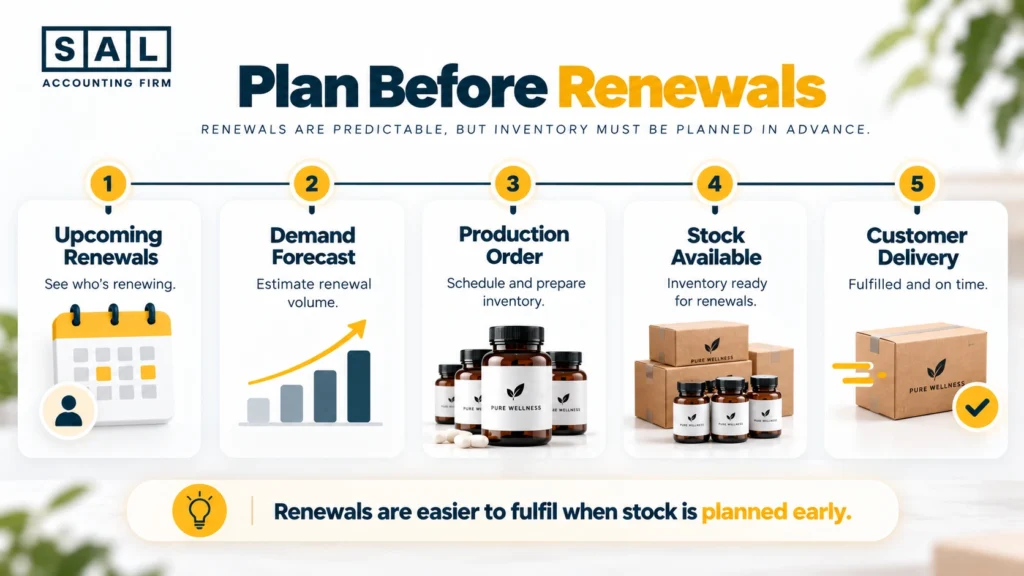
Subscriptions give you a good preview of future demand. If 2,000 people are set to renew next month, you have a rough idea of what you’ll ship. But that preview comes with a duty. You’ve promised to deliver. That means:
- Having enough stock ready for every renewal date
- Planning production runs early, since supplement manufacturers often need long lead times
- Avoiding stockouts, which can push subscribers to cancel
- Managing recurring demand alongside one-time orders and promos
A stockout hurts subscriptions more than one-time sales. A one-time buyer might wait. A subscriber whose box doesn’t show up often cancels for good.
Keeping stock records accurate is a separate job, covered in our guide to supplement inventory accounting.
What Makes a Supplement Subscription Model Difficult to Scale?
Growth puts stress on every number. Here are the five places it usually breaks:
CAC Keeps Increasing
The first few thousand subscribers are often the cheapest. As you reach past your core audience, each new one tends to cost more. If CAC climbs faster than contribution, payback stretches out.
Retention Is Weak
Customers leave before you earn back their CAC. More sign-ups just means more losses.
Discounts Reduce Contribution
Revenue grows, but each order keeps less. The business gets bigger and less profitable at the same time.
Fulfilment Costs Increase
More orders can mean a bigger warehouse, more staff, or a 3PL. Costs per order can go up before they come down. Adding a second sales channel makes this even harder, which is why multichannel accounting for supplement brands needs its own attention.
Inventory Cannot Support Growth
Demand outruns supply. Stockouts lead to missed renewals, and missed renewals lead to cancels.
Most growing brands hit at least one of these. It’s normal. What helps is spotting it early, and understanding how to scale an ecommerce brand without letting one weak number drag down the rest.
Pro Tip: Selling subscriptions into the US? Every renewal to a US customer counts as a sale. Since the Supreme Court’s Wayfair decision, states can make out-of-state sellers collect sales tax even with no physical presence there. Recurring orders can build up toward a state’s threshold faster than you’d expect, so keep an eye on sales tax nexus rules for online sellers as US subscribers grow.
How Can You Tell If Your Subscription Model Is Working?
Run through these six questions. If you can answer each with a number, you’re in good shape.
- How much does it cost to acquire one subscriber?
- How much contribution does each subscriber generate per order?
- How many months does it take to recover CAC?
- What share of subscribers reach a second, third, and sixth order?
- Are discounts improving retention, or just cutting margin?
- Can your stock and fulfilment keep up with subscription growth?
If any answer is “I’m not sure,” that’s the place to start. A lot of founders only track the first question, if that. It’s not a mistake anyone should feel bad about. Most subscription apps simply don’t show payback or contribution out of the box.
Setting up these numbers from Shopify, payout, and ad data is a core part of our Shopify accounting services. As you grow, having someone review them with you each month is what a virtual CFO for ecommerce does.
At the end of the day, subscription growth should mean better customer economics, not just a bigger recurring revenue number.