

The best ecommerce shipping provider depends on your package size, destination, delivery promise, and final carrier invoice. At SAL Accounting, we often see brands choose a low label rate, then lose the savings through surcharges, returns, and customs costs.
Keep reading before you lock in a carrier. The small fees most sellers overlook can quietly turn a “cheap” shipping option into one of the biggest drains on profit.
Quick Answer: Which Shipping Provider Is Best for Ecommerce?
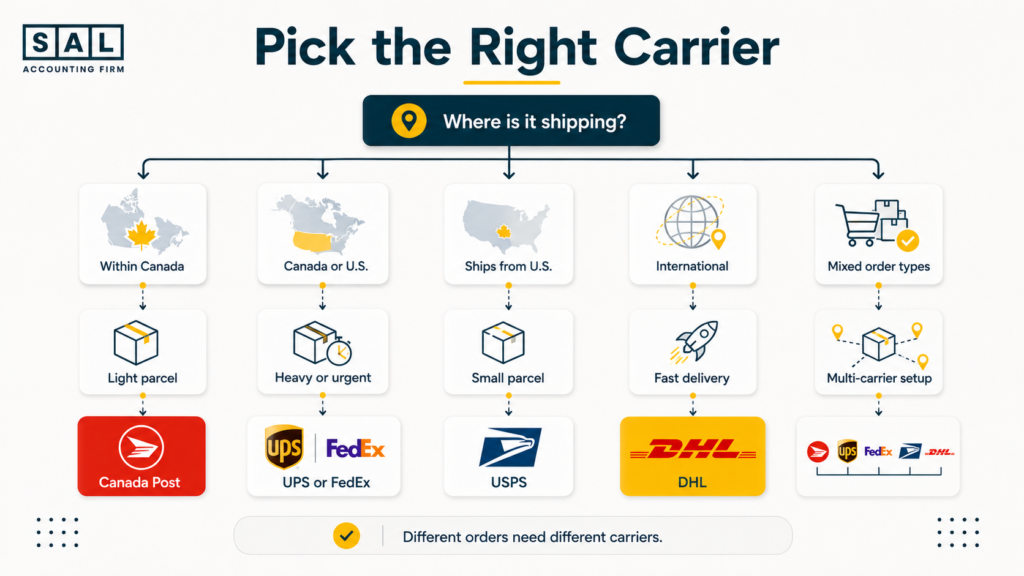
There’s no single winner for every ecommerce order. In most cases:
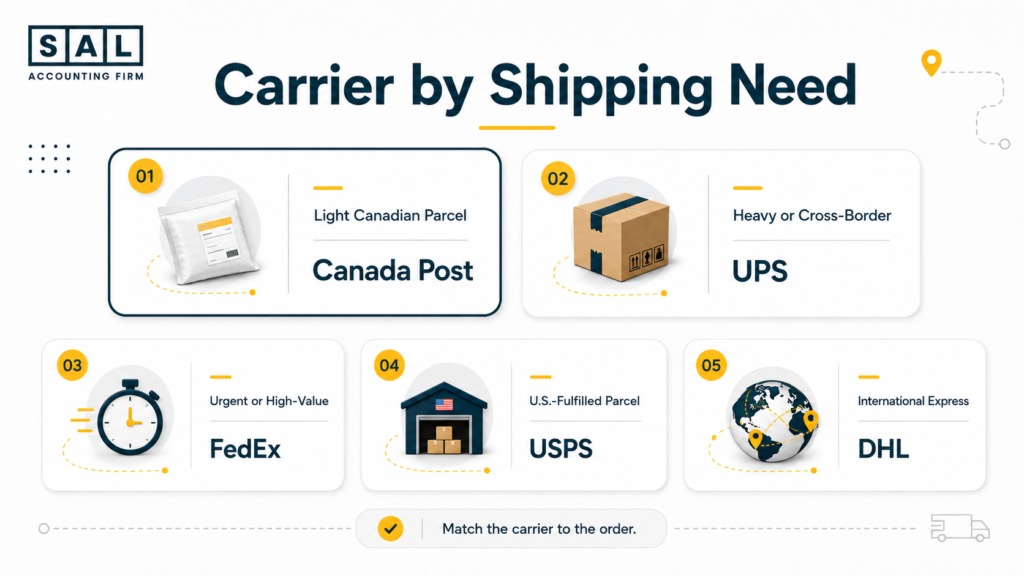
- Canada Post works well for lighter Canadian parcels, rural addresses, PO boxes, and FlexDelivery.
- UPS is worth testing for heavier shipments, dependable ground delivery, and recurring Canada-to-U.S. orders.
- FedEx often suits urgent, valuable, large, or tracking-sensitive packages.
- USPS makes the most sense when inventory or parcels already ship from inside the United States.
- DHL is usually strongest for international express or higher-volume cross-border ecommerce.
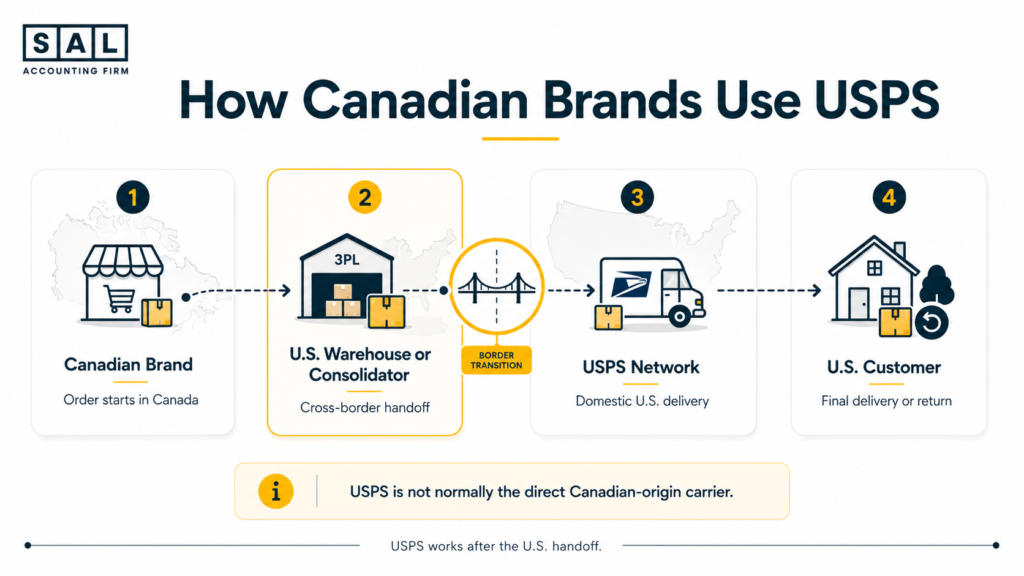
For example, USPS Ground Advantage is a domestic U.S. service with expected delivery in two to five days, tracking, a 70-pound maximum, and $100 of included insurance. It can be useful for U.S.-fulfilled orders, but it isn’t a direct replacement for Canada Post when the parcel starts in Canada.
The best carrier is the one that delivers reliably while protecting the final profit on the order, not simply the one showing the cheapest initial quote.
Not sure what shipping is doing to the wider business?
Use SAL’s Ecommerce EBITDA Calculator to compare sales with COGS, marketing, shipping, and other operating expenses.
What Should Ecommerce Brands Compare When Choosing a Shipping Provider?
Don’t compare carriers using one local order. Test a representative group of real shipments and review:
- Package profile: Final dimensions, actual weight, packaging type, and order value
- Shipping lanes: Canadian urban, rural, remote, U.S., and international destinations
- Delivery service: Economy, standard, expedited, or express
- Complete cost: Surcharges, duties, returns, claims, and final invoice adjustments
- Customer experience: Tracking, delivery attempts, pickup access, and return convenience
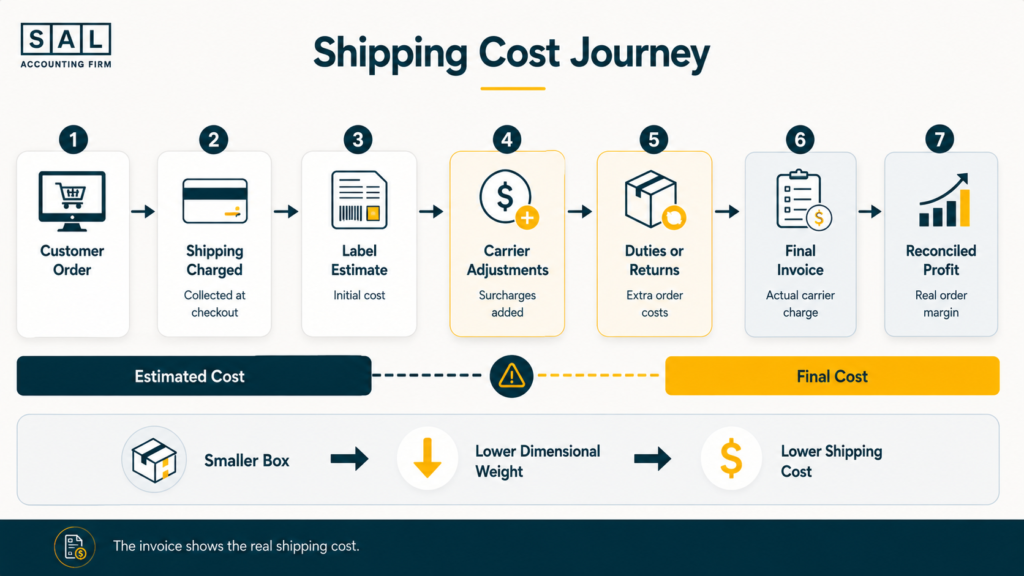
A $14 label isn’t really a $14 shipment when the carrier later adds a residential fee and a dimensional-weight adjustment.
Pro Tip: Test at least 20 to 30 recent orders. Include your common boxes, top destinations, a few remote addresses, returns, and unusual packages.
Shipping data also needs to reach the books properly. When the carrier invoice, customer shipping charge, and store order tell different stories, make every ecommerce cost explainable.
UPS vs FedEx vs USPS vs Canada Post vs DHL
Each carrier has different strengths, costs, and coverage. Here’s how UPS, FedEx, USPS, Canada Post, and DHL compare for ecommerce shipping.
UPS
UPS is often a strong option for medium, large, or heavy packages. Its range of ground, express, and cross-border services can also suit brands that want one network for Canadian and U.S. deliveries.
The main concern is surcharge exposure. UPS advises sellers to enter accurate dimensions, weight, packaging details, and residential-address classifications because incorrect information can lead to shipping-charge corrections. (UPS shipping-charge guidance)
Best fit: Heavy parcels, predictable delivery, commercial addresses, and regular Canada-to-U.S. volume.
FedEx
FedEx is often worth comparing when delivery speed, tracking detail, and time-sensitive service matter more than the lowest economy rate.
Its Canadian pricing structure includes possible charges for additional handling, oversize packages, residential delivery, address correction, remote areas, declared value, customs processing, and demand periods. FedEx changed several rates and surcharge criteria in 2026, so older comparisons may no longer reflect current costs. (FedEx 2026 rate changes)
Best fit: Urgent, valuable, large, or tracking-sensitive shipments.
USPS
USPS becomes most relevant after inventory or parcels enter the United States.
A Canadian brand may use USPS through a U.S. warehouse, 3PL, marketplace fulfilment network, or cross-border consolidator. It can be particularly useful for lightweight U.S. domestic orders, PO boxes, residential delivery, and returns.
Best fit: U.S.-fulfilled lightweight parcels and domestic U.S. returns.
Canada Post
Canada Post is often the most practical starting point for Canadian ecommerce brands, particularly when products are lightweight and customers are spread across the country.
For shipments between major urban centres, its published national standards include two business days for Xpresspost, two to eight days for Expedited Parcel, and four to ten days for Regular Parcel. Exact timing depends on the service, origin, destination, and operating conditions. (Canada Post delivery standards)
Canada Post also supports postal boxes and FlexDelivery, which lets customers direct eligible online purchases to a selected post office.
Best fit: Lightweight Canadian parcels, rural customers, postal addresses, and flexible delivery speeds.
DHL
DHL Express and DHL eCommerce solve different problems.
DHL Express focuses on fast international shipping and customs clearance. Import duties, taxes, and government charges remain separate from the transportation rate and may be assigned to the seller, receiver, or another party. (DHL Express Canada)
DHL eCommerce focuses more on higher-volume B2C shipping, including services for businesses sending large quantities of orders from Canada to the United States. (DHL eCommerce Canada)
Best fit: International express or recurring, higher-volume Canada-to-U.S. orders.
Comparison Table: Cost, Speed, Coverage and Best Use
| Provider | Best Use | Main Strength | Main Watch-Out |
| UPS | Heavy or cross-border parcels | Ground and express flexibility | Handling and dimensional charges |
| FedEx | Fast, valuable, or large orders | Express options and tracking | Oversize, remote, and correction fees |
| USPS | U.S.-fulfilled lightweight parcels | Broad U.S. postal coverage | Requires a U.S. origin or handoff |
| Canada Post | Lightweight Canadian orders | Rural, PO box, and national reach | Economy delivery may be slower |
| DHL | International or volume cross-border orders | Global and customs-focused services | Premium rates or volume requirements |
Which Shipping Provider Is Best for Different Ecommerce Needs?
The right choice becomes much clearer when you match each carrier to the type of shipping job it handles best:
Best for Shipping Within Canada
Canada Post is usually the first provider to test for lightweight domestic parcels. Its network works well for urban, rural, remote, PO box, and FlexDelivery addresses.
UPS and FedEx may become more competitive when packages are heavier, delivery timing matters, or your business has negotiated rates. Don’t test only Toronto-to-Mississauga orders. Include western Canada, Atlantic Canada, and remote destinations.
Best for Canada-to-U.S. Shipping
Canada Post may work well for lighter and less urgent parcels. Its current published standards include two to three business days for Xpresspost USA and four to seven days for Expedited Parcel USA and Tracked Packet USA, excluding customs time and other exceptions.
UPS and FedEx are worth testing for larger packages, faster delivery, and more detailed tracking. DHL eCommerce may suit brands with consistent B2C volume, while USPS usually enters the process after the parcel reaches a U.S. fulfillment or consolidation network.
- Also read: “Cross-Border Ecommerce Shipping for Canadian Sellers“
Best for International Shipping
DHL Express, UPS, and FedEx are usually the first carriers to compare for urgent international orders.
Canada Post may cost less for lightweight, non-urgent parcels, but another postal operator may complete the final delivery. That can affect tracking detail, delivery timing, claims, and customer pickup.
Best for Small and Lightweight Packages
Canada Post is often a strong starting point for lightweight parcels leaving Canada. USPS may be more economical when the same order ships from inside the United States.
DHL eCommerce can also be worth reviewing when a business has consistent Canada-to-U.S. volume. Keep in mind that a lightweight item may still become expensive when its box is oversized.
Best for Fast, Large or Heavy Shipments
UPS and FedEx are normally the first carriers to compare for urgent, large, or heavy parcels.
However, a discounted rate can lose its advantage when additional handling or oversize fees appear. For extremely large products, compare freight or a specialist delivery company before forcing the shipment through a parcel network.
What Costs Should You Consider Beyond the Shipping Rate?
The label rate is only one part of the complete delivery cost.
| Cost Area | Common Trigger | Margin Risk | What to Check |
| Surcharges | Residential, remote, peak, or unusual delivery | Invoice exceeds quote | Adjustment codes |
| Dimensional weight | Large box with low actual weight | Light items become expensive | Packed dimensions |
| Cross-border costs | Duties, tax, brokerage, or processing | Seller or buyer pays more | Origin, HS code, value |
| Returns and claims | Return, loss, damage, or failed delivery | One order creates several costs | Labels, coverage, credits |
Carrier Surcharges
Surcharges may apply because of the destination, package, shipment data, or market conditions.
Common examples include residential delivery, remote-area service, additional handling, oversize packages, address correction, fuel, and temporary demand fees.
Some are unavoidable. Others signal that checkout information, stored package measurements, or packaging rules need attention.
Dimensional-Weight Pricing
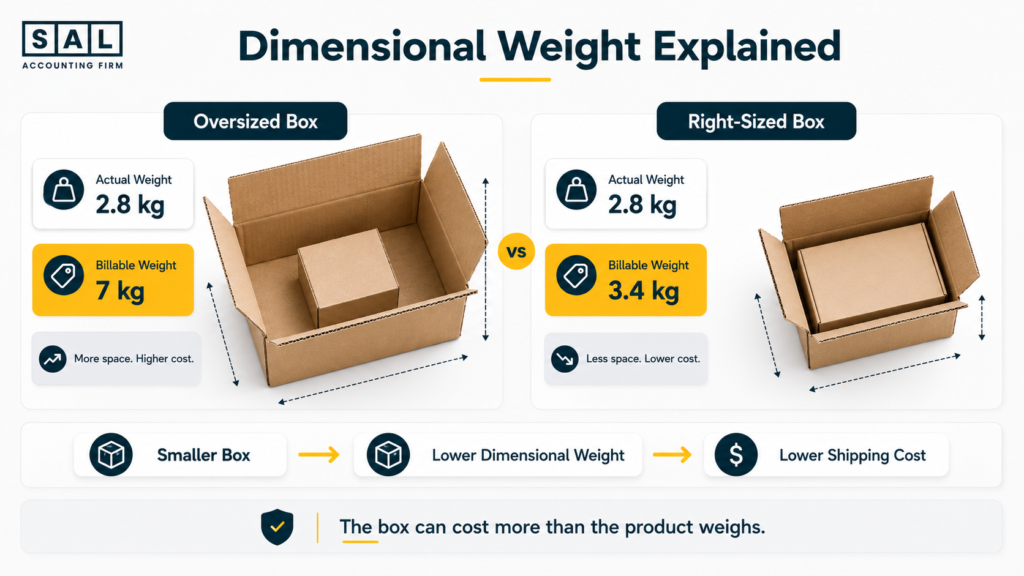
Dimensional weight charges for the space a package occupies, not just what it weighs.
Suppose a parcel weighs 2.8 kg, but its box is large enough to produce a billable dimensional weight of 7 kg. That difference repeats on every order using the same packaging.
Before switching carriers, test smaller boxes, protective mailers, fewer inserts, and more accurate stored dimensions.
Pro Tip: Remeasure your standard packages whenever a supplier, product bundle, or protective material changes. A few extra centimetres may push a common order into another pricing tier.
Customs, Duties and Brokerage Fees
Cross-border shipments may include duties, import taxes, brokerage, disbursement fees, and processing charges.
With a duties-paid setup, the seller covers or prepays the applicable import costs. With a duties-unpaid setup, the customer may need to pay before delivery.
Duties paid can create a smoother customer experience. Duties unpaid may create surprise charges, refused packages, and additional returns.
U.S. sales can also create state tax responsibilities that have nothing to do with which carrier you use. Before cross-border volume grows, check your state-by-state sales tax position. The SAL checker is a screening tool and notes that thresholds can change.
Insurance, Returns and Claims
Carrier protection doesn’t guarantee full reimbursement for every lost or damaged order.
Review what products are covered, what evidence is required, packaging rules, claim deadlines, and whether transportation costs are included.
For example, a returned order could create:
- $16.40 in outbound shipping
- $15.75 for the return label
- $4.50 for inspection and repacking
- $9.25 in lost product value
That is $45.90 in additional cost before payment fees or customer-service time.
How Do These Shipping Providers Handle Cross-Border Ecommerce?
Cross-border delivery depends on accurate customs data as much as carrier choice. Before shipping, confirm:
- The product description is specific.
- The HS or tariff code is correct.
- The country of origin is accurate.
- The declared value matches your records.
- The commercial invoice and duty-payment terms are clear.
Canadian brands also need to be careful with older advice about the U.S. $800 de minimis threshold. Effective August 29, 2025, duty-free de minimis treatment was suspended for qualifying imports from all countries, including international mail. Low-value commercial shipments may now face applicable duties, taxes, fees, and entry requirements. (Current CBP guidance)
Basically, don’t promise that an order under $800 will enter the U.S. duty-free. Verify the current product classification, country of origin, tariff treatment, and carrier processing costs first.
Should You Use One Shipping Provider or Multiple Carriers?
One carrier may be enough when your package sizes are similar, customers are concentrated in one region, and operational simplicity matters more than small price differences.
A multi-carrier setup becomes more useful when:
- Package sizes and destinations vary
- Customers choose between standard and express delivery
- Different carriers perform better in different regions
- You need a tested backup during delays or service interruptions
You don’t need to show five confusing choices at checkout. Your system can route orders behind the scenes while customers see two clear options, such as standard and express.
Case Study: How Maya in Liberty Village Builds a Smarter Multi-Carrier Setup1
Maya runs a Shopify skincare brand from Liberty Village, Toronto. Most orders contain one or two lightweight products, but seasonal gift sets need larger boxes. She sends every package through the same courier because the account is already connected to Shopify.
The Problem
Maya compares the original label rates but doesn’t separate small Canadian parcels, gift sets, remote destinations, and U.S. orders. Residential and dimensional adjustments regularly appear on the final invoices.
What We Do
We group her orders by package type, destination, service, and final cost. Canada Post is tested for lighter Canadian parcels, while UPS and FedEx are compared for larger gift sets. U.S. orders are reviewed as a separate shipping lane.
Result
Maya keeps two primary providers and replaces an oversized gift-set box. Her team can now explain which service works for each package and why the final invoice differs from the original quote.
Shopify orders, shipping charges, and payouts should tell the same story.
Clean up the complete order-to-bank trail.
How Shipping-Provider Costs Affect Ecommerce Profit
Shipping affects product margins, free-shipping thresholds, returns, advertising decisions, and cash flow.
A store can grow revenue while losing profit when the final carrier charges aren’t connected to the orders that created them.
Shipping Income vs Shipping Costs
Shipping charged to a customer should be recorded separately from the carrier expense.
Example: Suppose a customer buys a three-product bundle for $146 and pays $12 for delivery. The carrier initially quotes $15.80, but the final invoice is $19.35 after a residential adjustment. Record:
- $146 as product revenue
- $12 as shipping income
- $19.35 as shipping expense
Don’t record only the $7.35 shortfall. Keeping the amounts separate shows whether customer shipping charges cover delivery and which destinations are losing money.
Free-Shipping Margins
Free shipping is a pricing decision. It isn’t a free service.
Consider a $184 order with $61 in product cost, $18 in payment, fulfilment, and packaging costs, $23 in carrier charges, and an $8 expected return allowance. That leaves $74 before advertising, payroll, software, and overhead.
Now add a $9 dimensional adjustment and a $19 return label. The contribution falls to $46.
For Shopify orders, shipping is only one part of the deduction picture. Calculate the platform and payment fees behind each sale before deciding whether your free-shipping threshold still works.
“Read more: How Ecommerce Contribution Margin Shows What Each Order Really Keeps”
Duties, Returns and Other Hidden Costs
Cross-border profit may also be reduced by duties, brokerage, currency conversion, refused deliveries, replacement shipments, damage, and unrecovered claims.
A Canada-to-U.S. order can look profitable in Shopify while losing money once the carrier and customs invoices arrive.
Record these costs separately by destination, product, or sales channel rather than placing everything inside one general shipping account.
“Also read: Hidden Ecommerce Expenses That Quietly Reduce Profit”
Carrier-Invoice Reconciliation
Carrier-invoice reconciliation means matching final shipping charges to orders, labels, returns, claims, credits, and payments.
A useful monthly process is:
- Match tracking numbers to ecommerce orders.
- Compare estimated label rates with final charges.
- Separate outbound shipping, returns, duties, brokerage, and insurance.
- Match voided labels, claims, refunds, and carrier credits.
- Review final cost by carrier, destination, product, and service.
This shows whether shipping spend increased because of higher volume, larger packages, new surcharges, return activity, or incorrect shipment data.
Amazon FBM settlements can create a similar problem because shipping income, labels, refunds, claims, and adjustments may all affect one payout. Make every Amazon settlement explainable.
Case Study: How Daniel in Meadowvale Finds the Real Cost of Free Shipping2
Daniel runs a home-accessories store from a small warehouse in Meadowvale, Mississauga. He offers free Canada-wide shipping above $100 and uses one main courier. Sales look healthy, but cash flow feels tighter each month.
The Problem
Every carrier payment goes into one delivery-expense account. Outbound labels, returns, duties, address corrections, and dimensional adjustments are mixed together. Daniel calculates his average shipping cost from label estimates rather than final invoices.
What We Do
We match carrier charges to orders and tracking numbers, then separate standard delivery, returns, surcharge adjustments, and claim credits. Costs are reviewed by province, product, box size, and order value.
Result
Daniel discovers that one decorative product regularly triggers dimensional fees. He changes the box and adjusts the free-shipping threshold for low-margin orders. He can now see the actual delivered profit rather than relying on an incomplete store estimate.
How to Choose the Right Shipping Provider for Your Ecommerce Brand
Use your own shipment history instead of looking for one universal winner.
- Build a representative sample. Use one to three months of orders across common packages, destinations, and service levels.
- Measure final packages. Record the packed dimensions and weight, not just the supplier’s product measurements.
- Request comparable quotes. Use the same origin, destination, dimensions, speed, value, and duty terms.
- Add non-label costs. Include surcharges, packaging, duties, insurance, returns, software, and warehouse labour.
- Review service quality. Compare on-time delivery, tracking complaints, damage, claims, and failed attempts.
- Calculate profit by method. Choose the service that protects margin while meeting customer expectations.
- Keep a backup. Test another provider before delays or capacity restrictions force a rushed decision.
Pro Tip: Set simple routing rules, such as “Canada Post under 1 kg” or “UPS for this bundle.” Your team shouldn’t have to restart the carrier comparison for every package.
When Should You Review or Change Shipping Providers?
Don’t switch because of one delayed parcel. Look for a repeated cost or service problem.
| Review Trigger | Warning Sign | Data to Check | Likely Action |
| Volume grows | Existing rates no longer fit | Parcels and monthly spend | Renegotiate rates |
| Products change | Dimensional fees increase | Cost by SKU and box | Redesign packaging |
| U.S. sales rise | Import and return costs grow | Landed cost by country | Test another service |
| Adjustments rise | Quotes rarely match invoices | Carrier adjustment codes | Correct data or routing |
| Service declines | Complaints and failures increase | Delivery results by region | Reroute affected areas |
Review the setup at least quarterly and after a product launch, packaging redesign, warehouse move, carrier-rate change, or expansion into a new country.
Which Shipping Provider Is the Best Fit for Your Ecommerce Brand?
For many Canadian ecommerce businesses:
- Canada Post suits lighter domestic parcels and postal addresses.
- UPS or FedEx may work better for heavier, faster, or more predictable shipments.
- USPS becomes useful after inventory or parcels enter the United States.
- DHL often stands out for international express or recurring cross-border volume.
But one provider doesn’t need to handle every order. The best setup may combine different carriers based on destination, package type, delivery speed, and final cost.
At the end of the day, the right shipping provider is the one that delivers the customer experience you promised without hiding what each order truly costs.
When carrier invoices, shipping income, returns, and duties no longer make sense together, book a conversation with SAL Accounting and find out what needs to be cleaned up first.