
Amazon might bring in more sales while Shopify skips the referral fee, but neither tells you which channel actually earns more. The answer comes from running the same product through the same math on both: net sales minus landed cost, channel fees, fulfillment, returns, and the ads that drove the order.
That’s how SAL Accounting compares channels for supplement brands. Here’s the framework, with a worked example for one SKU.
Every channel takes a cut before you see the money. See what each Shopify order keeps with the Shopify Fee Calculator.
Quick Takeaways
- Higher revenue doesn’t mean a more profitable channel.
- Compare the same SKU, over the same period, with the same cost definitions.
- Start from net sales and a common landed product cost, then subtract each channel’s own costs.
- Amazon often charges more in visible fees, while Shopify can carry more in shipping, fulfillment, and acquisition costs.
- Look at contributions both before and after advertising.
- The answer can differ by SKU, so don’t decide once for your whole catalog.
Want a clear view of what each channel really earns? Our ecommerce bookkeeping team splits your numbers by channel every month, so you’re never guessing.
Why Doesn’t Higher Revenue Mean a More Profitable Channel?
Because revenue shows what came in, not what you kept after the costs of making the sale. Say your brand did $100,000 on Amazon and $70,000 on Shopify last quarter. It’s tempting to call Amazon the winner. But until you subtract the costs tied to each channel, those numbers can’t be compared. The useful question is: how much contribution remains from each order after the costs needed to make and complete the sale?
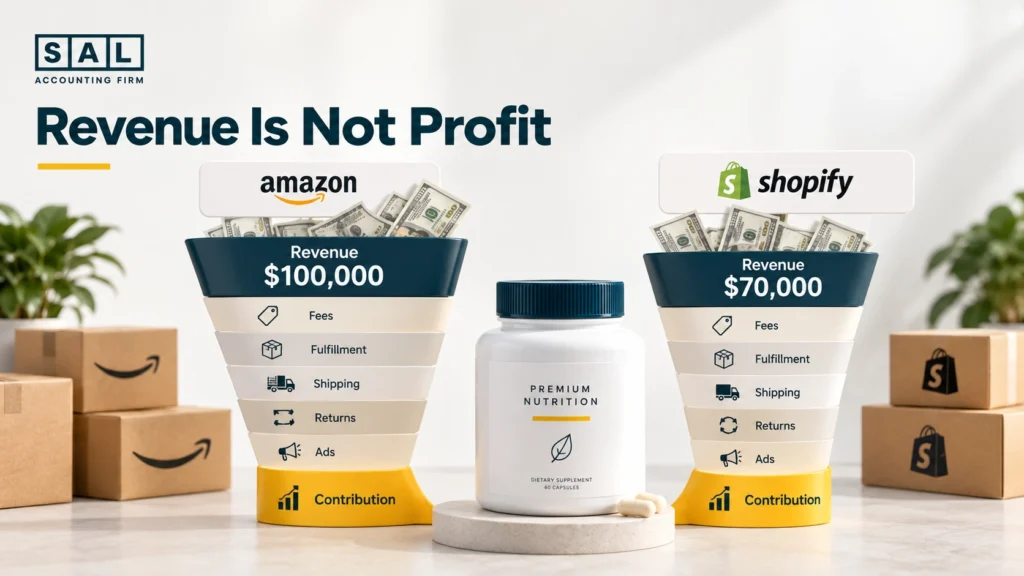
Amazon might keep less per order after fees and fulfillment. Shopify might lose more to shipping and ads. You only know once you run both through the same math. For a broader look at how the two platforms differ beyond profit, there’s a general comparison of Shopify vs Amazon FBA. This article stays on the numbers.
How Should an Online Supplement Brand Compare Amazon and Shopify Fairly?
Use the same product, the same period, and the same cost definitions on both sides. The ground rules:
- Same SKU, where possible
- Same time period
- Each channel’s actual selling price
- The same product cost basis
- The same definition of contribution
- Consistent treatment of advertising and returns
Break any of these and one channel can look better than it really is. Comparing a high-margin hero SKU on Amazon against a low-margin bundle on Shopify, for example, tells you about the products, not the channels.
Keeping each channel’s numbers separate in your books makes this far easier. That’s a core part of multichannel accounting for supplement brands.
What Revenue Should You Use for the Amazon vs Shopify Comparison?
Use net sales for each channel, after discounts, promotions, and refunds. Start with what customers actually paid for the product, then account for:
- Selling price on each channel
- Discounts and promo codes
- Promotions like coupons or lightning deals
- Refunds
If your tub sells for $50 on Amazon but averages $47 on Shopify after discount codes, use $47 for Shopify. Don’t force both channels to the same price.
Don’t use bank payouts as revenue either. A payout is what’s left after fees, refunds, and reserves, so it hides the very costs you’re trying to compare. The gap between sales and deposits is exactly what revenue vs payout reconciliation sorts out.
If you sell on Amazon.com in US dollars, convert to Canadian dollars using a consistent rate, such as the Bank of Canada’s daily exchange rate, so both channels are in the same currency.
Should the Same Supplement SKU Have the Same COGS on Amazon and Shopify?
Yes, the same physical SKU should start from the same landed product cost on both channels. The product doesn’t change based on where you sell it. So the cost of making it and getting it to your warehouse, its landed cost, is a common starting point. Channel-specific costs come after that:
- Product cost: what it cost to make and receive the unit (same on both channels)
- Cost of selling: fees, fulfillment, shipping, returns, and ads (different on each channel)

Keeping these two separate is what makes the comparison fair. BDC describes the cost of goods sold as the cost of the products themselves, not the costs of selling them. How to work out that product cost is covered step by step in calculating the landed cost for an online supplement business.
What Amazon Costs Should Be Included in the Profitability Comparison?
Include every cost Amazon charges to make and complete the sale, not just the referral fee. Depending on your setup, that can include:
- Referral fees on each item sold
- FBA fulfillment fees, if Amazon ships your orders
- FBA storage fees
- Selling plan fees
- Amazon advertising
- Refunds and returns
- Other selling costs tied directly to Amazon orders
Amazon’s fees aren’t one flat number. Its pricing page explains that costs depend on your selling plan, product category, and fulfillment method, and that Amazon charges the greater of the referral fee percentage or a per-item minimum. Use your own Seller Central fee reports, not a rule of thumb.
FBA storage often gets missed because it doesn’t show up on each order. Spreading it across the units sold gives a truer per-order cost, which is one of several Amazon FBA accounting best practices worth following.
What Shopify Costs Should Be Included in the Comparison?
Include every cost of completing a Shopify order, even the ones that don’t look like fees. Depending on your setup:
- Payment processing fees
- Shopify transaction fees, if you use a third-party payment provider
- 3PL or warehouse fulfillment
- Pick and pack charges
- Outbound shipping
- Free shipping you absorb
- Refunds and returns
- Advertising that drove Shopify orders
The goal isn’t to prove Shopify is cheaper because it has no referral fee. Shopify orders often carry bigger costs elsewhere, especially shipping and customer acquisition. Seeing how Shopify fees affect your profit margin shows where those costs hide.
How Do Fulfillment and Shipping Change Amazon vs Shopify Profitability?
Fulfillment and shipping can swing the result more than any single fee. On Amazon, FBA bundles fulfillment and shipping into one fee per unit. On Shopify, the same costs are split across several bills:
- A 3PL or your own packing time
- Carrier rates, which depend on your volume and contracts
- Free-shipping thresholds
- Shipping subsidies when customers pay less than it costs you
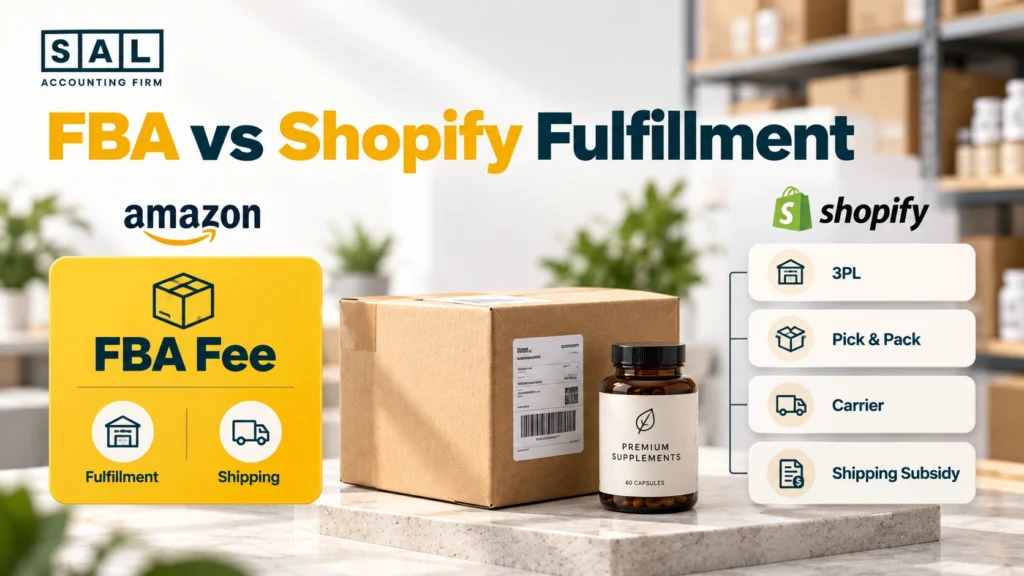
Compare the total fulfillment cost per order on each channel, not just the most visible fee. A Shopify order with free shipping can end up costing more to fulfill than the same order through FBA, or less, depending on your rates.
If shipping is where Shopify loses ground, comparing ecommerce shipping providers is often the quickest fix.
Pro Tip: Work out your average Shopify fulfillment and shipping cost per order, including subsidies. Then put it right next to your average FBA fee per unit for the same SKU.
How Should Returns and Refunds Be Compared Between Amazon and Shopify?
Measure returns the same way on both channels: refund dollars plus any related costs. For each channel, track:
- Refund dollars
- Return shipping costs
- Product you can’t resell
- Other costs tied directly to returns
Supplements add a twist. Once a sealed product comes back, it often can’t be resold, so a return can cost you both the refund and the product.
Compare return costs as a share of sales for the same SKU and period. Return rates can differ a lot between a marketplace and your own store, and a clear refund policy shapes how many come back on Shopify.
How Should Advertising Be Handled in an Amazon vs Shopify Profitability Comparison?
Calculate contribution twice for each channel: once before advertising and once after. This is where most comparisons go wrong. It’s easy to compare Amazon’s numbers before ads against Shopify’s numbers after paid acquisition, or the other way around. That makes one channel look much better than it is. Use two views instead:
- Contribution before advertising: the underlying economics of selling through each channel
- Contribution after attributable advertising: what’s left after the ads needed to drive those sales
On Amazon, attributable advertising is usually your Amazon Ads spend. On Shopify, it’s the paid acquisition that drove store orders, like Meta or Google ads. Make sure those numbers are real before you use them, because ad platforms and stores often report different results, which is why Meta, Shopify, and Triple Whale numbers rarely match.
Whether a customer’s later orders pay back their acquisition cost is a separate question. If subscriptions drive your Shopify sales, check whether your supplement subscriptions are profitable on their own terms.
What Does an Amazon vs Shopify Profitability Calculation Look Like?
Run the same SKU through the same framework on each channel and compare both dollars and margin.
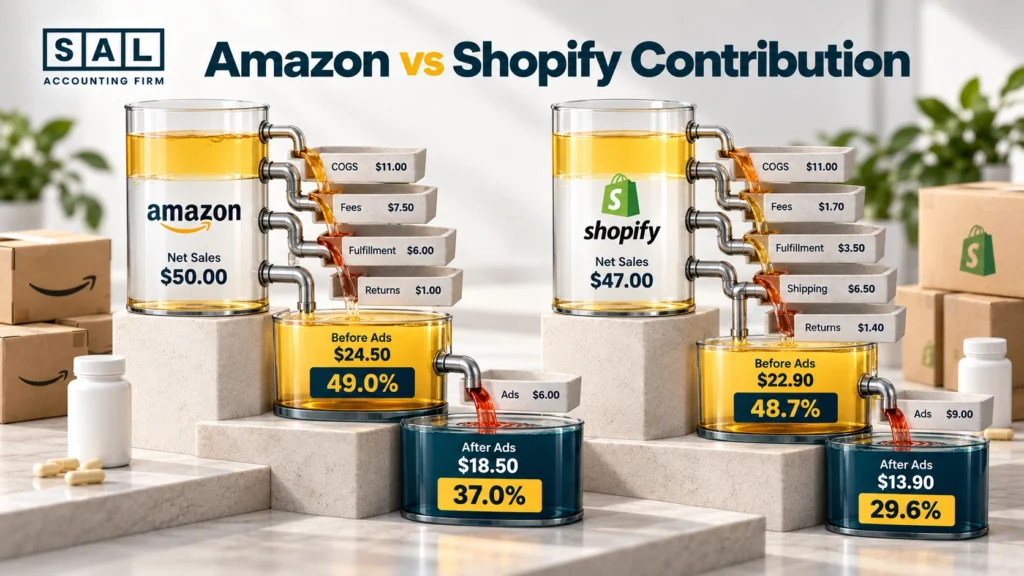
Here’s an illustrative example for one supplement tub. The numbers are made up to show the method, not typical benchmarks.
| Line | Amazon | Shopify |
|---|---|---|
| Net sales | $50.00 | $47.00 |
| Landed COGS | −$11.00 | −$11.00 |
| Channel fees (referral or payment fees) | −$7.50 | −$1.70 |
| Fulfillment and pick and pack | −$6.00 | −$3.50 |
| Shipping subsidy | $0.00 | −$6.50 |
| Returns | −$1.00 | −$1.40 |
| Contribution before advertising | $24.50 | $22.90 |
| Contribution margin before advertising | 49.0% | 48.7% |
| Attributable advertising | −$6.00 | −$9.00 |
| Contribution after advertising | $18.50 | $13.90 |
| Contribution margin after advertising | 37.0% | 29.6% |
Before advertising, the two channels are almost even. Amazon pays more in fees, while Shopify pays more in shipping. After advertising, Amazon pulls ahead in this example, because it costs less to win each Amazon order.
Change one number, like a cheaper carrier rate or a better Shopify ad cost, and the answer could flip. That’s why you run your own numbers.
Case Study: How Ethan’s Protein Brand in Davisville, Toronto Finds Its Real Best Channel1
Ethan runs an online protein brand from a small office in Davisville, Toronto. About 60% of his sales come from Amazon and 40% from Shopify. Because Shopify has no referral fee, he assumes it’s his more profitable channel and plans to move the ad budget away from Amazon.
The problem: Ethan has never compared the two channels on the same terms. His Shopify numbers leave out the free shipping he absorbs and his Meta ad spend. His Amazon numbers include every fee and all his Amazon Ads.
What we do: We take his top SKU and run both channels through the same framework, including fees, fulfillment, shipping subsidies, returns, and the ads behind each channel’s orders. This kind of channel split is part of the monthly work our Amazon bookkeeping team does for supplement brands.
The result: Before ads, the two channels are close. After ads, Amazon keeps about $4 more per order for that SKU. Ethan keeps his Amazon budget, and he works on lowering his Shopify shipping costs before deciding where to grow.
Can Amazon Be More Profitable for One Supplement SKU and Shopify for Another?
Yes, the more profitable channel can change from one SKU to the next. Different products have different:
- Selling prices
- Sizes and weights, which change fulfillment and shipping costs
- Return rates
- Ad costs
- Promotion patterns
A light capsule bottle might be cheap to ship on Shopify, while a heavy protein tub might cost far less to fulfill through FBA. So don’t make one decision for your whole brand and assume every product behaves the same way. Which individual products earn their keep is a deeper question, covered in SKU-level profitability for supplement brands.
Case Study: How Zoe’s Supplement Brand in Lakeview, Mississauga Splits Its Channels by Product2
Zoe sells a heavy greens powder and a light sleep capsule online from a warehouse unit in Lakeview, Mississauga. She sells both products on Amazon and Shopify, and she treats both channels the same for every product.
The problem: Her blended numbers show Shopify and Amazon earning about the same. But she has no idea whether that holds for each product, or whether one strong product is hiding a weak one.
What we do: We run each SKU through both channels separately, using the same framework. Shipping the heavy greens tub costs far more on Shopify than through FBA. The light capsules are cheap to ship from her 3PL, and her Shopify ads for them perform well. Splitting her numbers by channel and product is part of what our Shopify accounting services team handles for her each month.
The result: Amazon is the better channel for the greens powder, and Shopify is better for the capsules. Zoe shifts her ad budget to match. Each product now gets promoted where it keeps the most.
Which Number Should Decide Whether Amazon or Shopify Is More Profitable?
Use contribution, in dollars per order and as a margin, measured the same way on both channels. The most useful numbers are:
- Contribution dollars per order
- Contribution margin before advertising
- Contribution margin after advertising
Don’t rely on:
- Gross sales
- Payout amounts
- Gross margin alone
- Marketplace fees alone
Contribution is not net profit, since it leaves out shared costs like rent, software, and salaries. But it’s the right number for comparing channels, because it shows what each sale leaves to cover those shared costs. The basics of ecommerce contribution margin explain what it includes. If your overall margin has slipped, a shift in channel mix is often one reason an online supplement profit margin is dropping.
Final Thought: Which Channel Really Earns More for Your Online Supplement Brand?
Neither Amazon nor Shopify is automatically more profitable. Run the same SKU through the same framework on both: net sales, landed cost, channel fees, fulfillment, shipping, returns, and advertising. Then compare contributions before and after ads.
Do it product by product, and repeat it whenever your fees, shipping, or ad costs change. Once you know which channel earns more, the next step is growing it. Start with our free growth roadmap.