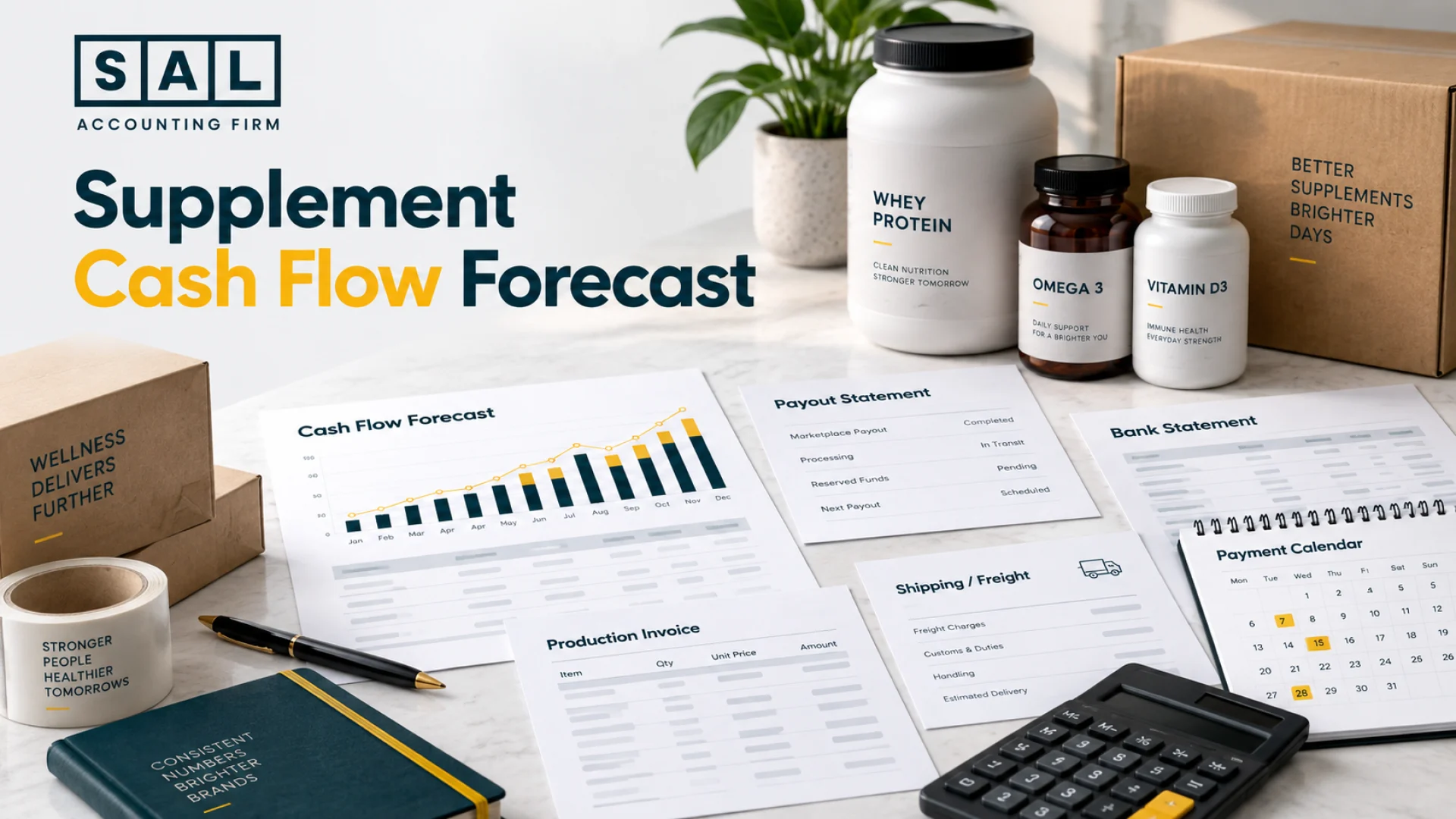
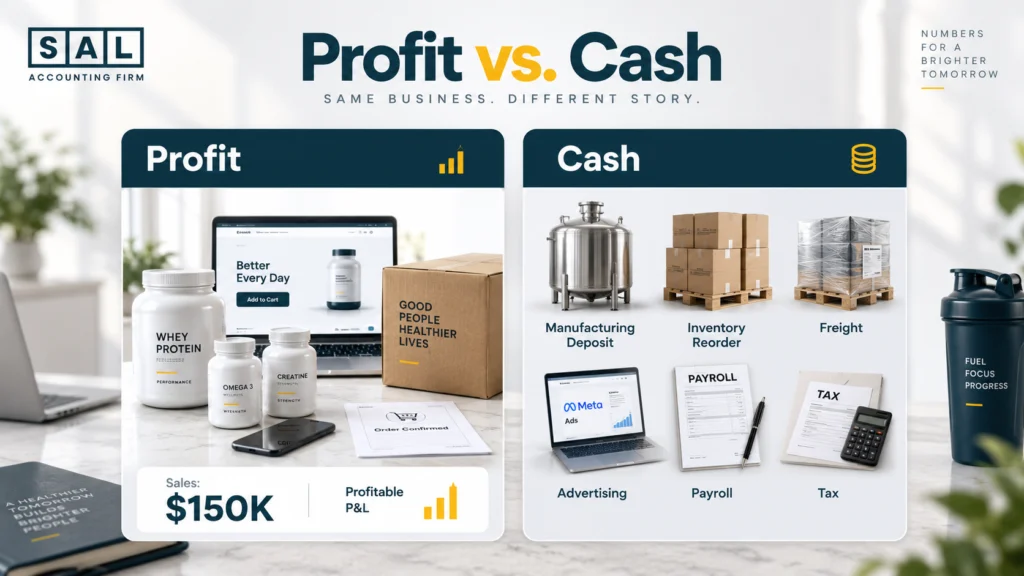
A supplement brand can be profitable and still run short of cash before its next production run. Manufacturing deposits, reorders, freight, ads, payroll, tax, and ecommerce payouts all move on different schedules.
That is why cash planning for an online brand needs the ecommerce-specific lens behind SAL Accounting, not just a monthly sales forecast. See the gap before your manufacturer, payroll, or next reorder forces you to deal with it.
Want a quick profit benchmark first? Check Your Ecommerce EBITDA.
Quick Takeaways
- Start with the cash actually available today.
- Forecast sales cash when it should reach the bank, not when the order happens.
- Put manufacturing deposits and final payments into their actual payment periods.
- Include reorders, freight, ads, payroll, tax, and other known commitments.
- Watch the lowest projected balance, not only month-end cash.
- Run a downside case before making a major production or inventory commitment.
- Update the forecast when the assumptions behind a decision change.
What Is a Cash Flow Forecast for a Supplement Ecommerce Business?
A cash flow forecast estimates how much money should enter and leave your business over the coming weeks or months. The basic calculation is:
Opening Cash + Expected Cash In − Expected Cash Out = Projected Closing Cash
Suppose you start the week with $100,000. You expect $35,000 to reach the bank and $60,000 to leave. Your projected closing cash is $75,000. That $75,000 becomes the opening balance for the next week.
Xero’s cash flow forecasting guidance follows the same basic idea: estimate future inflows and outflows to understand what cash should be available at a particular point in time.
That is different from your P&L.
Your P&L measures revenue, expenses, and profit. The forecast is concerned with when money actually moves. That difference is why an ecommerce business can report profit while experiencing the profit-cash gap.
- Also read: “Why Your Supplement Brand’s Profit Looks Wrong”
Why Does Cash Flow Get Tight for Online Supplement Brands?
Supplement brands often commit cash well before the related inventory generates sales.
Imagine you have $150,000 in the bank. Over the next few weeks, you already expect:
- a $60,000 production deposit;
- $25,000 of advertising;
- payroll;
- inbound freight;
- a tax payment;
- supplier balances;
- another inventory commitment shortly afterward.
The question is no longer, “Do we have $150,000?” It is: How much should still be available after everything already coming due?
RBC’s cash flow forecasting framework uses that same practical approach: start with available cash, add expected receipts, subtract upcoming payments, and carry the resulting balance forward.
Manufacturing Cash Leaves Before Sales Cash Arrives
A co-packer or manufacturer may want a deposit before production and the remaining balance before releasing the finished inventory.
You might pay a large portion of the production cost weeks before the first bottle from that run is sold. Then, while Batch 1 is still selling, Batch 2 may already need a deposit.
That overlap is one reason accounting for an online supplement business has to keep inventory, payouts, production costs, and liabilities separate enough for the owner to see what is actually happening.
What Should You Include in a Supplement Ecommerce Cash Flow Forecast?
Your forecast does not need hundreds of rows. It needs the cash movements that could change a decision. Here are the main ones.
| Forecast Item | Supplement Example | Timing to Use | Common Miss | Why It Matters |
|---|---|---|---|---|
| Opening cash | Available bank cash | Start of period | Counting committed cash as free | Starting position |
| Cash receipts | Shopify, Amazon, wholesale | Expected bank date | Using order date | Usable cash |
| Manufacturing | Deposit, co-packer, final balance | Payment date | Recording deposit only | Production pressure |
| Inventory | Reorder, packaging, freight | Payment date | Waiting for stock arrival | Pre-sale cash need |
| Operations | Ads, payroll, 3PL | Expected charge date | Averaging payments | Operating pressure |
| Tax | Corporate tax, GST/HST | Expected payment date | Leaving tax out | Future cash requirement |
| Closing cash | Cash left | End of period | Watching sales instead | Expected liquidity |
The starting numbers matter. A clean supplement ecommerce month-end close makes forecasting much easier because the bank, payouts, inventory, and accounting records have already been reconciled.
Pro tip: Put a known future payment into the forecast as soon as you know the amount and likely date. Do not wait until it leaves the bank.

How Do You Build a Cash Flow Forecast for an Online Supplement Brand?
Keep the model simple enough that you will actually update it.
Step 1: Choose Weekly or Monthly Forecasting
Weekly forecasting usually makes more sense when:
- a major production payment is approaching;
- several large payments fall close together;
- cash is tight;
- advertising spend changes quickly;
- sales or payouts are volatile.
Monthly forecasting works better when you want a broader planning view and your cash movements are more stable.
You can also use weekly periods for the near term and monthly periods farther out.
The period should match the decision. If you need to know whether $50,000 will be available next Thursday, a monthly forecast is too broad.
Step 2: Enter Your Opening Cash
Start with cash actually available at the beginning of the period.
Then add expected receipts, subtract expected payments, and carry the remaining balance into the next period.
Do not make the model more complicated until the simple version stops answering the questions you need it to answer.
Step 3: Forecast Ecommerce Cash When It Reaches the Bank
This is one of the easiest places to overstate cash.
A $100,000 sales month does not automatically mean $100,000 reaches the bank that month. For a supplement brand selling across several channels, understanding why revenue and payouts do not match gives you a better starting point for forecasting actual receipts.
Shopify
For Shopify Payments in Canada, settlement and bank-processing time affect when sales become usable cash. Shopify’s Canadian payout guidance explains the platform timing, but your own recent payout history should determine what you put into the forecast.
Pro tip: Compare four to eight weeks of Shopify payouts with the deposits that actually reached your bank. Use that pattern instead of assuming every sale becomes cash immediately.
Amazon
Amazon needs its own timing assumption. Fees, refunds, reserves, and the settlement cycle can all affect when the money reaches your account, so use Amazon’s seller payment guidance together with your recent settlement history.
Other Payment Channels
Use the same rule for Stripe, PayPal, wholesale customers, subscriptions, or any other payment route: Forecast the cash when you realistically expect it to reach the bank—not when the sale happens.
For a supplement brand using several sales channels, keeping those different payment streams aligned becomes part of multichannel supplement ecommerce accounting.
Step 4: Add Manufacturing Deposits and Final Payments
Suppose your next production run costs $100,000. The manufacturer requires:
- $50,000 when the order is confirmed;
- $50,000 before shipment.
If the deposit is due October 8 and the final payment is due December 2, put those payments into October and December.
Do not wait until the inventory arrives.
And do not wait until those products become COGS.
The accounting treatment is different from the cash movement. Inventory may need to stay on the balance sheet until it is sold, while the bank account may have already lost most of the cash months earlier.
Likewise, calculating ecommerce COGS tells you when product cost affects profit. Your forecast is asking when the supplier actually gets paid.
Pro tip: Get exact payment milestones from your manufacturer or co-packer. “$100,000 production run” is not enough for a forecast. “$50,000 on October 8 and $50,000 before shipment on December 2” is.
Case Study: Rachel in Leslieville, Toronto Tests a Second Production Run1
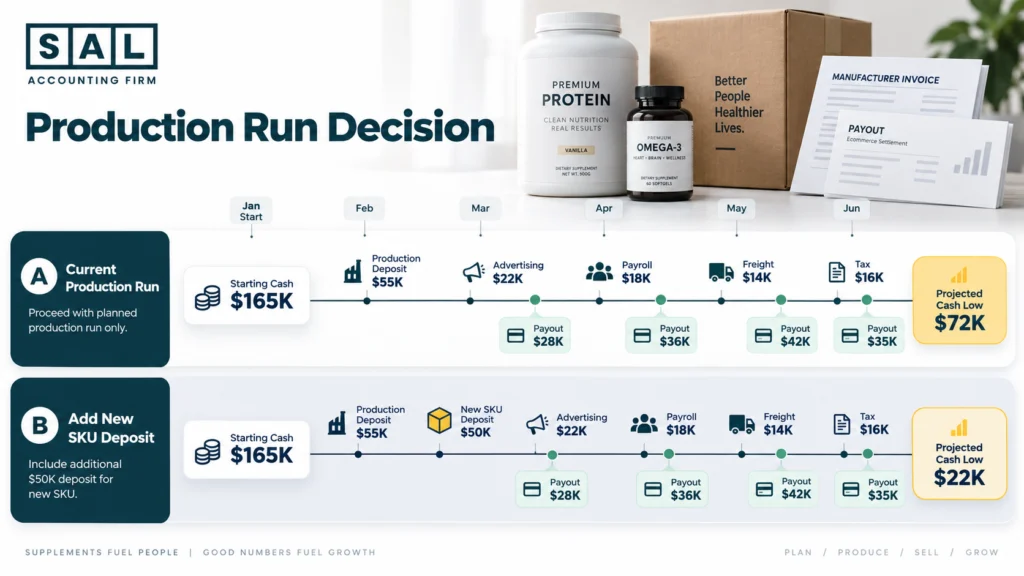
Rachel runs an online supplement brand from Leslieville. She has $165,000 in the bank and is about to approve a $110,000 production run. The manufacturer wants a $55,000 deposit now.
Over the next four weeks, she also expects $22,000 in advertising, $18,000 of payroll, $14,000 of inbound freight, and a $16,000 tax payment. About $105,000 of ecommerce payouts should arrive during the same period, but not before every payment is due.
The Problem
The $165,000 bank balance makes the production order look easy to afford.
Once the payments are put on their actual dates, the forecast shows cash falling to about $72,000 before the largest payout arrives.
Rachel is also considering a $50,000 deposit on a new SKU. Adding that second decision pushes the projected low point to roughly $22,000.
What We Do
We run the forecast once with the existing production order and once with both deposits.
The first version leaves about $72,000 at the low point. The second leaves around $22,000.
Now Rachel can see that the issue is not the existing production run. It is stacking another major commitment on top of it before the cash from the current cycle has come back.
The Result
Rachel has four practical options: delay the second SKU, negotiate a staged deposit, reduce another planned cash outflow, or wait for the next large payout.
The forecast does not tell her which option to choose. It tells her exactly which decision is creating the cash pressure.
Step 5: Add Reorders, Freight, and Other Inventory Cash
The manufacturer’s invoice may not be the full cash requirement. A production run may also need:
- labels and packaging;
- inbound freight;
- duties;
- prep or receiving costs;
- another deposit before the current batch has sold through.
For example, a $40,000 supplier invoice may require considerably more than $40,000 of cash before those units are ready to sell. Building the full landed cost of the inventory gives you a better idea of what that next batch will actually consume.
Inventory timing matters too.
Six weeks of stock does not mean you can wait six weeks to reorder if the manufacturer needs eight weeks to produce the next batch.
Step 6: Add Advertising and Normal Operating Payments
Now add the costs required to keep the online brand running:
- Meta and Google advertising;
- payroll;
- 3PL and fulfillment;
- software;
- contractors;
- rent;
- insurance;
- professional fees;
- debt payments.
Use the date you expect the cash to leave.
If the advertising card is paid on the 21st, show the payment around the 21st. Do not smooth $40,000 of monthly expenses into four equal $10,000 weeks just because the spreadsheet looks cleaner.
A forecast also exposes costs that are easy to underestimate when small ecommerce expenses keep leaking out of margin.
Step 7: Add Tax Payments
Taxes compete for the same cash as inventory, payroll, and advertising, so known tax payments should be built into the forecast instead of treated as a surprise later. Include items such as:
- Corporate income tax: Canadian corporations may have instalments during the year, with any remaining balance due based on the corporation’s balance-due date. Use the CRA corporate tax payment rules to confirm the timing that applies to your business.
- GST/HST: Add expected GST/HST payments to the period when you reasonably expect the cash to leave. For ecommerce-specific considerations, SAL’s GST/HST guide for ecommerce stores covers the underlying tax side in more detail.
- Other known tax payments: Include any other material tax amounts that are likely to fall within the forecast period.
The forecast does not need to calculate the tax itself. Its job is to make sure a known payment is visible before you approve the next production run or reorder.
Supplement Ecommerce Cash Flow Forecast Example
A simple weekly forecast can make the timing problem obvious.
| Forecast Item | Week 1 | Week 2 | Week 3 | Week 4 | Main Driver |
|---|---|---|---|---|---|
| Opening cash | $120,000 | $133,000 | $93,000 | $107,000 | Prior balance |
| Cash received | $35,000 | $30,000 | $42,000 | $38,000 | Payout timing |
| Cash paid | $22,000 | $70,000 | $28,000 | $75,000 | Production + operations |
| Closing cash | $133,000 | $93,000 | $107,000 | $70,000 | Cash remaining |
| Major event | Normal week | Production deposit | Normal week | Final payment + freight |
The business finishes Week 4 with $70,000, but that is not the only number worth watching. Week 2 and Week 4 are the pressure points. Now you can ask:
- What happens if Week 4 payouts are $10,000 lower?
- Does another reorder start in Week 5?
- Is payroll due immediately afterward?
- Can current ad spend continue without pushing cash too low?
That is where a forecast becomes a decision tool instead of a spreadsheet exercise.
What Should the Forecast Tell You Before You Spend More Cash?
Once the forecast is built, look for four things:
- The lowest cash point: Month-end may look fine while the middle of the month gets dangerously tight.
- The payment causing the drop: Manufacturing, freight, payroll, ads, or tax usually explains most of the movement.
- Timing gaps: A $45,000 payment on the 10th and a $55,000 payout on the 17th still create a seven-day cash problem.
- Whether the next commitment fits: Ask what remains after the new payment and everything else due before the next meaningful receipt.
Inventory decisions also become stronger when cash timing is considered alongside SKU profitability. Tying up $80,000 in a high-margin, fast-moving product is a different decision from putting the same cash into a slow SKU with weak contribution.
- Also read: “Shopify Cash Flow Warning Signs to Watch”
Should You Run a Downside Cash Flow Scenario?
Yes. A single forecast assumes your current expectations are roughly right. A downside case asks what happens if they are not. You do not need five scenarios. Three are enough:
- Expected: your realistic current assumptions.
- Better: stronger sales or faster receipts.
- Downside: weaker sales, lower payouts, higher freight, or an earlier payment.
BDC recommends considering multiple outcomes when preparing financial projections rather than relying on one version of the future. Its projection guidance is useful for that broader planning process.
The important question is simple: Can the business still handle its commitments if the downside case happens?
When decisions start extending beyond the next production run into hiring, inventory investment, financing, and growth planning, that is where ecommerce CFO-level forecasting starts becoming more useful.
Case Study: Daniel in Port Credit, Mississauga Updates a Reorder Before Committing2
Daniel’s online supplement brand starts the month with $118,000 available. His forecast says a planned $60,000 reorder deposit should still leave roughly $61,000 at the lowest point.
Two weeks later, the assumptions change.
Expected payouts of $52,000 come in at $41,000. Freight is $9,000 above forecast. The manufacturer also moves the deposit forward by one week.
The Problem
Daniel is about to approve the reorder using a forecast that no longer reflects the business.
The original model says the low point is about $61,000. Once the new information is added, it falls to roughly $34,000.
What We Do
We do not rebuild the entire forecast.
We update the three assumptions that changed:
- expected receipts fall by $11,000;
- freight increases by $9,000;
- the $60,000 deposit moves one week earlier.
Then we test one downside assumption: the next payout comes in 10% below plan.
The Result
Daniel now sees two useful numbers. The updated expected case drops to around $34,000. The downside case brings the low point closer to $29,000.
He can now decide whether to accept that cushion, negotiate a split deposit, delay another expense, or move the reorder date.
The forecast changed because the business changed. That is exactly what should happen.
How Do You Keep the Cash Flow Forecast Accurate?
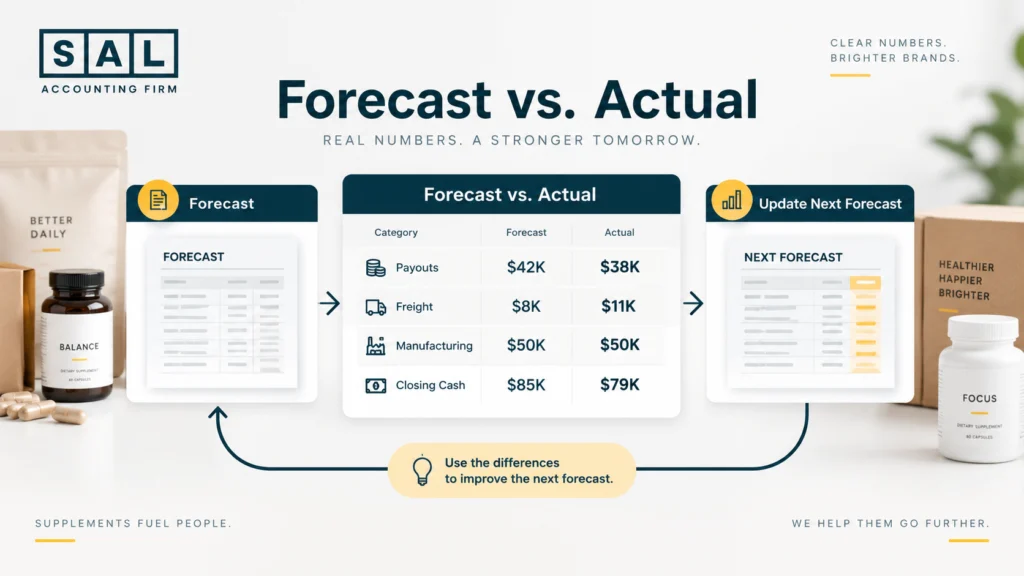
Do not judge the forecast only by whether it was right or wrong. Compare the assumptions with what actually happened. This gives you something useful to fix.
| Item | Forecast | Actual | Variance | Next Forecast Change |
|---|---|---|---|---|
| Payout receipts | $42,000 | $38,000 | -$4,000 | Lower receipt estimate |
| Manufacturing | $50,000 | $50,000 | $0 | Keep schedule |
| Freight | $8,000 | $11,000 | +$3,000 | Raise freight estimate |
| Advertising | $15,000 | $14,000 | -$1,000 | Update run rate |
| Closing cash | $85,000 | $79,000 | -$6,000 | Revise low point |
Maybe payouts regularly arrive later than expected. Maybe freight keeps coming in 15% above your assumption. Maybe your reorder timing is consistently too optimistic. Those patterns make the next forecast better.
Pro tip: Keep the original forecast. Do not overwrite it with actual results. You need both versions to understand where the assumptions went wrong.
This is the same reason good ecommerce management reporting focuses on what changed and why, not just the final number.
That is also where SAL’s ecommerce accounting services fit: fixing the underlying numbers so decisions are not being made from a forecast built on bad inputs.
How Often Should You Update It?
Weekly reviews usually make sense when cash is tight, payouts are changing quickly, or a large production payment is approaching. Monthly updates may be enough when the business is more predictable.
The rule is simple: update the forecast when an assumption changes enough to affect a decision.
Common Cash Flow Forecasting Mistakes for Supplement Sellers
Most forecast problems come down to timing or missing commitments:
- Using sales instead of cash receipts: Orders do not always become bank cash in the same period.
- Forgetting payout timing: Forecast the deposit date, not just the sale date.
- Recording only the production deposit: Include the final manufacturer payment too.
- Missing the next reorder: A future PO still affects future cash.
- Leaving out freight and duties: The supplier invoice may not be the full cash requirement.
- Forgetting tax: Expected tax payments compete with inventory for the same cash.
- Using best-case sales: Start with realistic assumptions and test upside separately.
- Ignoring irregular payments: Annual software, insurance, equipment, and professional fees still use cash.
- Watching month-end only: Always find the lowest projected balance.