
Unit economics comes down to two questions: what does one order leave after its own costs, and does that cover what you paid to win the customer? For an online supplement brand, the first answer is contribution per order. The second depends on CAC and repeat purchases.
SAL Accounting starts with both before a supplement brand spends more on growth. Here’s the math, with one running example from first order to payback.
Once you know what each order leaves, see how it flows through to operating profit with the Ecommerce EBITDA Calculator.
Quick Takeaways
- Unit economics shows whether each order and each customer leaves enough contribution to support profitable growth.
- Contribution per order is net order revenue minus product cost, fulfillment, shipping, payment fees, and expected returns.
- Contribution isn’t profit. It still has to cover customer acquisition cost (CAC) and your fixed costs.
- A first order can lose money after CAC and still lead to a profitable customer, if repeat orders arrive soon enough.
- A higher average order value or a strong ROAS doesn’t guarantee better unit economics.
- Before scaling ads, check that real repeat purchases recover CAC within a timeframe your cash can handle.
Want to know what every order and customer really earns? Our ecommerce bookkeeping team keeps the costs behind each sale clean, so your unit economics are numbers you can act on.
What Does Unit Economics Mean for an Online Supplement Business?
Unit economics tells you whether each order and each customer leaves enough money after the costs tied to winning and serving them. It works on two levels:
- Order economics: what one order contributes after product cost, fulfillment, shipping, payment fees, returns, and other variable costs
- Customer economics: whether the contribution from a customer’s orders, over time, covers what it cost to acquire them
This isn’t the same as product profitability. A product can carry a healthy margin on paper and still produce weak unit economics once shipping, fees, returns, and CAC are included. Whether a single product earns its keep is a narrower question, answered by SKU-level profitability for supplement brands. Unit economics builds on the same idea as ecommerce contribution margin, then adds the cost of getting the customer in the door.
What Numbers Do You Need to Calculate Unit Economics?
You need the variable costs of each order, plus your customer acquisition and repeat-purchase data. Gather these figures:
- Net order revenue: what you keep after discounts and refunds, excluding sales tax collected for the government
- Product cost: the inventory cost of the products in the order
- Fulfillment: pick-and-pack and packaging charges
- Shipping: the outbound shipping your business pays
- Payment and marketplace fees: the transaction and platform charges on the sale
- Expected return costs: returns not already reflected in net order revenue
- Customer acquisition cost (CAC): what it costs to win one new customer
- Repeat-purchase data: how often customers reorder, and how long they wait between orders
CAC should include more than ad spend. BDC describes customer acquisition cost as the total cost of acquiring a customer. For a supplement brand, that can include creative production, influencer fees, affiliate commissions, and agency fees.
Treat sales, discounts, refunds, fees, and product costs the same way every month, or your results will drift. A consistent way to categorize ecommerce transactions keeps the inputs reliable.
How Do You Calculate Contribution per Order?
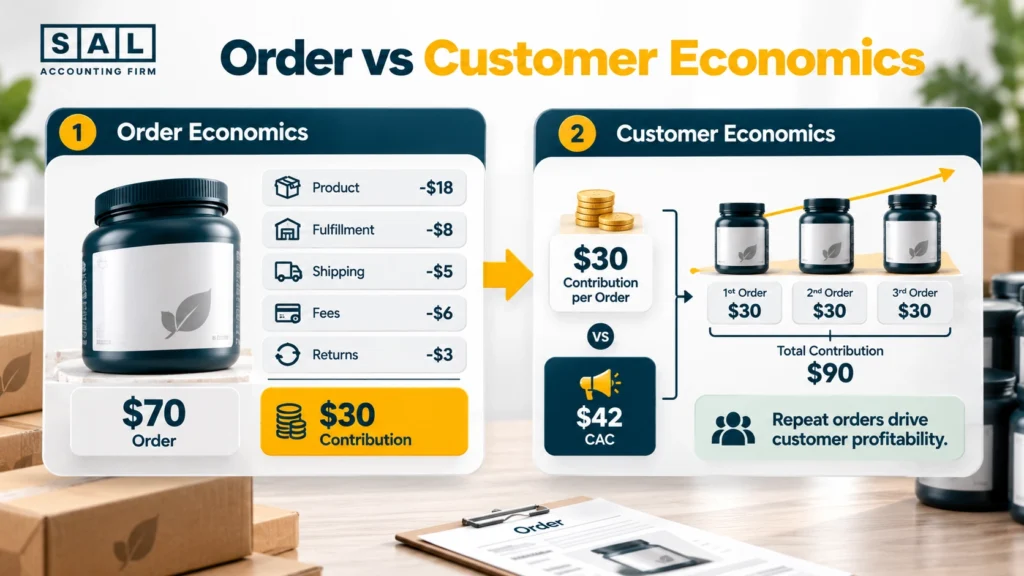
Subtract the order’s variable costs from its net revenue. Contribution per Order = Net Order Revenue − Variable Order Costs Here’s the running example for this article: a $70 supplement order.
| Line | Amount |
|---|---|
| Net order revenue | $70 |
| Product cost | −$22 |
| Fulfillment | −$6 |
| Shipping paid by the business | −$7 |
| Payment fees | −$3 |
| Expected return cost | −$2 |
| Contribution per order | $30 |
The $70 order leaves $30 after the costs directly tied to it. That $30 still has to cover CAC and fixed costs like payroll, software, and rent, so it isn’t net profit.
Two inputs need extra care. The $22 product cost should be the inventory cost of the units sold, not what you paid your manufacturer that month, which is why getting your COGS for supplement brands right matters here. Marketplace fees also vary. Amazon’s selling fees depend on your plan, product category, and fulfillment method, so use your actual fee reports rather than an estimate.
Pro Tip: Calculate contribution separately for each sales channel. The same tub can leave a very different amount on Amazon than on your own store.
How Do You Calculate First-Order Contribution After CAC?
Subtract CAC from the first order’s contribution.
First-Order Contribution After CAC = Contribution per Order − CAC
In our example, the order contributes $30 and CAC is $42:
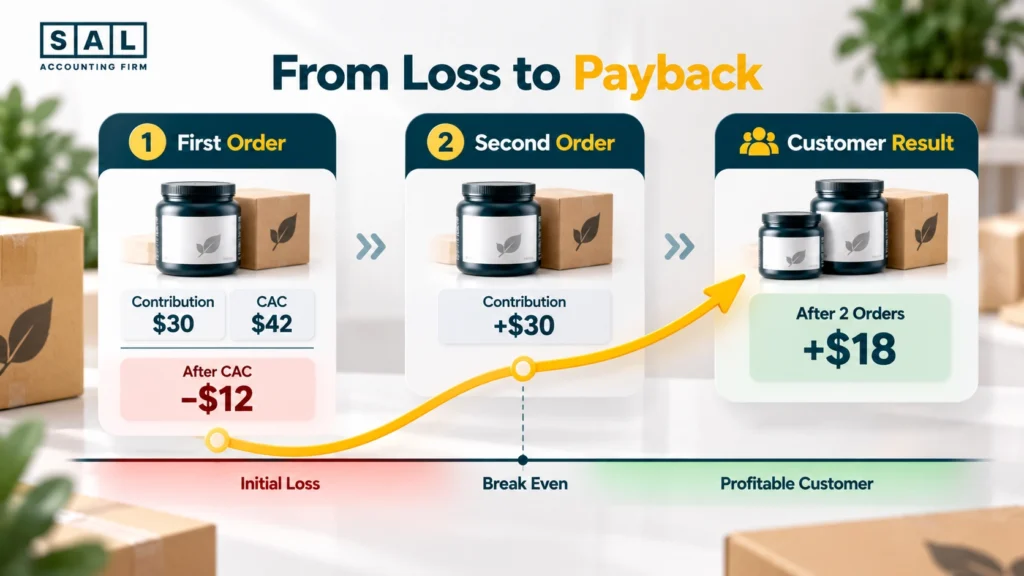
$30 − 42=-12
The first order leaves the customer $12 short of paying back what you spent to win them.
That doesn’t make the customer unprofitable. It means the first order hasn’t covered acquisition yet. For most supplement brands, that’s normal. The question is whether the next order arrives.
How Do Repeat Orders Change Customer Unit Economics?
Repeat orders recover CAC and turn a first-order loss into customer profit. Back to the example. The first order leaves the customer at −$12. If they place a second order that also contributes $30, the running total becomes:
−$12 + 30=+18
After two orders, this customer has paid back their acquisition cost and contributed $18 toward your fixed costs. To judge whether that will actually happen, track three things:
- Repeat-purchase rate: what share of first-time customers order again
- Contribution from later orders: what each repeat order leaves after its variable costs
- Time between orders: how long customers wait before buying again
Subscriptions change this picture, often through a discounted first order. Whether your subscribers stay long enough to pay back their CAC is the whole focus of online supplement subscription profitability.
Why Can a Good ROAS Still Produce Weak Unit Economics?
ROAS measures revenue per ad dollar, not what each sale leaves after its costs. Two campaigns each spend $1,000 and bring in $4,000 in attributed revenue, a 4x ROAS on both.
| Campaign | Revenue | Contribution Before Ads | Ad Spend | Contribution After Ads |
|---|---|---|---|---|
| A | $4,000 | $1,600 | $1,000 | +$600 |
| B | $4,000 | $800 | $1,000 | −$200 |
Same ROAS, opposite results. Campaign B’s orders carry heavier product, shipping, or discount costs, so the same revenue leaves half the contribution.
This is how a brand can grow sales while sliding into negative contribution margin. It’s also worth checking the ROAS itself, since ad platforms and stores often disagree, which is why Meta, Shopify, and Triple Whale numbers rarely match.
Case Study: How Priya’s Sea Moss Brand in Trinity Bellwoods, Toronto Finds Its Best Campaign Was Losing Money1
Priya sells sea moss gel online from a small kitchen space in Trinity Bellwoods, Toronto. Her best Meta campaign shows a 4.2x ROAS, so she plans to double its budget.
The problem: Sea moss gel ships in insulated packaging with cold packs, and the campaign’s offer includes free express shipping. Once fulfillment, packaging, and shipping are counted, each order from that campaign leaves very little. After ad spend, the campaign loses money on almost every first order.
What we do: We calculate contribution per order for that campaign’s orders specifically, including the insulated packaging and express shipping. Then we compare contribution after ads with her other campaigns, which use standard shipping and a minimum order for free delivery.
The result: The 4.2x campaign turns out to be her least profitable. Priya adds a two-jar minimum for free shipping and moves part of the budget to a lower-ROAS campaign that actually leaves more per order.
How Do You Calculate Customer Payback?
Divide CAC by contribution per order to see how many orders it takes to recover acquisition cost.
CAC Payback Orders = CAC ÷ Contribution per Order
In our example: $42 ÷ $30 = 1.4. So the customer pays back their CAC during their second order.
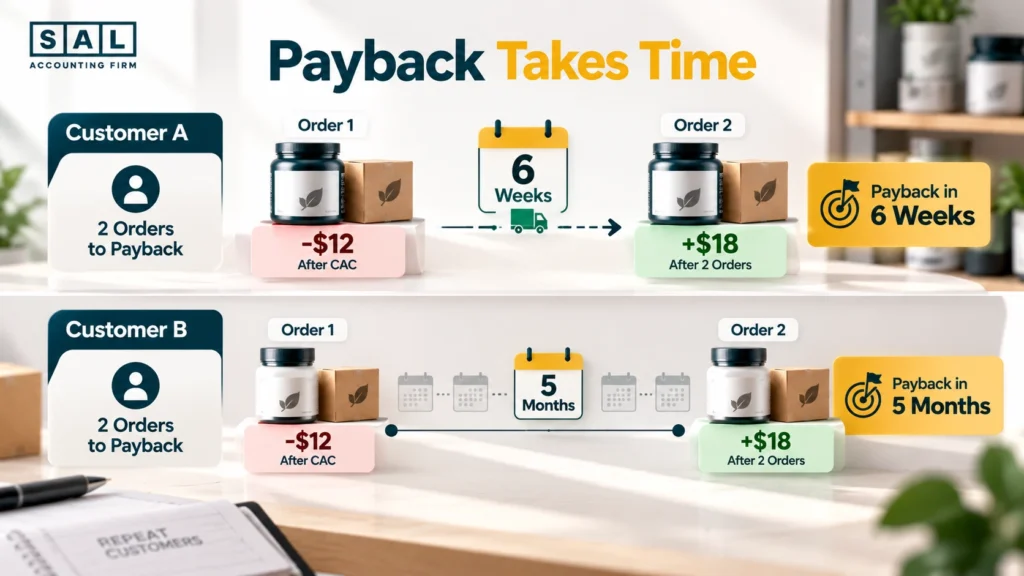
The number of orders is only half the answer. The other half is time:
- A customer who reorders every 6 weeks pays back CAC about 6 weeks after their first order
- A customer who reorders every 5 months takes about 5 months
Until payback, you’ve spent cash you haven’t recovered. The longer the gap, the more cash your growth ties up, and the more a supplement cash flow forecast matters before you scale.
Case Study: How Connor’s Kids’ Vitamin Brand in Erindale, Mississauga Paces Its Growth2
Connor sells kids’ multivitamins online from a warehouse unit in Erindale, Mississauga. His numbers look a lot like our example: each order contributes about $30, and CAC is about $42. Customers pay back their CAC on the second order, so he plans to triple his ad budget next month.
The problem: Connor’s average customer reorders every 5 months, not every few weeks. Tripling ad spend means paying for three times as many customers up front, while their second orders, and his payback, are still 5 months away. His bank balance can’t carry that gap.
What we do: We map his payback by month, using real reorder timing from his order history. Then we test a slower ramp that grows ad spend in steps while earlier customers start paying back. Tracking this every month is part of what our Shopify accounting services team handles for him.
The result: Connor increases ad spend in three monthly steps instead of one jump. His customer economics stay positive, and his cash never dips below his safety buffer.
Why Can a Higher Average Order Value Still Produce Worse Unit Economics?
A higher AOV can leave less contribution when the extra revenue comes with even bigger extra costs. Compare two orders:
| Order | Revenue | What Changed | Contribution |
|---|---|---|---|
| Standard order | $70 | Our running example | $30 |
| Larger order | $95 | Added product, 15% discount, free shipping, heavier box | $24 |
The larger order brings in $25 more revenue but leaves $6 less contribution. On a sales report, it looks like progress. In unit economics, it’s a step back. For supplement brands, the extra costs usually come from:
- Deeper discounts
- Free shipping
- Heavier products
- Higher fulfillment charges
- Lower-margin add-ons
- Free gifts or samples
A higher AOV only helps when the added revenue leaves more contribution after the added costs. Reviewing your ecommerce pricing strategy with contribution in mind, not just order value, keeps upsells working for you.
How Do Bundles, Multi-Packs, and Subscriptions Change Unit Economics?
They change unit economics by shifting order value, costs, or repeat contribution, and the test is always contribution, not revenue.
- Bundles: combining products can spread fulfillment and shipping across a bigger order, as long as the bundle discount doesn’t eat the savings
- Multi-packs: shipping several units together lowers the cost per unit, but a lower price per bottle can offset that
- Subscriptions: a discounted first order leaves less to offset CAC, while later orders add contribution if the subscriber stays
Subscriptions also bring their own accounting, since recurring payments and the inventory behind them need to be recorded consistently. That side is covered in subscription accounting for supplement brands.
What Do Strong and Weak Unit Economics Look Like?
Strong unit economics means customers pay back CAC within a timeframe you can afford, with contribution left over.
| Factor | Strong | Weak |
|---|---|---|
| Contribution per order | Meaningful after all variable costs | Thin after shipping, fees, and returns |
| CAC recovery | Within a timeframe your cash can carry | Never, or only on unrealistic repeat rates |
| Repeat purchases | Backed by real customer data | Assumed, not observed |
| Effect of more sales | Improves results | Grows losses |
| Order value | Rises with contribution | Rises while contribution falls |
There’s no universal CAC or payback target for online supplement brands. The right answer depends on your contribution per order, your actual repeat-purchase behaviour, and how long your cash can wait for payback. When weak unit economics go unnoticed, they often show up later as an online supplement profit margin that keeps dropping.
How Should an Online Supplement Business Use Unit Economics Before Scaling?
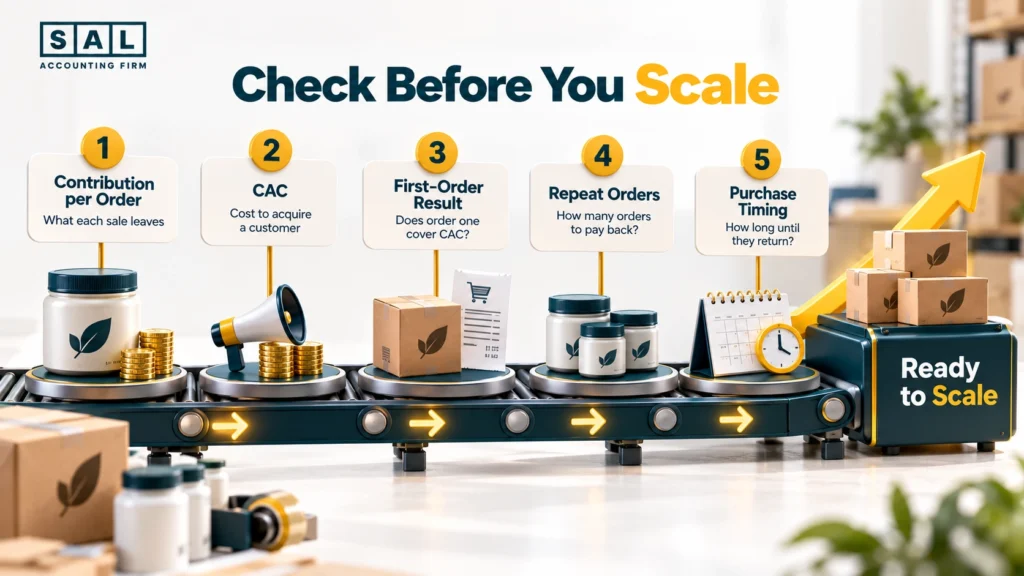
Check that each new customer pays for themselves before you spend more to get them. Before increasing ad spend, confirm five numbers:
- Contribution per order: what each sale leaves after variable costs
- CAC: what each new customer costs to acquire
- First-order result: whether the first order covers CAC
- Repeat purchases: how many more orders it takes to recover CAC
- Purchase timing: how long those orders take to arrive
The last two need real customer data, not hopes. If each order contributes $30 and CAC is $42, the math works on paper. It only works in practice if customers actually place that second order within a timeframe your business can carry.
These numbers are only as reliable as your books. Sales, inventory costs, fees, refunds, and payouts should all reconcile at a dependable month-end close for supplement brands. And growth needs more than good unit economics, since cash, inventory, and operations all have to keep up, which is the wider picture in how to scale an ecommerce brand.
Final Thought: Does Every New Customer Pay for Themselves?
Unit economics tells you whether growth will make your supplement brand more profitable or just bigger. Start with contribution per order, subtract CAC, then follow real repeat purchases until each customer pays back what they cost. Do that before you scale, and every ad dollar has a clear job.
Once your unit economics hold up, the next step is growing on solid ground. Start with our free growth roadmap.