
Not sure you’re charging the right tax on your Montreal store’s orders? Here’s the short version. Customers in Quebec pay 5% GST plus 9.975% QST. Customers in Ontario and the Atlantic provinces pay HST instead, and customers elsewhere in Canada pay 5% GST. Both taxes are handled through Revenu Québec.
Below, SAL Accounting lays out what a Montreal store charges, registers for, and files.
Quick Takeaways
- Montreal stores charge Quebec customers 5% GST plus 9.975% QST, which is 14.975% combined.
- QST is calculated on the price before GST, not on top of it.
- Montreal businesses register and file both taxes with Revenu Québec, not the CRA.
- You generally have to register once taxable sales pass $30,000.
- Orders to HST provinces get HST, and orders to the rest of Canada get 5% GST.
- You can claim back GST and QST paid on business purchases through ITCs and ITRs.
- Returns are due every reporting period, even when you owe nothing, and must be filed electronically.
Sales tax is one of the first things a new online store has to get right. Seeing how ecommerce bookkeeping tracks it alongside everything else shows which records to keep from day one.
What Sales Tax Does a Montreal Online Store Charge Quebec Customers?
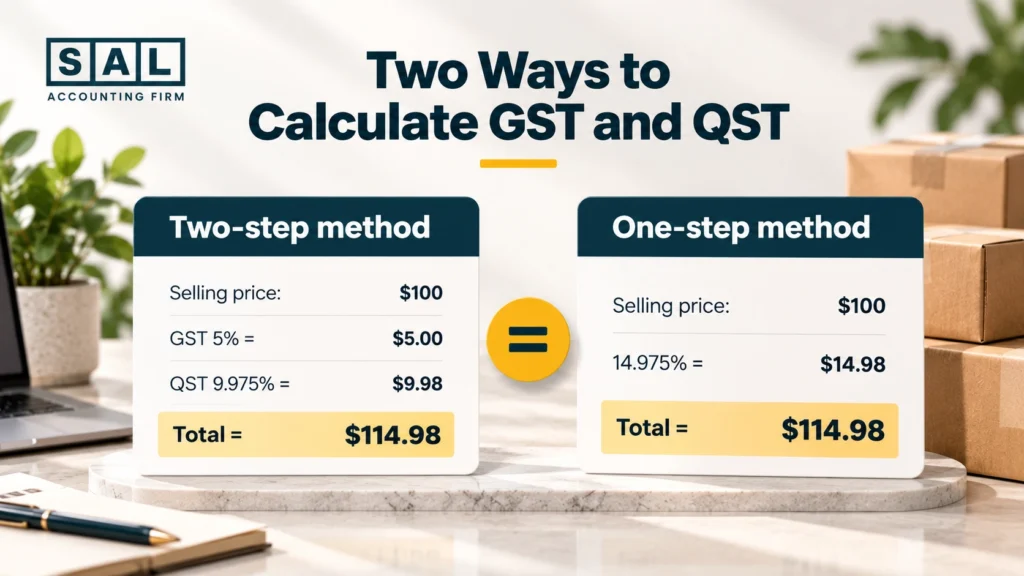
A Montreal store charges Quebec customers 5% GST plus 9.975% QST, or 14.975% combined. The GST is the federal tax. The QST is Quebec’s own tax, set out in the Act respecting the Québec sales tax. Both are calculated on the selling price before tax. Here’s a $100 order:
| Line | Amount |
|---|---|
| Selling price | $100.00 |
| GST (5%) | $5.00 |
| QST (9.975%) | $9.98 |
| Total | $114.98 |
The QST works out to $9.975, which rounds up to $9.98. Only fractions of half a cent or more get rounded up to the next cent.
How Do You Calculate GST and QST Correctly?
Calculate each tax on the price before tax, then add both to the price. There are two ways your system can do it, and Revenu Québec sets the rate for each:
- Two-step method: apply 5% GST to the selling price, then apply 9.975% QST to the same selling price
- One-step method: apply a single 14.975% rate to the selling price
The rounded rates, 9.97% and 14.97%, are only allowed if your system can’t handle three decimals. And whichever method you use, the 9.97%, 14.97%, and 14.975% rates must not appear on the receipt or invoice.
If an order has several items, you can calculate the taxes on the order total before rounding. The full rules are on Revenu Québec’s page for calculating the taxes.
Pro Tip: Check your store’s tax settings. If QST is set to 9.97% and your platform can handle three decimals, change it to 9.975%. Getting the Shopify GST/HST settings right from the start also makes sure each province gets the right tax.
Who Do Montreal Online Stores Register With: CRA or Revenu Québec?
Montreal businesses register with Revenu Québec for both GST and QST. That’s different from the rest of Canada, where businesses deal with the CRA for GST. In Quebec, Revenu Québec generally administers the GST/HST, and CRA’s guide for GST/HST registrants confirms that businesses physically located in Quebec file their returns with Revenu Québec using its forms. In practice, that means one agency for:
- Registering for both taxes
- Filing your returns
- Paying what you owe
- Claiming refunds
- Audits and questions
Revenu Québec also requires the same fiscal year for both taxes, so your GST and QST filing schedules always match. The broader rules for staying on track are laid out in GST/HST compliance for ecommerce stores.
When Does Your Montreal Online Store Have to Register for GST and QST?
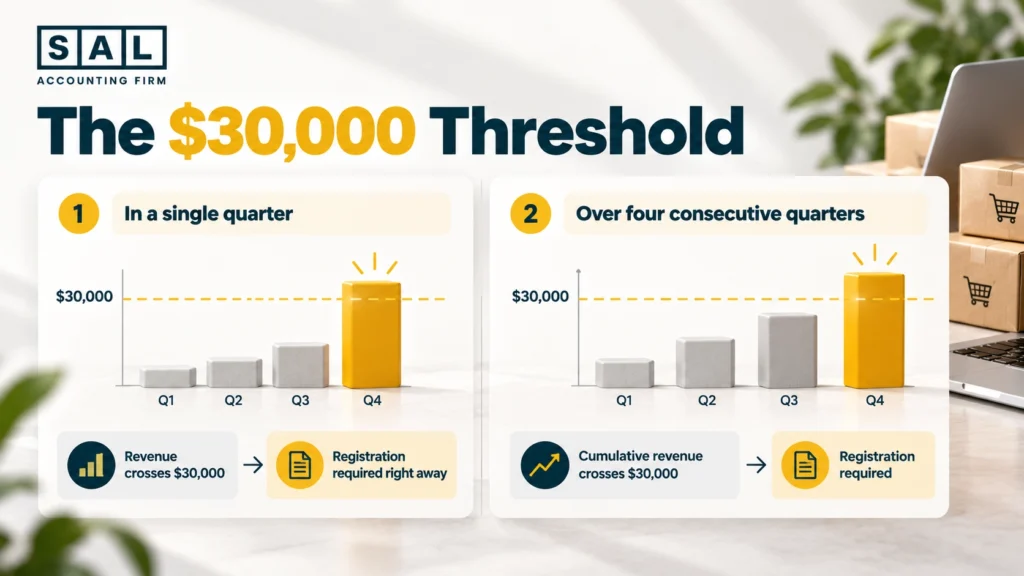
You generally have to register once your taxable sales pass $30,000 in a calendar quarter or over four quarters in a row.
That $30,000 includes your worldwide taxable sales and those of any associated businesses. Until you pass it, you’re a small supplier and don’t have to register or collect the taxes. How you cross the line matters:
- Over four quarters: you generally stop being a small supplier at the end of the month after the four quarters in which you went over
- In a single quarter: you stop being a small supplier right away, and you must charge tax on the sale that pushed you over and every sale after it
You can also register voluntarily before you reach $30,000. That lets you claim back the tax you pay on business purchases, but once you register, you have to stay registered for at least one year. If you register for the QST, you must register for the GST too.
Staying under the limit without registering has its own trade-offs, and the risks for an ecommerce seller that isn’t registered for GST/HST are worth knowing before you decide.
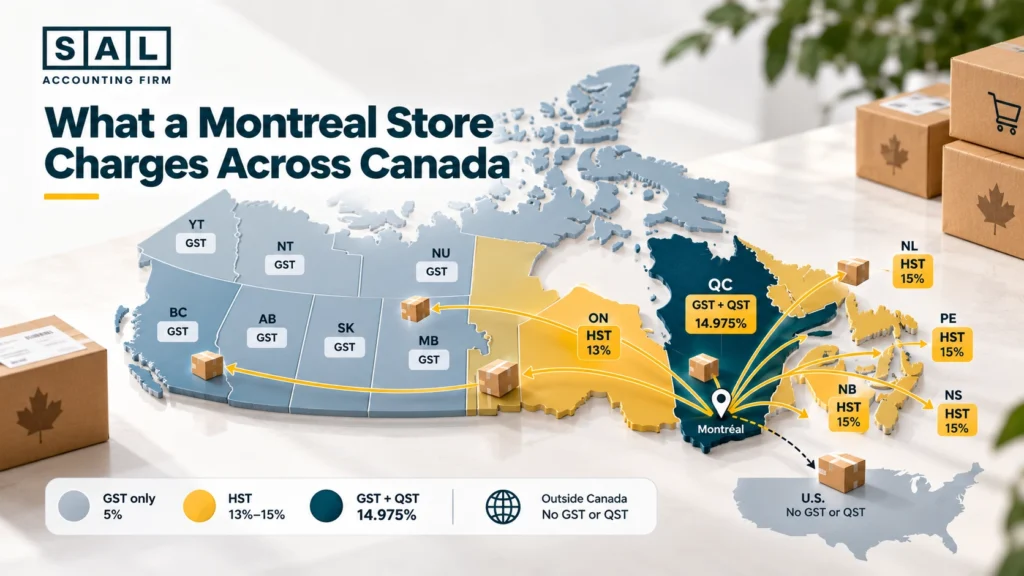
What Do Montreal Online Stores Charge Customers Outside Quebec?
It depends on where the order is delivered, not where your store is. Revenu Québec’s place-of-supply rules come down to the delivery address:
| Order Delivered To | Tax a Montreal Store Charges |
|---|---|
| Quebec | 5% GST plus 9.975% QST |
| Ontario | 13% HST |
| Nova Scotia | 14% HST |
| New Brunswick, Newfoundland and Labrador, PEI | 15% HST |
| Anywhere else in Canada | 5% GST, with no QST |
| Outside Canada | No GST or QST |
Orders delivered outside Canada carry no GST or QST because the sale is made outside Canada.
Customers in BC, Saskatchewan, and Manitoba pay 5% GST on your orders, but those provinces also have their own sales taxes, with their own rules for out-of-province sellers. The out-of-province sales tax rules for Canadian ecommerce walk through that side.
Case Study: How a Montreal Ceramics Shop Gets Caught by the Single-Quarter Rule1
Élodie sells handmade mugs and bowls online from a small studio in Saint-Henri, Montreal. For two years, her sales stay well under $30,000 a year, so she’s a small supplier and doesn’t charge GST or QST. Then, in November, a video of her glazing process goes viral.
The problem: Orders flood in. Her October to December sales pass $30,000 on December 8. Élodie assumes she has until the end of the year to deal with registration, so she keeps selling without charging tax. But because she crossed the limit in a single quarter, she stopped being a small supplier immediately. Tax applied from the sale that pushed her over.
What she does: Élodie registers with Revenu Québec right away and turns on GST and QST in her store. She works with her accountant to sort out the tax on the orders she sold between December 8 and her registration date.
The result: Every order now carries the right tax. Élodie also sets up a simple sales tracker by quarter, so she can see the next threshold coming instead of finding out after the fact.
How Do Input Tax Credits and Input Tax Refunds Work for Montreal Sellers?
You claim back the GST you pay on business purchases through input tax credits (ITCs) and the QST through input tax refunds (ITRs).
If you’re registered, the GST and QST you pay on purchases for your business don’t have to be a cost. You claim them on your returns, which reduces what you owe. For an online store, that usually covers purchases like:
- Inventory
- Advertising billed with GST and QST
- Apps and software
- Shipping and packing supplies
Your invoices have to back up every claim. Revenu Québec sets the information required based on the sale amount. For example, on purchases of $100 or more, the invoice needs your supplier’s GST and QST registration numbers. Sorting purchases correctly as you go makes this much easier, and knowing how to categorize ecommerce transactions keeps the tax amounts easy to find.
Before you file, you can estimate what’s coming back with the GST/HST Refund Calculator.
Pro Tip: When a supplier’s invoice is missing their GST or QST number, ask for a corrected one right away. It’s much harder to fix months later.
Case Study: How a Montreal Apparel Brand Stops Overpaying2
Julien runs an online apparel brand from a shared workspace in Mile End, Montreal. He files his GST and QST returns on time and pays what he collected. He’s never thought much about the taxes he pays on his own purchases.
The problem: Julien has never claimed ITCs or ITRs. Every year, he pays GST and QST on his inventory, his ads, and his apps, and never claims any of it back. He’s been sending Revenu Québec more than he owes.
What he does: Julien’s bookkeeper sets up his books to track the GST and QST paid on every purchase separately, and checks that each invoice has the supplier’s registration numbers. From his next return on, he claims ITCs and ITRs.
The result: Julien’s net tax owing drops on his next return. He now treats tax tracking as part of his monthly bookkeeping, not a once-a-year task.
How Do Montreal Online Stores File GST and QST Returns?
You report both taxes to Revenu Québec on the filing schedule it assigns you. Your filing frequency is based on your annual taxable sales:
| Annual Taxable Sales | Assigned Frequency | Filing Deadline |
|---|---|---|
| $1,500,000 or less | Annual | Generally three months after your fiscal year ends |
| Over $1,500,000 up to $6,000,000 | Quarterly | One month after each quarter ends |
| Over $6,000,000 | Monthly | One month after each month ends |
A few rules apply to every Montreal registrant:
- File every period: you must file a return for each reporting period, even if you have no refund and nothing to pay
- File together: you can file one combined GST/HST and QST return
- File online: since January 1, 2024, all registrants except charities must file electronically
Each return brings together what you collected and what you paid: the GST and QST collected on sales, minus your ITCs and ITRs. You pay the difference, or get it back.
Your records need to show the GST and QST you collected and paid, so keep them organized all year. Walking through each line is easier once you understand how a GST/HST return is put together, and a financial calendar of key deadlines keeps your due dates in view.

Final Thought: Is Your Montreal Online Store Charging the Right Tax on Every Order?
Selling online from Montreal means getting two taxes right at home and different ones everywhere else. Charge 5% GST plus 9.975% QST in Quebec, HST in the HST provinces, and 5% GST in the rest of Canada. File with Revenu Québec every period, and claim back the GST and QST you pay on your business purchases.
Know where each order is going, and the right tax follows. Map out what comes next for your store with our free growth roadmap.