
Running your store from home and not sure if the City needs to know? It probably does. An online store run from home generally counts as a home-based business, and the City says that if you operate a business from your home in Vancouver, you may need a business licence. The rules on space, storage, and visitors are simple once you see them.
Below, our team at SAL Accounting breaks down what applies, what it costs, and how to apply.
Quick Takeaways
- An online store run from your Vancouver home generally counts as a home-based business.
- Your business can use up to 33.3% of your home’s floor area or 46 m², whichever is less.
- Applying costs a one-time $77 fee, plus an annual licence fee based on your business type.
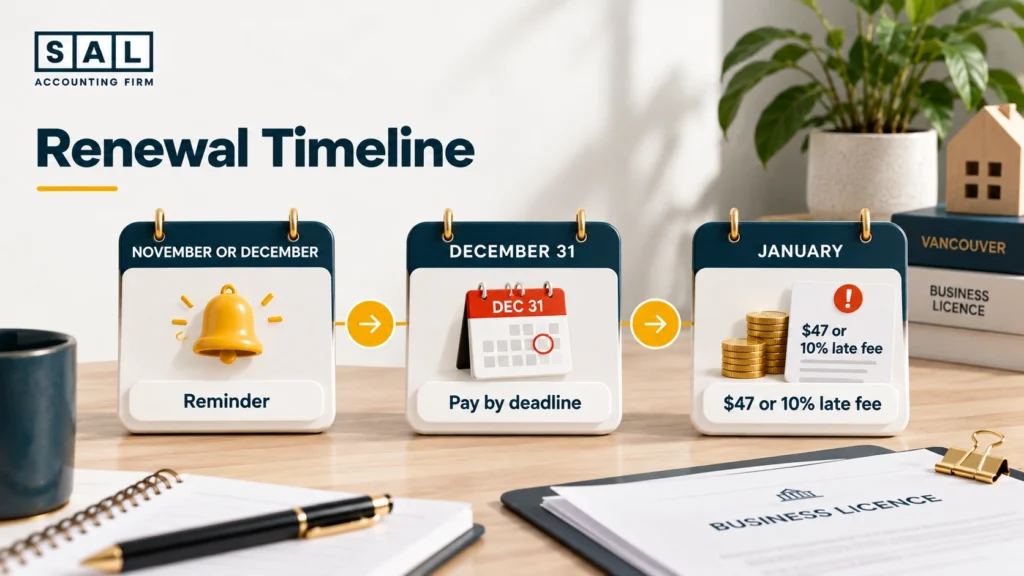
- Every Vancouver business licence expires on December 31 and must be renewed each year.
- Late renewals are charged $47 or 10% of the licence fee, whichever is greater.
- If your home is your main place of business, you may be able to deduct part of your home costs.
A City licence is one of the first setup steps for any online store. Seeing how ecommerce bookkeeping fits around it shows which records to keep from day one.
Does an Online Store Count as a Home-Based Business in Vancouver?
Yes, an online store you run from your Vancouver home counts as a home-based business.
The City describes a home-based business as a business, trade, profession, or occupation located within your home, where the building’s main use stays residential. If you operate a business from your home in Vancouver, you may need a business licence.
There’s one exception. A home-based business doesn’t include employees who simply work remotely from a home office for someone else’s company. If you’re running your own store, that exception doesn’t apply to you.
It’s also the owner who needs the licence. The City is clear that business owners need a licence, but their employees don’t.
What Rules Does a Home-Based Online Store in Vancouver Have to Follow?
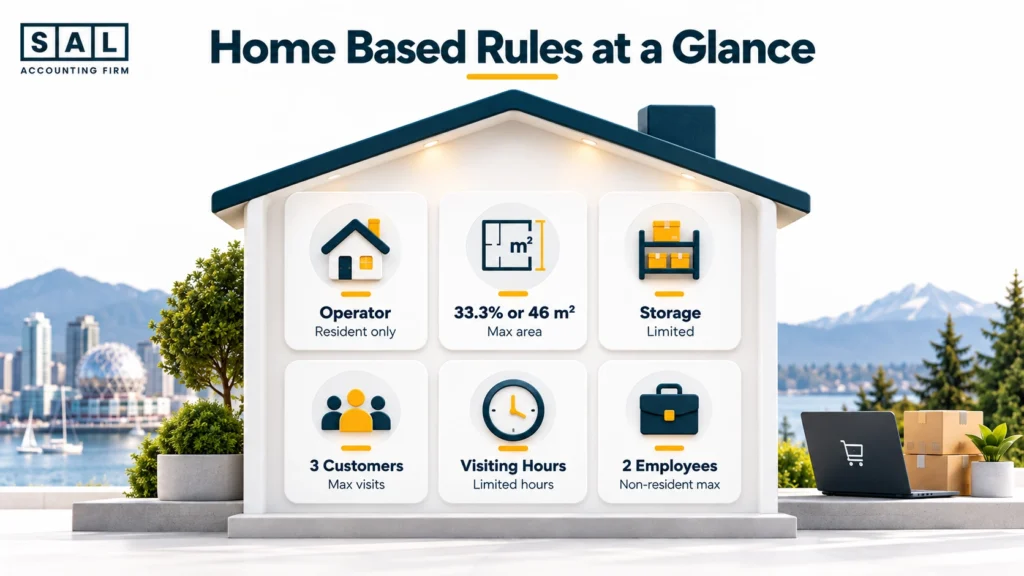
Your store has to stay small enough that your home is still mainly a home. The main rules:
- Operator: the business must be run by someone who lives in the home
- Space: the business can use up to 33.3% of your home’s total floor area or 46 m², whichever is less
- Storage: products and materials can be kept in a building on your property, like a shed or garage
- Customers: no more than 3 at a time, by appointment only
- Visiting hours: 8 am to 8 pm on weekdays, and 10 am to 8 pm on weekends and holidays
- Employees: no more than 2 non-resident employees at a time
These limits apply to the whole home, no matter how many home-based businesses run from it. The space limit comes from the City’s Zoning and Development By-law.
If you rent, there’s an extra step. You need the property owner’s approval. If you live in a secondary suite or rental unit, the owner’s suite or unit must have a valid long-term rental business licence before the City can issue yours. Here’s what these rules mean for an online store:
- Inventory: keep stock within the space limit, or use your garage or shed
- Packing help: someone who doesn’t live with you counts toward the 2-employee limit
- Local pickup: customers collecting orders count as visitors, so book pickups as appointments within the allowed hours
Pro Tip: Live in a condo or rental? Check your strata bylaws and your lease before you apply, not just the City’s rules. Measuring the space your store actually uses, including shelves and packing areas, also makes it easier to stay within the limit.
Can More Than One Online Store Run From the Same Vancouver Home?
Yes, a home with more than one resident can have more than one home-based business licence.
The City says there’s no limit to the number of home-based business licences registered to one address. So if you and a partner or roommate each run your own online store, you can each hold a licence.
There’s one catch. The space limit covers all the businesses together, not each one separately. If two stores share one home, their combined space still can’t go over 33.3% of the floor area or 46 m², whichever is less. The 3-customer limit also applies to the whole home, no matter how many businesses are running.
How Do You Apply for a Vancouver Business Licence?
You apply online or with the City’s general application form, along with your photo ID. You’ll need:
- The business owner’s current government-issued photo ID
- If your business is incorporated in BC, your BC Certificate of Incorporation and a Notice of Articles listing all current directors
- If someone applies on your behalf, a letter of authorization from you plus their own photo ID
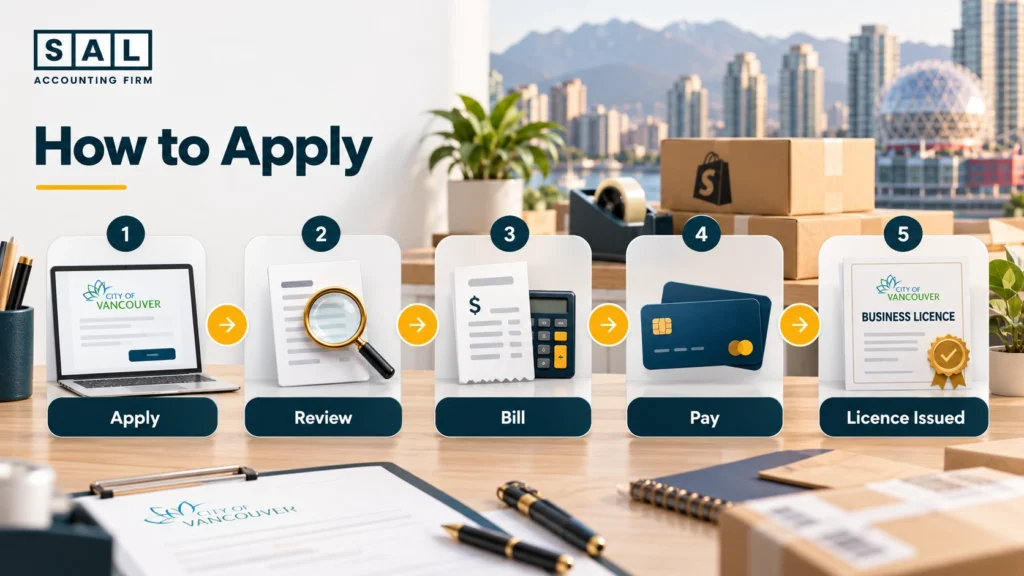
Here’s how the process works:
- Apply online, or fill out the General Business Licence Application Form
- The City reviews your application and contacts you if anything’s missing
- You receive your bill
- You pay your fees
- Your licence is issued
Applying online lets you track your application’s status and get updates.
Pro Tip: Apply only once for each business. The City notes that duplicate applications cause delays.
How Much Does a Vancouver Business Licence Cost?
You pay a one-time $77 application fee plus an annual licence fee based on your business type. Here’s how the fees work:
- Application fee: $77, one time, non-refundable
- Annual licence fee: the amount depends on your business type
- First year: the annual fee is pro-rated based on your business start date
- Expiry: your licence is valid until December 31, and you pay the annual fee by then to renew for the next year
- Late renewal: payments after December 31 are charged $47 or 10% of the licence fee, whichever is greater
Case Study: How a Vancouver Candle Brand Misses Its Renewal1
Leah runs an online candle brand from her apartment in Mount Pleasant, Vancouver. Her licence is up to date, and she’s careful with her books. Every year, though, December is her busiest month by far.
The problem: Leah’s renewal reminder arrives just as holiday orders pile up. She sets it aside to deal with later. By the time she remembers in January, the December 31 deadline has passed.
What she does: Leah renews right away and pays the $47 late fee on top of her annual fee. She also adds a reminder to her calendar for the start of every December.
The result: Her licence is back in good standing. The next year, she renews in early December, before the holiday rush peaks, and avoids the fee completely.
How Do You Renew, Update, or Cancel a Vancouver Business Licence?
You manage your licence online, from yearly renewals to updates and cancellation. Here’s what you can do:
- Renew: pay your annual licence fee by December 31 each year. The City sends a reminder in November or December, but it’s smart to set your own too.
- Update your licence information: for example, if your business details change
- Transfer your licence
- Get a copy of your licence
- Cancel your licence: when you close your business
Keeping your licence details current matters most when something about your store changes, like moving to a new home or changing how the business is set up. Check what’s needed with the City before the change happens, not after.
What If Your Vancouver Online Store Uses a Warehouse, 3PL, or Pop-Up Market?
A home-based licence only covers your home, so any other business location needs its own check. The City says every business in Vancouver needs a licence, and its application treats a commercial or industrial premise differently from a home-based one. If you’re planning to:
- Rent a warehouse or storage unit in Vancouver
- Move your stock to a third-party logistics (3PL) company
- Sell in person at markets or pop-up events
contact the City’s Licence Office before you make the move. The right answer depends on who runs the space and how you’re selling, so confirm it directly rather than assuming your home licence covers it.
What Else Does a Vancouver Online Store Need Besides a City Licence?
A City licence is just one piece of running a compliant online store. Other registrations to look at:
- GST: you generally need to register once your taxable sales pass $30,000
- BC PST: check whether you need to register, based on what you sell
- Business name: check whether you need to register a business name in BC
Once you’re registered for GST, you can claim back the GST you pay on business costs, and the GST/HST Refund Calculator gives you a quick estimate. If you ship across Canada, the rules for charging tax in other provinces get more complex, and the out-of-province sales tax rules for Canadian ecommerce are where most sellers slip.
How Do You Record Your Vancouver Licence Fee in Your Books?
Your licence fees are a deductible business expense. To record them properly:
- Put them in a “licences and permits” or similar expense account
- Record the $77 application fee and your annual fee when you pay them
- Keep the receipt or bill from the City
Small fees like these are easy to miss, but they add up. Knowing how to categorize ecommerce transactions consistently keeps them from slipping through the cracks.
Can You Deduct Part of Your Vancouver Home Costs?
Often, yes, if your home is your main place of business. CRA allows you to deduct expenses for a work space in your home if you meet one of two conditions:
- It’s your main place of business, or
- You use the space only to earn business income, and you use it regularly to meet clients or customers
For most home-based online stores, the first condition is the one that applies. You can deduct part of costs like heating, electricity, home insurance, cleaning materials, property taxes, and mortgage interest. To work out your share, use a reasonable basis, such as the area of your work space divided by the total area of your home. If a room is used for both your store and personal living, CRA says to also factor in how many hours a day it’s used for the business.
These deductions can’t create or increase a business loss. Any amount you can’t use this year can be carried forward to a future year.

Case Study: How a Vancouver Apparel Brand Misses Small Deductions2
Ben runs an online apparel brand from his home in Kitsilano, Vancouver. He pays his business licence and a few other small City fees each year, usually with his personal credit card. He never records them in his books.
The problem: At year-end, Ben’s accountant asks about licences and permits. Ben has paid them, but there’s no record in his books and no receipts saved. Those costs were real business expenses, and he’s about to miss the deductions.
What he does: Ben pulls the charges from his card statements and finds the City’s emailed bills. He adds a licences and permits account to his books and records each fee there.
The result: Ben claims the fees he’d missed. He now pays all City fees with his business card, so they show up in his books automatically.
Final Thought: Is Your Vancouver Online Store Licensed and Ready to Renew?
If you sell online from your home in Vancouver, get licensed, follow the home-based rules, and renew by December 31 each year. Keep your space, storage, and visitors within the limits, and record every fee and home cost in your books.
Licensing is the easy part. Map out what comes next for your store with our free growth roadmap.