If your online supplement store’s P&L says you’re profitable but your bank account keeps telling a different story, there’s usually a gap between what looks good on paper and what is actually happening in your business. Margins can appear healthy while cash quietly disappears through inventory costs, subscriptions, refunds, and platform fees.
This is the exact gap SAL Accounting spends its days closing for supplement brands. Keep reading, because the fix below could be the difference between guessing at your margin and actually trusting it.
Pull together everything you need with the Tax Document Checklist for eCommerce Stores before your accountant’s next review.
Quick Takeaways
- Profitable on paper doesn’t always mean healthy cash. Usually it’s how the numbers are tracked, not the sales.
- COGS, subscription timing, and platform fees are the most common places supplement brands lose track of real profit.
- Multi-channel sellers need monthly reconciliation, or revenue gets double-counted or missed.
- Once volume or channel count grows past what you can track alone, a professional accountant usually pays for itself.
How Do You Know If Your Profit Numbers Are Wrong?
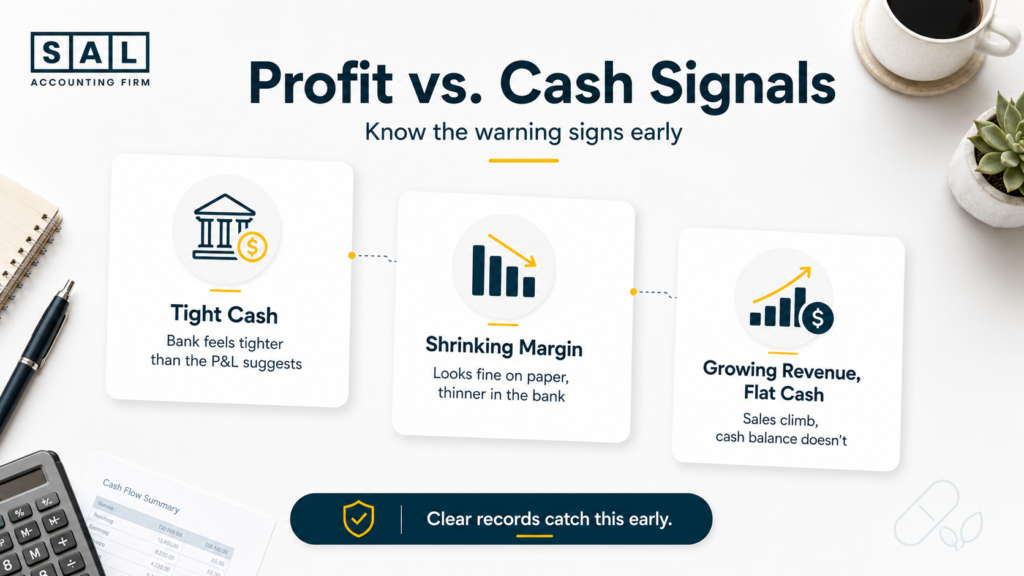
A few signs usually show up before the bigger problems do:
- Cash feels tighter than your P&L suggests, even in a month you’d call a good one
- Margin looks healthy on the report but shrinks a little more every time you check the bank
- Revenue keeps growing month over month, yet your cash balance isn’t moving with it
None of this means you’re doing something wrong. It usually means your books aren’t capturing everything happening in your business, and that’s fixable once you know where to look. This is the same pattern we’ve laid out in the difference between profit and cash flow in ecommerce businesses, since the two rarely move together the way founders expect.
Why Isn’t Your COGS Capturing the Real Cost of Your Supplements?
For supplement brands, COGS is rarely just “what I paid the manufacturer.” A lot of the actual cost gets missed or filed in the wrong place, and that alone can make a product look more profitable than it is.
- Raw ingredient costs aren’t updated per batch or lot, so supplier pricing changes never make it into your margin calculations
- Manufacturing and co-packer fees get left out of landed cost entirely
- Third-party lab testing and certification costs sit in a separate expense bucket instead of COGS
- Packaging and label costs get bundled into “supplies” instead of being tied to the product they belong to
The table below shows where each of these costs should actually sit.
| Cost Component | Usually Missed? | Should Sit In | What Happens If It’s Missed |
|---|---|---|---|
| Ingredients (per batch) | Yes | COGS | Cost lags behind real supplier pricing |
| Co-packer/manufacturing fees | Yes | COGS | Margin looks better than it is |
| Lab testing & certification | Often | COGS | Hides a recurring per-batch cost |
| Packaging & labels | Often | COGS | Understates true unit cost |
Pro tip: Update your COGS every time your co-packer or supplier changes pricing, not just once a year at tax time.
These same costs need to sit inside inventory rather than get expensed upfront, which is one more reason they belong in COGS rather than a general supplies account.
If you’re rebuilding this from the ground up, calculating COGS at the SKU level for ecommerce stores is the place to start, and the Shopify-specific version of that same process covers how online orders should be costed differently from wholesale.
Is Your Subscription Revenue Being Recognized at the Wrong Time?
Subscription and auto-ship programs are one of the best things a supplement brand can build, but they’re also one of the easiest places for revenue timing to go wrong.
Auto-Ship Revenue Recorded Before the Product Ships
Some platforms record revenue the moment a card is charged, not when the product actually ships. If your books follow that same timing, you’re counting revenue for orders that haven’t gone out the door yet, which pulls your numbers forward and makes a slower month look stronger than it was. This is the same timing mismatch we walk through in how a Shopify order moves through its full financial lifecycle, from the moment a card is charged to the moment cash actually clears. Shopify’s own payout schedule documentation confirms this gap between charge date and payout date directly.
Cancellations and Skipped Shipments Not Adjusted in the Books
When a customer skips a shipment or cancels mid-cycle, that adjustment needs to flow back into your revenue. If it doesn’t, you’re left holding revenue on the books for a shipment that never happened. Underneath it, this is really a cash versus accrual question, and the distinction between cash and accrual accounting for ecommerce is worth understanding before you decide how to handle skipped shipments.
Case Study: How Amara in Liberty Village, Toronto Found Her Missing Margin1
Amara runs a plant-based protein and collagen supplement brand out of a small studio in Liberty Village, Toronto. Sales have grown steadily for over a year, subscriptions make up nearly half her revenue, and her P&L consistently shows a healthy 40% margin.
But her bank balance tells a different story every month, and she can’t explain the gap. She’s already switched bookkeepers twice, assuming the issue is a data entry mistake somewhere, but the numbers never line up no matter who touches them.
The Problem Amara’s COGS hasn’t been updated in over eight months, even though her co-packer has raised manufacturing fees twice in that period. On top of that, her subscription platform records revenue the day a card is charged, not the day product actually ships, which means a chunk of her “revenue” each month belongs to orders still sitting in her fulfillment queue.
What We Do We rebuild her COGS at the SKU level using her current supplier and co-packer pricing, folding in lab testing and packaging costs that have been sitting in a general supplies account. We also adjust her subscription revenue recognition so it matches shipment date instead of charge date, keeping the reconciliation consistent every month through Shopify accounting support based in Toronto.
Result Her actual margin comes in closer to 27%, not 40%, but for the first time it matches what’s happening in her bank account. With accurate numbers, Amara reprices two of her lowest-margin SKUs and cuts a bundle that had been losing money every time it sold.
Are Platform and Fulfillment Fees Eating More Than You Think?
Platform fees rarely show up as one clean number, which is exactly why they’re easy to underestimate.
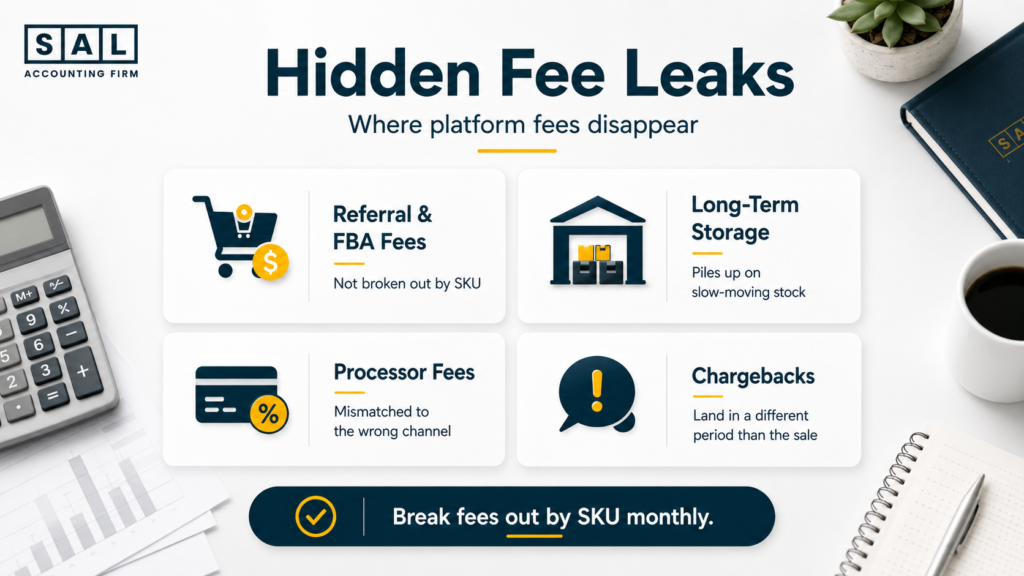
- Amazon referral and FBA fees aren’t broken out by SKU, so you can’t tell which products are actually profitable after fees
- Long-term storage fees pile up on slow-moving SKUs and get buried in a general “Amazon fees” line
- Payment processor fees aren’t matched to the right sales channel, which skews channel-level profitability
- Chargebacks and reserve holdbacks distort monthly revenue when they land in a different period than the original sale
A lot of these charges live in the blind spot that hidden Shopify costs create for founders who never go looking for them. Long-term storage charges in particular follow Amazon’s aged inventory surcharge, which climbs the longer a SKU sits unsold.
Run your own numbers through the Shopify Fee Calculator before your next month-end close.
Pro tip: Break out Amazon and Shopify fees by SKU each month instead of lumping them into one line. It’s the fastest way to spot which products are actually carrying your margin.
- Read more: “Amazon FBA Bookkeeping Guide“
Are Discounts, Bundles, and Free Products Hiding Your Real Margin?
Promotions drive sales, but they can also erase the margin you think you’re making if they’re not accounted for correctly.
- Bundle pricing isn’t allocated across the individual SKUs inside it, so you can’t tell which product in the bundle is actually carrying the margin
- “Buy one get one” promotions get recorded at full gross value instead of the discounted amount actually collected
- Free samples and trial sizes aren’t tracked as a cost at all, even though the ingredients, packaging, and shipping still cost money
Bundles are one of the fastest ways to end up with a negative contribution margin without anyone noticing, since the math rarely gets checked at the SKU level once a promotion goes live.
Are Returns and Expired Inventory Throwing Off Your Margins?
Supplements have a shelf life, and that changes how returns and inventory losses need to be handled compared to most other product categories.
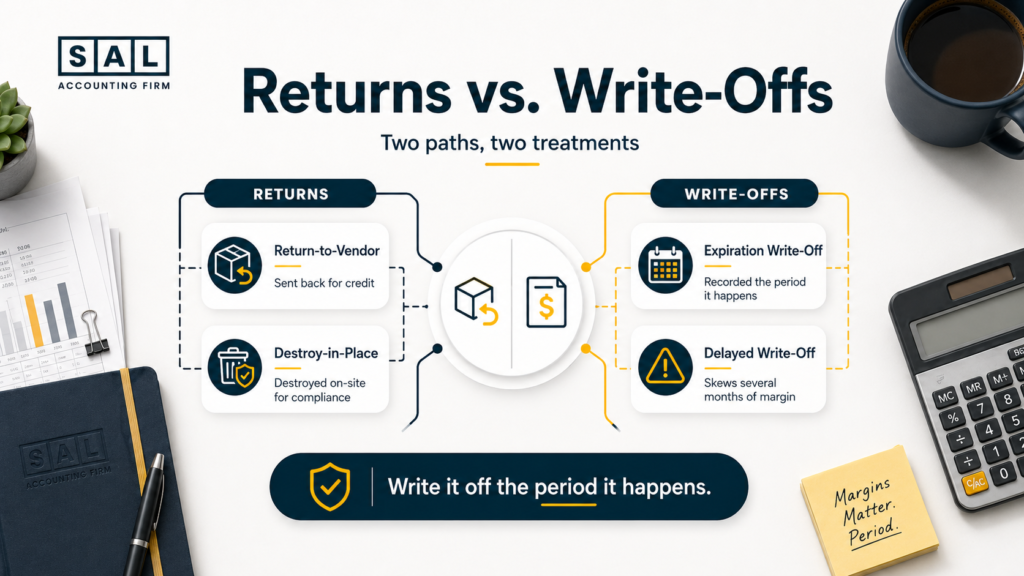
Expiration-Driven Write-Offs Skew Monthly Margins If Ignored
When inventory expires, it needs to be written off in the period it happens, not left sitting on the books as an asset it no longer is. Skip this step and a single bad batch or slow-moving SKU can make several months of margin look better than they actually were.
This lines up with CRA’s guidance on markdowns for goods with reduced saleability, which expects those markdowns to be charged to the period the condition arose in, not spread out later.
Return-to-Vendor vs. Destroy-in-Place Accounting Treatment
Not every return gets treated the same way. Product sent back to a vendor for credit is different from product destroyed on-site for compliance reasons, and each one needs its own accounting treatment. This distinction understates or overstates your cost of returns if the two get mixed up. Supplements also carry shelf-life rules that most product categories don’t, and Health Canada’s labelling requirements for natural health products set out how expiry dating should work for these products, which is worth checking against your own labeling before you decide when a batch needs writing off.
Are Your Multi-Channel Sales Actually Reconciled?
Most supplement brands sell across more than one channel, and that’s usually where reconciliation problems start.
- Shopify and Amazon sales get double-counted or under-counted when the two platforms aren’t reconciled against each other monthly
- Wholesale orders on separate payment terms don’t get matched to invoices, so revenue shows up before or after the cash actually does
- Sales tax and GST/HST collected on behalf of the government get treated as revenue instead of a liability, which inflates your top line and your apparent margin
Shopify and Amazon rarely reconcile on their own, which is why matching Shopify payments channel by channel matters for sellers running both side by side. The tax side counts just as much. Check what you might be owed with the GST/HST Refund Calculator for eCommerce Stores.
Case Study: How Deshawn in Port Credit, Mississauga Fixed His Multi-Channel Mess2
Deshawn sells a line of sports nutrition supplements through Shopify, Amazon, and a small wholesale account with a chain of gyms across Mississauga and the GTA. His business is growing fast, but every month-end close takes him days longer than it should, and he’s never confident the final number is right.
The Problem Shopify and Amazon sales get pulled into his books separately, with no reconciliation step between them, which leads to a handful of orders being counted twice. His wholesale account operates on 30-day payment terms, but those orders get recorded as revenue on the invoice date rather than matched to the actual invoices, so his cash position never matches his reported revenue.
What We Do We set up a monthly reconciliation process across all three channels, matching Shopify and Amazon transaction reports against his bank deposits, and matching wholesale invoices to actual payments rather than invoice dates. This is the same process built into Amazon bookkeeping support for onlin sellers, where multi-channel reconciliation runs on a fixed monthly schedule rather than whenever there’s time.
Result Deshawn’s monthly close goes from several days of manual checking to under an hour, and he finally has a revenue number he can trust when deciding whether to take on a second wholesale account.
- Also read: “FIFO vs. Weighted-Average Cost for Ecommerce“
How Do You Fix Your Supplement Brand’s Profit Numbers?
This doesn’t require an overhaul, it requires a process:
- Rebuild COGS at the SKU level so every product carries its actual cost, not an estimate
- Set a monthly close process so revenue, fees, and returns get reviewed on a consistent schedule instead of only at tax time
- Reconcile every channel against your books before you trust what the P&L is telling you
| Problem Area | What to Check Monthly | Who Usually Catches It |
|---|---|---|
| COGS | Ingredient, co-packer, and packaging costs are current | Bookkeeper or accountant |
| Subscriptions | Revenue matches ship date, not charge date | Accountant |
| Platform fees | Fees broken out by SKU and channel | Bookkeeper |
| Multi-channel sales | Shopify, Amazon, and wholesale reconciled to bank deposits | Accountant |
A repeatable monthly close is really what ties all of this together, and a basic ecommerce bookkeeping checklist is a reasonable starting point if you don’t already have one. Shopify sellers specifically can lean on a month-end close checklist built for Shopify, which walks through the same process in more platform-specific detail.
Pro tip: Set a recurring calendar reminder for the same day each month to run this checklist. A process only works if it actually repeats.
The point is, once these three things are in place, your numbers stop being a guess and start being something you can actually make decisions from.
- Read more: “Ecommerce Profit Calculation Mistakes“
When Should You Bring In a Professional Accountant?
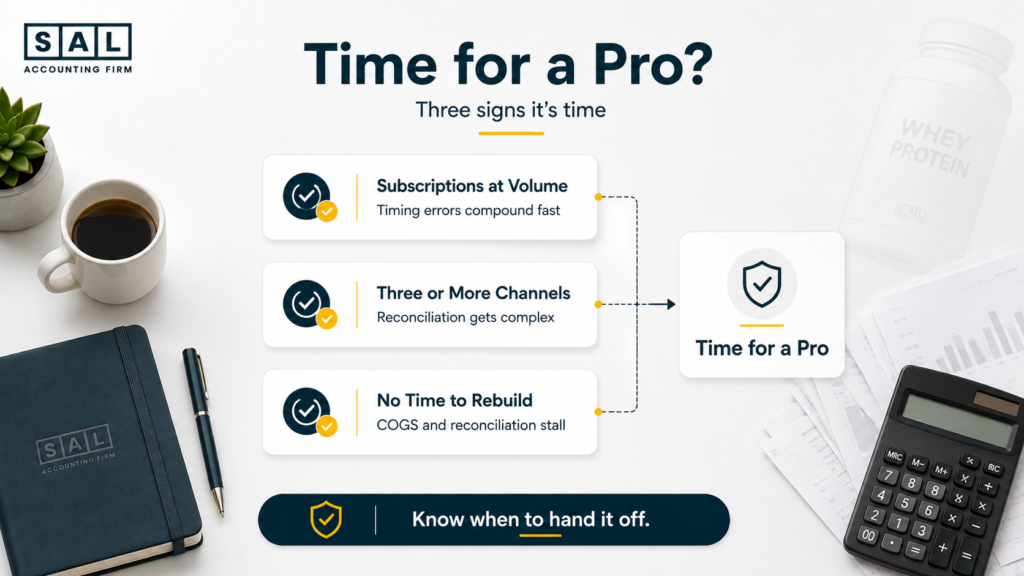
DIY fixes work up to a point. A professional usually earns their cost back once:
- You’re running subscriptions at volume
- You’re selling across three or more channels
- You don’t have the time to rebuild your COGS and reconciliation process from scratch
Plenty of founders get this far on their own, though the risks of DIY ecommerce bookkeeping tend to show up right around this point as volume grows. If you’re already asking whether it’s time for a change, the signs it’s time to switch accountants as an ecommerce business are worth reviewing.
SAL Accounting’s ecommerce bookkeeping service picks up exactly where these DIY fixes stop working, folding all of the above into one monthly process instead of a checklist you have to remember on your own.