
Once a supplement seller adds more sales channels, sales, fees, refunds, tax, payouts, and inventory stop moving through one system. Different numbers are normal. The problem is when you can’t explain how they connect.
At SAL Accounting, we focus on making that channel-to-bank trail clear. If you can’t trace that trail now, every new channel gives a small mismatch more room to become a bigger month-end problem.
Selling through Shopify too? Check the fee layer with SAL’s Shopify Fee Calculator.
Quick Takeaways
- Reconcile each supplement ecommerce sales channel separately.
- Start with supplement sales activity, not just the bank deposit.
- Keep sales, refunds, fees, tax, adjustments, and payouts clearly identifiable across channels.
- Track supplement inventory transfers separately from actual sales.
- Review clearing-account balances as part of your monthly supplement ecommerce reconciliation.
- Bring all supplement sales channels together only after each one has been reconciled and explained.
Multiple channels already making the books hard to follow? See our Ecommerce Accounting Services.
Why Does Multichannel Accounting Get Complicated for Supplement Businesses?
Each system can be recording a different stage of the same transaction.
Your store records the order. A marketplace or payment processor may deduct fees. A refund could happen later. The payout may reach your bank on another date. Meanwhile, your supplement inventory could be moving between warehouses and fulfillment locations.
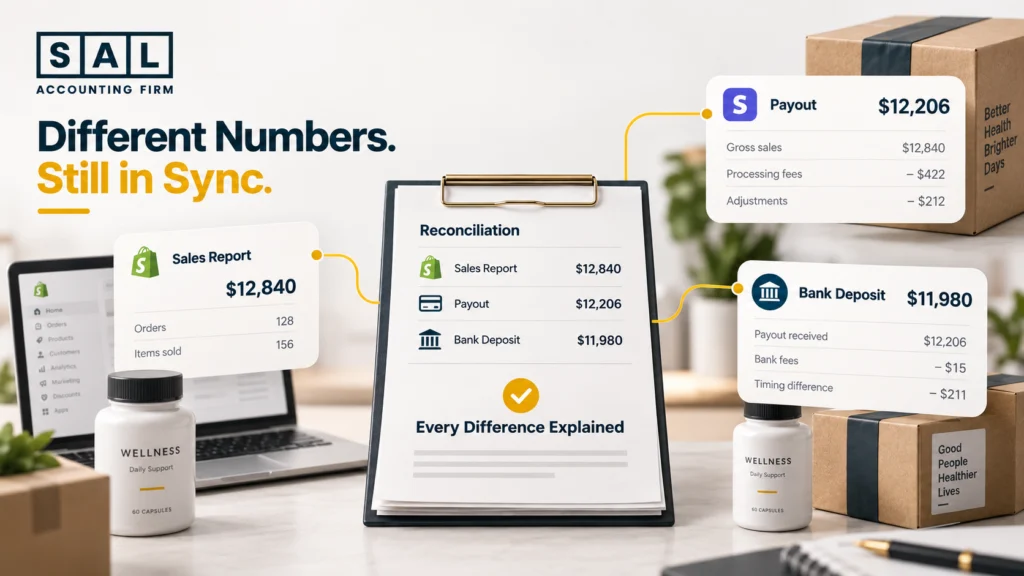
So these numbers can all be different without any of them necessarily being wrong:
| Record | What It Shows | Why It May Differ | What It Should Connect To |
|---|---|---|---|
| Sales report | Customer activity | Before deductions | Payout activity |
| Payout report | Settlement amount | Fees, refunds, timing | Sales + bank |
| Bank | Cash received | Final net deposit | Payouts |
| Books | Financial activity | Posting and mapping | All systems |
| Inventory report | Units by location | Transfers and adjustments | Fulfillment + books |
For example, Shopify separates the customer payment from when the funds become available for payout. A sale near month-end can therefore appear in one period while the cash reaches the bank in another.
Other channels have the same basic issue. Etsy can deduct fees from your sales before the remaining balance becomes available for deposit.
The point is not to force every platform to display the same number. It is to explain why they are different.
That’s why revenue and payout reconciliation for supplement stores should start with the underlying activity rather than whatever cash happened to reach the bank.
Pro tip: Before fixing a mismatch, make sure you’re comparing the same thing. A sales report and a payout report often should not match.
- Also read: “Ecommerce Reconciliation Best Practices”
What Should an Online Supplement Store Track Separately Across Sales Channels?
Do not combine everything too early. For each meaningful channel, you should still be able to identify:
- gross sales;
- discounts;
- refunds;
- fees;
- tax;
- adjustments;
- payouts.
You do not need a separate accounting account for every small charge. You need enough detail to answer one basic question:
Where did this difference come from?
Say one marketplace is $6,000 off at month-end. If every channel has already been combined into one generic sales account, you first have to separate everything again before you can investigate the $6,000.
That is why categorizing ecommerce transactions correctly matters more as the number of channels grows.
Tax should remain identifiable too. CRA explains that GST/HST collected is held in trust until it is remitted, subject to the applicable GST/HST rules.
Basically, keep enough detail to trace each meaningful channel without turning your chart of accounts into another ecommerce platform.
How Do You Reconcile Sales Across Multiple Online Channels?
Start with what actually happened on the channel, not the amount that landed in the bank.
A basic reconciliation is:
Gross Sales − Discounts − Refunds − Fees ± Adjustments = Expected Payout
Tax should remain separately identifiable where applicable. Then match the expected payout to the actual payout and bank deposit. Here’s a simple example:
| Activity | Amount | Where to Check | What It Explains |
|---|---|---|---|
| Gross sales | $50,000 | Sales report | Starting activity |
| Refunds | ($2,500) | Refund report | Customer returns |
| Fees | ($1,800) | Settlement report | Channel costs |
| Adjustments | ($700) | Settlement report | Other differences |
| Expected payout | $45,000 | Payout report | Cash expected |
If $45,000 reaches your bank and you record $45,000 as revenue, the bank may look fine. But the accounting does not. You have lost visibility into:
- $50,000 of actual sales;
- $2,500 of refunds;
- $1,800 of fees;
- $700 of adjustments.
This is why the detailed reports matter. Amazon’s payment reports can contain activity such as income, expenses, taxes, and transfers rather than only the final deposit.
Payment processors also provide the bridge behind the deposit. Stripe, for example, lets businesses reconcile a payout back to the transactions behind it.
Your ecommerce payment reconciliation should follow the same logic: activity first, payout second, bank third.
Pro tip: Take one recent payout and work backward. If you can explain every meaningful difference between the sales activity and cash received, the reconciliation trail is working.

Case Study: How a Leslieville Supplement Brand Finds Where $15,500 Went1
A supplement seller in Leslieville, Toronto sells through a DTC store and two marketplaces. The channels report $120,000 in gross sales for the month, but only $104,500 has reached the bank. Looking only at the deposits, it feels like $15,500 is missing.
The Problem
The bookkeeping starts with the bank deposits instead of the sales reports. Once we compare the three channels separately, the difference becomes clear:
- $5,200 in refunds;
- $4,800 in marketplace and payment fees;
- $2,000 in other settlement adjustments;
- $3,500 in payouts still in transit.
The money is not simply “missing.” The books just do not explain where it went.
What We Do
We reconcile each channel from gross sales to its expected payout, then match those payouts to the bank. Refunds and fees are recorded separately, adjustments are reviewed, and the $3,500 not yet deposited stays in the clearing account until the cash arrives.
Result
The seller can now explain the full $120,000:
$120,000 sales − $5,200 refunds − $4,800 fees − $2,000 adjustments = $108,000 expected payouts
Then:
$108,000 payouts = $104,500 received + $3,500 still in transit
Instead of wondering why sales and the bank do not match, the seller can see exactly what happened to every part of the difference.
How Do You Keep Supplement Inventory in Sync Across Multiple Locations?
Inventory creates a second multichannel trail. A supplement brand may hold products at:
- its own warehouse;
- a 3PL;
- a marketplace fulfillment centre;
- another fulfillment location.
The key distinction is simple:
Moving inventory is not the same as selling inventory.
Say you move 1,000 bottles from your main 3PL to another fulfillment centre. You still own those 1,000 bottles. Their location changed. Your total inventory did not automatically increase or decrease. For each location, you should be able to explain:
- units received;
- units sold;
- transfers in and out;
- samples or promotional units;
- damaged or expired products;
- ending inventory.
Inventory is only one part of online supplement business accounting, especially once products are moving across several sales channels and fulfillment locations.
Case Study: How a Port Credit Supplement Seller Fixes Inventory That Was Overstated by 1,200 Units2
A supplement seller in Port Credit, Mississauga has 7,800 bottles across a 3PL and a marketplace fulfillment centre. Before a promotion, the business transfers 1,200 bottles from the 3PL to the marketplace.
After the transfer, the combined inventory reports suddenly show 9,000 bottles.
The Problem
The marketplace correctly records the 1,200 units arriving, but the original 3PL balance is never reduced in the accounting records.
The same 1,200 bottles are now being counted in two places.
If nobody catches it, the business may believe it has more sellable inventory than it actually does.
What We Do
We trace the transfer using the 3PL shipment record and the marketplace receiving report. The transfer-out and transfer-in are matched as one inventory movement, not treated as a new purchase or sale.
We then reconcile the remaining units by location so the total business inventory agrees with the fulfillment records.
Result
The total returns to the correct 7,800 units. The business can now explain both numbers:
- 6,600 units remain at the original location after the transfer;
- 1,200 units are now at the marketplace fulfillment centre;
- total company inventory is still 7,800 units.
The key lesson is simple: when inventory moves between fulfillment locations, the location changes. The total inventory does not automatically change with it.

What Are the Most Common Multichannel Accounting Problems for Supplement Brands?
Most problems happen somewhere between the channel, payout, fulfillment records, and books, such as:
Sales and Payout Problems
These usually happen when the books start from the bank deposit instead of the activity behind the payout.
- net payouts recorded as revenue;
- missing channel fees;
- refunds recorded against the wrong channel;
- payout differences carried into another month.
Duplicate or Missing Activity
This is where integrations create trouble: the same transaction gets recorded twice, or something never reaches the books at all.
- revenue imported twice;
- two integrations recording the same transaction;
- one channel posted into another;
- adjustments missing from the books.
Tax and Clearing Problems
These issues usually build up quietly when tax and payout timing are not kept separate from ordinary sales activity.
- tax mixed into ordinary revenue;
- payouts left sitting in clearing accounts;
- old clearing balances never investigated.
Inventory Problems
Inventory gets messy when transfers between locations are treated like new purchases or sales instead of simple movements.
- transfers recorded as purchases or sales;
- the same stock counted at two locations;
- fulfillment reports no longer matching the books.
The bank deposit alone cannot tell you which of these happened. PayPal’s own transaction and balance reports, for example, separate sales, refunds, fees, withdrawals, and other movements rather than reducing everything to one deposit.
- Read more: “Common Ecommerce Accounting Mistakes”
How Should a Supplement Business Reconcile Its Sales Channels Each Month?
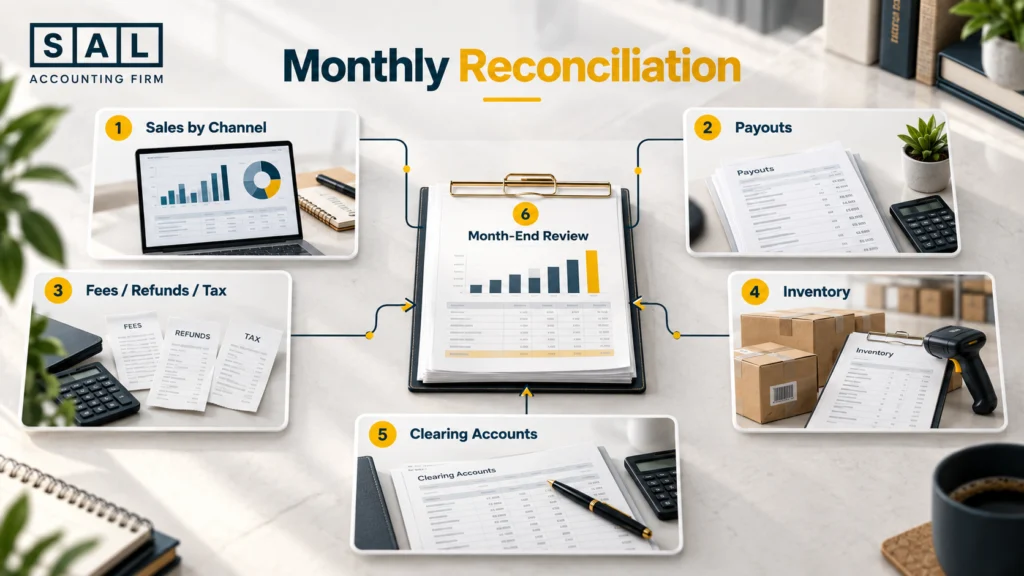
Reconcile the channels separately first. Then bring them together. A simple month-end process looks like this:
| Step | What to Review | Main Question | Month-End Goal |
|---|---|---|---|
| Sales | Channel reports | Is all activity recorded? | Sales confirmed |
| Payouts | Settlements + bank | Did expected cash arrive? | Payouts matched |
| Differences | Fees, refunds, tax | What explains the gap? | Difference explained |
| Inventory | Locations + transfers | Where did units move? | Inventory matched |
| Clearing | Open balances | What remains outstanding? | Old items reviewed |
| Close | Exceptions | Can we explain them? | Month finalized |
1. Reconcile Sales by Channel
Confirm sales, refunds, fees, tax, and adjustments for each meaningful sales channel. The goal is to make sure the activity in the books matches what the channel actually reported for the month.
2. Match Payouts to Bank Deposits
Trace each material payout back to its settlement activity and then to the bank. This is different from ordinary bank reconciliation, where accounting transactions are matched against the bank statement. With ecommerce, you first need to understand what sits behind the deposit.
3. Check Fees, Refunds, Tax, and Adjustments
These usually explain why sales and bank deposits are different. Review them separately so a payout gap does not get treated as missing revenue.
4. Reconcile Inventory Across Locations
Match sales and transfers against warehouse and fulfillment records. You should be able to explain where inventory moved and why the total changed, if it changed at all.
5. Review Clearing Account Balances
A recent balance may simply be a payout in transit. An unexplained balance that has been sitting there for months is different and should be investigated before it keeps rolling forward.
6. Resolve Differences Before Month-End
By month-end, material differences should be:
- explained;
- corrected; or
- intentionally documented.
A consistent ecommerce bookkeeping checklist makes this part of the normal close instead of a cleanup exercise months later.
- Also read: “Shopify Month-End Close Checklist”
How Should Accounting Be Structured for a Multichannel Supplement Business?
You need enough separation to isolate a channel problem without making the books impossible to read. A practical setup usually keeps:
- meaningful sales channels identifiable;
- significant channel fees visible;
- clearing accounts separated where needed;
- one company-level set of financial statements;
- deeper channel detail in supporting reports.
A good test is:
If one channel stops reconciling tomorrow, can you isolate the problem without rebuilding the entire month?
Software can make this easier, but automation does not automatically mean accurate accounting. The right ecommerce accounting software still needs clean mappings and a clear source for every number.
Shopify is one of your main channels? See SAL’s Shopify Accounting Services.
How Do You Know Your Online Supplement Accounting Is in Sync?
You should be able to explain the numbers without guessing. Check whether:
- each meaningful sales channel reconciles;
- payouts can be traced back to sales activity;
- bank deposits can be matched to payouts;
- fees, refunds, tax, and adjustments remain identifiable;
- inventory movements between locations can be explained;
- old clearing balances are investigated;
- all channels roll into one reliable company-level picture.
The systems do not need identical numbers. They need to tell one explainable story. That is what “in sync” actually means.
The Bottom Line: Keeping Multichannel Supplement Ecommerce Accounting in Sync
Multichannel supplement accounting is in sync when each sales channel stays traceable and you can explain the differences between sales, fees, refunds, payouts, inventory, books, and bank deposits. The numbers do not need to look identical across every system. They just need to make sense together.
Ready to see what those numbers should tell you next? Get the Financial Growth Blueprint.