
An online supplement brand should review its P&L, balance sheet, cash flow statement, inventory reports, payables and, where relevant, receivables every month. For supplement brands, SAL Accounting looks at those reports together because inventory, manufacturing deposits, payouts and supplier bills rarely move on the same schedule.
One report can look healthy while another is flashing a warning. Keep reading, the report you skip could be the one explaining why a profitable month still feels tight on cash.
Want a quick read on what your numbers are saying? Start with the Ecommerce EBITDA Calculator to estimate your operating profitability.
Quick Takeaways
- Your P&L tells you whether the business made money, but it does not tell you how much cash is available.
- Your balance sheet shows where money is sitting and what the business still owes.
- Your cash flow statement explains why profit and the bank balance move differently.
- Inventory reporting matters because inventory affects both the balance sheet and COGS.
- AR and AP become more important as wholesale and supplier commitments grow.
- SKU and channel reports add useful detail, but only once the underlying accounting is reliable.
Get the monthly books underneath the reports in order with SAL’s ecommerce bookkeeping services.
Why Should a Supplement Ecommerce Business Review Financial Reports Every Month?
A supplement brand can have a good sales month and still end up tighter on cash. Why? Because cash may already be going toward:
- manufacturing deposits;
- inventory;
- packaging;
- freight;
- fulfilment;
- advertising;
- tax;
- supplier balances.
That is one reason online supplement business accounting has to keep sales, inventory, production costs and payouts separate enough for the owner to understand what actually changed.
Let’s say sales increase from $250,000 to $310,000.
That looks good.
But during the same month, you pay a $55,000 production deposit, inventory increases by $40,000 and your manufacturer has another $35,000 balance coming due.
Looking only at sales, or even only at profit, misses most of that story.
This monthly review also depends on a consistent supplement ecommerce month-end close. Clean-looking reports are not very useful if the underlying payouts, inventory, supplier balances or tax accounts have not been reconciled first.
Pro tip: Review the same core reports in the same order every month. It becomes much easier to spot something unusual when you know what “normal” looks like.
Which Financial Reports Should an Online Supplement Business Review Each Month?
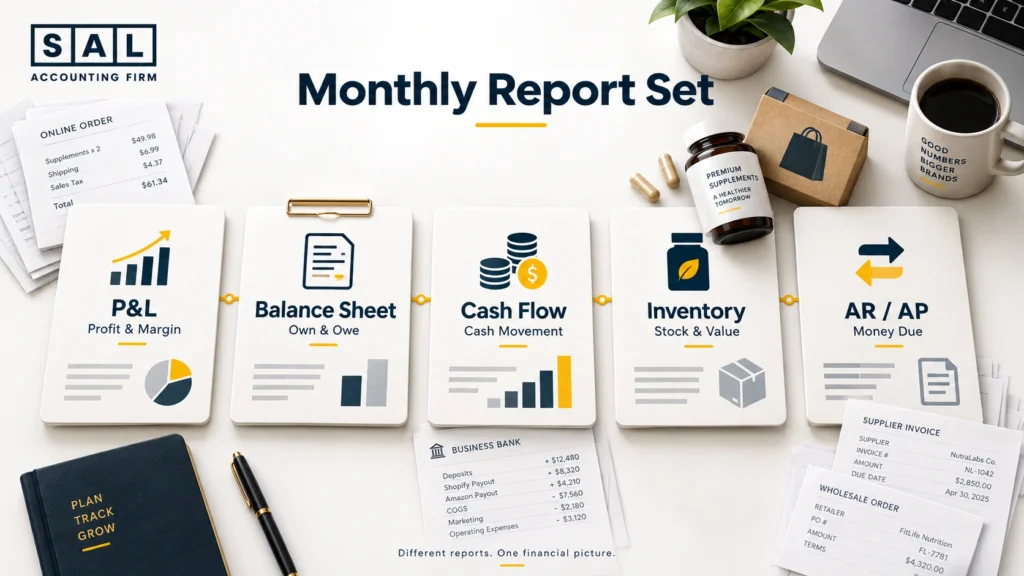
You do not need twenty reports. For most supplement businesses, these five areas give you the core financial picture.
| Report | Main Question | Watch Closely | Review |
|---|---|---|---|
| P&L | Did we make money? | COGS, margin, ads, fulfilment | Monthly |
| Balance Sheet | What do we own and owe? | Cash, inventory, deposits, tax | Monthly |
| Cash Flow | Where did cash go? | Inventory, debt, deposits | Monthly |
| Inventory | What stock do we have? | Value, quantity, aging | Monthly |
| AR / AP Aging | Who owes us and who do we owe? | Overdue invoices, supplier bills | As relevant |
The P&L, balance sheet and cash flow statement form the main financial-statement picture. This ecommerce financial statements breakdown goes deeper into what each statement does without treating them as interchangeable.
Then you add supporting reports based on the business. A DTC-only Shopify brand may have almost no traditional accounts receivable. A supplement company selling to gyms, retailers and distributors may need to watch AR every month.
That is the point. Your reporting package should reflect how your business actually works.
What Should You Look for in the Profit and Loss Statement?
Your Profit and Loss Statement answers: Did the business make money during this period, and where did that money go? Start with:
- revenue;
- COGS;
- gross profit;
- gross margin;
- fulfilment;
- advertising;
- operating expenses;
- net profit.
Now compare those numbers with previous months. Say revenue rises 20%, but gross margin falls from 52% to 44%. The question is no longer just, “Why did sales go up?” It becomes:
What got more expensive?
Maybe manufacturing costs changed. Maybe freight increased. Maybe discounts got heavier. Maybe your product mix changed.
Your P&L is only as useful as the underlying ecommerce COGS calculation. If product costs are incomplete or outdated, gross margin can look better than reality.
Refunds, platform fees, shipping and tax treatment can create other ecommerce profit calculation mistakes even when the final P&L looks perfectly tidy.
What about Shopify reports?
Shopify sellers also have platform-level finance reports covering sales, payments, taxes and gross-profit information. Those reports are useful inputs, but they are not a replacement for the company’s accounting statements. Shopify explains its current Finance reports in its Help Center.
For a supplement store, you still need to reconcile what Shopify reports with fees, refunds, inventory, bank deposits and the books. That is where revenue vs. payout reconciliation for supplement stores becomes important.
See what payment costs leave behind on each order with the Shopify Fee Calculator.
Pro tip: Compare margins as percentages as well as dollars. Gross profit can increase in dollars while gross margin quietly gets worse.
- Also read: “Why Your Supplement Brand’s Profit Looks Wrong”
What Should You Look for on the Balance Sheet?
The balance sheet shows what the business owns and owes at one point in time. For an online supplement brand, that may include:
- cash;
- accounts receivable;
- inventory;
- manufacturing deposits;
- prepaid costs;
- accounts payable;
- credit cards;
- loans;
- GST/HST or other tax liabilities;
- equity.
This is where you see what the P&L cannot show on its own.
Imagine the business reports a $60,000 monthly profit. But the balance sheet also shows:
- $220,000 of inventory;
- $50,000 paid toward future production;
- $75,000 owed to suppliers;
- $30,000 sitting in tax liabilities.
The business can still be profitable.
But that does not mean the whole bank balance is free to spend.
Manufacturing deposits are also much easier to follow when the chart of accounts for a supplement ecommerce business gives deposits, inventory, supplier balances and tax liabilities a clear place instead of burying everything in broad expense accounts.
Basically, the P&L tells you what you earned.
The balance sheet tells you what you have—and what already has a claim against it.
What Does the Cash Flow Statement Tell You That the P&L Does Not?
Profit and cash answer different questions. Profit tells you how the business performed during a period. Cash flow tells you what actually moved in and out.
Let’s say the P&L shows a $45,000 profit. During that same month, you:
- pay a $40,000 manufacturing deposit;
- purchase $30,000 of additional inventory;
- repay $8,000 of debt;
- wait for $18,000 of wholesale invoices to be collected.
Your business can be profitable while your bank balance falls. That does not automatically mean something is wrong. It means profit and cash moved differently.
The deeper profit vs. cash flow problem in ecommerce usually comes down to inventory, payouts, supplier timing, tax, debt or other cash movements that do not hit the P&L in the same way.
For Shopify businesses, timing can add another layer because a sale, payout and bank deposit do not necessarily happen at the same moment.

Case Study: How Maya in Liberty Village, Toronto Finds the Cash Behind Her Profit1
Maya runs a growing supplement brand from Liberty Village, Toronto. Her P&L shows a $32,000 profit for the month, but the bank balance falls. Sales are healthy, so she starts wondering whether the financial reports are wrong.
The Problem
During the month, Maya pays a $45,000 deposit toward her next production run and another large amount toward inbound inventory and freight. She is looking at the P&L without looking at where cash has moved on the balance sheet and cash flow statement.
What We Do
We review the P&L beside cash flow, inventory, manufacturing deposits and upcoming supplier balances. Instead of forcing the bank balance to “match” profit, each movement is traced to the report where it belongs.
Result
Maya can see that the business is profitable, but a meaningful amount of cash has already been committed to future inventory. The reports are not contradicting each other anymore. They are explaining different parts of the same month.
What Inventory Reports Should a Supplement Business Review?
Inventory deserves its own monthly review. For a supplement brand, you should be able to understand:
- how many units are on hand;
- what that inventory is worth;
- where products are stored;
- significant adjustments;
- slow-moving products;
- damaged or unsellable stock;
- whether accounting inventory reasonably agrees with operational records.
Why does this matter so much? Because inventory affects both the balance sheet and COGS.
The CRA’s inventory and cost of goods sold guidance also makes that relationship clear: inventory is used in determining COGS and income.
So if inventory is wrong, the problem does not stay inside an inventory report. It can move into your P&L too.
Maybe the books show $180,000 of inventory, but $25,000 relates to old products that are no longer moving.
Or your manufacturer has increased unit costs, but your accounting system is still carrying older costs. Now gross profit can start drifting away from reality.
Pro tip: Do not review only the total inventory dollar value. A stable total can hide one SKU building up while another keeps selling out.
When purchase prices change from batch to batch, the choice between FIFO and weighted-average inventory costing can also affect how product costs move through the books.
When Should You Review Accounts Receivable Aging?
Accounts receivable aging matters when customers buy now and pay later. That usually becomes more relevant when a supplement brand sells through:
- wholesale;
- retail accounts;
- gyms;
- distributors;
- corporate customers;
- other invoiced buyers.
AR aging answers:
Who owes us money, how much, and how long has it been outstanding?
Say wholesale revenue increases by $70,000 this month. Great.
But $28,000 from previous invoices is now overdue.
Your P&L can still show the revenue while your bank account waits for the cash. For a mostly prepaid DTC brand, AR may be a very small part of the monthly review. As wholesale grows, that changes quickly.
Why Should You Review Accounts Payable Aging?
Accounts payable aging shows:
- who you owe;
- how much is due;
- when it is due;
- what is already overdue.
For supplement brands, large balances can sit with manufacturers, co-packers, packaging suppliers, freight providers or 3PLs.
Imagine you have $125,000 in the bank. That feels comfortable. Then AP aging shows:
- $48,000 due to your manufacturer;
- $16,000 due for packaging;
- $12,000 due for freight.
The bank balance is still $125,000. But now you know that a large part of it already has a job.
That is why AP should be read beside cash, not weeks later when the bills become urgent.

Should You Review SKU and Channel Profitability Every Month?
Yes, once the underlying data is reliable. But keep one distinction clear:
Financial statements tell you how the company performed. Management reports help explain where that performance came from. That means SKU and channel reporting can sit beside your monthly statements, but they are not the same thing. Useful management views may include:
- profitability by SKU;
- Shopify vs. Amazon or other marketplaces;
- DTC vs. wholesale;
- subscriptions vs. one-time orders;
- product family or bundle performance.
A company-wide P&L might show a 46% gross margin. But underneath that:
- Shopify might be stronger;
- wholesale may carry different economics;
- one bestselling SKU may have much thinner profit than expected.
That is where ecommerce SKU profitability analysis becomes useful. It moves the question from “Which product sells the most?” to “Which product actually leaves enough behind?”
This is also the difference between standard financial statements and ecommerce management reporting. One gives you the accounting result. The other gives you another layer for decisions.
Just do not build detailed product reports on top of unreliable bookkeeping. More detail on bad data does not create better information. It creates a more detailed wrong answer.
How Do Monthly Financial Reports Work Together?
This is where the reports become much more useful.
Imagine sales are up 25%. The P&L looks strong. Then you keep going. The balance sheet shows inventory increased sharply. Cash flow shows cash fell.
AP shows a large manufacturer payment coming due. AR shows two wholesale customers are late. Now you understand the month differently. It may still have been a good month.
But you probably make a different decision about another production run, a hiring plan or a large ad push.
As the business grows, the right ecommerce financial reporting setup also becomes more important because the data may be coming from accounting software, Shopify, marketplaces, inventory systems and 3PLs rather than one clean source.
Running most of your sales through Shopify? Bring sales, fees, payouts and inventory into the same monthly process with SAL’s Shopify accounting services.
The point is simple: There is no single report that tells you whether the whole business is healthy. You need to see how they fit together.

Case Study: How Daniel in Port Credit, Mississauga Sees What Wholesale Growth Is Hiding2
Daniel runs a supplement ecommerce brand from Port Credit, Mississauga. DTC sales are steady, and the brand has recently added several wholesale accounts. Revenue is climbing, so the month looks strong at first glance.
The Problem
Some wholesale customers are taking longer to pay while manufacturer and packaging bills still come due on schedule. Daniel is using the revenue number to judge growth without looking closely enough at AR, AP and available cash.
What We Do
We review the P&L with AR aging, AP aging, cash flow and the balance sheet. Wholesale sales are separated from collections, and upcoming supplier commitments are kept visible beside available cash.
Result
Daniel can see that the brand is growing, but collections are not moving at the same speed as supplier obligations. He now knows which invoices need attention and how much cash is already committed before placing another large order.
What Changes Should You Compare From Month to Month?
The number itself only tells you so much. The better question is: What changed, and why? Here are five movements worth checking every month.
| Change | Possible Signal | Check | Ask |
|---|---|---|---|
| Sales up, margin down | Costs rising | P&L | What got more expensive? |
| Inventory up faster than sales | Stock building | Inventory + Balance Sheet | Why are units accumulating? |
| Profit up, cash down | Timing or large payments | Cash Flow | Where did cash go? |
| AR getting older | Collections slowing | AR Aging | Who is overdue? |
| AP increasing | More cash committed | AP Aging | What is due next? |
One unusual movement does not automatically mean there is a problem. It does mean you should understand it.
Pro tip: Ask for explanations in plain English. “Inventory increased because Batch B arrived before Batch A sold through” is useful. “The balance changed due to accounting entries” is not.
How Do You Know if Your Monthly Financial Reports Are Reliable?
Reliable reports should connect back to what actually happened in the business. At a high level, you should be able to follow:
Sales → COGS → Profit
Inventory → Balance Sheet
Receivables / Payables → Cash
You should also be able to explain major movements. If inventory jumps $70,000, why? If margin falls five percentage points, what changed? If the month is profitable but cash drops, where did it go?
The CRA’s business records guidance includes financial statements, bank records, receivables, payables and inventory among the records used to support and understand business activity.
Basically, your final reports should not exist separately from the transactions underneath them.
The more channels, inventory locations, wholesale customers and reporting needs you add, the more important clear ownership becomes. The right ecommerce finance team by revenue and complexity may also change as the business grows.
Keep the review pack complete with the Tax Document Checklist for eCommerce stores.
What Should Your Monthly Financial Review Actually Look Like?
You don’t need to spend hours going through reports every month. The easier approach is to review them in the same order and let each one answer a specific question.
1. Start with the P&L: Did We Actually Make Money?
Look at revenue, COGS, gross margin and net profit. Then compare them with the previous month. Ask:
- Did sales go up or down?
- Did gross margin change?
- Which costs moved the most?
The goal is not just to see the final profit number. It is to understand what created it.
2. Check the Balance Sheet: Where Is the Money Sitting?
Now look at what the business owns and owes. Pay particular attention to:
- cash;
- inventory;
- manufacturing deposits;
- receivables;
- supplier balances;
- tax liabilities.
A profitable month can look very different once you see how much cash is tied up in inventory or already committed elsewhere.
3. Review Cash Flow: Why Did the Bank Balance Change?
Next, explain the movement in cash. Did cash fall because the business performed poorly?
Or because you bought inventory, paid a production deposit, repaid debt or are still waiting for customers to pay? That distinction matters.
4. Check Inventory: Does the Number Make Sense?
Look beyond the total inventory value. Ask whether:
- stock levels match what you expect;
- certain SKUs are building up;
- products are moving more slowly;
- there are damaged, old or potentially unsellable units.
For a supplement brand, inventory can tie up a lot of cash and directly affect COGS, so this is not a number to glance over.
5. Review AR and AP: What Cash Is Still Coming In or Going Out?
Accounts receivable tells you who still owes the business money. Accounts payable tells you what the business still owes suppliers. Together, they answer a very practical question:
What is about to happen to cash next?
That becomes especially important when you have wholesale customers, large manufacturers or significant packaging and freight bills.
6. Finish with Management Reports: What Is Driving the Result?
Once the core financial reports make sense, go one level deeper. Look at things like:
- SKU profitability;
- channel profitability;
- Shopify vs. marketplace performance;
- subscriptions vs. one-time orders.
These reports help explain where the overall result came from.
Pro tip: Review the reports in the same order every month. Over time, changes become much easier to spot because you know what your normal numbers look like.
At the end of the review, you should be able to answer three simple questions: Did we make money? Where did the cash go? What changed enough that we need to act on it?
That is what a useful monthly financial review should give you.
What Should You Do With These Reports Each Month?
At the end of the day, the goal is not to collect more financial reports. It is to know what changed, why it changed and what you need to do next.
When profit, cash, inventory, receivables and supplier commitments are reviewed together, the business becomes much easier to understand and much harder to manage by guesswork.
Running a Canadian Shopify-based supplement brand and thinking about what the next finance layer should look like? Use the growth blueprint.