
Your co-packer’s $9 quote is rarely what a unit really costs you. Add separately bought packaging, inbound freight, duties, and prep, then divide by the units you can actually sell, and the number often climbs. Get it wrong, and every margin and reorder decision built on it is off too.
Working out that true cost is a core part of how SAL Accounting approaches supplement inventory. Here’s the method, from cost pool to cost per SKU:
Want landed costs that stay accurate every production run? Our ecommerce bookkeeping team tracks every invoice, shipment, and SKU so your unit costs are always right.
Quick Takeaways
- Landed cost is everything it takes to get a product made, delivered, and ready to sell.
- Your manufacturer’s quoted unit price is only the starting point.
- Calculate the full cost of a production run first, then work out cost per unit.
- Divide by the units you can actually sell, not the units you ordered.
- Shared costs like freight need a reasonable, consistent allocation method across SKUs.
- Landed cost can change from batch to batch, so update it with every new run.
Once you know what each unit really costs, see how it changes your earnings with the Ecommerce EBITDA Calculator.
What Is Landed Cost for an Online Supplement Business?
Landed cost is the total cost of getting a product made, delivered, and ready to sell. For a supplement brand, that usually means more than what your manufacturer charges. The basic formula looks like this:
Manufacturing or Purchase Cost + Relevant Inbound Costs + Required Preparation = Landed Cost
Then, to get the cost of one unit:
Total Landed Cost ÷ Appropriate Units = Landed Cost per Unit
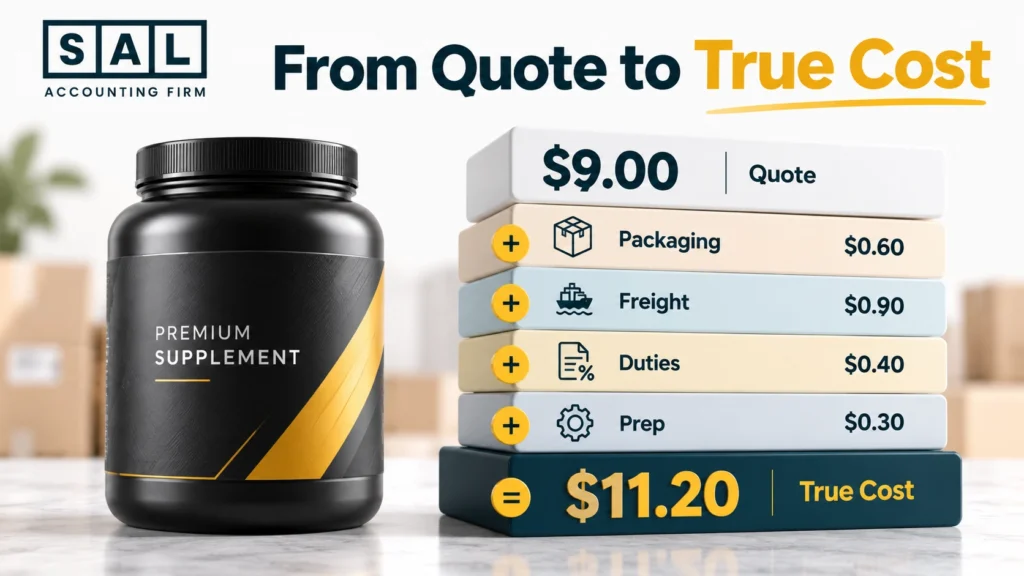
Say your co-packer quotes $9 per tub. You also buy the tubs and labels yourself, pay a carrier to bring the batch to your 3PL, and pay duties on an imported ingredient. Each of those adds to what each tub really costs.
The broader idea applies to any product business, and the basics of landed cost accounting for ecommerce are a useful starting point. What follows is specific to supplement production runs.
What Costs Do You Need Before Calculating Supplement Landed Cost?
You need every invoice tied to one production run, usually from several different suppliers. A single batch can involve:
Ingredient Supplier + Packaging Supplier + Co-Packer + Freight Carrier + Customs Broker
Common inputs include:
- Finished-product purchase cost, if you buy finished goods
- Ingredients you supply to the co-packer
- Product packaging, like tubs, bottles, labels, and scoops
- Co-packer or manufacturing charges
- Inbound freight to your warehouse or 3PL
- Import duties, where they apply
- Required preparation or labelling before sale
- Other directly attributable inbound costs, where appropriate
If you import ingredients or finished goods, CBSA notes that duties and taxes can apply at importation. Duties you can’t recover belong in the cost pool.
Not every cost before a sale belongs here, though. Which costs count as product cost is laid out in this breakdown of COGS for supplement brands. This article picks up once you know which costs qualify.
How Do You Calculate the Landed Cost of a Supplement Production Run?
Add up every qualifying cost for the run first, before dividing by any units. Here’s an illustrative example for one production run.
| Cost | Amount | Source |
|---|---|---|
| Manufacturing | $24,000 | Co-packer invoice |
| Brand-supplied packaging | $3,500 | Packaging supplier |
| Inbound freight | $1,500 | Freight carrier |
| Duty and import costs | $700 | Customs broker |
| Required preparation | $300 | 3PL or co-packer |
| Total landed cost | $30,000 |
The co-packer’s invoice says $24,000. The real cost of the run is $30,000, or 25% more. That total is your cost pool. Only once it’s complete should you allocate it to products and units.
Case Study: How Hannah’s Collagen Brand in Little Portugal, Toronto Finds Its Real Unit Cost1
Hannah runs an online collagen brand from a small office in Little Portugal, Toronto. She sells on Shopify and Amazon. Her co-packer quotes $9 per tub, so that’s the cost she uses for pricing and margin reports. Her gross margin looks healthy at about 70%.
The problem: Hannah buys her own tubs and labels, pays freight to bring each batch to her 3PL, and pays duties on an imported collagen peptide. None of those costs are in her $9 figure. They sit in separate expense accounts, so her product cost looks lower than it really is.
What we do: We pull every invoice tied to her last production run and build one cost pool: manufacturing, packaging, freight, and duties. Then we divide it by the tubs that actually reached her 3PL in saleable condition. Product costing like this is part of the regular work our Shopify accounting services do for supplement brands.
The result: Hannah’s true landed cost is about $11.20 per tub, not $9. Her real gross margin is closer to 63%. She adjusts her Amazon pricing, which was the thinnest, and now updates her landed cost with every new run.
How Do You Calculate Landed Cost per Finished Unit?
Divide the run’s total landed cost by the units you can actually sell, not the units you ordered. Quantities can change along the way:
Ordered → Produced → Received → Saleable
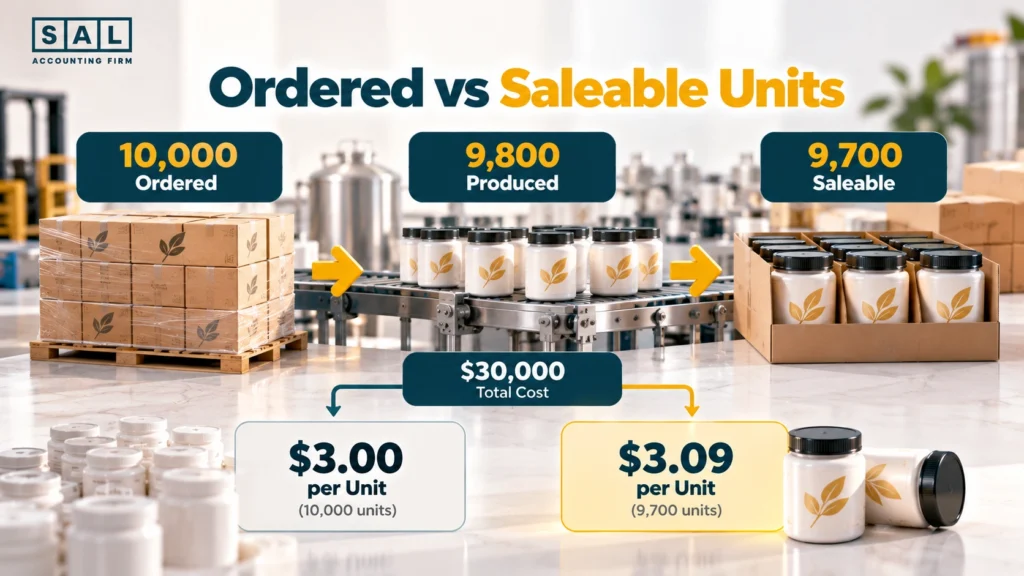
In our example, you ordered 10,000 units. The co-packer produced 9,800, and 9,700 arrived at your 3PL in saleable condition.
- Divided by units ordered: $30,000 ÷ 10,000 = $3.00 per unit
- Divided by saleable units: $30,000 ÷ 9,700 = $3.09 per unit
Differences between those numbers can come from:
- Production loss
- Rejected units
- Samples
- Damaged units
- Units still on quality hold
- Short receipts
How each of those is recorded is a separate question. The key point is that a correct total divided by the wrong quantity still gives you the wrong landed cost. Your quantity should tie back to production and receiving records, which is exactly what you check when you reconcile a co-packer production run.
How Do You Allocate Freight, Duties, and Other Shared Costs Across Multiple SKUs?
Pick a method that matches what caused each cost, then use it consistently. This matters whenever one shipment or production run includes more than one product. Common allocation methods:
- By units: works when products are similar in size and value
- By weight or volume: better when one SKU takes up much more freight space
- By purchase or manufacturing value: can make sense for some shared costs, like value-based fees
- By shipment or batch: use when a cost can be traced directly to one batch or group of products
There’s no single right method for every business. Freight is often driven by weight or space, while some fees are driven by value, so the best method can differ by type of cost.
Pro Tip: Write down which allocation method you use for each type of shared cost. When you or your accountant revisit the numbers months later, you’ll know exactly how each cost was split.
How Do You Calculate Landed Cost for Each Supplement SKU?
Add each product’s direct costs to its share of shared costs, then divide by its saleable units.
The steps follow a set order:
Total Shared Costs → Allocate Between SKUs → Add Direct SKU Costs → Divide by Relevant Units → Landed Cost per SKU Unit
Say one shipment includes two products:
- 2,000 collagen tubs, with $18,000 of direct manufacturing cost
- 4,000 electrolyte pouches, with $8,000 of direct manufacturing cost
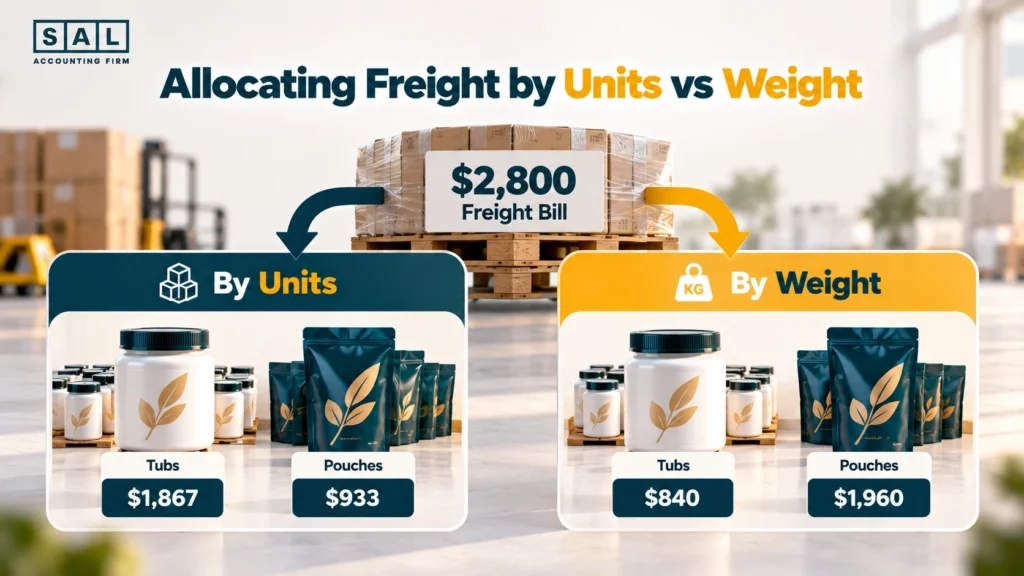
- $2,800 of shared freight and brokerage
The tubs are heavier. Together they weigh about 2,000 kg, while the pouches weigh about 1,000 kg. Here’s how the allocation method changes the result.
| SKU | Direct Cost | Shared Cost by Units | Cost per Unit by Units | Shared Cost by Weight | Cost per Unit by Weight |
|---|---|---|---|---|---|
| Collagen tubs | $18,000 | $933 | $9.47 | $1,867 | $9.93 |
| Electrolyte pouches | $8,000 | $1,867 | $2.47 | $933 | $2.23 |
Splitting by units makes the light pouches carry most of the freight, even though the heavy tubs used most of the space. Splitting by weight fits better here, because weight is what drove the freight bill. Either way, each SKU ends up with its own landed cost, not one blended number.
Case Study: How Dylan’s Supplement Brand in Malton, Mississauga Fixes a Blended Cost2
Dylan sells collagen tubs and electrolyte pouches online from a warehouse unit in Malton, Mississauga. Both products come in on the same shipments. To keep things simple, he adds all the freight together and splits it evenly by units.
The problem: His electrolyte pouches look more expensive than they really are, and his collagen tubs look cheaper. Based on those numbers, he’s about to cut back on pouches, his lighter and more profitable product, and push harder on tubs.
What we do: We review his last three shipments and reallocate freight by weight, since weight is what drives his carrier’s charges. We keep manufacturing cost as a direct cost for each SKU and recalculate landed cost per unit for both products.
The result: The pouches turn out to be cheaper per unit than Dylan thought, and the tubs cost more. He reverses his plan, keeps pouches as a core product, and reviews his tub pricing instead.
Why Can the Same Supplement SKU Have a Different Landed Cost on the Next Production Run?
Because ingredient, packaging, freight, duty, and exchange-rate costs change between batches. Common reasons include:
- Ingredient prices
- Packaging prices
- Production quantity
- Manufacturing rates
- Freight rates
- Duties
- Exchange rates
- Preparation costs
Exchange rates catch many Canadian brands off guard. If your co-packer bills in US dollars, a weaker Canadian dollar raises your landed cost even when the supplier’s price stays the same. The Bank of Canada’s daily exchange rates show how much the rate moved between runs.
So don’t carry an old unit cost forward when a new batch costs more or less. When two batches of the same SKU sit in inventory at different costs, your costing method decides which cost moves to COGS first, which is the heart of FIFO vs weighted average.
How Does Landed Cost Flow Into Inventory and COGS?
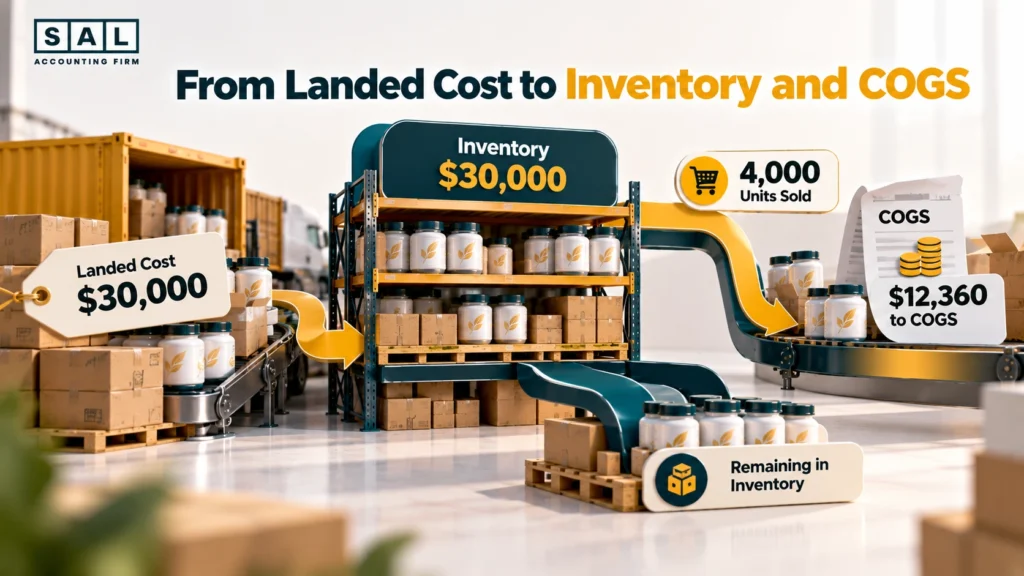
Landed cost becomes your inventory value and moves into COGS only as units sell. Here’s the flow:
Landed Cost → Inventory Value → COGS When the Units Sell
Using our example, you have 9,700 saleable units at a landed cost of $3.09 each. If you sell 4,000 units this month, about $12,360 moves to COGS. The rest stays on your books as inventory until those units sell.
Paying for a production run doesn’t make the whole run that month’s expense. How the unsold inventory is tracked and valued over time sits within supplement inventory accounting.
Why Does Accurate Landed Cost Matter for SKU Profitability and Reorders?
Every margin, price, and reorder decision starts with what a product really costs. A wrong landed cost can distort:
- Gross margin
- SKU comparisons
- Pricing decisions
- Reorder economics
- Production decisions
- Inventory value
If Hannah had kept using $9 instead of $11.20, every margin report and every reorder plan would have looked better than reality.
Landed cost is the starting point. What a product earns after selling costs like fees, fulfillment, and ads is the next step, and that’s where SKU-level profitability for supplement brands comes in. If your margins have already slipped, a rising landed cost is often one of the first things to check when an online supplement profit margin is dropping.
What Are the Most Common Landed-Cost Mistakes in a Supplement Ecommerce Business?
Most mistakes come from missing costs, wrong quantities, or poor allocation. Watch for these ten:
- Using only the co-packer’s quoted unit price
- Leaving separately purchased packaging out of the calculation
- Forgetting inbound freight
- Mixing outbound customer shipping into landed cost
- Missing qualifying import costs
- Splitting every shared cost evenly, without considering what caused it
- Dividing by ordered units instead of actual production and receiving quantities
- Double-counting costs already included in the manufacturer’s invoice
- Using an outdated landed cost after production costs change
- Using one blended landed cost for very different SKUs
Most of these show up the same way: a margin that looks better on paper than it does in the bank.
Read more: “Online Supplement Business Accounting”
Final Thought: Does Your Online Supplement Brand Know What Each Unit Really Costs?
Your manufacturer’s quote is only the start. A true landed cost adds packaging, freight, duties, and preparation, then divides by the units you can actually sell. When products share a shipment, a reasonable, consistent allocation gives each SKU its own cost.
Recalculate it with every production run. Every margin, price, and reorder decision depends on it.
Knowing your true product cost is a strong first step. Map out what comes next with our financial roadmap for online supplement brands.