
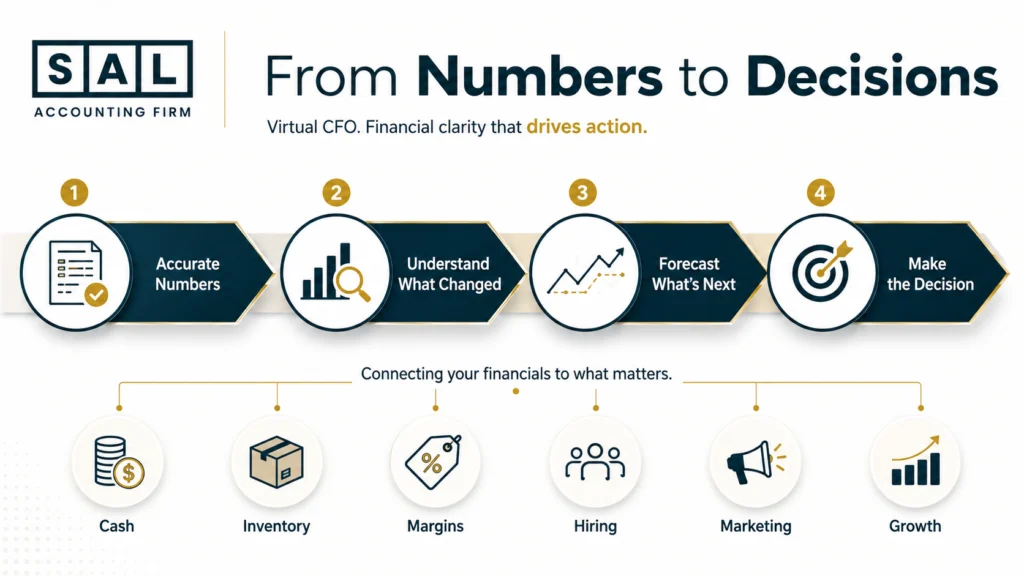
A virtual CFO helps an ecommerce business understand what its numbers mean, forecast what happens next, and make better decisions around cash, inventory, margins, hiring, marketing, and growth.
For growing online brands, that is the gap SAL Accounting focuses on: moving from accurate numbers to better decisions. Keep reading, because the expensive mistakes usually happen before your P&L shows you they were mistakes.
Before you plan what comes next, make sure the right numbers are on hand: use the Tax Document Checklist for eCommerce Stores.
Quick Takeaways
- A virtual CFO turns financial data into forward-looking decisions.
- Cash flow forecasting shows what will actually be available after upcoming commitments.
- Profit analysis explains why margins changed, not simply that they changed.
- Budgeting connects growth plans to inventory, marketing, hiring, tax, and cash.
- Management reporting should show what happened, why it happened, and what needs attention.
- Scenario planning lets you test major decisions before committing real money.
- Reliable bookkeeping comes first. A forecast built on unreliable numbers is still unreliable.
What Does a Virtual CFO Actually Do?
A virtual CFO provides CFO-level financial planning and decision support without necessarily joining your company as a full-time executive. You may also hear terms such as fractional CFO or outsourced CFO. The arrangement can differ, but the real question is what that person actually does for the business.
For an ecommerce founder, the work starts where ordinary financial reporting often stops. Your P&L says profit fell, but why? Your bank says you have $180,000, but how much is really available? Amazon is growing faster than Shopify, but does that mean Amazon deserves the next marketing dollar?
A virtual CFO takes reliable financial information and uses it to answer those questions before you commit more cash.
1. Cash Flow Forecasting
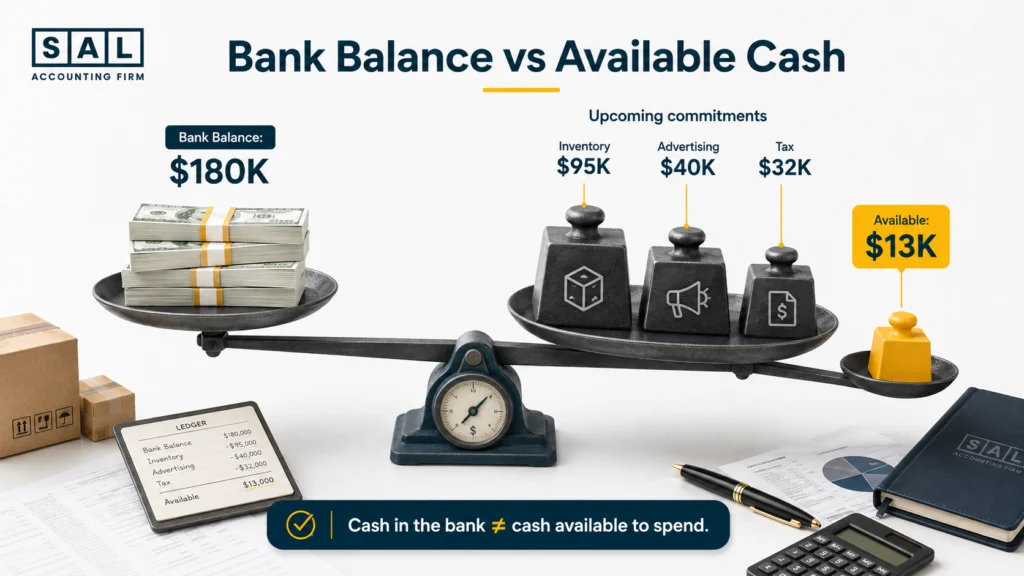
Your bank balance tells you how much cash is sitting there today, but it does not tell you what will still be there six weeks from now. That matters a lot in ecommerce because inventory, supplier payments, payroll, advertising, tax, and platform payouts rarely happen at the same time.
A store can look cash-rich today while most of that money is already committed. This timing problem is behind many of the cash flow traps ecommerce brands run into as they grow. Take a simple example:
You have $180,000 in the bank. Over the next six weeks, $95,000 of inventory is due, advertising will use another $40,000, and $32,000 is set aside for tax. Before payroll, software, fulfilment, or anything unexpected, that comfortable-looking $180,000 is already down to $13,000.
Nothing necessarily went wrong. The bank balance simply did not show the commitments sitting behind it.
Inventory makes this even easier to misread. Cash leaves when stock is purchased, while the cost may reach your P&L later as those products are sold. That is one reason understanding when ecommerce inventory should be capitalized or expensed matters when you are trying to understand the difference between profit and cash.
Payout timing adds another layer. Shopify explains that the timing of Shopify Payments payouts depends on factors such as the country, payout schedule, processing, and banking time. A sale showing inside Shopify today does not automatically mean that cash is available in your bank today. A virtual CFO brings those moving pieces together into one forecast, including:
- Expected Shopify, Amazon, and processor payouts
- Inventory deposits and supplier balances
- Payroll
- Advertising
- Fulfilment
- Debt payments
- GST/HST and other tax payments
- Fixed operating expenses
- Planned hires or investments
The point is to catch the gap while you still have choices. The warning signs of a Shopify cash flow problem are much more useful before the bank account becomes the warning sign itself.
GST/HST should sit inside that forecast as well. The CRA’s guidance on remitting GST/HST makes the basic point clear: tax collected from customers is not simply extra cash available to spend.
Want a quick estimate before the next forecast review? Run the GST/HST Refund Calculator.
Pro tip: Separate the cash you can actually use from cash already spoken for by inventory, payroll, tax, debt, and other known commitments. One bank balance should not answer both questions.
2. Profit and Margin Analysis
A virtual CFO should not simply tell you that profit was down 4% this month. The useful part is explaining why it fell and what changed underneath the headline number.
For an ecommerce business, that normally means looking at several layers of profitability together. Ecommerce contribution margin tells you more than gross margin alone because it brings in the variable costs required to generate the sale, while SKU profitability analysis shows whether the products generating the most revenue are actually the products leaving the most money behind.
Product cost also has to be right before either calculation means much. Freight, duties, brokerage, and other relevant inbound costs can change the true landed cost of ecommerce inventory, especially when products are sourced internationally.
Let’s say a product sells for $100. After product cost, you have $54 left. Looks good. Now take out:
- $4 in payment fees
- $11 in fulfilment and shipping
- $6 in average refunds and discounts
- $20 in customer acquisition cost
Now you have $13 left before fixed overhead.
That tells you something very different from saying, “This product has a 54% gross margin.”
Marketplace and platform costs can push that number around quickly. Amazon’s official seller pricing includes referral fees and other possible selling and fulfilment charges, while Shopify costs can vary with your plan, payment setup, apps, and transaction structure.
That is why a growing store should understand how Shopify fees affect ecommerce profit margins instead of judging profitability from the amount deposited into the bank.
Want to see how platform costs change the order economics? Run the Shopify Fee Calculator.
Once the numbers are separated properly, the CFO can work on the decision behind them. Maybe the price needs to change. Maybe one SKU needs different fulfilment. Maybe acquisition works for one product but not another. Maybe your bestseller deserves less inventory because another product produces much stronger contribution.
A proper ecommerce product profitability test makes those decisions much easier than ranking products by revenue alone.
Pro tip: When margin falls, do not start by cutting random expenses. First isolate whether the change came from product cost, fulfilment, discounts, returns, platform fees, or advertising. Fix the thing that actually moved.

3. Forecasting and Budgeting
A useful budget should change as the business changes. A virtual CFO compares actual results against forecasts for revenue, inventory, marketing, hiring, tax, and cash, then updates the plan as new information comes in.
For example, 25% revenue growth may also mean more inventory, higher ad spend, larger supplier payments, and possibly another hire.
This is the side of scaling an ecommerce brand that revenue projections alone cannot answer. Growth may eventually produce more cash, but you often have to fund the growth before that cash arrives.
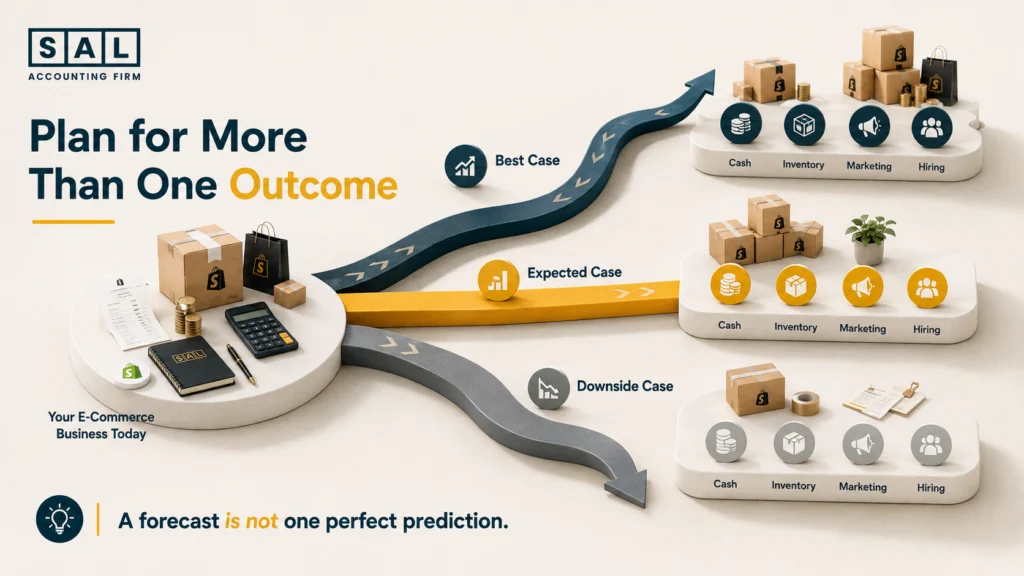
A good virtual CFO also should not pretend there is only one possible future. The forecast might look at:
- Best case: Sales outperform plan and margins hold.
- Expected case: Revenue and costs follow current assumptions.
- Downside case: Revenue slows, advertising stays expensive, and the inventory order still has to be paid.
Now you can see what each scenario does to cash and decide what you would change if the downside case starts happening.
Corporate income tax can also become part of that planning for incorporated Canadian businesses. The CRA’s information on corporation instalment payments is a useful reminder that tax can require cash during the year, not only when the annual return is filed.
Want a number to put into the first version of the forecast? Estimate corporate income tax.
The point is not to predict the future perfectly. It is to see the range of possible outcomes early enough to do something about them.
4. Management Reporting
Management reporting should make running the business easier. A founder does not need another dashboard full of numbers nobody discusses; they need a small group of reports that answer actual business questions.
For ecommerce brands that have moved beyond basic monthly statements, ecommerce financial reporting needs to connect profit, inventory, cash, sales channels, and operating performance instead of treating each one separately.
Here is what the core reports should tell you:
| Report | What It Shows | Founder Question | CFO Focus |
|---|---|---|---|
| P&L | Revenue, COGS, expenses, profit | Why did profit change? | Margin and cost movement |
| Balance Sheet | Cash, inventory, debt, liabilities | Where is money tied up? | Working capital |
| Cash Forecast | Expected cash in and out | What can we afford? | Timing and funding gaps |
| Forecast vs Actual | Plan compared with results | Where did we miss? | Variances and actions |
| Inventory Report | Stock value and movement | Are we carrying too much? | Reorders and slow stock |
| Channel Report | Shopify, Amazon, wholesale | Which channel performs best? | Contribution by channel |
| KPI Report | Important operating metrics | What needs attention now? | Decision-driving trends |
The reports are useful because of the relationships between them. Profit can rise while cash falls because more money is tied up in inventory. Revenue can increase while contribution gets worse because acquisition or fulfilment became more expensive.
Amazon can also be growing faster than Shopify while Shopify is still producing the better financial return. Good ecommerce management reporting should make those differences visible before the founder decides where to put the next dollar.
Want a cleaner view of operating performance? Run the Ecommerce EBITDA Calculator.
What Decisions Does a Virtual CFO Help an Ecommerce Founder Make?
This is probably the easiest way to understand the role: a virtual CFO puts numbers behind decisions that would otherwise be made mostly from instinct.
A founder may already know they want to hire, increase advertising, order more inventory, enter the U.S., or raise financing. CFO work helps answer whether the business can afford that decision, what needs to go right for it to work, and what happens if the plan underperforms. Common questions include:
- Can we afford another $150,000 inventory order?
- Should we increase Meta or Google ad spend next month?
- Is it time to hire another employee?
- Which channel is producing the strongest contribution?
- How much cash should stay untouched?
- Can we afford to enter the U.S.?
- What happens if supplier prices increase?
- Is growth improving profit or just increasing working-capital pressure?
- Should we borrow now or wait?
- How much inventory can we safely commit to for Q4?
Can We Increase Advertising Spend?
A campaign is performing, so increasing the budget can feel like an obvious next move. But Meta, Shopify, and attribution tools may all report performance differently, which is why it helps to understand why Meta Ads, Shopify, and Triple Whale numbers may not match before scaling spend.
A virtual CFO looks at what happens financially when the budget increases, including:
- CAC and contribution margin
- Cash required to fund the growth
- Customer payback and repeat purchases
The better question is not just, “Can we get more sales?” It is, “How much profitable growth can our cash actually support?”
Can We Afford to Expand Into the U.S.?
U.S. expansion affects more than revenue. Currency, inventory, shipping, duties, payment timing, sales tax, and entity structure can all change at once, so the financial model needs to reflect the real cost of entering the market.
For a Canadian ecommerce brand, the main areas to model are:
- Inventory and cross-border shipping costs
- U.S. sales tax exposure
- Currency and payout timing
- Entity and operating costs
The economics of importing and exporting in ecommerce may look very different from selling only in Canada. U.S. economic nexus rules also vary by state, so there is no single nationwide sales threshold to monitor.
See where your sales may be approaching a threshold: run the US Economic Nexus Threshold Checker. Entity structure is a separate decision. A U.S. LLC is not automatically the right next step for every Canadian seller.
Still weighing the structure? Use the Shopify US LLC decision tool.
The virtual CFO models the financial impact. Tax and legal specialists handle the parts that require specific Canadian or U.S. advice.
When Should We Raise Financing?
Financing becomes easier to evaluate when you know exactly what the money needs to fund and how long it needs to last. A virtual CFO can model the cash requirement before you take on debt or approach an investor.
For an ecommerce business, that usually means looking at:
- How much financing is actually needed
- What inventory or growth it will fund
- When repayment begins
- What happens if sales miss the forecast
A business borrowing $300,000 to fund profitable inventory growth is in a very different position from one borrowing $300,000 to cover continuing operating losses.
The same financial discipline becomes useful before an exit. Preparing a Shopify business for sale often exposes issues with inventory, margins, tax, or reporting that were easier to overlook while the company was simply growing.
Pro tip: Model the decision before debating the decision. An inventory order, new hire, or major advertising increase often looks very different after you see its 6- or 12-month cash effect.
Case Study: How a Leslieville Shopify Brand Spots the Cash Gap Before Reordering1
A growing Shopify brand in Leslieville, Toronto is profitable on the P&L and sales continue to rise. The founder is preparing another large production run and assumes the cash currently in the bank is enough, but inventory deposits, advertising, payroll, tax, and supplier bills all fall due before most of the new stock will be sold.
The Problem
The founder is using today’s bank balance to decide whether the next inventory order is affordable. The numbers do not show how much of that cash is already committed over the next eight weeks.
What We Do
We build a rolling cash forecast around expected Shopify payouts, supplier deposits, final inventory payments, payroll, marketing, tax, and regular operating costs. Then we model the new purchase order inside that forecast before the business commits.
Result
The funding gap becomes visible before the order is placed. The founder can adjust the order, negotiate supplier timing, reduce another expense, or arrange financing while there is still time to choose.
Virtual CFO vs Bookkeeper vs Accountant: What Is the Difference?
Bookkeepers, accountants, CPAs, and virtual CFOs often work closely together, but they are not the same role. The easiest way to separate them is by the main question each one is trying to answer.
| Role | Main Focus | Typical Work | Time Horizon | Main Question |
|---|---|---|---|---|
| Bookkeeper | Accurate records | Transactions, reconciliations, close | Past | Are the books accurate? |
| Accountant / CPA | Reporting and tax | Statements, tax, accounting treatment | Past + present | Is this reported correctly? |
| Virtual CFO | Planning and decisions | Forecasting, modelling, strategy | Present + future | What should we do next? |
A bookkeeper creates the financial foundation. An accountant or CPA deals with reporting, tax, accounting treatment, and other work within their scope, while a virtual CFO uses reliable financial information to make forward-looking decisions.
The important part is that one layer cannot compensate for a broken one underneath it. Poor ecommerce bookkeeping does more than make the transaction list messy; it can distort margins, inventory, tax estimates, management reports, and the forecast built on top of them.
Before CFO work becomes useful, you should be able to answer a few basic questions confidently:
- Do Shopify sales reconcile?
- Do Amazon settlements reconcile?
- Are fees and refunds separated?
- Does the inventory balance make sense?
- Are bank and credit card accounts reconciled?
- Can we trust the P&L and balance sheet?
When the underlying problem is still inaccurate reconciliations or unreliable monthly books, it makes more sense to fix that layer first. See SAL’s ecommerce bookkeeping services for the recurring accounting work that needs to be in place before forecasting becomes useful.
When Does an Ecommerce Business Need a Virtual CFO?
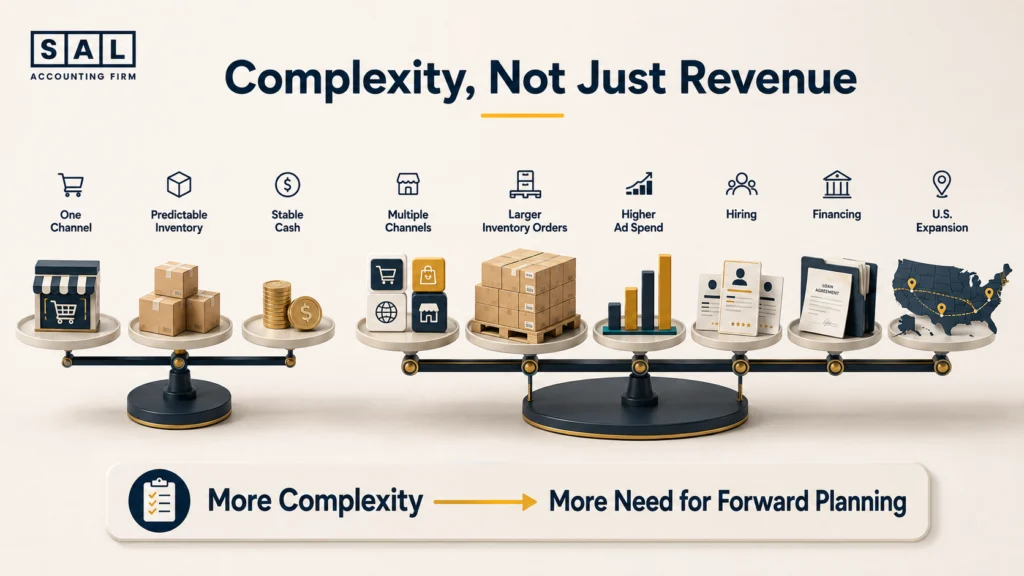
There is no magic revenue number where every ecommerce business suddenly needs a virtual CFO. Complexity is usually the better trigger.
A $4 million store with one predictable sales channel, stable margins, and a simple inventory cycle may have fewer CFO-level decisions than a smaller company selling through Shopify, Amazon, wholesale, several currencies, and two countries. Revenue matters, but it does not tell you how difficult the financial decisions have become.
You may be reaching the point where virtual CFO support becomes useful when:
- Cash is becoming difficult to predict.
- Inventory commitments are getting larger.
- Revenue is growing but profit remains unclear.
- You sell through several channels.
- Advertising decisions involve meaningful amounts of cash.
- Hiring is accelerating.
- You need projections for a lender or investor.
- You are entering the U.S.
- You are considering debt or outside financing.
- Major decisions regularly get made without knowing the cash effect first.
A useful distinction is this: when the problem is “I don’t trust my numbers,” the accounting or bookkeeping layer usually needs attention first. When the problem becomes “I trust the numbers, but I still don’t know what decision to make,” CFO support starts to make much more sense.
Sometimes both problems exist at the same time. That is why a clear ecommerce bookkeeping engagement letter should spell out who owns recurring bookkeeping, reconciliations, reporting, tax work, and advisory work rather than hiding everything behind “accounting included.”
Case Study: How a Port Credit Brand Finds Which Channel Deserves the Next Marketing Dollar2
A multichannel ecommerce brand in Port Credit, Mississauga is growing through Shopify and Amazon. Amazon sales are climbing faster, so the founder assumes that channel should receive more inventory and advertising budget, but the financial reporting blends both channels together.
The Problem
Total revenue and net profit are visible, but the founder cannot see what Shopify and Amazon each leave behind after product cost, marketplace fees, fulfilment, returns, discounts, and advertising.
What We Do
We separate the channel economics, build contribution-margin reporting, compare inventory requirements, and model what happens when additional marketing and stock are allocated to either channel.
Result
The founder can decide where to invest based on contribution and cash impact instead of top-line sales alone. The question changes from “Which channel is bigger?” to “Which channel gives us the better result when we put another dollar into it?”
What Should You Expect From a Virtual CFO Each Month?
A virtual CFO relationship should have a recurring rhythm. Otherwise, it can easily become an expensive monthly meeting where everyone looks at last month’s dashboard and very little changes afterward.
For an ecommerce business, a useful monthly process normally moves from accurate books to analysis, then forecasting, then decisions:
- The books close.
Shopify, Amazon, bank accounts, fees, refunds, inventory, payroll, and other important activity are brought up to date. - Results are reviewed.
Revenue, gross margin, contribution, operating expenses, inventory, and cash are compared with the plan and previous periods. - The forecast is updated.
Actual results replace old assumptions, and the next few months are recalculated. - Variances are explained.
A missed sales target, higher CAC, falling margin, increased fulfilment cost, or unexpected inventory build gets traced back to its cause. - Cash and inventory requirements are reviewed.
Upcoming supplier orders, payroll, tax, advertising, and other commitments are checked against expected cash. - Major decisions are modelled.
Hiring, inventory, advertising, financing, new channels, pricing changes, or U.S. expansion are tested financially before the money is committed. - Next actions are agreed.
The meeting finishes with a short list of decisions, owners, and actions rather than another pile of reports.
The process works much better when financial reporting is already consistent. A Canadian Shopify profit framework can show where the operating numbers deserve attention, while the CFO layer works out what should happen next.
Pro tip: Ask yourself what changes after the CFO meeting. If the answer is always “we reviewed the dashboard,” something is missing. A good meeting should regularly produce a decision, action, updated assumption, or issue to investigate.
What Does a Virtual CFO Usually Not Do?
A virtual CFO may oversee bookkeeping, but that does not necessarily mean they personally categorize transactions or reconcile every bank account. They may forecast a tax payment without preparing every tax return, and they may model hiring costs without processing payroll.
The same distinction applies to cross-border growth. A virtual CFO can model the financial impact of entering the U.S., but that does not automatically make every U.S. legal, entity, and tax issue part of the CFO engagement.
Basically, the scope needs to be clear. Ecommerce bookkeeping, inventory accounting, tax, payroll, reporting, and advisory work sit close enough together that vague scope can create confusion quickly.