
Your company P&L can look healthy while one sales channel quietly carries the others. A channel-level P&L splits revenue, product cost, and selling costs by where each sale happened, so you can see what Shopify, Amazon, and wholesale each contribute before shared overhead.
At SAL Accounting, it’s a core monthly report for multichannel supplement brands. Here’s how to set one up, read it, and keep it tied to your books.
Once you know what each channel contributes, see how it rolls up to operating profit with the Ecommerce EBITDA Calculator.
Quick Takeaways
- A channel-level P&L shows revenue, gross profit, and contribution for each sales channel.
- Start from net sales by channel, never from payouts.
- Use the same product cost for the same SKU on every channel.
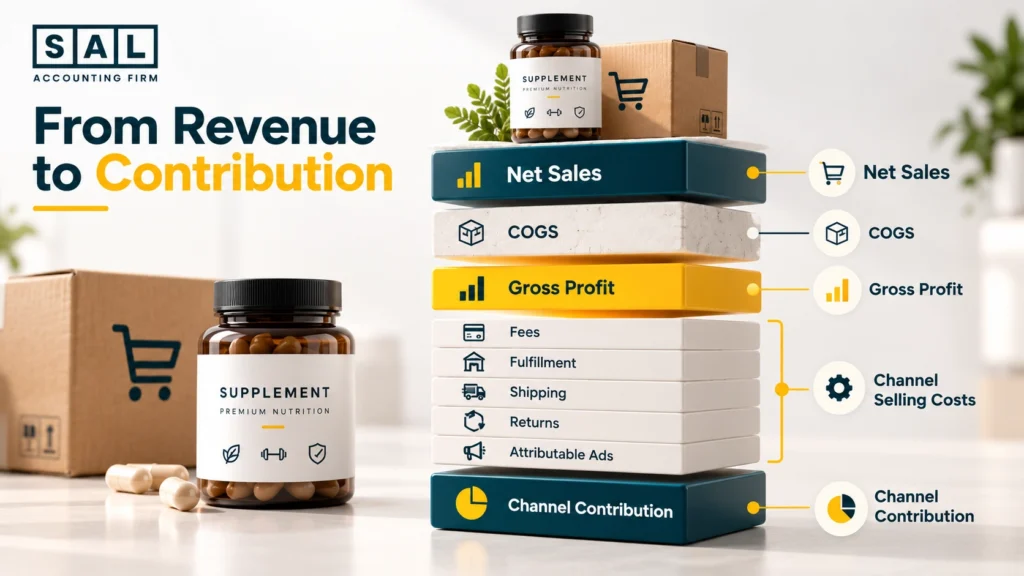
- Subtract each channel’s own fees, fulfillment, shipping, returns, and attributable ads to get channel contribution.
- Keep shared overhead at company level unless you have a defensible way to allocate it.
- Channel totals should always tie back to your company books.
- The channel with the most revenue isn’t always the one that contributes the most.
Want a channel report you can trust every month? Our ecommerce bookkeeping team keeps every channel’s sales and costs separate, so your channel P&L is ready when you need it.
What Is a Channel-Level P&L for an Online Supplement Brand?
A channel-level P&L is a profitability report that shows each sales channel’s revenue, gross profit, and contribution separately.
A channel is the route through which a sale happens, such as:
- Shopify or your direct online store
- Amazon or another marketplace
- Wholesale
The report follows a simple path:
Revenue → Gross Profit → Channel Contribution
Its purpose is to show what each channel contributes before shared overhead like salaries, rent, and accounting. Large public companies use the same idea in segment reporting. Under IFRS 8, a segment is a part of the business whose results management regularly reviews to decide where resources go. A channel P&L brings that thinking down to the size of a supplement brand.
It also depends on clean records. Keeping every channel identifiable in your books is the job of multichannel accounting for supplement brands. This report turns those records into a profitability view.
What Can a Channel-Level P&L Tell an Ecommerce Supplement Brand?
It tells you where your money is actually made, not just where your sales come from.
A good channel P&L answers:
- Which channels bring in the most revenue?
- Which produce the most gross profit?
- Which spend the most on fees and fulfillment?
- Which need the most advertising?
- Which produce the most contribution dollars?
- Are channel results improving or slipping over time?
The point is management visibility. It sits alongside your other monthly financial reports for supplement businesses, but it answers a question the company P&L can’t.
Read more: “Ecommerce Management Reporting”
How Do You Define Sales Channels for an Ecommerce Channel P&L?
Define a fixed set of channels based on where sales happen, and keep them the same every month. Common channel definitions for a supplement brand:
- Direct ecommerce, such as your Shopify store
- Amazon
- Wholesale
- Any other marketplace big enough to matter
Two rules keep the report useful:
- Don’t change definitions month to month. If a channel moves categories, past and present months stop being comparable.
- A channel isn’t a payment processor. Shopify orders paid through Shopify Payments, PayPal, and other providers all belong to the same direct ecommerce channel.
Pro Tip: Write your channel definitions down, including where small channels like pop-ups or second marketplaces go. A one-page definition saves months of messy comparisons.
What Revenue Should You Use in an Ecommerce Channel P&L?
Use each channel’s net sales, built from its sales records, never its bank deposits.
Net channel sales usually reflect:
- Gross sales through that channel
- Minus discounts
- Minus refunds and returns, where your reporting presentation includes them here
Don’t use Amazon or Shopify payouts as revenue. A payout has already had fees, refunds, reserves, and other adjustments taken out, so it hides the costs this report is meant to show. Sales tax collected from customers also stays out, since it belongs to the government. The gap between sales and deposits is a separate job, handled through revenue vs payout reconciliation.
If a channel sells in US dollars, like Amazon.com, convert its results to Canadian dollars with a consistent rate, such as the Bank of Canada’s daily exchange rate, so every channel is measured in the same currency.
How Do You Assign COGS by Sales Channel for Supplement Products?
Assign each channel the product cost of the units it sold, using the same cost for the same SKU everywhere.
The calculation is simple:
Channel Net Sales − COGS of Products Sold Through That Channel = Channel Gross Profit
A tub of collagen doesn’t cost more to make because it sells on Amazon. Unless there’s a real reason the product cost differs, the same physical SKU should carry the same supported cost on every channel. BDC describes cost of goods sold as the cost of the products sold during the period, which keeps it separate from the costs of selling them.
That supported cost starts with getting the landed cost for an online supplement business right. Your channel P&L simply applies it.
Which Channel Fees Belong in an Ecommerce Channel P&L?
Include the fees that exist only because the sale happened through that particular channel. Typical channel fees:
- Marketplace: referral or selling fees and other marketplace selling charges
- Direct ecommerce: payment processing fees and other directly attributable transaction fees
- Wholesale: any distributor or platform fees tied to those sales
Amazon’s fees aren’t one flat rate. Its selling fees depend on your selling plan, product category, and fulfillment method, so pull the actual fees from your reports instead of estimating.
The key is consistency. If a type of cost counts as a channel cost for Amazon, the comparable cost on Shopify should count too. To see what each direct order loses to fees, the Shopify Fee Calculator gives a quick estimate.
How Do Fulfillment and Shipping Costs Affect Ecommerce Channel Profitability?
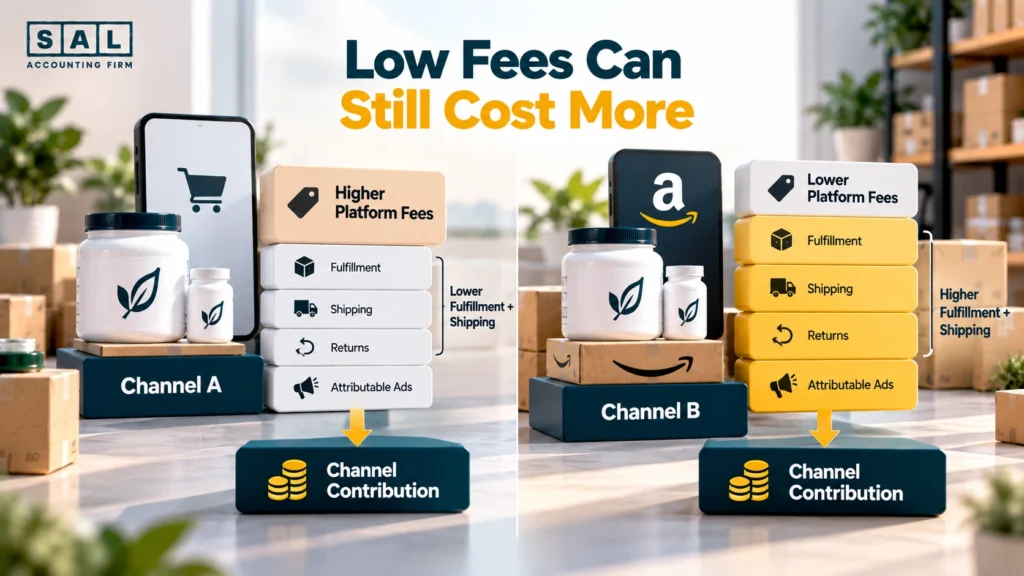
Fulfillment and shipping can change which channel contributes most, so count them separately from product cost.
Channel fulfillment costs can include:
- Pick-and-pack charges
- Marketplace fulfillment fees
- Outbound shipping
- Shipping subsidies, when customers pay less than shipping costs you
- Other directly attributable fulfillment costs
A channel with low platform fees can still contribute less if its fulfillment and shipping costs are high. A direct store offering free shipping, for example, can give back much of what it saved by avoiding marketplace fees. If shipping is eating a channel’s contribution, comparing ecommerce shipping providers is often a quick place to start.
- Also read: “Amazon FBA Accounting Best Practices”
How Do Returns and Refunds Affect Profitability by Sales Channel?
Returns reduce the profitability of the channel where the original sale happened, so keep them there.
Depending on how you present the report, a return can show up as:
- Lower net revenue
- Return processing or fulfillment costs
- Product loss, when returned items can’t be resold
Supplements make that last point matter. Once a sealed product comes back, it often can’t go back on the shelf.
The goal is simple: don’t let one channel’s return burden disappear into company-wide totals. Return rates often differ by channel, and a clear refund policy shapes how many come back through your own store.
How Should Advertising Be Allocated by Ecommerce Sales Channel?
Allocate advertising to a channel only when it clearly drove that channel’s sales.
Clear examples:
- Amazon Ads go to Amazon
- Campaigns that send traffic only to your store go to direct ecommerce
Brand-wide spending is different. A podcast sponsorship or a trade show might lift sales on every channel. Don’t push that kind of spend into one channel just because it’s hard to split. Keep it at company level, or allocate it only with a method you can explain. Check the attributed numbers before you use them, too, because ad platforms and stores often disagree, which is why Meta, Shopify, and Triple Whale numbers rarely match.
Showing contribution both before and after channel advertising often helps, because it separates a channel’s underlying economics from what it costs to drive traffic there. That two-view approach is how a single SKU gets compared in Amazon vs Shopify for an online supplement brand. Here, the same idea applies to the whole channel.
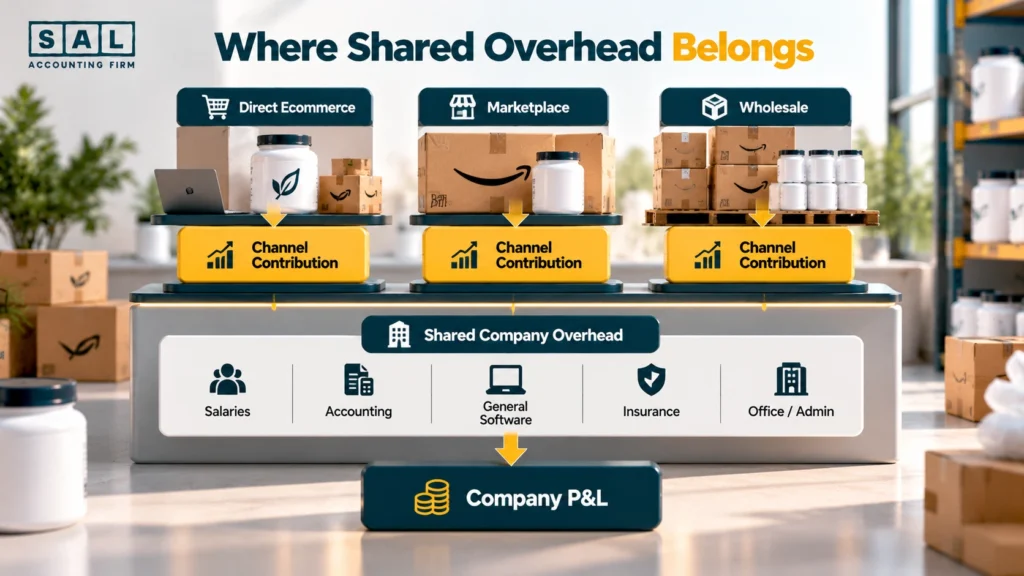
Should Shared Overhead Be Allocated to Each Ecommerce Channel?
Usually not, unless you have a defensible method for splitting it. Shared overhead includes costs like:
- Accounting and professional fees
- General management salaries
- General software
- Insurance
- Office and admin costs
These don’t change based on which channel made a sale. Splitting them by revenue or order count can produce a “channel net profit” that looks precise but means very little. A channel can suddenly look unprofitable just because it absorbed a share of salaries it didn’t cause.
If you don’t have a sound allocation method, stop the channel report at channel contribution and keep shared overhead on the company P&L. A channel can contribute strongly to the business without having its own fully loaded net income figure. Shared costs that go unnoticed are a common problem, and the most frequent ones are laid out in hidden ecommerce expenses that eat into profit margins.
Case Study: How Grace’s Supplement Brand in Cabbagetown, Toronto Almost Cut Its Best Channel1
Grace runs a multichannel supplement brand from a small office in Cabbagetown, Toronto. She sells through Shopify, Amazon, and a growing wholesale program with local health stores. Her old reports split every cost by revenue, including salaries, software, and rent.
The problem: Wholesale is her smallest channel by revenue, but those reports put a large share of overhead on it. After allocation, wholesale showed a loss most months, and Grace was planning to wind it down.
What we do: We rebuild her channel report to stop at channel contribution. Product cost, channel fees, fulfillment, and wholesale allowances stay with each channel, and shared overhead stays at company level.
The result: Wholesale turns out to have the highest contribution margin of her three channels, because it carries no ad spend and very little fulfillment cost. Grace keeps the program and starts pitching it to more stores.
What Is the Difference Between Channel Gross Profit, Contribution Margin, and Net Profit?
Channel gross profit subtracts product cost, contribution margin subtracts selling costs too, and net profit only exists at company level.
| Measure | Calculation | What It Tells You |
|---|---|---|
| Channel gross profit | Net sales − COGS | How much the products sold through a channel earn |
| Channel contribution | Gross profit − direct channel selling costs | What the channel leaves to cover shared costs |
| Contribution margin | Channel contribution ÷ net sales | Contribution as a percentage of the channel’s sales |
| Company net profit | All revenue − all expenses | What the whole business earns |
Don’t use “channel net profit” casually when shared overhead hasn’t been allocated. Channel contribution is the honest measure at channel level, and the basics of ecommerce contribution margin explain why it’s such a useful middle point.
Read more: “Negative Contribution Margin in Ecommerce”
What Does a Channel-Level P&L Look Like for an Online Supplement Brand?
It lines up each channel side by side, from net sales down to contribution, with a company total.
Here’s an illustrative month for a supplement brand with three channels. The numbers are made up to show the format.
| Line | Direct Ecommerce | Marketplace | Wholesale | Total |
|---|---|---|---|---|
| Net sales | $120,000 | $150,000 | $80,000 | $350,000 |
| COGS | $36,000 | $45,000 | $28,000 | $109,000 |
| Gross profit | $84,000 | $105,000 | $52,000 | $241,000 |
| Gross margin | 70% | 70% | 65% | 69% |
| Direct selling costs | $54,000 | $75,000 | $20,000 | $149,000 |
| Channel contribution | $30,000 | $30,000 | $32,000 | $92,000 |
| Contribution margin | 25% | 20% | 40% | 26% |
The marketplace brings in the most revenue, but wholesale produces the most contribution. Wholesale has the lowest gross margin of the three, yet it keeps the most after selling costs.
That’s the main lesson. The highest-revenue channel isn’t automatically the biggest contributor, and the highest gross margin isn’t either. Neither result makes one channel the “best.” Each one plays a different role.
How Do You Reconcile a Channel P&L to Your Company P&L?
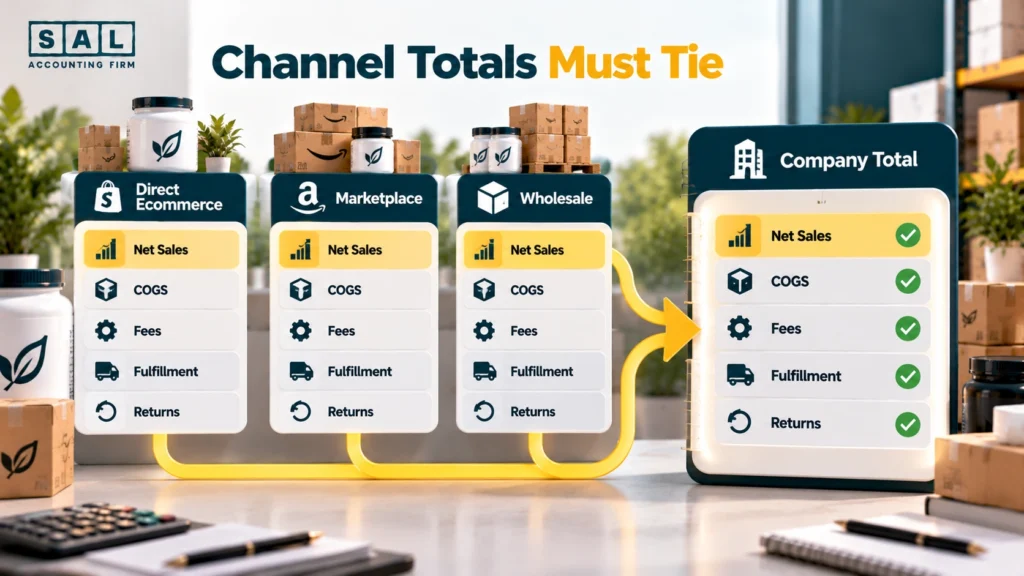
Add up every channel line, and each total should match the same figure in your company books.
For example:
Direct Ecommerce Net Sales + Marketplace Net Sales + Wholesale Net Sales = Company Net Sales
The same check applies to COGS, fees, fulfillment, and returns. Each channel total should tie back to the company figure or to a supported schedule.
This is an important control. A channel P&L is a management view built from your books, not a second set of books. If the channel totals don’t tie out, something is missing, double-counted, or sitting in the wrong channel. Keep the reports and the records behind them, too. CRA expects businesses to keep adequate records that support what’s in their books.
Case Study: How Devin’s Supplement Brand in Mississauga Finds a Double-Counted Fee2
Devin sells protein and electrolytes online from a warehouse unit near Hurontario Street in Mississauga. Most of his growth comes from Amazon. His channel report shows Amazon contribution falling for three months straight, even though Amazon sales keep climbing.
The problem: When we add up his channel totals, Amazon’s selling costs come out higher than the fees recorded in his company books. His report pulled Amazon fulfillment fees once inside a “fees” line and again inside “fulfillment,” so they were counted twice.
What we do: We reconcile each channel’s lines back to his company P&L and fix the mapping, so each Amazon fee type appears in exactly one row. Tying channel reports to the books every month is part of the work our Amazon bookkeeping team does for him.
The result: Amazon’s contribution was never falling. Devin’s real Amazon contribution is steady, and he puts more inventory behind the channel with confidence.
Is Channel Mix or Product Mix Driving Your Ecommerce Channel Results?
Often it’s product mix, because a channel’s results reflect what it sells as much as where it sells.
A channel can look stronger simply because it sells:
- A higher-margin SKU mix
- Larger bundles
- Different subscription offers
- A higher average order value
So a channel-level P&L answers one question: what did this whole channel contribute?
It doesn’t answer a different one: would the same product be more profitable on another channel? That takes a SKU-by-channel comparison, and which products drive the most contribution is the job of SKU-level profitability for supplement brands.
What Should You Review in a Monthly Ecommerce Channel P&L?
Review how each channel’s sales, costs, and contribution moved from last month, not just where they landed.
Compare each month against the last, for every channel:
- Net sales
- Gross profit and gross margin
- Channel fees
- Fulfillment and shipping
- Returns
- Advertising
- Contribution dollars and contribution margin
Then look for warning signs:
- Costs rising faster than sales
- Contribution falling while revenue grows
- A rising return burden
- Shifts in channel mix
- Profitability moving in the opposite direction from revenue
These numbers are only as reliable as the books underneath, which is why the report should come after a dependable month-end close for supplement brands. When a channel’s results do slip, the same diagnosis that explains why an online supplement profit margin is dropping works at channel level too.
How Do You Use a Channel P&L to Decide Where an Online Supplement Brand Should Grow?
Use contribution dollars, not revenue or margin percentage alone, to decide where to invest next.
A channel P&L helps you decide:
- Where to increase marketing
- Which channel’s fulfillment costs need attention
- Whether more revenue on a channel is producing more contribution
- Which channel deserves more inventory
- Where pricing or offers need a second look
But don’t automatically cut the channel with the lowest margin. A channel with a lower margin can still bring in the most contribution dollars. It can also reach customers your other channels can’t, or have more room to grow. Contribution dollars, strategic role, growth potential, and product mix all matter.
Before you put more money behind a channel, check whether each new customer it brings in pays back what they cost, which is where online supplement unit economics comes in.
Read more: “Working Capital for an Online Supplement Business”
Final Thought: Which Sales Channel Really Drives Your Online Supplement Brand’s Profit?
A channel-level P&L shows what your company P&L can’t: how much each channel really contributes. Start from net sales, apply the same product cost everywhere, subtract each channel’s own selling costs, and stop at contribution unless you can allocate overhead fairly. Then tie every total back to your books.
Review it monthly, and let contribution, not revenue, guide where you grow. When you’re ready to plan that growth, start with our free growth roadmap.