
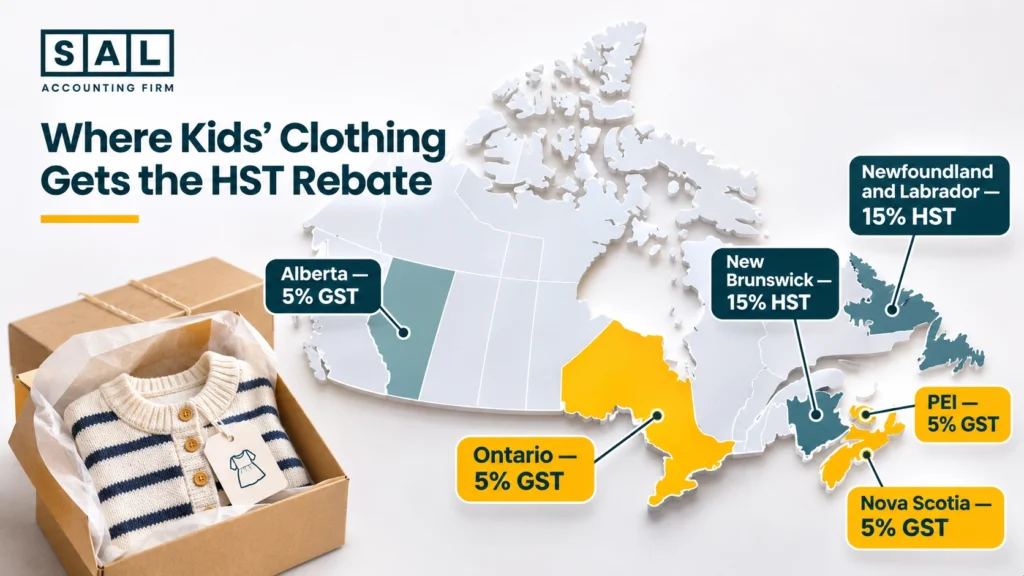
If you charge the same HST on every item, some of your customers are probably paying too much. In Ontario, Nova Scotia, and PEI, qualifying children’s clothing usually carries only the 5% GST at checkout. Charge tax based on where the order is delivered, then apply the children’s clothing rebate wherever it qualifies.
SAL Accounting sets this up for clothing brands. Scroll through the examples below before your next order ships, because one size can change the tax.
To see how much GST/HST you can claim back on inventory and business costs, try the GST/HST Refund Calculator.
Quick Takeaways
- You charge GST or HST based on the province where the order is delivered.
- In Ontario, Nova Scotia, and PEI, qualifying children’s clothing and footwear usually carry only the 5% GST.
- New Brunswick and Newfoundland and Labrador charge full HST on children’s clothing.
- What qualifies depends on the size and design of the item, not on who buys it.
- The rebate also applies when you sell kids’ clothing wholesale to retailers.
- Report the tax you actually collected, item by item.
Getting tax right on every size starts with clean records. With bookkeeping services for clothing brands, your GST/HST is tracked by item and province, so your returns match what you actually charged.
How Does GST/HST Work for an Online Clothing Store in Canada?
You charge GST or HST based on where the customer receives the order, once you’re registered.
Five provinces combine the federal GST and their provincial sales tax into one harmonized sales tax (HST). Everywhere else, you charge the 5% GST, and some provinces add their own sales tax on top.
| Province or Territory | Tax You Charge |
|---|---|
| Ontario | 13% HST |
| Nova Scotia | 14% HST |
| New Brunswick | 15% HST |
| Newfoundland and Labrador | 15% HST |
| Prince Edward Island | 15% HST |
| All other provinces and territories | 5% GST, plus provincial tax where it applies |
The rate depends on the delivery address, not on where your business is. A customer in Halifax pays Nova Scotia’s rate, even when you ship from Toronto. Charging tax correctly on orders to other provinces is the key idea behind out-of-province sales tax.
You only start charging once you’re registered. That’s required after your taxable sales pass $30,000 in a single quarter or over four quarters in a row. Until then, you can still choose to register early, and it’s worth knowing what happens when an ecommerce seller isn’t registered for GST/HST before you decide.
Do You Charge HST on Children’s Clothing in Canada?
In Ontario, Nova Scotia, and PEI, qualifying children’s clothing usually carries only the 5% GST at checkout.
HST has two parts: the 5% federal part, and the provincial part on top. In these three provinces, the provincial part is rebated right at the point of sale on qualifying children’s clothing and footwear. That means you collect only the 5% federal part, and the customer never pays the rest.
The rebate applies only in those three provinces. CRA’s guidance on the point-of-sale rebate on children’s goods lists Ontario, Nova Scotia, and PEI. New Brunswick and Newfoundland and Labrador charge the full HST on children’s clothing.
Here’s how it works for two $50 hoodies: a girls’ size 10, which qualifies, and an adult medium, which doesn’t.
| Customer’s Province | Girls’ Size 10 Hoodie | Adult Hoodie |
|---|---|---|
| Ontario (13% HST) | 5% GST = $2.50 | 13% = $6.50 |
| Nova Scotia (14% HST) | 5% GST = $2.50 | 14% = $7.00 |
| PEI (15% HST) | 5% GST = $2.50 | 15% = $7.50 |
| New Brunswick (15% HST) | 15% = $7.50 (no rebate) | 15% = $7.50 |
| Alberta (5% GST) | 5% = $2.50 | 5% = $2.50 |
What Counts as Children’s Clothing for the HST Rebate?
Clothing designed for children, up to girls’ size 16 and boys’ size 20, generally qualifies.
According to Ontario’s rules on HST point-of-sale rebates, children’s clothing includes:
- Clothing designed for babies, girls, and boys, up to girls’ Canada Standard Size 16 and boys’ Canada Standard Size 20
- Items sized small, medium, or large that have no Canada Standard Size and are designated for children
- Children’s hosiery, hats, scarves, gloves, and mittens in children’s sizes and styles
- Baby bibs, bunting blankets, and receiving blankets
Some items never qualify, even in small sizes:
| Qualifies | Doesn’t Qualify |
|---|---|
| Girls’ size 10 hoodie | Adult-sized clothing, even if bought for a child |
| Boys’ size 18 jeans | Costumes |
| Kids’ small, medium, or large tee designated for children | Protective sports gear |
| Children’s hats, mittens, and scarves | Skates, rollerblades, ski boots, and cleats |
| Baby bibs and receiving blankets |
The test is what the item is designed and sized for, not who ends up wearing it.
Pro Tip: Tag every kids’ product by its size range when you create it, so the right tax applies automatically at checkout.
How Does the HST Rebate Work for Children’s Footwear?
Children’s shoes generally qualify up to size 6, or with an insole length of 24.25 cm or less.
Children’s footwear counts up to girls’ size 6 and boys’ size 6, or when it’s designated small, medium, or large for children. CRA also uses a simple measurement: children’s footwear with an insole length of 24.25 cm or less qualifies.
Some footwear never qualifies, whatever the size:
- Skates and rollerblades
- Ski boots
- Cleated footwear
- Protective footwear
How Should an Online Clothing Store Handle Carts With Adult and Kids’ Items?
Apply the right tax to each item, so qualifying kids’ pieces get the rebate and adult pieces don’t.
Tax is worked out item by item, not on the cart as a whole. Here’s an Ontario order with one of each hoodie:
| Item | Price | Tax |
|---|---|---|
| Girls’ size 10 hoodie | $50 | $2.50 (5% GST) |
| Adult hoodie | $50 | $6.50 (13% HST) |
| Total tax | $9.00 |
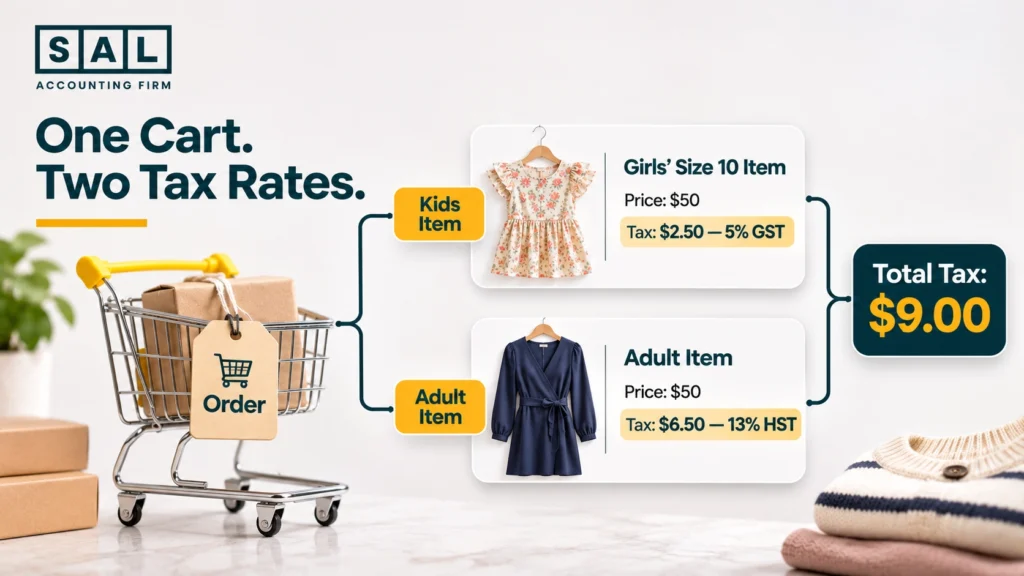
Charging 13% on both would total $13.00, overcharging the customer by $4.00.
Set up a separate tax rule in your store for qualifying children’s items, then place a test order to an Ontario address to check it. The way your store handles tax by product and province depends on its Shopify GST/HST settings.
Case Study: How Amanda’s Clothing Store in Bloor West Village, Toronto Fixes Its Kids’ Tax1
Amanda sells clothing for kids and adults online from a small studio in Bloor West Village, Toronto. Her girls’ and boys’ line has grown to almost half of her sales.
The problem: Amanda’s store charges 13% HST on everything. Her Ontario, Nova Scotia, and PEI customers have been paying the full HST on kids’ items that should only carry the 5% GST.
What we do: We set her kids’ collection to charge only GST for customers in those three provinces, and test it with sample orders. We also review her recent GST/HST returns to see how much was overcharged.
The result: Amanda’s customers are now charged correctly. She refunds or credits recent overcharges where it makes sense, and her filings are corrected to match.
Does the Children’s Clothing Rebate Apply to Wholesale Orders?
Yes, the rebate applies at any point in the distribution chain, including sales to retailers.
If you sell qualifying kids’ clothing wholesale to a store in Ontario, Nova Scotia, or PEI, you collect only the 5% federal part, just like a direct sale to a customer. The same size and design rules apply.
Case Study: How Brian’s Kids’ Clothing Brand in Mississauga Fixes Its Wholesale Invoices
Brian runs a kids’ clothing brand from a warehouse unit near Square One in Mississauga. Along with his online store, he sells wholesale to boutiques in Nova Scotia and Ontario.
The problem: Brian charges his boutique customers full HST on every wholesale invoice. The rebate applies at the wholesale level too, so his customers have been overpaying.
What we do: We apply the rebate to qualifying items on his wholesale invoices, and issue credit notes for past overcharges.
The result: Brian’s boutique customers stop overpaying, and his invoices and GST/HST returns now line up.
What About Sales Tax on Clothing in BC, Quebec, and Other Provinces?
Outside the HST provinces, you charge 5% GST, and some provinces add their own sales tax. Each of these provinces has its own rules for clothing:
- British Columbia: children-sized clothing and footwear are exempt from BC PST. Your BC registration rules depend on how much you sell there, which is the focus of BC PST registration for online stores.
- Quebec: Quebec adds its own provincial sales tax, the QST, on top of the GST. How the two work together is the focus of sales tax for Montreal online stores.
- Other provinces: check each province’s own rules before you register there.
How Do Imported Clothing and Returns Affect Your GST/HST?
You usually pay GST when imported clothing clears customs, and you can adjust tax on refunded sales.
When you import clothing, GST is generally paid when the goods clear customs. If you’re registered, you can usually claim that GST back as an input tax credit on your return. The cash goes out at the border and comes back later, so it affects your timing, not your costs. The bigger picture of bringing goods in and shipping them out is the heart of import vs export for Canadian ecommerce.
When a customer returns an item for a refund, you may refund or credit the GST/HST you charged, with a credit note. Doing so is optional, and you have up to four years to make the adjustment.
How Do You Report Children’s Clothing Sales on Your GST/HST Return?
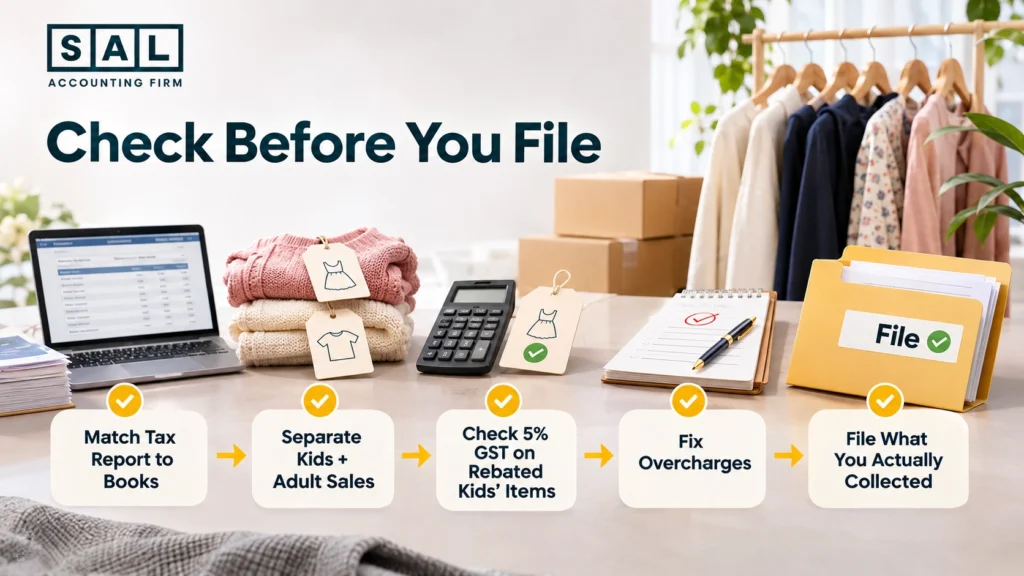
Report the tax you actually collected, so rebated kids’ sales show only the GST portion. Each month or quarter:
- Match your store’s tax report to your books
- Track kids’ and adult sales separately
- Check that rebated kids’ sales show only the 5% GST
- Fix any past overcharges before you file
Your return should show exactly what you charged, item by item. Filing it each period is easier once you understand the GST/HST return in Canada step by step, and it fits into the wider accounting for an online clothing store.
Final Thought: Is Your Clothing Store Charging the Right Tax on Every Size?
GST/HST for a clothing store comes down to two questions: where the order is going, and what the item is. Charge tax based on the delivery province. In Ontario, Nova Scotia, and PEI, apply the children’s clothing rebate to qualifying kids’ items, whether you sell online or wholesale. Everywhere else, follow each province’s own rules, and report exactly what you collected.
Once your tax is right on every size, our free roadmap for tax-ready growth helps you plan the next stage of your clothing brand with confidence.
- Any case studies discussed are composites of scenarios handled, discussed or read about and may or may not reflect existing SAL Accounting clients. We take no responsibility for actions taken or inferences derived from any content on our online or printed materials. ↩︎