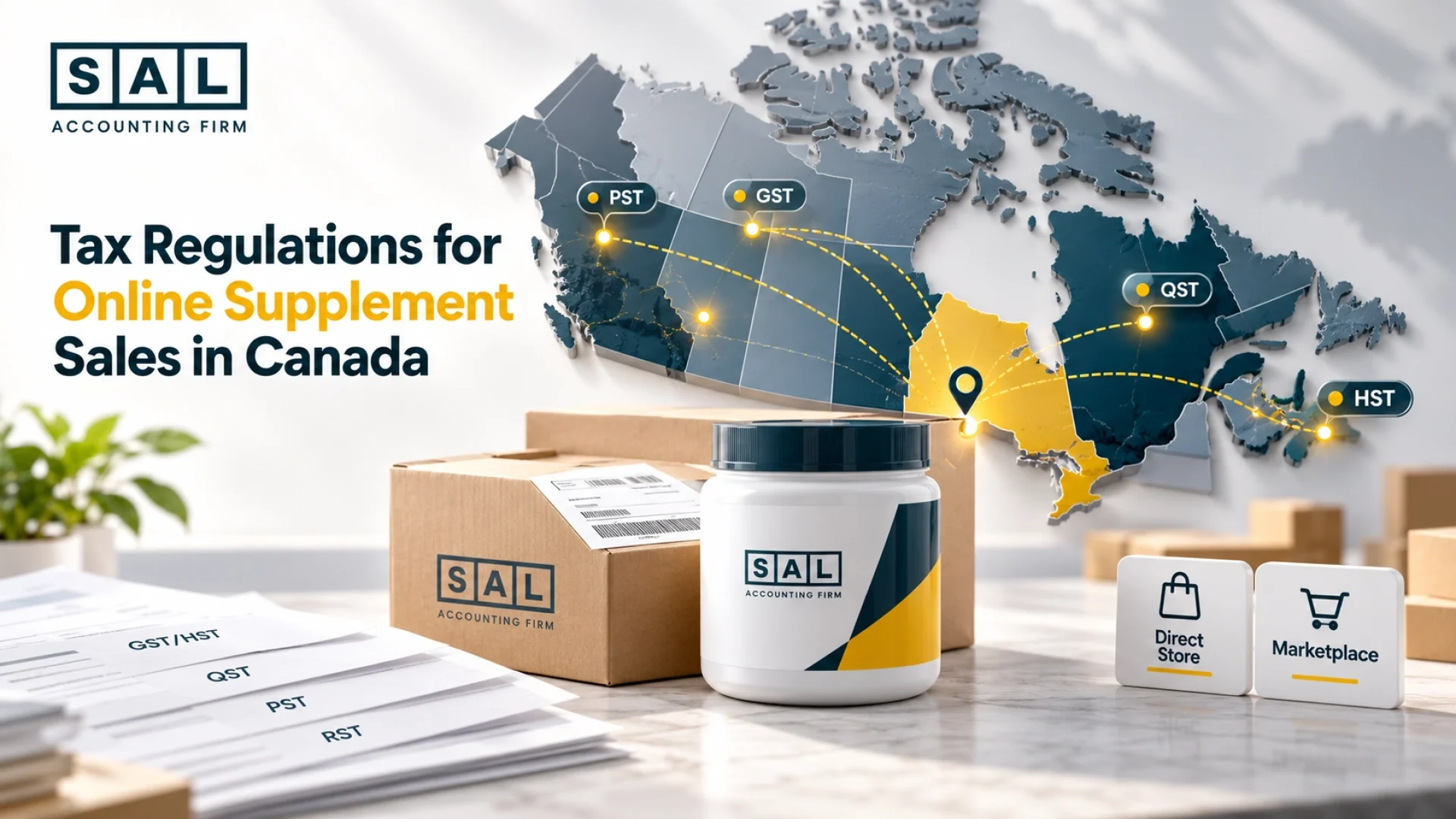
Selling supplements online across Canada can mean dealing with more than GST/HST. Depending on where your customer lives, Québec’s QST, BC’s PST, Saskatchewan’s PST, or Manitoba’s RST may need a look too. Whether the product is taxable, and whether the sale ran through Amazon or your own store, changes who collects.
Mapping that mix is everyday work at SAL Accounting for Ontario supplement brands. Here’s the map, province by province.
The GST/HST you pay on business costs can come back to you. See how much with the GST/HST Refund Calculator.
Quick Takeaways
- Canada doesn’t have one sales tax. GST, HST, QST, PST, and RST can all come into play.
- For shipped goods, the customer’s delivery province generally sets the GST/HST you charge.
- Québec, BC, Saskatchewan, and Manitoba each run their own sales tax, separate from GST/HST.
- Being registered for GST/HST doesn’t settle your provincial sales tax questions.
- Marketplace rules can shift who collects, but only for marketplace sales, not your own store.
- Map your business by province, channel, product, and registration.
Which Sales Taxes Apply When You Sell Supplements Online Across Canada?
It depends on where your orders go. Canada has a federal sales tax plus several provincial ones, and an online seller can touch more than one.
Picture an Ontario supplement brand that sells through Shopify and Amazon. This guide is written from the point of view of a seller based in Ontario. If your business is based in another province, your home province’s rules apply differently, so check them with your province directly.
Orders from this Ontario brand go out to customers in every province. Depending on where each order lands, the seller may need to think about:
- GST: the federal goods and services tax
- HST: GST and a provincial part combined, used in Ontario and the Atlantic provinces
- QST: Québec’s sales tax
- BC PST: British Columbia’s provincial sales tax
- Saskatchewan PST
- Manitoba RST: Manitoba’s retail sales tax
The table below shows how these fit together.
| Tax | Where It Applies | Who Runs It | Covered by GST/HST Registration? |
|---|---|---|---|
| GST | Provinces without HST | CRA | Yes |
| HST | Ontario and Atlantic provinces | CRA | Yes |
| QST | Québec | Revenu Québec | No |
| PST | British Columbia | Government of BC | No |
| PST | Saskatchewan | Government of Saskatchewan | No |
| RST | Manitoba | Government of Manitoba | No |
Now, this doesn’t mean every seller has to register for every tax. Many won’t. The point is to see the full map before deciding which parts apply to you.
Keep in mind, sales tax is only one of the types of taxes an ecommerce business deals with. This article stays on sales tax only.
What Three Questions Decide the Sales Tax on an Online Supplement Order?
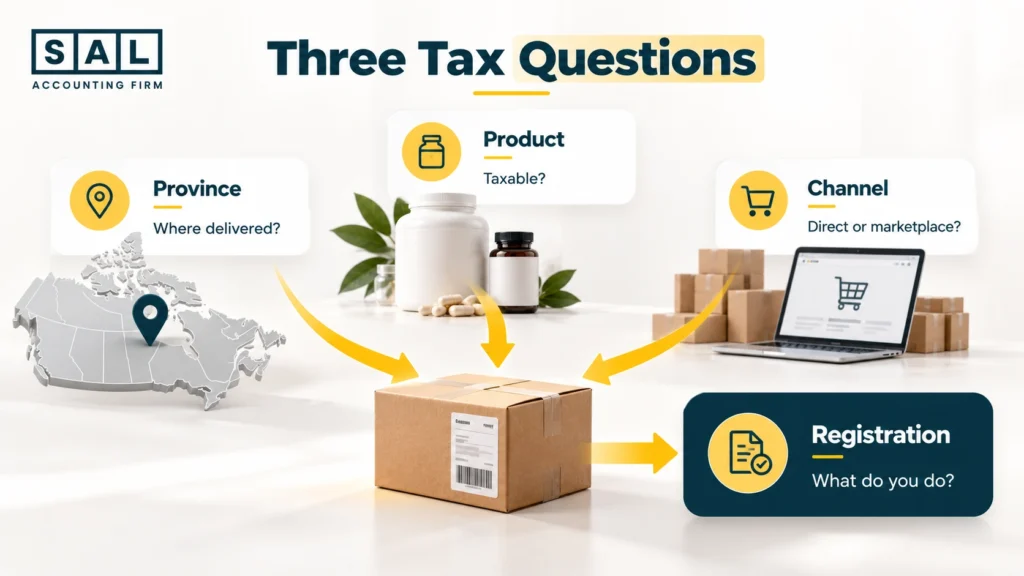
Three questions shape almost every answer: where the customer receives the order, whether the product is taxable, and whether the sale is direct or through a marketplace.
Where Is the Customer Receiving the Order?
For physical products you ship, the delivery location usually matters more than your own address. CRA explains that a sale of goods is generally made in the province where the goods are delivered to the customer. That decides which GST/HST rate applies.
Is the Product Taxable or Zero-Rated?
Before any rate applies, you need to know whether the SKU itself is taxable. A vitamin capsule and a qualifying meal replacement can be treated differently for GST/HST. That question has its own guide: GST/HST for online supplement stores.
Is the Sale Direct or Through a Marketplace?
- Direct: your Shopify store or brand website
- Marketplace: Amazon or another qualifying marketplace
Marketplace rules can change who is responsible for collecting a particular tax.
Here’s the framework for the rest of this article:
Province → Product → Channel
Then your registration status decides what you need to do.
Is There One Sales-Tax Threshold for Online Supplement Sellers in Canada?
No. Each tax system has its own rules, and crossing one threshold doesn’t settle the others.
For GST/HST, the small supplier rule is the starting point. You generally have to register once your worldwide taxable sales go over $30,000 in a single calendar quarter or over four consecutive quarters. Our guide on what happens when an ecommerce seller isn’t registered for GST/HST walks through how that works.
The provinces set their own rules. The table below shows the general picture at the time of writing.
| Tax | Registration Signal for an Ontario Online Seller | Marketplace Rule (General) | What to Check |
|---|---|---|---|
| GST/HST | Over $30,000 in taxable sales | Platforms mainly step in for unregistered sellers | Your total taxable sales |
| QST | Over $30,000 in taxable sales to Québec consumers in 12 months | Some platform sales are excluded from the seller’s count | Direct sales to Québec |
| BC PST | A sales threshold applies to out-of-province sellers | Marketplace facilitators collect on their sales | Whether your products are even taxable in BC |
| Saskatchewan PST | Rules can apply to out-of-province sellers selling directly | Marketplace facilitators register and collect | Direct sales into Saskatchewan |
| Manitoba RST | Over $30,000 in annual taxable sales | Online marketplaces collect on third-party sales | Direct taxable sales into Manitoba |
Here’s the key point. Being above or below the GST/HST threshold doesn’t answer your QST, PST, or RST questions. Each one needs its own check.
Thresholds and rules change, so confirm them with each government before you rely on them.
Why Does the Customer’s Province Matter for an Online Supplement Order?
Because the same product, shipped from the same warehouse, can be taxed differently depending on where it lands. Say an Ontario supplement brand ships four identical tubs of a taxable protein powder:
- One to Toronto
- One to Halifax
- One to Vancouver
- One to Montréal
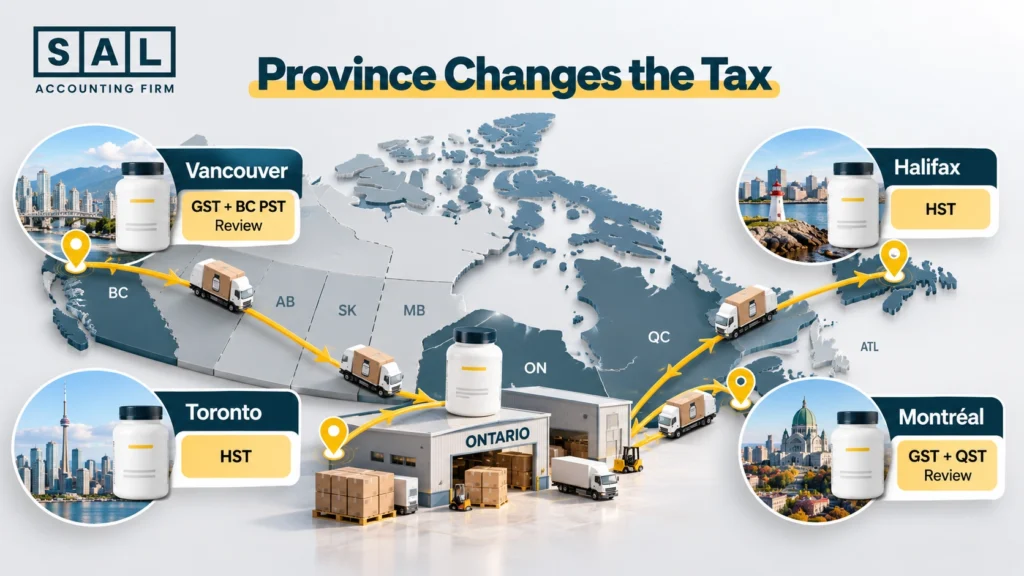
The seller didn’t move. The customer’s address did. And that changes:
- Which GST/HST rate applies, since Ontario and Nova Scotia use different HST rates and BC and Québec use GST only
- Whether a provincial sales tax needs a separate look (BC and Québec)
- Which tax setting the order should use in your store
Here’s where a lot of online sellers get stuck. They set their store to charge their home province’s rate on everything. That’s one of the most common mistakes in out-of-province sales tax for Canadian ecommerce.
The takeaway: your business address isn’t the only location that matters. For shipped orders, the customer’s province usually drives the answer.
Which Provinces Need a Separate Sales-Tax Review for Online Supplement Sellers?
Québec, British Columbia, Saskatchewan, and Manitoba. Each runs its own sales tax, so GST/HST registration alone doesn’t cover them.
Québec: QST
- Separate system: QST is run by Revenu Québec, not CRA.
- Threshold: A supplier outside Québec registered for GST/HST must register under the specified QST system once taxable sales to Québec consumers pass $30,000 in 12 months.
- Watch for: Stock stored in Québec, which can trigger different rules.
British Columbia: PST
- Separate system: BC runs its own PST, apart from GST.
- Key point for supplements: BC exempts vitamins and dietary supplements taken orally, so your core products may carry no PST at all.
- Watch for: Other items like shaker bottles or apparel, which may still be taxable.
Saskatchewan: PST
- Separate system: Saskatchewan runs its own PST.
- Marketplaces: Registered marketplace facilitators collect PST on the sales they handle.
- Watch for: Direct sales into the province, which may bring their own obligations. Saskatchewan’s provincial sales tax guidance covers registration and taxable products.
Manitoba: RST
- Separate system: Manitoba calls its tax Retail Sales Tax.
- Marketplaces: Online marketplaces collect RST on taxable goods sold by third-party sellers.
- Threshold: Businesses with annual taxable sales under $30,000 don’t have to register.
The point is, GST/HST registration alone doesn’t settle every provincial sales tax question.
Shopify vs Amazon: Who Collects Sales Tax on Online Supplement Orders?
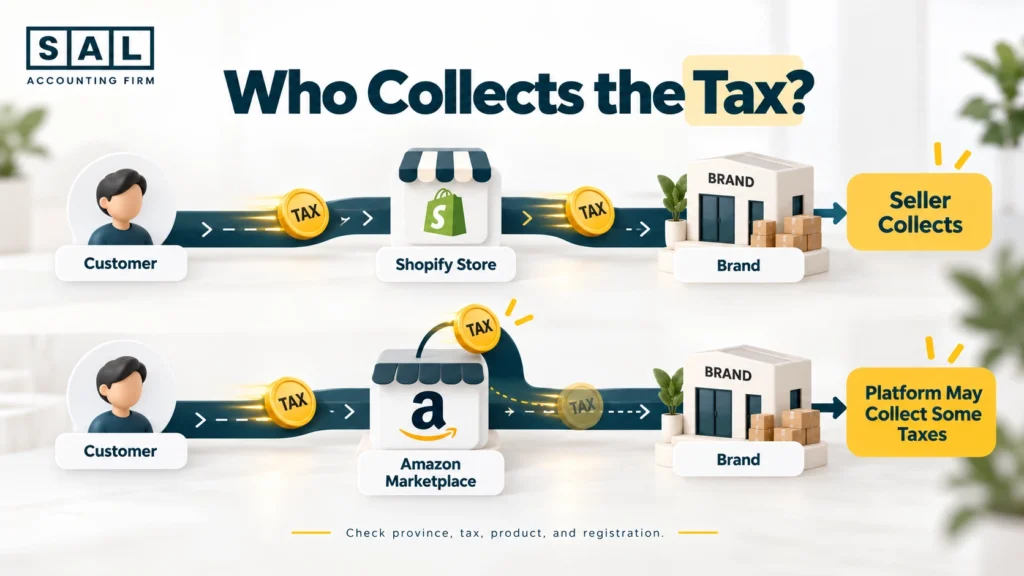
It depends on the channel. On your own store, you’re responsible. On a marketplace, some taxes may be collected by the marketplace instead.
Direct Shopify Sale
Shopify runs the checkout, but the sale is yours. You decide which taxes you’re registered for and which ones to charge. Shopify applies the settings you give it. It doesn’t decide your legal obligations. How those settings work is covered in our Shopify GST/HST tax guide.
Marketplace Sale
Customer → Amazon Marketplace → Supplement Brand
Marketplace rules can shift collection to the platform for some taxes. BC, Saskatchewan, and Manitoba all require qualifying marketplaces to collect provincial sales tax on sales they handle. Québec has its own platform rules.
GST/HST works differently. Federal platform rules mainly step in for sellers who aren’t registered for GST/HST. A registered Ontario seller generally stays responsible for GST/HST on its own marketplace sales, even when the marketplace calculates it at checkout.
So avoid the blanket assumption that “Amazon collects all the tax, so I don’t need to worry.” The right question is narrower:
For this province, this tax, this product, this registration status, and this channel, who collects?
Our Amazon seller tax guide covers the wider Amazon picture.
Why Doesn’t Marketplace-Collected Tax Cover Your Direct Supplement Store?
Because marketplace rules only apply to marketplace sales. Your own store is a separate channel.
Say your brand sells:
- $400,000 through Amazon
- $500,000 through Shopify
Suppose Amazon collects a particular provincial tax on its qualifying sales. That covers those Amazon orders only. It says nothing about the $500,000 of direct Shopify sales, which still need their own review.
That’s why sales tax has to be reviewed by channel:
- Marketplace sales: check what the platform collects and for which taxes
- Direct sales: check what you must collect yourself
Tracking those channels separately also makes your books cleaner, which is one reason multichannel accounting for supplement brands gets its own attention.
Case Study: How Liam’s Vitamin Brand in Corktown, Toronto Maps Its Canada-Wide Sales Tax1
Liam runs an online vitamin and protein brand from a small warehouse in Corktown, Toronto. He’s registered for GST/HST and sells through Shopify and Amazon. His Shopify store charges Ontario HST on every order, no matter where it ships. Sales to Québec and BC have grown fast this year, and he assumes Amazon handles the tax on everything outside Ontario.
The Problem
Liam’s Shopify store is charging the wrong GST/HST on orders shipped outside Ontario. Over the last 12 months, his direct Shopify sales to Québec consumers have passed $40,000, and he’s never looked at QST. He also doesn’t know whether his products are taxable in BC, or which provincial taxes Amazon actually collects on his marketplace orders.
What We Do
We map his sales by province, channel, and product. For each combination, we note the tax that applies, who collects it, and whether Liam is registered. We flag the Québec direct sales for a QST registration review. We check his BC sales against the province’s exemption for oral vitamins and supplements. Then we fix his Shopify settings so GST/HST follows the delivery province.
The Result
Liam starts the QST registration process and updates his store settings. He learns that most of his BC sales are vitamins and supplements that fall under BC’s exemption, so his BC review narrows to a few accessories. He now has a one-page map showing which taxes he collects, which ones Amazon collects, and where the gaps were.
How Should an Ecommerce Supplement Brand Map Its Canadian Sales-Tax Obligations?
Look at your business through four lenses at once: province, channel, product, and registration. The useful formula is:
Province × Channel × Product × Registration
Work through it one line at a time:
- Province: Where are your customers?
- Sales channel: Are orders coming through Shopify, Amazon, another marketplace, or subscriptions?
- Product treatment: Is each SKU taxable or zero-rated, and is it exempt in any province?
- Registration status: Which tax systems are you registered for today?
- Marketplace responsibility: Is the marketplace collecting the relevant tax on its sales?
- Seller responsibility: Which direct sales do you still need to collect on?
Here’s what part of that map might look like for an Ontario supplement brand.
| Province | Channel | Product | Who Collects | Seller Action |
|---|---|---|---|---|
| Ontario | Shopify | Taxable vitamin | Seller | Charge Ontario HST |
| Nova Scotia | Shopify | Taxable vitamin | Seller | Charge Nova Scotia HST |
| Québec | Shopify | Taxable vitamin | Seller, if registered for QST | Review QST threshold |
| Québec | Amazon | Taxable vitamin | Check platform rules | Confirm what Amazon collects |
| BC | Shopify | Oral supplement | No PST if exempt | Charge GST, confirm exemption |
| Manitoba | Amazon | Taxable accessory | Marketplace, for RST | Confirm Amazon collects RST |
Build one row for every province you sell into. Gaps show up fast.
This map also matters if you ever sell the business. A buyer will check sales tax risk closely, and a clear map makes that review far easier.
Pro Tip: Pull a sales report by shipping province and channel every quarter. It shows where your sales are growing before you cross a threshold.
What Changes Should Trigger a New Sales-Tax Review for an Online Supplement Brand?
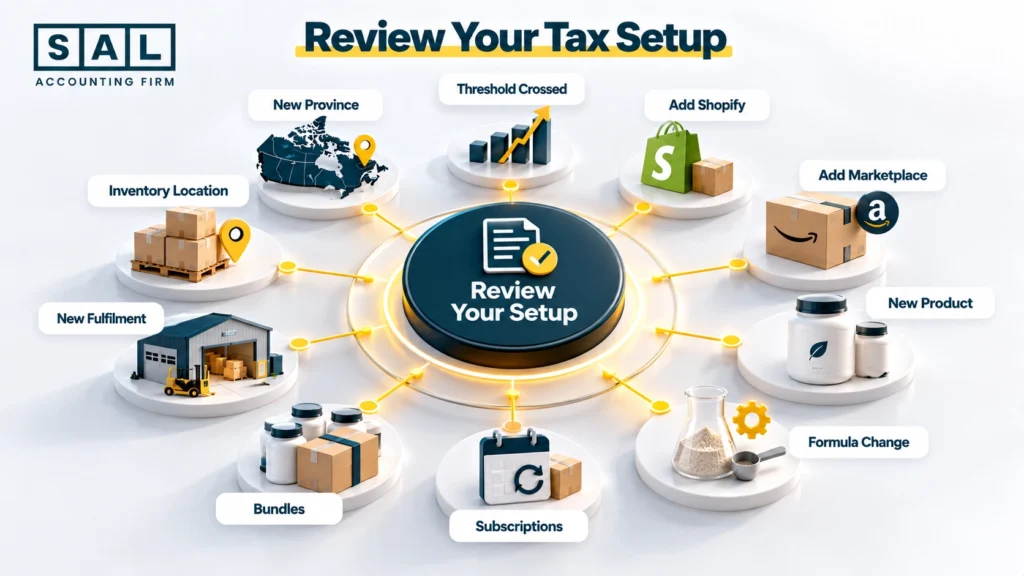
Any change in the facts behind your sales. Review your setup when you:
- Start getting meaningful sales in a new province
- Cross a registration threshold
- Add Shopify direct sales after selling mainly on a marketplace
- Add Amazon or another marketplace
- Launch a new product category
- Change a product’s formula or how it’s positioned
- Add subscriptions
- Introduce bundles
- Change fulfilment or inventory locations
- Change where your Canadian customers are served from
Subscriptions are a common one. Each shipment follows the same rules as a normal order, based on where it’s delivered. How recurring orders are recorded is covered in our guide to subscription accounting for supplement brands.
Not every small sale into a new province means a new registration. The point is that when the facts change, check whether your setup still works.
- Also read: “GST/HST Compliance for Ecommerce Stores”
Case Study: How Madison’s Greens Brand in Heartland, Mississauga Prepares for a Second Channel2
Madison sells a greens powder and a collagen blend from a warehouse unit near Heartland in Mississauga. For two years she sold almost only on Amazon, and she’s registered for GST/HST. Now she’s launching her own Shopify store and expects strong sales to Manitoba and Saskatchewan, where her ads perform well.
The Problem
Madison assumes her tax setup will carry over from Amazon. On Amazon, the marketplace has been collecting provincial tax on her Manitoba and Saskatchewan orders. On her own store, nobody will collect it unless she sets it up. Her direct Manitoba sales could pass $30,000 within the year.
What We Do
We split her expected sales by channel and province. We confirm which provincial taxes Amazon collects on her marketplace orders and which ones would fall on her for direct sales. We set a threshold watch for Manitoba and look at what Saskatchewan expects from out-of-province sellers selling directly. Then we check whether each of her products is taxable in each province.
The Result
Madison launches her Shopify store with GST/HST set by delivery province and a clear plan for provincial registrations. She registers where the rules require it before her direct sales grow, not after. She also knows exactly which provincial tax Amazon still handles, so nothing is collected twice or missed.
What Should You Confirm Before Trusting Your Ecommerce Tax Settings?
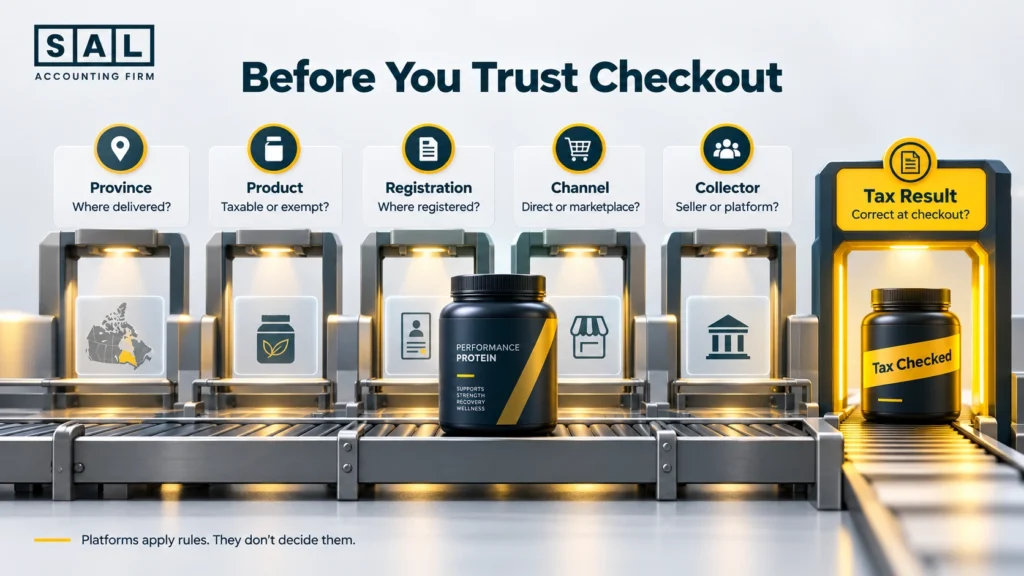
Your store and marketplace settings only apply the rules you give them. Before trusting them, confirm:
- Which Canadian tax systems apply to your sales
- Where each customer receives the product
- Whether each product is taxable, zero-rated, or exempt in that province
- Which registrations you hold
- Whether each sale is direct or through a marketplace
- Who is responsible for collecting each tax
Mistakes here can sit unnoticed for a long time. They often surface when CRA reviews a file, which our guide to CRA audits for ecommerce sellers covers.
Pro Tip: Place a few test orders to addresses in different provinces before a big launch. Check the tax on each one against your map.
At the end of the day, your ecommerce platform can apply a tax rule. It can’t decide which rule legally applies to your sale.
- Read more: “Accounting for an Online Supplement Business”
Final Thought: Does Your Online Supplement Brand Know Which Sales Tax Applies to Every Order?
Selling supplements online across Canada means more than one sales tax. The customer’s province, the product, the channel, and your registrations all shape what you charge and who collects it. GST/HST is the starting point, not the full answer.
Map your sales by province and channel once. Then review it whenever your business changes. Clean sales tax is one step toward stronger numbers. Map out what comes next with our financial roadmap for online supplement brands.