
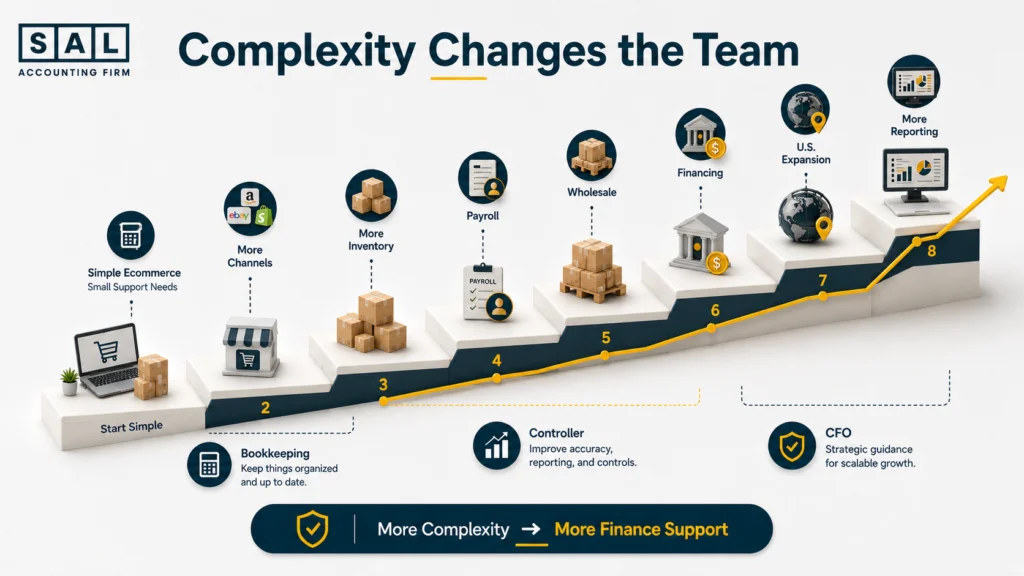
Your ecommerce finance team should change when the work changes. not just when revenue hits a round number. At $250K, reliable bookkeeping may be enough; by $3M–$5M, forecasting, margin ownership, and stronger finance support can matter much more.
SAL Accounting approaches it stage by stage, adding support only when the business actually needs it. Keep reading to see what your finance team should look like at each revenue stage and what you probably don’t need to hire yet.
Want a quick baseline on operating performance first? Run the Ecommerce EBITDA Calculator.
Quick Takeaways
- Revenue gives you a useful starting point, but complexity determines how quickly the finance team should develop.
- At $250K–$1M, reliable bookkeeping and accounting usually matter more than hiring finance employees.
- Around $1M–$3M, stronger month-end ownership and controller-level review may become useful.
- Around $3M–$5M, forecasting, margins, cash planning, and budgeting start needing clearer ownership.
- At $5M–$10M, a hybrid finance team often makes more sense than keeping everything outsourced.
- A full-time CFO usually comes later, when CFO-level decisions have become frequent enough to justify a permanent executive.
- The goal is not the biggest finance team you can afford. It is the right level of finance support for the decisions you are making now.
Why Your Ecommerce Finance Team Should Scale With Revenue and Complexity
Revenue matters because a larger ecommerce business usually has more transactions, more inventory, more staff, and more cash at risk. But it does not tell you the whole story.
Take two $2 million ecommerce brands. One sells through a single Shopify store in Canada with straightforward inventory and a small team. The other sells through Shopify, Amazon, and wholesale, holds inventory in Canada and the U.S., has employees, uses multiple currencies, and spends heavily on paid acquisition.
Same revenue. Completely different finance workload.
The things that usually push a business toward stronger finance support include:
- More sales channels and payment processors
- Larger inventory orders
- Multiple warehouses or 3PLs
- Payroll and a growing team
- Wholesale or B2B receivables
- Canada–U.S. expansion
- Financing or lender reporting
- Multiple currencies or entities
- More detailed product and channel reporting
- Larger advertising commitments
That is why the decision between in-house and outsourced ecommerce accounting should not come down to revenue alone. The amount of work, how quickly the business needs answers, and how much judgment is involved matter just as much.
Cross-border activity can accelerate the need particularly quickly. A brand can add U.S. inventory, currency exposure, tax obligations, and longer cash cycles without doubling revenue, yet suddenly face much more complicated cross-border ecommerce cash-flow problems.
Pro tip: Treat the revenue ranges below as checkpoints, not rules. A simple business may move through them more slowly. A complex multichannel brand may need the next finance layer much earlier.
$250K–$1M: Getting Your Books Under Control
At this stage, your finance setup does not need to look sophisticated. It needs to produce numbers you can trust.
The priority is getting sales, payouts, fees, refunds, bank activity, expenses, inventory, payroll where applicable, and tax records into a reliable monthly process. Before adding more senior finance roles, the founder should at least understand the core financial statements an ecommerce business should be reviewing.
The Roles You Actually Need at This Stage
For many ecommerce businesses between $250K and $1M, the setup can stay lean:
- Ecommerce bookkeeper or bookkeeping team
- Accountant or CPA oversight
- Tax support when needed
- Founder reviewing a small set of monthly numbers
The founder should not still be manually fixing the books every weekend, but the business probably does not need three internal finance employees either.
A clear ecommerce bookkeeping engagement letter becomes useful here because someone needs to own reconciliations, month-end, inventory adjustments, financial reporting, and tax records instead of assuming somebody else is handling them.
What to Outsource Instead of Hiring
Bookkeeping, ecommerce reconciliation, year-end accounting, tax work, and payroll can usually remain external when there is not enough recurring work to justify several specialists in-house.
At this stage, getting ecommerce reconciliation right normally matters more than building a larger finance team. For businesses that mainly need dependable monthly books, ecommerce bookkeeping services can provide that foundation without adding unnecessary permanent headcount.
Signs You’re Already Behind
The biggest warning signs here generally point to a bookkeeping problem rather than a CFO problem.
Watch for:
- Month-end is not happening consistently.
- Shopify or Amazon sales do not match the books.
- Payouts are being recorded as revenue.
- Inventory is updated only at year-end.
- Tax money is being treated like available operating cash.
- The founder still spends hours fixing transactions.
- Financial statements arrive too late to use.
Those poor ecommerce bookkeeping problems get harder to unwind as order volume grows. Every forecast or management report you build later depends on this layer being reliable first.
$1M–$3M: Moving Past Basic Bookkeeping
Once an ecommerce business crosses seven figures, bookkeeping is still essential, but recording everything correctly is no longer the whole job. Month-end needs to happen on time, inventory needs proper review, balance-sheet accounts need to make sense, and someone needs to explain why results changed.
This is where the question starts shifting from “Who does our bookkeeping?” to “Who actually owns the accounting process?”
The Roles You Actually Need at This Stage
A practical setup may include:
- Bookkeeper or staff-accounting capacity
- Accountant or CPA review
- Controller-level oversight as complexity increases
- External tax specialists
This is also where the difference between bookkeeping and when an ecommerce business needs CPA-level accounting support becomes more important. Someone needs to notice when the close is late, inventory does not reconcile, or a balance-sheet account looks wrong—and make sure it gets resolved.
When a Fractional Controller Starts to Make Sense
A controller sits between routine accounting work and CFO-level strategy. Their role is less about entering transactions and more about making sure the accounting system consistently produces reliable information.
That can include:
- Month-end close
- Balance-sheet review
- Inventory accounting
- Reporting deadlines
- Bookkeeper oversight
- Accounting processes and controls
- Coordination with payroll, tax, and outside accountants
You may need that experience without needing someone doing it five days a week. That is where fractional controller support can make sense.
This is also why looking only at salary or hourly rates gives you an incomplete comparison. The real cost of accounting for an online store also includes founder time, rework, reporting delays, and decisions made from unreliable information.

What You Still Don’t Need to Hire In-House
A full-time CFO is usually difficult to justify if there is not enough CFO-level work to fill the position. Payroll, specialized tax work, and even controller oversight can also stay external while their workload is concentrated rather than continuous.
Payroll is a good example. Adding employees does not automatically mean you need an internal payroll role; outsourcing ecommerce payroll can still be much more practical.
The point is not to bring everything inside because revenue crossed $1 million. Move a role in-house when the volume, response time, and need for day-to-day ownership justify it.
Case Study: A Liberty Village Brand Builds Its Finance Team Too Early1
A growing ecommerce brand in Liberty Village, Toronto crosses seven figures and assumes the next step is building an internal finance department. It hires two full-time finance employees while still relying on an external CPA, but there is not enough recurring finance work to keep all that capacity productive.
The Problem
Responsibilities overlap, while specialized accounting and tax work still sits outside the company. The brand has built the finance team around where it hopes to be rather than the work that actually exists today.
What We Do
We separate the workload into bookkeeping, accounting review, tax, reporting, and forward planning. Routine work stays with the appropriate accounting support, while controller or CFO capacity is used fractionally where more senior judgment is actually required.
Result
The business keeps the accounting quality and senior oversight it needs without carrying unnecessary full-time finance headcount.
$3M–$5M: Building Real Financial Infrastructure
Somewhere around this stage, the questions tend to change.
Instead of only asking whether last month’s books are accurate, the founder starts asking whether the company can afford another inventory order, why margins fell, whether another employee fits the budget, and what cash will look like three months from now.
That is a different finance problem.
The Roles You Actually Need at This Stage
For a more complex ecommerce brand, the structure may now include:
- Reliable bookkeeping or staff-accounting capacity
- Controller-level ownership
- CPA and tax support
- Fractional CFO or strategic finance support
Not every $4 million company needs all four. A simple operation may still run well with outsourced accounting and controller oversight, while a smaller multichannel business with U.S. operations and heavy inventory commitments may need forward planning earlier.
When CFO-Level Financial Support Starts to Make Sense
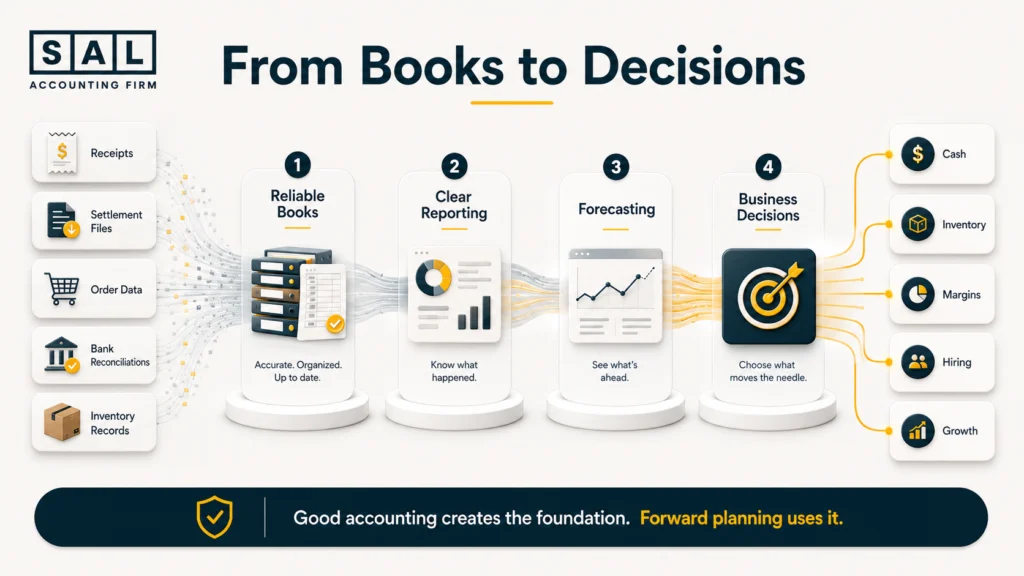
The controller largely protects the reliability of the accounting. CFO-level support takes those reliable numbers and asks what happens next.
That may include:
- Cash-flow forecasting
- Budgeting
- Scenario planning
- Inventory planning
- SKU and channel profitability
- Hiring models
- Financing decisions
- U.S. expansion
- Larger capital commitments
If the difference between those roles still feels unclear, what a virtual CFO actually does for an ecommerce business becomes much easier to understand once forecasting, margins, cash planning, and growth decisions need a clear owner.
This is also where standard financial statements can stop answering enough questions. Ecommerce management reporting connects the accounting results to the decisions the founder is actually making.
Bookkeeper vs. Controller vs. CFO
| Role | Main Focus | Typically Owns | Main Question |
|---|---|---|---|
| Bookkeeper | Accurate records | Transactions, payouts, reconciliations | Are the books up to date? |
| Controller | Accounting reliability | Close, balance sheet, inventory, reporting | Can we trust the numbers? |
| CFO | Forward planning | Forecasts, budgets, scenarios, financing | What should we do next? |
A growing company does not necessarily need three different full-time people. What matters is making sure all three types of work are covered when the business starts needing them.
Profitability also needs to get more detailed at this stage. Understanding ecommerce contribution margin tells you what remains after the variable costs required to generate an order, while SKU profitability analysis helps identify which products are actually producing that profit.
Neither analysis works well when product costs are incomplete. Reliable inventory landed-cost accounting becomes increasingly important once freight, duties, prep, and other inventory costs become material.
Cash needs the same level of attention. A company can report a profit and still have money tied up in inventory or other working capital, which is why understanding the ecommerce profit-versus-cash gap matters more as purchase orders get larger.
What to Keep Outsourced
Tax, payroll, technical accounting, cross-border work, and even CFO support can remain outsourced. The question is whether the company needs that expertise every day or simply needs reliable access to it.
For a Canadian ecommerce company expanding south, cross-border tax accounting can remain specialized and external while the operating finance team owns the day-to-day numbers.
Pro tip: Do not hire a CFO to compensate for unreliable bookkeeping. Fix the accounting layer first. Then add the forward-looking finance layer.
$5M–$10M: Preparing for a Full Finance Function
At this stage, keeping every finance responsibility outside the company can start creating friction. More managers need answers, approvals happen more often, and inventory, marketing, payroll, and financing decisions cannot always wait for the next monthly meeting.
That does not mean the whole department needs to move inside at once. A hybrid structure often becomes the better next step.
The Roles You Actually Need at This Stage
A growing $5M–$10M ecommerce business might have:
- In-house senior accountant or finance manager
- Bookkeeping or staff-accounting support
- Controller
- Fractional CFO or head-of-finance support
- External tax and specialist advisors
The exact titles matter less than ownership. Someone needs to own the close, someone needs to own the quality of the accounting, and someone needs to own the forecast and forward-looking decisions.
At this point, ecommerce financial reporting becomes operating infrastructure rather than something the founder looks at occasionally. Sales, margins, inventory, cash, and channel performance need to reach decision-makers quickly enough to change what they do.
In-House vs. Fractional: Making the Call
One useful question is: how often does the work happen?
If the controller or CFO is needed for several concentrated days each month, fractional support may still be efficient. If questions come up every day, multiple people need finance supervision, and important decisions cannot wait for the next scheduled meeting, bringing that role inside becomes easier to justify.
The same logic applies when scaling an ecommerce brand. Headcount should follow workload and responsibility, not just a bigger revenue number.
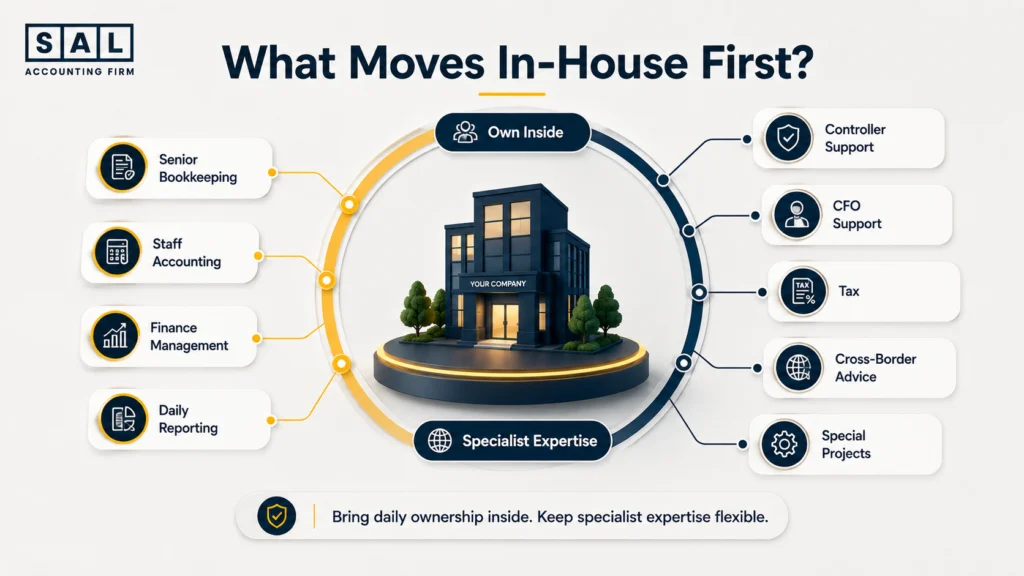
What Usually Moves In-House First
Recurring operating work normally moves inside before specialist work. The first internal finance hires may be:
- Senior bookkeeper
- Staff accountant
- Senior accountant
- Finance manager
- Accounting operations lead
These roles sit close to daily activity and can answer routine questions quickly. Controller, CFO, tax, and cross-border specialists may remain fractional until there is enough ongoing work to justify hiring them permanently.
Case Study: A Port Credit Brand Outgrows Bookkeeping Without Realizing It2
A multichannel ecommerce brand in Port Credit, Mississauga grows to roughly $7 million across Shopify, Amazon, and wholesale. The books are completed every month, so the founder assumes finance is covered. But nobody owns forecasting, channel margins, inventory planning, or the effect growth is having on cash.
The Problem
The company has reliable historical accounting but no real forward-looking finance ownership. Large inventory and marketing commitments are still being made mainly from top-line sales and the current bank balance.
What We Do
We add controller-level ownership around close and reporting, then introduce rolling cash forecasts, channel contribution reporting, and a regular planning process around inventory and larger spending decisions.
Result
Bookkeeping keeps doing the work it was intended to do, while a separate planning layer gives the founder visibility into the financial effect of major decisions before the cash is committed.
$10M+: Running a Finance Team, Not Just a Function
Beyond $10 million, finance can become a people-and-process problem as much as an accounting problem. Several employees may be producing information, reviewing it, handling payments, planning cash, and supporting leadership.
Revenue still does not automatically mean a full-time CFO is required. But clearer separation between roles becomes increasingly useful.
The Roles You Actually Need at This Stage
A more developed ecommerce finance team may include:
- Accounts payable and receivable support
- Bookkeeper or staff accountant
- Senior accountant or accounting manager
- Controller
- Finance manager or FP&A capacity
- CFO or senior finance lead
- External tax and specialist advisors
Some businesses combine several of these positions. Others need more specialization because of inventory volume, entities, countries, financing, acquisitions, or wholesale activity.
When It’s Time for a Full-Time CFO
The strongest signal is not simply reaching $10 million. It is having enough CFO-level work for the role to become continuous.
That can include:
- Company-wide budgeting and forecasting
- Capital allocation
- Financing and lender relationships
- Investor or board reporting
- Finance-team leadership
- Long-range planning
- Major expansion decisions
- Acquisitions or exits
- Scenario and risk analysis
When those responsibilities happen every week and the fractional CFO is effectively working like an internal executive already, the full-time version can become the cleaner structure.
What Can Still Stay Outsourced
Even a mature internal finance team does not need to own every specialty. Canadian–U.S. tax, technical accounting, valuations, transaction support, specialized payroll issues, and one-off projects can remain external.
Building an internal finance team does not mean stopping outsourcing. It means knowing which capabilities need to live inside the business and which only need to be available when required.
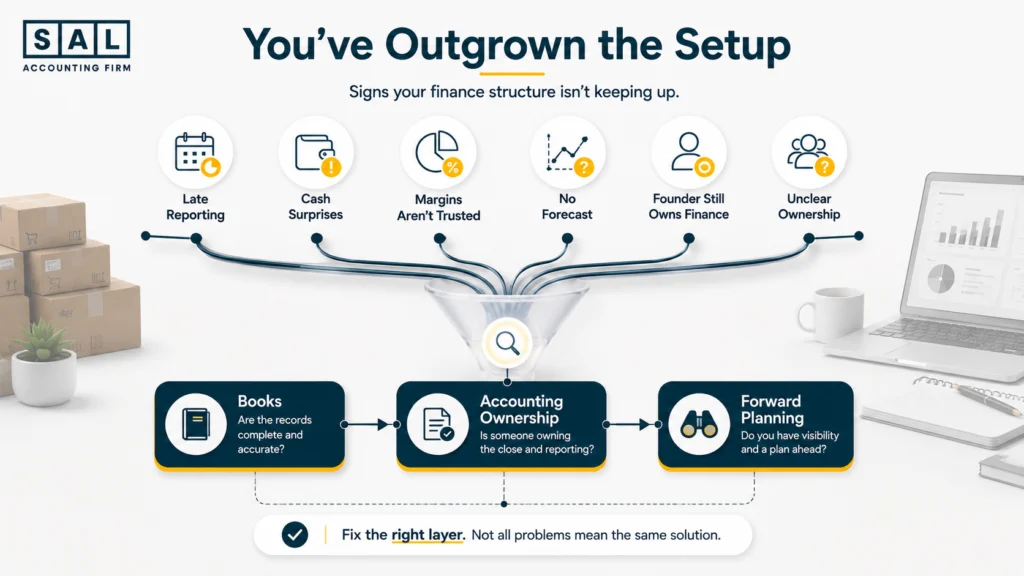
Signs You’ve Outgrown Your Current Finance Setup
You do not need to wait until the company reaches the next revenue range to make a change. The problems inside the finance process often tell you sooner.
Common signs include:
- Month-end reporting is consistently late.
- You do not trust product or channel margins.
- Cash surprises keep happening.
- Inventory orders are made without a forecast.
- Nobody owns budgeting.
- Nobody explains forecast-versus-actual results.
- The founder still answers routine finance questions.
- Different departments use different versions of the numbers.
- Reports tell you what happened but rarely why.
- Your accountant mainly looks backward while the business increasingly needs forward-looking answers.
Those problems do not all require the same hire. Unreliable reconciliations point back toward bookkeeping. A weak or inconsistent close points toward controller-level ownership. Reliable reporting with no forecasting or planning points toward CFO-level support.
That is why the questions you ask an ecommerce accountant should change as the business grows. Eventually, tax filing and year-end work are only part of what you need to understand.
- Also read: “Ecommerce Accountant Red Flags: What to Watch For”
Your Ecommerce Finance Team by Revenue Stage
Use this as a starting point rather than a hiring formula.
| Revenue Stage | Core Roles Needed | What Can Stay Outsourced | Main Risk |
|---|---|---|---|
| $250K–$1M | Bookkeeper + accountant/CPA | Bookkeeping, tax, payroll | Founder still doing finance |
| $1M–$3M | Bookkeeping + stronger accounting oversight | Controller, payroll, tax | Slow close, weak ownership |
| $3M–$5M | Accounting + controller + planning | Fractional CFO, tax, specialist work | No forecast or margin owner |
| $5M–$10M | In-house finance owner + controller | CFO, tax, cross-border work | Too many tasks, unclear ownership |
| $10M+ | Accounting team + controller + finance leadership | Specialized tax/projects | Finance still founder-dependent |
The progression is fairly straightforward: transaction accuracy comes first, accounting ownership comes next, and strategic finance becomes useful once reliable information exists underneath it.
In-House vs. Outsourced vs. Hybrid: Which Fits Your Stage?
There is no prize for bringing finance in-house early. There is also a point where keeping everything external starts slowing the company down.
The structural decision should come down to workload, specialization, response time, and how often finance needs to participate in operating decisions.
| Setup | Best For | Advantages | Limitations |
|---|---|---|---|
| Outsourced | Lean or lower-complexity businesses | Flexible capacity, specialist access, lower fixed headcount | Less daily availability |
| Hybrid | Growing, increasingly complex brands | Internal ownership + external expertise | Responsibilities must be clearly defined |
| In-House | High recurring workload and daily finance needs | Fast access, deeper company context | Higher fixed cost and hiring burden |
For many ecommerce brands, hybrid is the bridge between the other two. Routine accounting or finance management moves inside while tax, controller, CFO, and other specialist functions remain external until there is enough work to support them permanently.
The biggest risk is unclear ownership. Whether someone is an employee or an outside advisor, every recurring finance responsibility needs one clear owner.