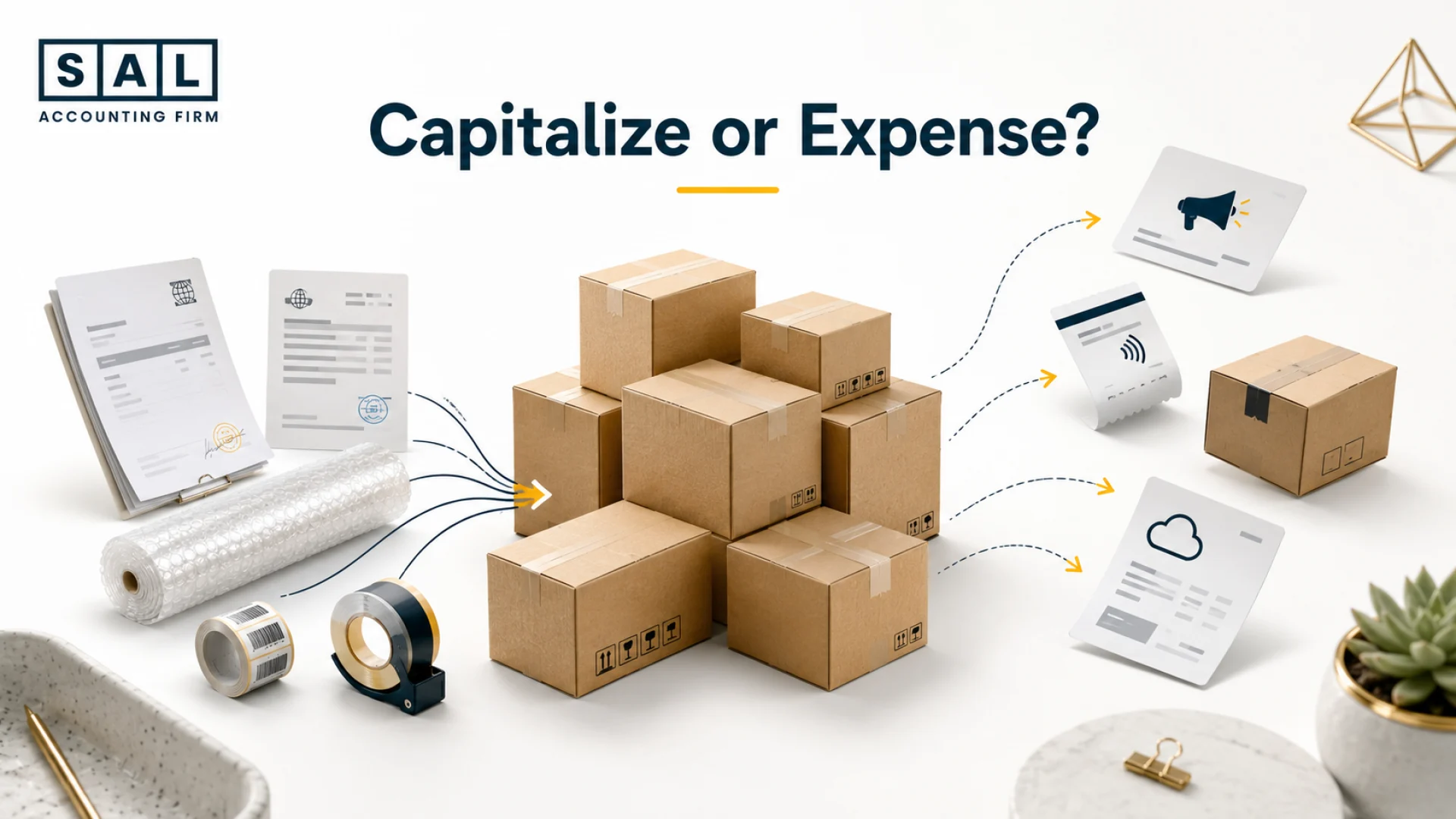
Ecommerce inventory should generally be capitalized when a cost is needed to buy, produce, or bring products to their current location and saleable condition. Costs tied to selling or running the business are usually expensed instead. SAL Accounting focuses on getting that split right because it directly affects COGS and gross margin.
Get it wrong, and your profit can look stronger, or weaker, than reality right before your next reorder or pricing decision.
See what a corrected COGS number does to operating profit with SAL’s Ecommerce EBITDA Calculator.
Quick Takeaways
- Inventory costs are generally capitalized when they help acquire, produce, or prepare products for sale.
- Capitalized inventory stays on the balance sheet until the related products are sold.
- Selling, marketing, fulfilment, and general operating costs are normally expensed instead.
- Freight-in and customer shipping are not treated the same way.
- Packaging, Amazon prep, 3PL charges, and storage can fall into grey areas.
What Does It Mean to Capitalize Ecommerce Inventory?
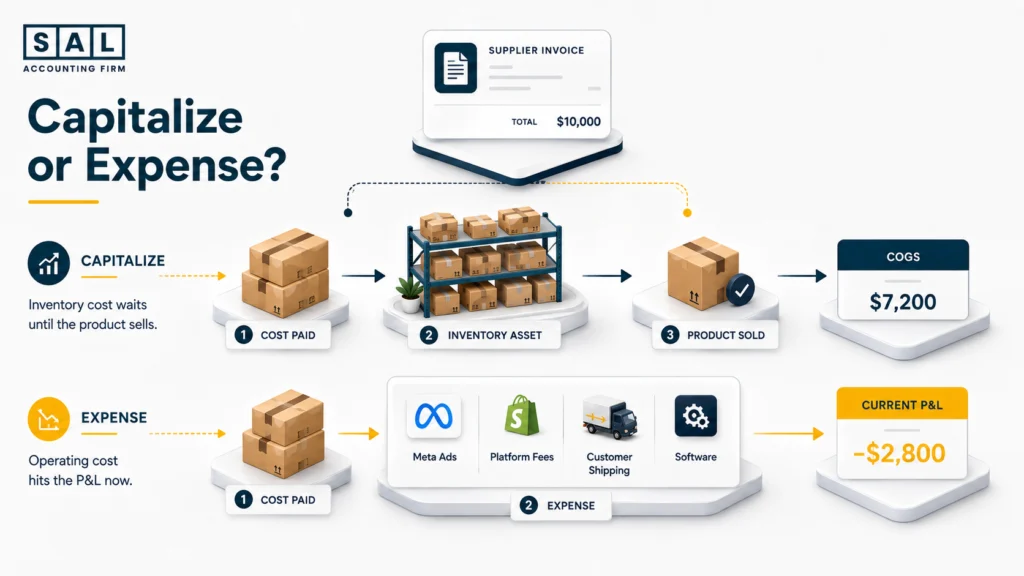
Capitalizing inventory means recording a cost as part of your inventory value rather than treating the full amount as an immediate expense. When the related product sells, that cost generally moves into cost of goods sold (COGS). For example, your store buys $20,000 of inventory. By month-end:
- $8,000 of inventory has been sold.
- $12,000 is still sitting in stock.
The remaining $12,000 does not normally become an expense just because you already paid the supplier. It stays in inventory until those products are sold.
That timing is one reason cash vs. accrual accounting for ecommerce can produce very different-looking monthly results.
For Canadian businesses, the CRA explains that inventory cost can include the amount paid for an item plus expenses needed to bring it to the business and put it into usable condition. CRA inventory guidance follows the same general idea. Basically:
- Unsold inventory → balance sheet
- Sold inventory → COGS
- Regular business costs → expenses
Keeping those buckets separate also makes your ecommerce financial statements much easier to trust.
- Read more: “How to Track and Calculate COGS for Ecommerce Stores”
Which Ecommerce Inventory Costs Should Be Capitalized?
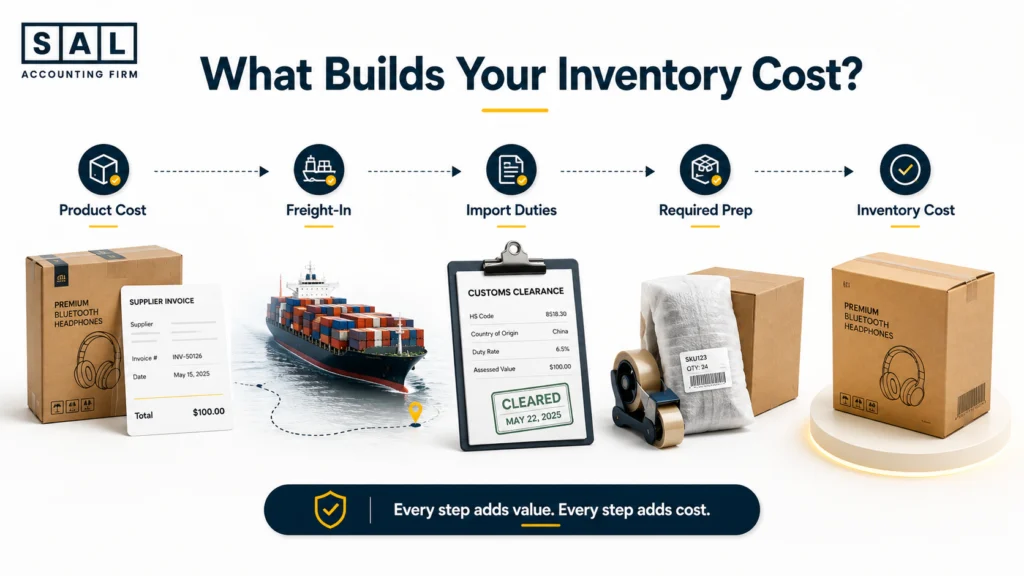
The easiest way to think about capitalization is to ask: Was this cost needed to acquire the product or get it to the location and condition where it could be sold?
If the answer is yes, it may belong in inventory. That is also the logic behind ecommerce landed cost accounting. The supplier invoice is often only one part of what a unit truly costs. Here is the basic split.
| Cost | Ecommerce Example | Usual Treatment | Main Reason |
|---|---|---|---|
| Product purchase | Supplier invoice | Capitalize | Direct inventory cost |
| Manufacturing | Private-label production | Capitalize | Creates the product |
| Inbound freight | Ocean or air freight | Capitalize | Brings stock in |
| Import duties | Duties on imported goods | Capitalize | Acquisition cost |
| Product preparation | Required labeling or assembly | May capitalize | Makes product saleable |
| Direct handling | Required inbound handling | May capitalize | Brings stock to location/condition |
The exact treatment still depends on what the charge actually covers.
Product Purchase and Manufacturing Costs
These are usually the clearest inventory costs. For a reseller, this typically starts with the supplier invoice. For a private-label brand, inventory cost may also include:
- Raw materials
- Finished-product manufacturing
- Components
- Direct production labour
- Product-specific manufacturing charges
These costs do not become ordinary business expenses simply because cash left the bank. That distinction should also appear in your ecommerce bookkeeping checklist, especially when inventory orders are large or irregular.
Pro tip: Don’t categorize a supplier payment based only on the bank transaction. Match it to the purchase order, units received, freight documents, and inventory records.
Freight-In and Transportation Costs
“Shipping” can mean two completely different things in ecommerce.
Let’s say you pay $3,000 to move inventory from an overseas manufacturer to your Canadian warehouse. That cost helps bring the inventory to you. Then you pay $12 to send one finished order from the warehouse to a customer. Those costs do different jobs:
- Supplier to warehouse → potentially inventory cost
- Warehouse to customer → generally fulfilment expense
Once those inbound costs are included in inventory, your costing method determines how they flow into COGS. That is where FIFO vs. weighted-average inventory costing becomes relevant.
Import Duties and Related Costs
Imported products often cost more than the supplier invoice suggests. Inventory cost may also include:
- Customs duties
- Certain brokerage costs
- Inbound freight
- Direct handling
- Non-recoverable taxes
IAS 2 includes import duties, non-refundable taxes, transport, handling, and other directly attributable acquisition costs within inventory cost. IAS 2 inventory guidance provides the formal accounting framework.
GST/HST needs separate treatment. Registered businesses may be able to recover qualifying GST/HST through input tax credits, so recoverable tax should not automatically be buried inside inventory cost.
Pro tip: Separate recoverable GST/HST before calculating landed cost. SAL’s GST/HST Refund Calculator for Ecommerce Stores gives you a useful first check.
Product Preparation Costs
Some costs happen after stock arrives but before it is actually ready to sell. Examples include:
- Required product labeling
- Assembly
- Product-specific modifications
- Preparation required before listing the product for sale
A skincare bottle that arrives without its required label is not necessarily in the same condition as the finished product ready for the customer.
The question is simple: Was the work required to make the product saleable?
Case Study: How Maya in Liberty Village, Toronto Separates Inventory Costs From Expenses1
Maya runs a Shopify skincare brand from Liberty Village, Toronto. Her supplier, freight company, customs broker, warehouse, and Shopify all charge her within the same few weeks, so the cash leaving her bank makes everything look like one big monthly expense.
The Problem
Inbound freight and duties are being expensed immediately even though most of the related inventory is still unsold. Meanwhile, some ordinary operating costs are mixed into product cost.
What We Do
We separate supplier cost, qualifying freight, duties, and required product preparation from storage, Shopify fees, and other selling costs.
The Result
Inventory better reflects the products Maya still owns, while COGS follows the units that actually sell. Her gross margin no longer swings simply because she placed a large inventory order.
For Shopify brands where inventory, payouts, fees, and COGS need to line up every month, SAL’s Shopify accounting services keep those pieces separated properly.
Also read: “How to Handle Inventory Accounting in Shopify”
Which Ecommerce Costs Should Usually Be Expensed?
Not every cost connected to a product belongs in inventory. Once a product is ready to sell, most costs connected to marketing, selling, fulfilling, or running the business are generally expenses. Common examples include:
- Advertising
- Shopify subscriptions
- Payment processing fees
- Outbound shipping
- Customer fulfilment
- General storage
- Business software
These belong with your broader ecommerce business expenses, rather than automatically being added to inventory.
Marketing and Advertising
Meta Ads, Google Ads, influencer campaigns, and affiliate commissions may affect whether a product is profitable, but they do not normally make the physical product ready for sale.
That means they are generally treated as selling expenses.
This distinction matters because hidden ecommerce expenses can still reduce profit even when they are not part of COGS.
Shopify and Payment Processing Fees
Shopify subscriptions, card-processing charges, and transaction fees are tied to running the store and processing sales. They are not generally inventory costs.
Shopify’s official pricing information separates plan fees, card rates, and transaction fees from the cost of the physical products you sell. Mixing these fees into product cost is also one reason Shopify profit calculations go wrong.
See what each order loses to platform and payment costs with SAL’s Shopify Fee Calculator.
Customer Fulfilment and Outbound Shipping
Costs incurred after the product is ready for sale are generally treated differently from freight-in. That can include:
- Pick and pack
- Customer shipping
- Delivery fees
- Certain fulfilment charges
- Returns handling
Amazon describes its FBA fulfilment fees as covering activities such as picking, packing, shipping, customer service, and returns. Those are fulfilment activities rather than the original cost of acquiring the product. Amazon FBA pricing explains the fee structure.
General Storage Costs
Normal storage for products already ready to sell is generally an expense rather than inventory cost. IAS 2 specifically excludes storage costs unless they are necessary in the production process before another production stage. So there is a difference between:
- Storage necessary during production
- Finished inventory waiting in a warehouse for a customer
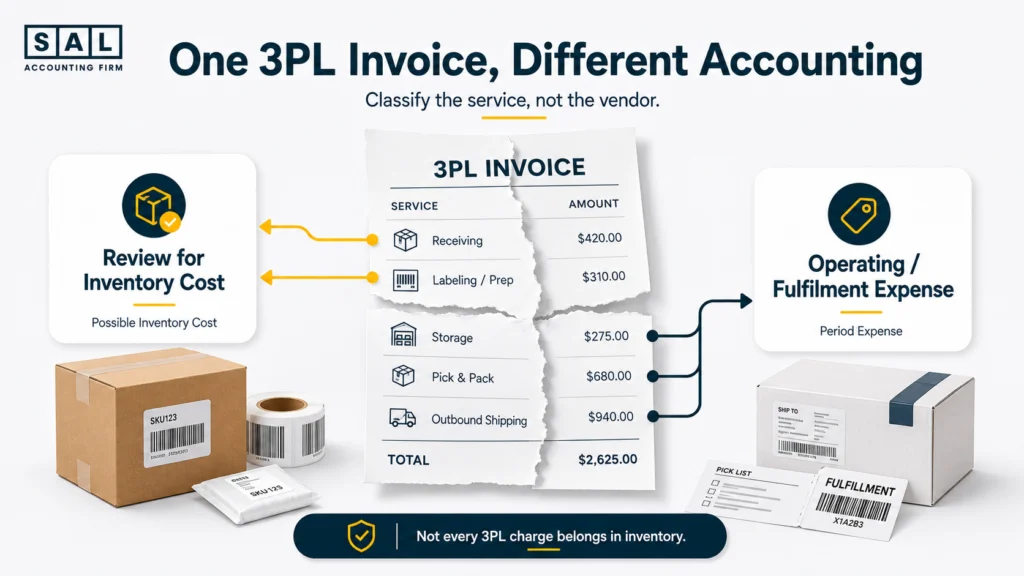
That distinction is easy to miss when a 3PL sends one monthly invoice for several different services.
Which Ecommerce Inventory Costs Fall Into a Grey Area?
This is where you need to look beyond the invoice label. Terms such as “prep fee,” “warehouse fee,” and “packaging” can cover very different activities. The purpose of the charge matters more than the name.
| Cost | May Be Capitalized When… | More Likely Expensed When… | Check |
|---|---|---|---|
| Packaging | Required to make product saleable | Used for customer shipment | Purpose |
| Amazon prep | Prepares inventory before sale | Relates to fulfilment | Service |
| 3PL receiving | Directly brings stock into inventory | General warehouse admin | Invoice detail |
| Storage | Required during production | Finished stock waits for sale | Timing |
| Brokerage | Directly tied to importing stock | General admin | Scope |
| Inspection | Required before product is saleable | Routine later check | Reason |
Packaging Costs
Imagine you sell supplements. The bottle, label, seal, and retail box may be necessary before the finished product can be sold. The mailer used to ship that product after an order comes in does something completely different.
Calling both of them “packaging” does not make them the same accounting cost. Separating the two also improves your SKU profitability analysis because product cost starts from a cleaner number.
Amazon Prep and 3PL Charges
A single 3PL invoice could contain:
- Receiving
- Labeling
- Storage
- Pick and pack
- Outbound shipping
You should not assume the entire invoice belongs in inventory. Some charges may relate to preparing or receiving the product. Others clearly happen after the product is ready for sale.
A proper ecommerce product profitability test becomes much more useful once those costs are separated.
Pro tip: Ask your 3PL for itemized invoices. “Warehouse services — $8,000” is not enough detail to classify the cost properly.
A Simple Example: Capitalized vs. Expensed Ecommerce Costs
Suppose a Canadian ecommerce brand places a $30,000 inventory order. It also pays:
- $3,000 ocean freight
- $2,000 import duties
- $800 required product labeling
- $700 finished-goods storage
- $1,500 Meta Ads
- $900 customer shipping
- $600 Shopify and payment fees
A simplified treatment could look like this:
Potential inventory cost
- $30,000 supplier cost
- $3,000 freight-in
- $2,000 duties
- $800 qualifying preparation
Potential total capitalized inventory: $35,800
The other costs would generally remain separate expenses:
- Storage
- Advertising
- Customer shipping
- Shopify/payment fees
Now imagine only half the inventory sells.
Expensing the full $35,800 immediately could make the purchase month look much weaker even though a large amount of stock is still sitting on the shelf.
That is one of the reasons DIY ecommerce bookkeeping mistakes can distort the timing of inventory and COGS.
Case Study: How Daniel in Meadowvale, Mississauga Separates Amazon and 3PL Costs2
Hypothetical scenario.
Daniel runs a home-organization brand from Meadowvale, Mississauga. His Amazon and 3PL charges cover receiving, prep, storage, fulfilment, returns, and other warehouse activity.
The Problem
Most of those charges are sitting in one broad product-cost account. Daniel cannot easily tell what it costs to acquire the inventory versus what Amazon costs him to sell it.
What We Do
We split the charges by purpose. Qualifying inbound and preparation costs are reviewed separately from storage, fulfilment, selling fees, and returns.
The Result
Daniel gets a cleaner inventory cost and a clearer view of Amazon selling expenses. His product margin becomes easier to interpret because COGS is no longer carrying unrelated fulfilment costs.
For sellers dealing with settlements, FBA fees, and inventory at the same time, SAL’s Amazon accounting services keep those movements in the right buckets.
Also read: “Amazon FBA Accounting Best Practices”
What Happens When Inventory Is Capitalized or Expensed Incorrectly?
The biggest problem is not the accounting label itself. It is what happens to your profit.
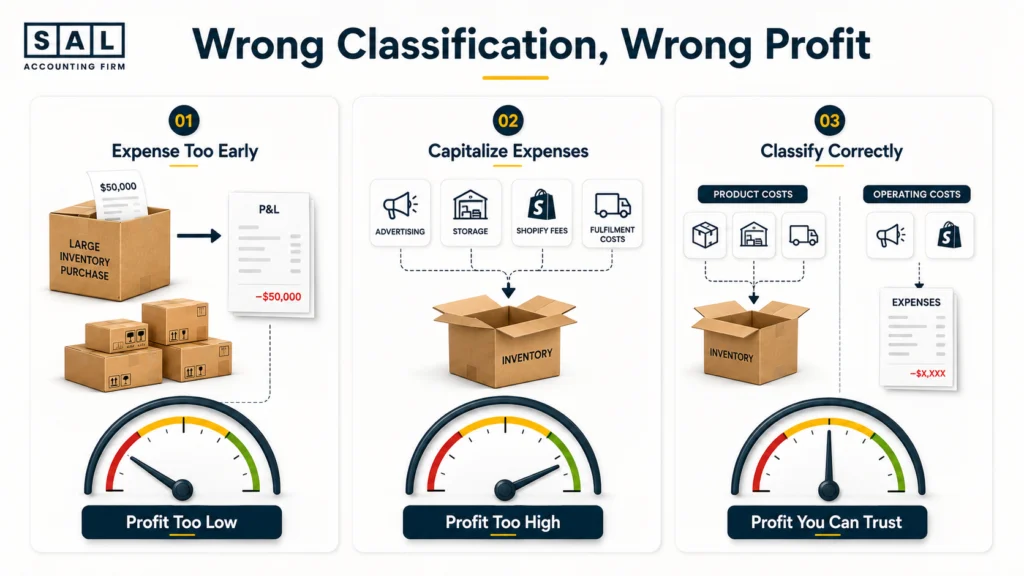
Expensing Inventory Too Early Can Make Profit Look Too Low
Suppose you buy $50,000 of inventory in September but sell it over six months. Expensing the full amount in September can make that month look unusually weak.
Then future months may look unusually profitable because the products are selling without the matching inventory cost flowing through properly.
Capitalizing Expenses Can Make Profit Look Too High
The opposite happens when ordinary expenses are placed into inventory. For example, capitalizing costs such as:
- Advertising
- Finished-goods storage
- Customer fulfilment
- Selling fees
can move those expenses off the current P&L. Reported profit rises, but the business did not actually become more profitable.
That is one way ecommerce financial statements become unreliable even when the books appear tidy.
COGS and Gross Margin Become Harder to Trust
Your gross margin depends on COGS starting with the right product cost. When freight and duties are missing, product cost may look too low.
When selling costs are pushed into inventory, product cost may look too high. The point is simple: product cost and the wider cost of making a sale need to stay separate.
For ongoing bookkeeping built around inventory, COGS, payouts, and platform fees, SAL’s ecommerce accounting services are designed around those ecommerce-specific movements.
Quick Test: Should This Ecommerce Cost Be Capitalized?
When you are unsure where a cost belongs, ask:
- Was it directly tied to buying or producing inventory?
- Was it needed to bring inventory to its current location?
- Was it required to make the product saleable?
- Did the cost happen after the product was already ready to sell?
- Is it really a marketing, fulfilment, storage, platform, or admin cost?
The first three answers point more toward capitalization. The last two point more toward expensing. And if one invoice includes both? Split it.
That is the same logic behind proper ecommerce transaction categorization: record what actually happened rather than categorizing everything based on the vendor name.