

Cross-border ecommerce cash flow problems can hide behind strong sales. Money gets trapped in launch costs, inventory, slow break-even timing, marketplace reserves, tax, and sales that never fully reach your bank.
SAL Accounting works with Canadian Shopify and Amazon sellers to trace those gaps across Canada and the U.S. Keep reading before your next busy month turns a small cash mismatch into a payroll, inventory, or tax problem.
Start with the gap between your store revenue and the amount reaching your bank. See what Shopify may be deducting before each payout lands.
Quick Takeaways
- Strong sales do not always produce strong cash flow.
- Cross-border growth usually uses cash before it generates dependable payouts.
- Inventory, freight, duties, platform fees, and tax all affect how much money remains available.
- Shopify payouts and Amazon settlements should not be recorded as simple sales deposits.
- Several small cash problems often stack up during the same month.
- A weekly forecast shows emerging cash shortages earlier than a monthly sales report.
When sales, fees, refunds, inventory, and tax no longer line up, SAL’s ecommerce bookkeeping keeps the full sales-to-cash trail in one monthly process.
What Causes Cash to Get Stuck in Cross-Border Ecommerce?
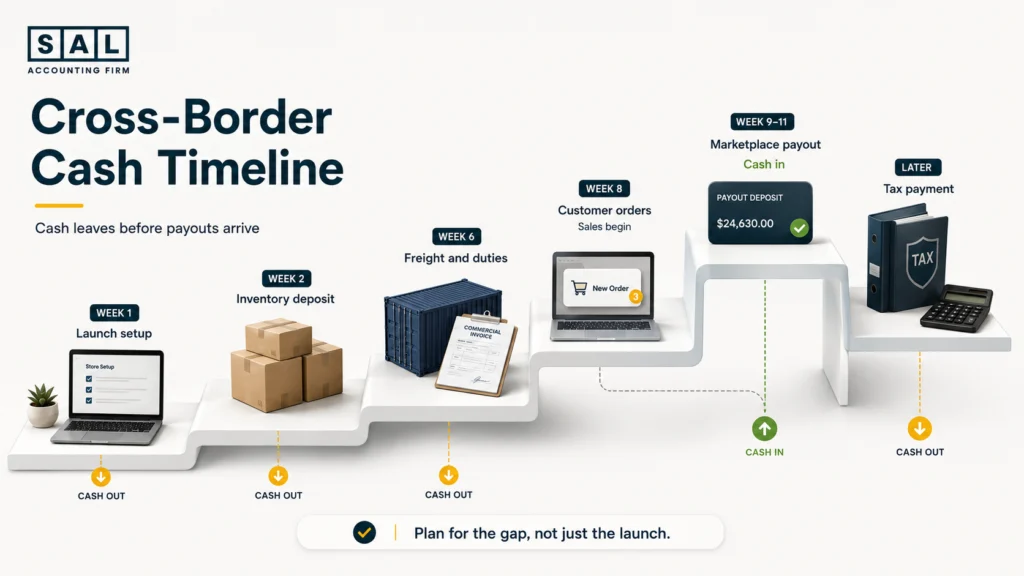
Cash gets stuck when your business must spend, reserve, or return money before its cross-border sales become available in the bank.
The money is not always lost. It may be sitting in unsold inventory, held by a marketplace, waiting in a payout cycle, or already committed to an upcoming tax bill.
| Cash-flow problem | Where cash gets stuck | Early warning sign | First number to check |
|---|---|---|---|
| Expansion spending | Setup, ads and operations | Costs rise before sales | Launch budget |
| Inventory and imports | Stock, freight and duties | Inventory rises while cash falls | Landed cost |
| Slow break-even | Ongoing market losses | Revenue rises but cash drops | Weekly net cash |
| Payment holds | Platform or processor reserves | Sales exceed deposits | Payout report |
| Unexpected tax | GST/HST, income or sales tax | No tax cash is reserved | Estimated tax payable |
| Lost collections | Refunds, disputes and bad debt | Gross sales exceed net cash | Refund and dispute rate |

1. Why Cross-Border Expansion Uses Cash Before It Produces Cash
Entering a new market requires more than switching on international shipping.
Your store may need to pay for:
- New packaging or labelling
- U.S. advertising campaigns
- Marketplace setup
- Product registrations
- Additional software
- A warehouse or third-party logistics provider
- Professional advice
- Customer support
- Returns processing
- Currency conversion
Most of those costs arrive before the new market creates consistent sales.
For example, a Canadian store might spend $17,000 preparing inventory and operations for a U.S. launch. It then spends another $12,000 testing advertising during the first eight weeks.
The expansion has already used $29,000 before the founder knows whether repeat orders will cover its monthly costs.
The bigger risk is funding that launch with money already needed for Canadian payroll, inventory, or tax.
Pro Tip: Build a separate expansion budget. Include setup costs, monthly expenses, inventory, tax, and enough working cash to protect the existing business.
A U.S. company may look like an easy way to lower cross-border payment costs, but it also adds tax and filing responsibilities. Check whether a U.S. LLC leaves your Shopify store better off before adding another company to the structure.
2. How Inventory, Freight, and Duties Tie Up Cash
Inventory creates a timing gap because you pay for products before customers pay you.
With cross-border inventory, the supplier invoice is only the beginning. Your cash commitment may also include:
- Supplier deposits
- Final production payments
- International freight
- Cargo insurance
- Customs duty
- Brokerage fees
- Inspection charges
- Warehouse receiving
- Storage
- Currency conversion
CBSA guidance explains that the duties and taxes on commercial imports depend on factors such as tariff treatment, the duty rate, the value of the goods, and whether GST or other charges apply. That means the amount required to receive a shipment can be much higher than the supplier invoice suggests. Review the CBSA import guidance.
Suppose you order $46,000 of products. Freight, insurance, brokerage, duties, and receiving add another $10,400.
Your store has now committed $56,400, and some of those products may sit for several months before they turn back into cash.
Basically, owning more inventory does not mean you have more money available.
Pro Tip: Calculate landed cost by shipment and, where practical, by SKU. A product may have a strong selling price but still absorb too much cash after freight, duties, storage, and returns.
Case Study: How a Meadowvale Amazon Seller Freed Up Cash Tied to Inventory1
A home-goods seller in Meadowvale, Mississauga, was expanding through Amazon FBA in the United States. Orders were rising, so the owner kept placing larger inventory orders. However, each Amazon settlement seemed too small to fund the next shipment. The Seller Central dashboard showed strong demand, but the bank balance kept falling.
The Problem
The business was comparing Amazon sales directly with bank deposits. FBA fees, advertising, refunds, storage charges, reserve movements, and inbound freight were not separated clearly.
The store had also ordered too much of three slow-moving products. Cash was sitting in inventory while the owner prepared another large purchase order.
What We Do
We rebuild the Amazon settlement flow so sales, returns, advertising, FBA charges, reserves, and deposits are visible separately.
Then we compare each product’s sales with its landed cost, Amazon deductions, return rate, and sell-through speed. The next inventory order is based on what is likely to sell, not only what the Amazon dashboard reports.
Result
The owner removes two slow-moving SKUs from the next purchase order and reduces another order by $21,500. The forecast also includes a $15,200 Amazon reserve instead of treating that money as immediately available.
The store stops using Canadian payroll cash to fund excess U.S. inventory and knows how much each future Amazon settlement should leave behind.
Turn Amazon settlements into numbers you can use: Explore Amazon seller bookkeeping in Toronto.
Inventory was only one part of the pressure. The business also needed enough cash to survive the period before its U.S. sales became self-funding.
3. Why Cross-Border Break-Even Takes Longer Than Planned
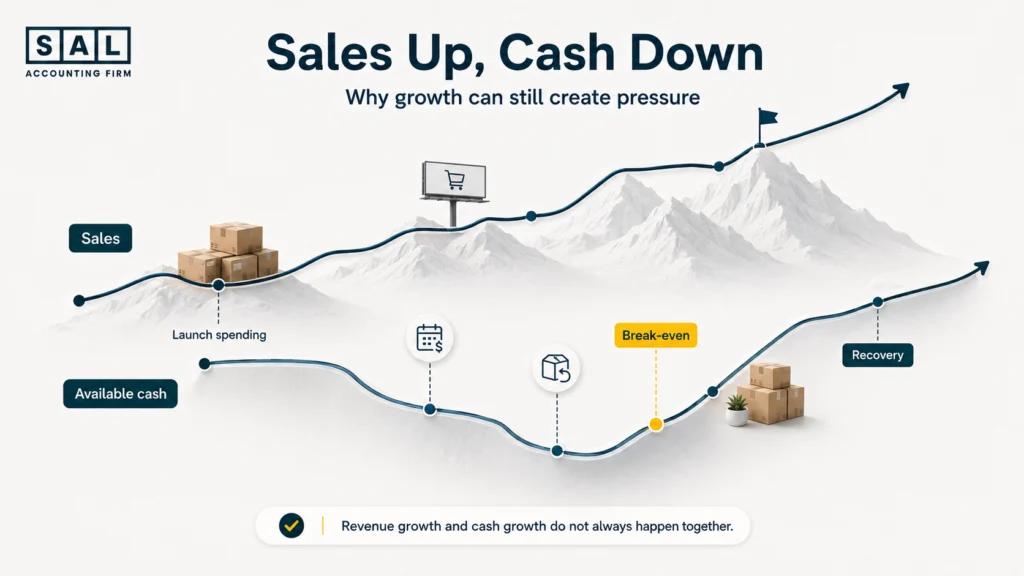
A new market can generate revenue without covering its own costs.
Imagine your U.S. channel produces $72,000 in monthly sales. After product costs, advertising, shipping, marketplace fees, refunds, and additional support, it still uses $8,000 more cash than it produces.
That does not automatically mean the expansion has failed. It means the existing business must fund the loss until the new channel reaches break-even.
The problem appears when you planned for three unprofitable months and the real timeline is closer to nine.
A sales forecast asks:
How much could we sell?
A cash forecast asks:
Do we have enough money to reach the point where those sales support the business?
Before increasing advertising or inventory, see what your store’s core operations are producing. The Ecommerce EBITDA Calculator gives you a starting view of performance after product costs, marketing, and operating expenses.
It does not replace a cash forecast. A profitable store can still run short when payouts arrive after large bills are due.
Pro Tip: Forecast the next 13 weeks by week. Include expected payouts, inventory deposits, payroll, advertising, tax, loan payments, and fixed overhead.
4. How Marketplace Reserves and Payment Holds Delay Payouts
A completed sale is not available cash until the marketplace or payment processor releases the money.
Shopify defines a reserve as a temporary hold on part, or sometimes all, of the transactions processed through Shopify Payments. Reserves may be used to cover potential losses from issues such as refunds and chargebacks, and the terms are communicated directly to the merchant. Shopify’s reserve guidance explains the main reserve types and review process.
Amazon also shows funds under an account-level reserve in the Payments report. Amazon says these reserves may cover obligations such as refunds, claims, and chargebacks. Amazon’s reserve guidance explains where sellers can review the balance.
Here is what that payout gap might look like:
- Gross orders: $98,000
- Refunds and discounts: $7,400
- Platform and payment fees: $5,600
- Marketplace reserve: $13,000
- Current bank deposit: $72,000
The store sold $98,000, but only $72,000 became available during that payout period.
That does not mean revenue was $72,000. Your books should show the full sales, refunds, discounts, fees, taxes, reserve movements, and final deposit.
Shopify’s payout reconciliation report provides a breakdown of transactions, fees, and payouts for a selected period and currency.
Case Study: How a Liberty Village Shopify Store Found $28,400 in Trapped Cash2
A skincare brand in Liberty Village, Toronto, had grown to more than $145,000 in monthly Canadian and U.S. Shopify sales. Despite the growth, the founder regularly transferred personal money into the business before payroll.
She assumed advertising was draining the account. The bigger issue was that several parts of the Shopify sales cycle were being mixed together.
The Problem
Shopify bank deposits were being recorded as total sales. Processing fees, refunds, foreign exchange charges, and payout adjustments were missing from the monthly reports.
The business had also prepaid for inventory, while GST/HST collected from customers remained mixed into operating cash.
What We Do
We separate gross sales, discounts, refunds, fees, tax, payout adjustments, and deposits.
Inventory payments are matched with the related shipments, and expected Shopify payouts are placed into a 13-week cash forecast. That shows which money is available now, which is still coming, and which already belongs elsewhere.
Result
The founder sees that the missing $28,400 is not one unexplained loss:
- $12,900 is tied up in inventory in transit
- $7,300 relates to payout deductions and delayed funds
- $5,100 needs to remain available for GST/HST
- $3,100 relates to refunds and disputes
She delays one non-urgent purchase, separates the tax money, and schedules the next inventory deposit around expected Shopify payouts.
Make every Shopify deposit explainable: Explore Shopify accounting services in Toronto.
Once the payouts were separated properly, the next issue became easier to see. Part of the remaining bank balance was already needed for tax.
5. How Unexpected Tax Bills Drain Working Cash
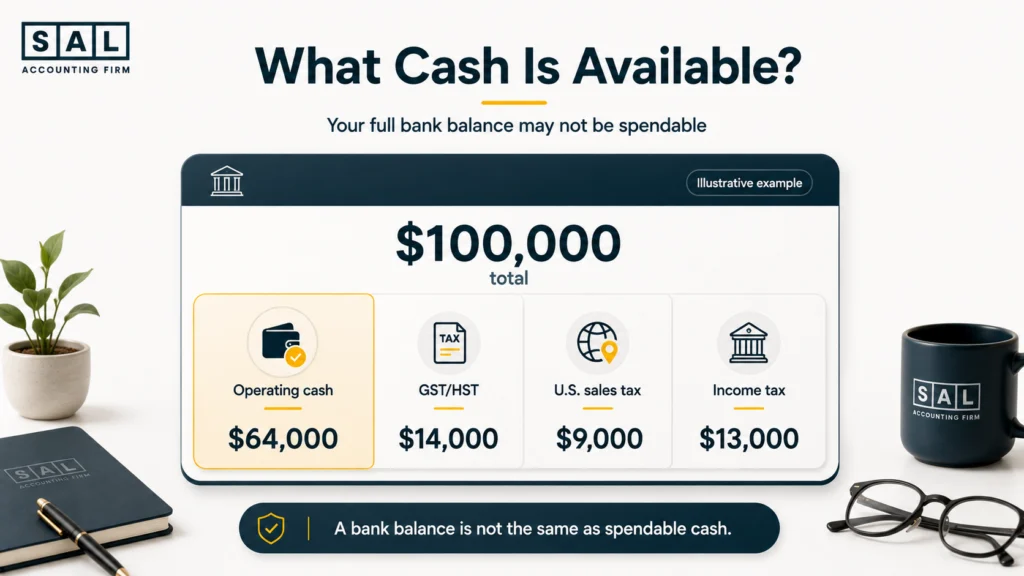
Tax becomes a cash-flow problem when money collected or owed for tax is treated as normal operating cash.
A Canadian cross-border seller may need to track:
- GST/HST collected on Canadian sales
- Input tax credits on eligible expenses
- Corporate income tax
- Provincial sales taxes
- U.S. state sales tax
- Tax connected to a U.S. entity
- Foreign tax payments or credits
The CRA states that eligible GST/HST registrants may recover GST/HST paid or payable on purchases and expenses related to commercial activities by claiming input tax credits. Certain exports may also be zero-rated, depending on the transaction and supporting records. Review CRA’s GST/HST guidance for imports and exports.
U.S. sales tax needs a separate review. States use different economic nexus thresholds and may calculate those thresholds using gross, retail, or taxable sales. Physical activity, such as storing inventory in a state, can create additional obligations. Remote-seller state guidance provides a state-by-state starting point.
Use the relevant check rather than treating tax as one general number:
- Estimate the corporate tax your current profit may create.
- Compare GST/HST collected with eligible GST/HST paid.
- Screen your U.S. sales against state nexus thresholds.
These tools provide starting estimates. Your registrations, filing periods, inventory locations, entity structure, and actual transactions still need to be reviewed.
Pro Tip: Transfer estimated tax into a separate bank account every month. Waiting until the filing deadline makes it much easier to spend cash that was never truly available.
- Also read: “The Cost of Ignoring Cross-Border Tax Planning”
6. Why Refunds, Chargebacks, and Bad Debt Reduce Collections
Some sales shown in your reports will never become permanent cash.
The money may disappear through:
- Customer refunds
- Chargebacks
- Fraud
- Failed payments
- Shipping claims
- Marketplace claims
- Unpaid wholesale invoices
- Currency losses
For direct-to-consumer stores, refunds and disputes are usually more common than traditional unpaid invoices.
Shopify states that when a Shopify Payments chargeback is issued, the amount is deducted from the next available payout. If the merchant wins the dispute, the disputed amount is returned. Review Shopify’s chargeback process.
For stores offering wholesale or B2B credit terms, some receivables may eventually become bad debt. CRA guidance says a receivable generally needs to be determined to be a bad debt in the year before it is claimed as such. CRA’s bad-debt guidance outlines the general conditions.
Do not leave doubtful amounts mixed into normal receivables. Separate them, review their age, document collection attempts, and decide whether the money is delayed or realistically gone.
Pro Tip: Track refunds and chargebacks by product. A bestseller with frequent returns may increase reported sales while weakening profit and cash flow.
How Do Cross-Border Cash Flow Problems Stack Up?
Cross-border cash shortages are usually caused by several normal events happening at once, not one dramatic loss.
Consider a Canadian seller that records $125,000 in U.S. orders during a strong month. The founder expects those sales to fund the next inventory purchase.
| Cash movement | Expected | Actual | Gap | Main reason |
|---|---|---|---|---|
| Customer sales | $125,000 | $125,000 | $0 | Orders processed |
| Marketplace payout | $125,000 | $104,000 | $21,000 | Fees, refunds and reserve |
| Inventory payment | $35,000 | $49,500 | $14,500 | Freight, duty and larger order |
| Tax reserve | $0 | $8,500 | $8,500 | Tax was not separated |
| Cash before overhead | $90,000 | $46,000 | $44,000 | Three issues stacked |
The business did not lose $44,000 in one transaction.
Instead:
- Part of the sales had not been released.
- The next inventory order cost more than expected.
- Money needed for tax had been treated as spendable cash.
Each issue looks manageable on its own. Together, they leave much less for payroll, marketing, software, and normal overhead.
That is why the sales dashboard can look strong while the bank account feels empty.
How Can You Find Where Ecommerce Cash Is Stuck?
Start with the last three months of bank statements. Then compare the deposits and withdrawals with your Shopify payouts, Amazon settlements, inventory payments, refund reports, and tax balances.
| What to review | Compare these numbers | Warning sign | First action |
|---|---|---|---|
| Platform payouts | Gross sales and deposits | Deposits stay much lower | Separate deductions |
| Inventory | Purchases and sell-through | Stock rises while cash falls | Reduce reorders |
| Tax | Collected tax and cash reserved | Nothing is set aside | Estimate the balance |
| Refunds | Gross and net sales | Refund rate keeps rising | Review products |
| Receivables | Invoices and collections | Old balances keep growing | Assess recovery |
| Expansion | New-market cost and contribution | Channel keeps using cash | Reforecast break-even |
Work through these questions:
- Which costs were paid before a sale happened?
- Which completed sales have not reached the bank?
- How much of the bank balance already belongs to tax?
- Which inventory will not sell before the next order is due?
- Which refunds, disputes, or invoices are unlikely to be recovered?
- Does the same cash shortage appear every month?
Gathering the right reports is often the hardest first step. Build your review file with the Ecommerce Tax Document Checklist. It covers the platform reports, banking records, tax information, and system access usually needed for a proper review.