Not sure if your eCommerce numbers actually make sense? You’re not alone.
Maybe Shopify says one thing, your payouts say another, and your accountant gives you a P&L that makes things even more confusing.
This is one of the most common issues we see with ecommerce businesses. Bad e-commerce accounting is not just “messy books.” It can lead to wrong profit numbers, inventory mistakes, tax risk, and decisions based on wrong numbers. Canada’s ecommerce market hit US$64.5 billion in revenue in 2025, which means getting your accounting wrong is more expensive than ever.
This guide from SAL Accounting is for Shopify, Amazon FBA, and multichannel sellers in the US and Canada who are working with a general accountant and wondering:
Do they actually understand eCommerce?
Let’s walk through the main ecommerce accountant red flags, what they can cost you, and what good ecommerce accounting should look like instead.
Quick Takeaways
- Payouts are not revenue. Gross sales, fees, refunds, tax, and payouts should be tracked separately.
- If platform reports, tax forms, and payouts do not match, revenue may be wrong.
- Wrong COGS means wrong gross margin and poor product decisions.
- Inventory businesses usually need more than cash-basis accounting.
- A good ecommerce accountant understands platform access, Seller Central, sales tax, GST/HST, and cross-border issues.
Why Is Ecommerce Accounting Different From Regular Bookkeeping?
A regular business might send an invoice, get paid, and record the deposit. Ecommerce does not work that cleanly.
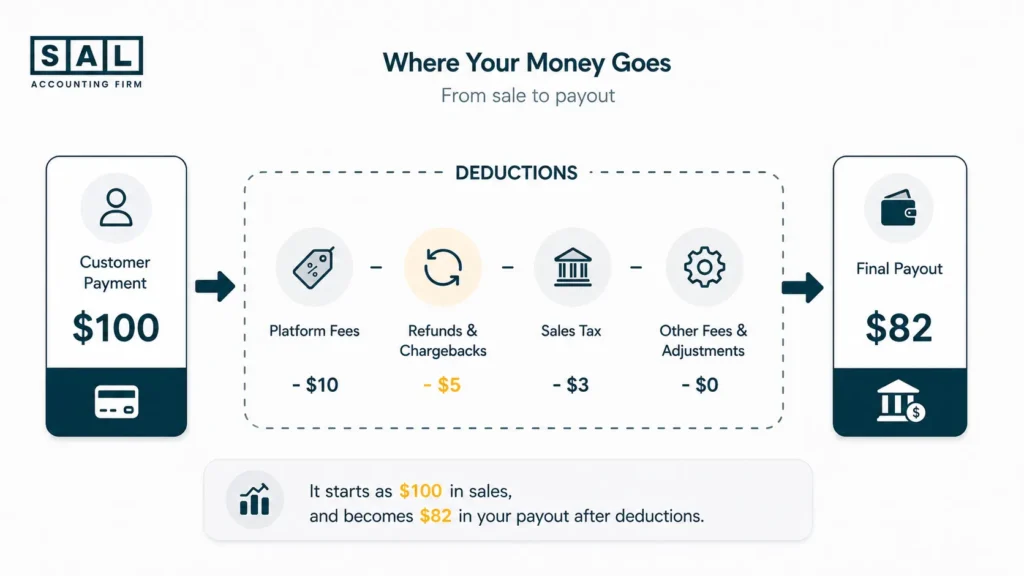
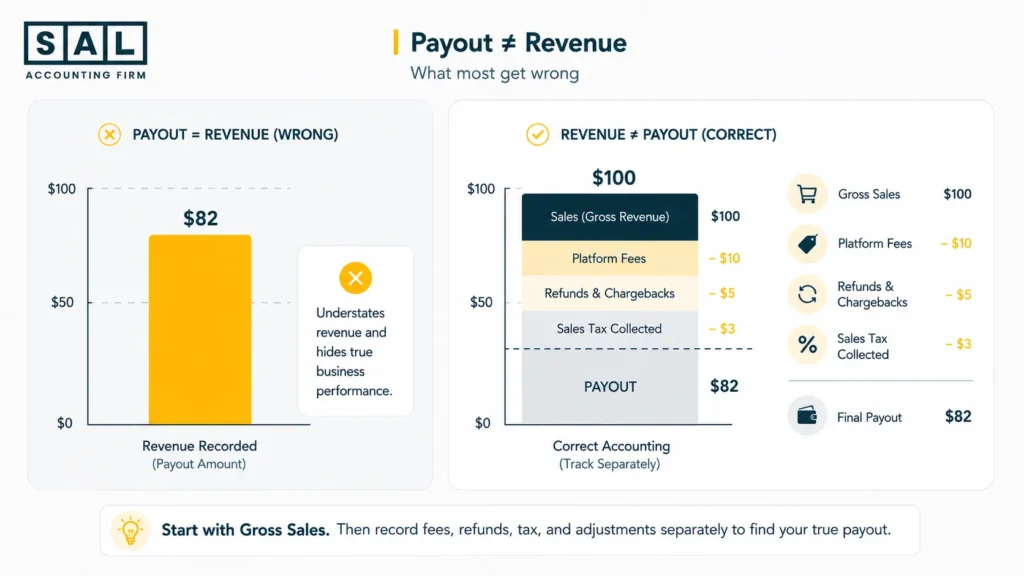
Let’s say you sell a product for $100 on Shopify. After fees, refunds, chargebacks, sales tax, shipping adjustments, and app charges, only $82 might come through in your payout. If your accountant records that $82 as revenue, your books are already wrong.
Ecommerce accounting has more moving parts: multiple platforms, marketplace fees, refunds, inventory, COGS, sales tax, GST/HST, tax forms, and timing differences between sales reports and payouts.
The point is simple: your accountant needs to understand how your store actually makes money. If they do not, your reports can look clean while still being wrong.
If your numbers feel messy, working with an ecommerce accounting expert can help you understand your financial situation more clearly.
8 Red Flags of a Bad Ecommerce Accountant
What are the red flags of an ecommerce accountant? The clearest signs are wrong revenue, messy payout matching, inaccurate COGS, no platform access, tax blind spots, late books, and confusing reports.
Some of these may sound familiar. That does not mean you’ve done anything wrong. These are some of the most common bad ecommerce accounting signs we see when businesses outgrow their current setup.
1. They Treat Payouts as Revenue
This is one of the biggest ecommerce accounting mistakes.
Let’s say you sell $100,000 through Shopify in a month, but only $82,000 comes through after fees, refunds, chargebacks, sales tax, and adjustments.
If your accountant records that $82,000 payout as revenue, they are missing the full picture.
Now you know that payouts are not revenue, you can use our Shopify Fee Calculator to see your numbers more clearly for free.
What good looks like
A good ecommerce accountant starts with gross sales, then records refunds, fees, taxes, adjustments, and the final payout separately. They show you what actually happened.
That’s the difference between guessing and actually understanding your numbers.
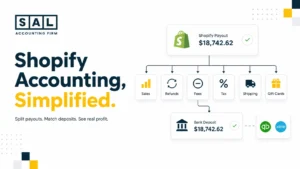
Note: If Shopify is where things start to feel confusing, Shopify accounting free support can help you feel clearer on your numbers.
2. They Can’t Reconcile Platform Reports to Payouts
Do Shopify, Amazon, Stripe, PayPal, and tax forms all show different numbers? That’s normal. But your accountant should be able to explain why.
Sales, refunds, chargebacks, fees, holds, reserves, and payouts can all hit different dates. If they are not matched properly, they can get duplicated, missed, or wrong. This is one of the most common Shopify accountant errors, especially when payouts are treated as revenue.
What good looks like
A good ecommerce accountant uses clearing accounts and monthly payout checks. The numbers do not need to look identical at first glance, but they should always be explainable.
3. COGS Is Wrong or Inconsistently Tracked
COGS means the cost of goods sold, or the cost of products you’ve actually sold. This is where a lot of inventory and COGS mistakes start to happen.
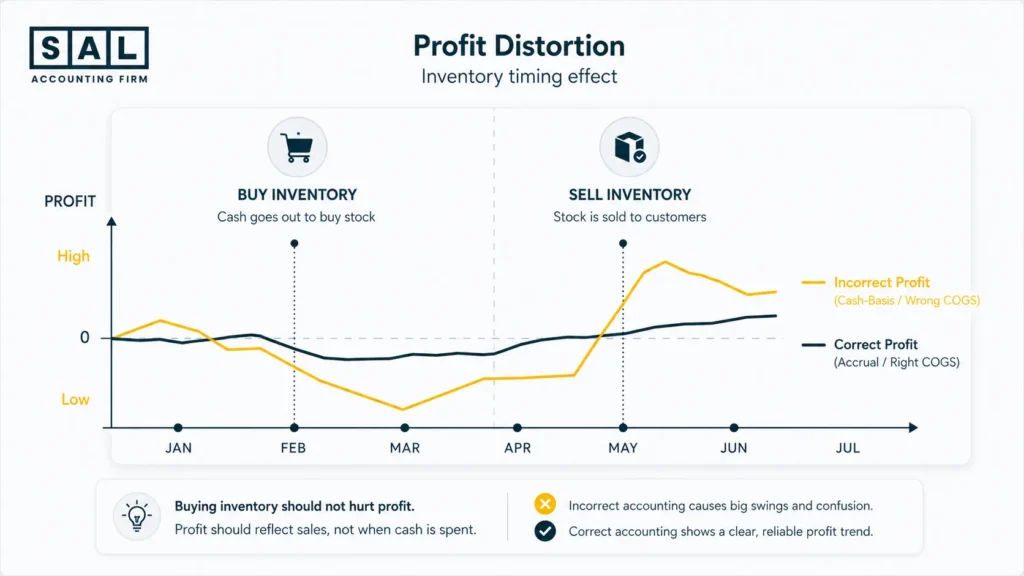
If you buy $50,000 of inventory in January, that full cost should not usually hit profit right away. It should move through your books as products sell.
When COGS is wrong, profit is wrong. One month can look terrible because you bought stock. Another can look great because product costs were missed.
What good looks like
A good ecommerce accountant tracks inventory as an asset until it sells, includes landed cost, and matches COGS to units sold.
Basically, they help answer: “Are we actually making money on this product?”
Pro Tip: If your accountant uses a rough inventory estimate to calculate COGS instead of actual sales and inventory data, the process is probably not set up properly.
4. They Use Cash-Basis Accounting for an Inventory Business
Cash-basis accounting can work for simple businesses. But for an ecommerce business with inventory, it can make profit look confusing.
Your reports may show a loss when you buy stock, then too much profit when that stock sells.
What good looks like
A good ecommerce accountant knows when accrual accounting is needed. They match product costs to the sales they belong to, so your profit looks more accurate and useful. The point is to make the numbers more useful.
5. They Do Not Ask for Seller Central or Platform Access
If your accountant handles Amazon FBA but never asks for Seller Central access, that is a red flag.
Amazon payouts alone do not show the full story. Key details like fees, refunds, reimbursements, reserves, storage charges, and inventory data are in the Seller Central. This is also one of the more common Amazon FBA accounting mistakes, since payouts alone never show the full picture.
The same applies to Shopify, Stripe, PayPal, Etsy, WooCommerce, and other platforms. If your accountant cannot see the source data, they are guessing.
What good looks like
A good ecommerce accountant asks for the right access early, usually read-only access.
If your Amazon numbers are hard to understand, expert Amazon accountants can help you feel clearer on what is happening in the business.
6. They Don’t Understand Sales Tax, GST/HST, or Cross-Border Issues
A common line we hear is:
“Shopify handles sales tax, so I think we’re fine.”
Maybe. Maybe not. Platforms can help calculate or collect tax, but they do not always cover everything.
In the US, economic nexus typically triggers at $100,000 in sales per state. For Canadian sellers, GST/HST, CRA reporting, US sales tax, customs, duties, and inventory location can all overlap.
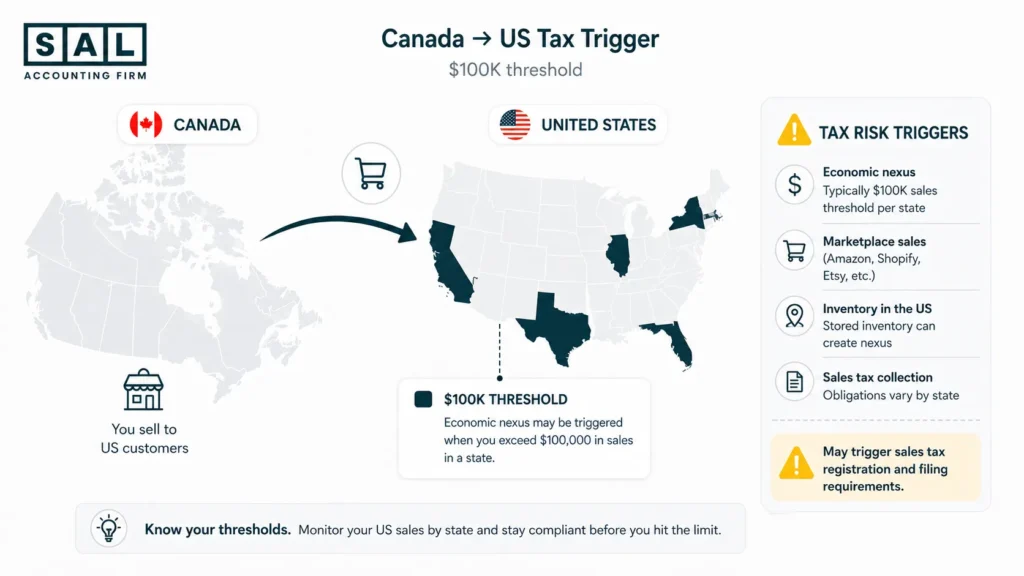
If you’re not sure whether your US sales could create a tax problem, our US Economic Nexus Threshold Checker Tool can help you check before it becomes a burden, for free.
What good looks like
A good ecommerce accountant does not assume the platform handles everything.
They review your sales channels, customer locations, marketplace activity, tax settings, and tax liabilities. They also know when to bring in a specialist.
If selling into the US is starting to feel risky or unclear, a cross-border tax accountant can help you understand what you need and how to stay safe.
7. Your Books Are Always Late or There Is No Monthly Close
If your books are only updated at tax time, you’re running your business with old numbers.
That may work for a very small side business. But once you have inventory, ads, fulfillment, multiple platforms, sales tax, or cross-border sales, year-end bookkeeping is not enough. Late reports are a problem too.
What good looks like
A good ecommerce accountant follows a monthly close process. Monthly books do not need to be perfect. But they should be clear enough to help you make decisions.
8. Reports Are Confusing, Vague, or Give No Actionable Insight
Some accountants send reports but cannot explain what they mean.
You get a P&L, balance sheet, or cash-flow report. But when you ask, “Why did profit drop?” or “Why is cash tight if sales are up?” the answer is vague.
That is not enough. Slow, unclear, or reactive communication is part of the problem too.
What good looks like
A good ecommerce accountant explains the numbers in plain English. Basically, they do not just send reports. They help you understand them.
Self-Check: Is Your Ecommerce Accounting Set Up Properly?
Ask yourself:
- Can your accountant explain sales vs. payouts?
- Do your platform reports and payouts match?
- Is COGS based on what is sold, not just what you bought?
- Has your accountant asked for platform access?
- Is sales tax or GST/HST recorded properly?
- Do you get monthly reports on time?
- If you sell into the US, are cross-border issues being checked?
If you answered “no” to more than two, your financial situation may need a closer look before you rely on them.
How to Choose an Ecommerce Accountant: Questions to Ask
Do not just ask, “Do you work with ecommerce businesses?” Ask how they work with ecommerce businesses.
Good questions include:
- How do you match platform reports to payouts?
- Do you separate gross sales, fees, refunds, taxes, and payouts?
- How do you calculate inventory and COGS?
- When do you use accrual accounting for inventory?
- What platform access do you need?
- Do you review sales tax, GST/HST, and cross-border issues?
- What happens during your monthly close?
- When will I receive reports?
- How do you clean up inaccurate books?
Pro Tip: Ask about your actual platforms. “How do you reconcile Amazon payouts?” is much stronger than “Do you work with ecommerce businesses?” Anyone can say yes to that.
Also gather the right documents together before anyone reviews your books. Our free Tax Document Checklist for can help you since it is designed for ecommerce store owners like you.
When Should You Replace Your Ecommerce Accountant?
If you’re wondering when to replace your ecommerce accountant, it usually comes down to whether they can explain your numbers clearly. Replacing your accountant can feel awkward, but that’s understandable.
But staying with the wrong setup can cost more than switching.
You may need to move on if they cannot explain your revenue, fees, COGS, margins, tax issues, cash flow, or why your reports do not match Shopify or Amazon.
One mistake does not always mean you need a new accountant. But if they cannot diagnose the issue, explain it, or fix the process, it may be time.
What to Do Next: Diagnostic Review, Cleanup, and Monthly Close
If your numbers are not clear or your accountant cannot explain what is happening in your store, the next step is not to panic, but to find what is actually wrong.
At SAL Accounting, we look at how your ecommerce business really works: your platforms, payouts, fees, inventory, taxes, and cross-border setup.
We usually start with a diagnostic review. That helps show what can be trusted, what feels off, and what needs fixing first. If cleanup is needed, we help you sort out issues.
Once the books are cleaned up, a monthly close helps you stay on top of the numbers instead of guessing every month.
If you’re not sure whether your books can be trusted, book a free consultation and we can help you understand what is going on, and what your next step should be.