
Your Shopify store is growing. Amazon orders are coming in. Maybe you’re also selling through WooCommerce, Etsy, or a dropshipping setup. That’s great, until the numbers start getting harder to trust.
Your payouts don’t match your sales reports. Margins look thinner than expected. Inventory costs are harder to track. Tax questions are piling up. And you’re spending evenings trying to figure out what actually happened instead of planning your next move. That’s usually the point where basic bookkeeping stops being enough.
This guide from SAL Accounting walks you through when to move beyond a bookkeeper or general accountant and bring in CPA-level support for your ecommerce business.
Quick Takeaways
- Most ecommerce sellers outgrow basic bookkeeping when revenue grows, sales channels multiply, or tax rules get harder to manage.
- A CPA can help with tax planning, sales tax nexus, inventory, COGS, financial reports, CRA/IRS notices, and cross-border setup.
- Common signs include U.S. sales tax issues, messy Amazon FBA or Shopify inventory, funding prep, tax notices, entity changes, and unreliable margins.
- The right CPA can help clean up your numbers, avoid costly mistakes, find missed deductions, and make better decisions.
- Canadian sellers expanding into the U.S. usually need a CPA who understands cross-border ecommerce.
Wondering how much Shopify is actually taking? Try our free Shopify fee calculator.
What’s the Difference Between a Bookkeeper, Accountant, and CPA for Ecommerce Businesses?
Most store owners group bookkeepers, accountants, and CPAs together. They’re related, but they don’t do the same job. If you’re still early, ecommerce bookkeeping can help keep everything clean. Here is the breakdown:
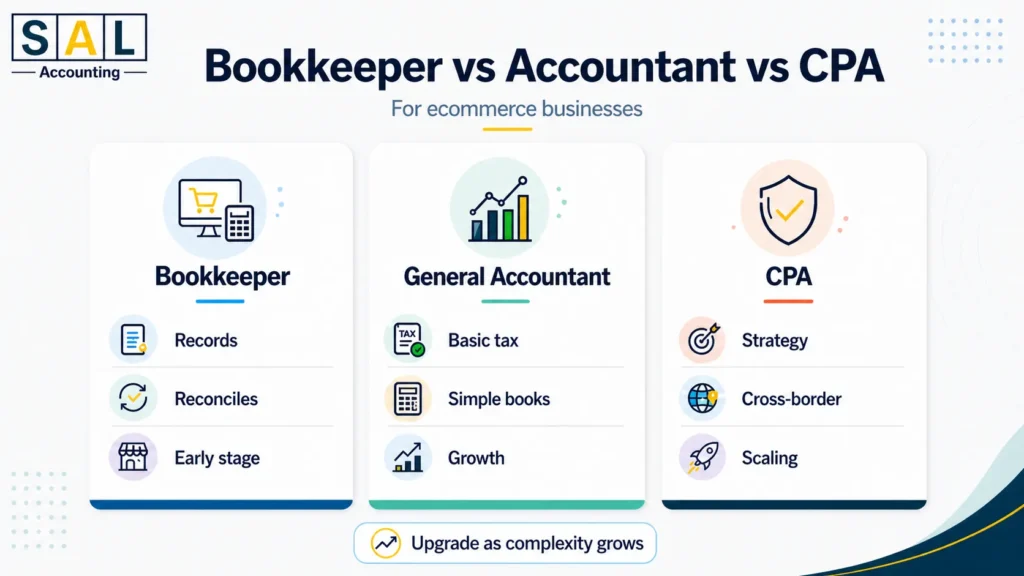
- A bookkeeper records your transactions, reconciles bank accounts, matches platform payouts, and keeps your books organized. This is usually enough when your store is simple.
- A general accountant may handle bookkeeping, basic tax returns, and simple financial statements for online stores. That can work if your business has one or two sales channels and limited tax complexity.
- A CPA steps in when the business needs more than recordkeeping. They help with tax planning, sales tax nexus, CRA or IRS representation, reviewed or audited statements, inventory and COGS issues, cross-border structure, and funding or sale preparation.
Basically, a bookkeeper helps you track what happened. A CPA helps you understand what it means and what to do next. For ecommerce, that difference matters. Shopify, Amazon, refunds, fees, chargebacks, discounts, gift cards, payment processors, inventory timing, and sales tax can all make the numbers harder to read.
Here’s a quick comparison of what each one actually does for ecommerce businesses:
| Role | Typical Services | Best For | Limitations | When to Upgrade |
| Bookkeeper | Transaction recording & bank reconciliations | Early-stage stores | No tax strategy or complex filings | Multi-channel or tax issues arise |
| General Accountant | Bookkeeping + basic tax returns | Growing simple operations | Limited nexus, inventory & cross-border | US sales tax, funding or audits |
| CPA | Tax strategy, nexus, audits, CRA/IRS representation | Scaling & cross-border | Higher cost (offset by ROI) | When you see 3+ triggers below |
How Do You Know It’s Time to Hire a CPA for Your Ecommerce Business?
You usually need a CPA when your ecommerce numbers stop feeling harder to trust. Maybe margins don’t make sense, payouts take too long to reconcile, or U.S. sales tax questions are starting to show up.That doesn’t mean you’ve done anything wrong. It usually means your business has grown past basic bookkeeping.
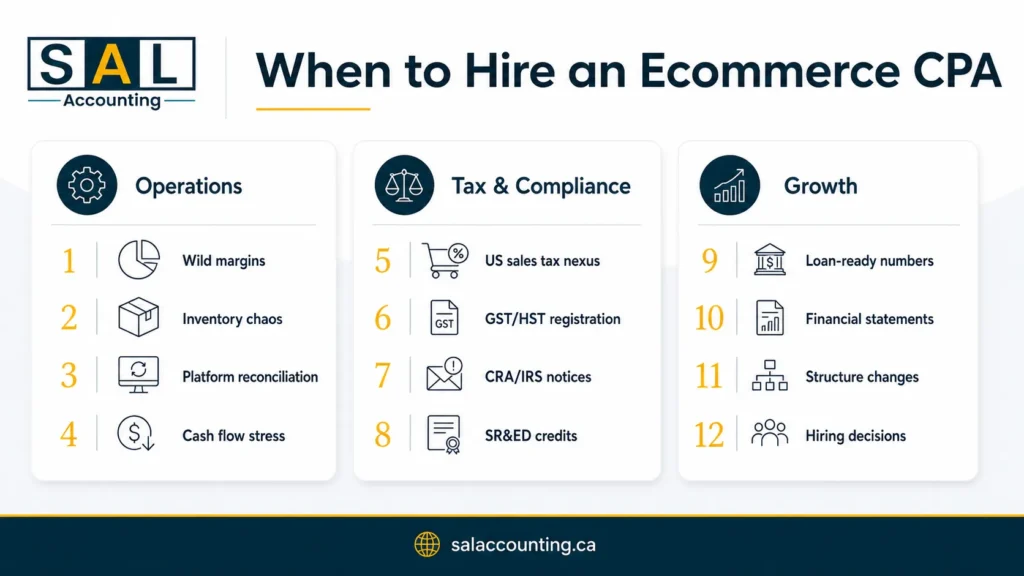
Many Canadian sellers reach this point somewhere around $150k to $500k in annual revenue. But revenue is not the only trigger. A smaller store with U.S. sales, inventory issues, tax notices, or funding plans may need CPA support earlier. Here are 12 practical signs it may be time to upgrade.
- Also Read: “In-House vs Outsourced Ecommerce Accounting”
Operational Complexity Triggers
You might be growing fast, but if your day-to-day numbers are starting to feel messy and unreliable, that’s usually the first sign you’ve outgrown basic bookkeeping.
- Your profit margins swing wildly month to month, and you can’t explain why.
- Inventory and COGS tracking for your online store has become a nightmare (especially with Amazon FBA, Shopify, or dropshipping).
- You’re selling across multiple platforms and waste hours reconciling payouts every month.
- Cash flow looks okay on paper, but you’re always scrambling for money to buy stock or run ads.
Tax and Compliance Triggers
Once you start selling across borders or in multiple states, tax rules get complicated quickly. This is where most ecommerce sellers run into serious (and expensive) problems.
- You’ve hit (or are close to hitting) US sales tax nexus in multiple states.
- You need to register for Canadian GST/HST.
- You’ve received a notice from the CRA or IRS.
- You want to claim SR&ED/R&D tax credits or other advanced deductions.
Pro Tip: Track your sales by state and province every month. Many Canadian Shopify and Amazon sellers unknowingly trigger nexus in 5–10+ US states within their first big growth year.
Growth and Strategic Triggers
When you’re thinking about raising money, taking out a loan, or selling your business, your financials need to look professional and trustworthy, not just “good enough.”
- You’re preparing for a loan, raising money from investors, or planning to sell the business.
- You need proper GAAP or ASPE financial statements (CRA books and records guidance).
- You’re deciding on or changing your business structure (Canadian corp + US LLC, etc.).
- Your team is growing, and you need reliable numbers to make decisions.
- Read More: “Top 10 Ecommerce Bookkeeping Services in Canada”
Can a CPA Help You with Sales Tax Nexus and Cross-Border Ecommerce Taxes?
Yes. This is one of the biggest reasons ecommerce sellers bring in CPA support. If you sell into the U.S., you may need to track sales by state, marketplace sales, direct Shopify sales, Amazon activity, and Canadian GST/HST at the same time. That can get confusing fast. A specialized CPA can help you:
- Review where your sales may create nexus
- Register sales tax for a Canadian seller in the right states when needed
- Handle GST/HST alongside U.S. sales tax
- Track sales by province and state
- Avoid missed or duplicate filings
- Understand how your entity structure affects reporting
- Keep the setup manageable as you grow
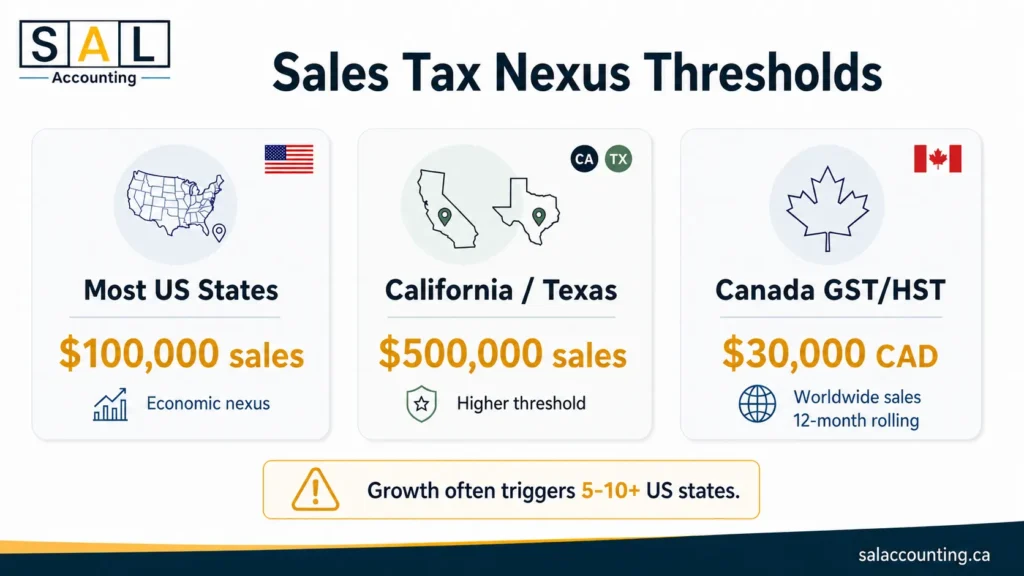
| Jurisdiction | Threshold Example | What Triggers It |
| Most US States | $100,000 sales | Economic nexus |
| California / Texas | $500,000 sales | Higher revenue threshold |
| Canada GST/HST | $30,000 CAD worldwide | Any 12-month rolling period |
Keep in mind, this table is only a simplified guide. Rules vary by state, and the details matter. The goal is not to register everywhere just in case. The goal is to know where you actually have obligations and what needs to happen next.
Case Study: How an Amazon FBA Seller Near Square One Cleans Up Inventory and US Sales Tax Confusion1
A home products seller near Square One in Toronto sells through Amazon FBA and Shopify. Orders are growing, but the owner has a hard time tracking inventory costs, Amazon fees, and US sales. The business is moving in the right direction, but the numbers are starting to feel messy.
The Problem
Inventory, COGS, Amazon fees, and Shopify sales are not clearly organized. The owner also has US customers, which makes sales tax questions harder to ignore.
What We Do
We review Amazon settlement reports, Shopify sales, inventory records, product costs, and sales by state. Then we organize the numbers so the owner can see real product costs, channel profit, and where US sales tax may need attention.
The Result
The owner gets a clearer view of which products and channels are actually profitable from our Amazon FBA accountant. They also understand what needs to be fixed now and what to monitor as the business keeps growing.
How Does a CPA Fix Common Ecommerce Problems?
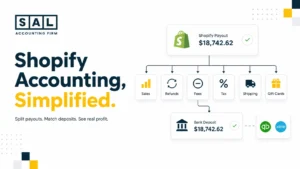
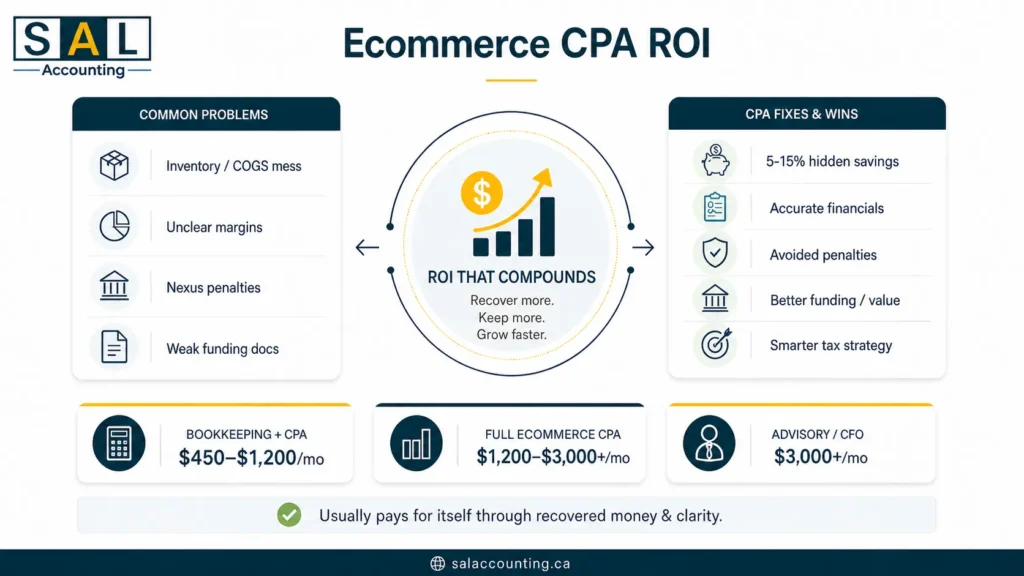
Your books might look organized at first glance, but your real profit can still be hard to understand.This happens a lot in ecommerce. Shopify might show one sales number. Amazon might show another. Your bank deposits may be lower because of fees, refunds, chargebacks, discounts, shipping adjustments, or sales tax. A specialized ecommerce CPA can help by:
- Setting up proper inventory valuation policies for Shopify and other platforms (critical for Amazon FBA, Shopify, and dropshipping)
- Calculating accurate COGS across platforms
- Separating fees, refunds, returns, chargebacks, and discounts
- Showing true contribution margin by product or channel
- Reviewing Amazon settlements and Shopify payouts
- Making sure reports match how your business actually works
This cleanup often reveals 5–15% in hidden leakage, money you’ve been losing without even realizing it.
Pro Tip: Have your CPA review your last 3–6 months of Amazon settlements and Shopify payouts. Most sellers are shocked at how much money they recover right away.
Once this is sorted, you’ll finally know what’s actually profitable, make better decisions, and stop leaving money on the table every month.
- Read More: “Common eCommerce Errors You Must Avoid”
Case Study: How a Shopify Seller in Liberty Village Gets Clearer on Profit2
A skincare brand in Liberty Village, Toronto is growing steadily on Shopify. Sales look strong, but the owner keeps wondering why the money in the bank doesn’t match what Shopify shows. Fees, refunds, discounts, and shipping costs are all mixed into the payouts, making it hard to see what the store is actually keeping.
The Problem
The reports are too basic for the business. Shopify sales, bank deposits, fees, refunds, and discounts are not clearly separated, so profit is hard to trust.
What We Do
We review the Shopify payouts, payment processor reports, refunds, fees, and bank deposits. Then we clean up the numbers so the owner can see what comes in, what gets deducted, and what the business actually keeps.
The Result
The owner gets a clearer view of profit, product performance, and cash flow. Instead of guessing why the numbers look off, she can make better decisions about pricing, ads, and inventory. You can also use our free US Economic Nexus Calculator.
How Can Hiring an Ecommerce CPA Help You Raise Funding, Get Loans, or Sell Your Business?
Investors, banks, and buyers look at your numbers differently than you do. You may focus on sales, growth, and customer demand. They look at margins, debt, cash flow, inventory, tax risk, working capital, and whether the financials are reliable. A good ecommerce CPA helps by:
- Preparing or reviewing financial statements that meet lender or investor expectations
- Cleaning up inventory, COGS, sales tax, and payout issues
- Building forecasts based on real ecommerce data
- Helping you explain margins and cash flow clearly
- Preparing reports that make due diligence easier
- Showing what a buyer, lender, or investor may question
For example, if inventory is overstated, profit may look stronger than it really is. If sales tax liabilities are unclear, a buyer may ask for a price adjustment. If COGS keeps moving around, investors may not trust the margins. A CPA helps clean this up before those conversations happen.
- Read More: “Shopify Capital Loans and Alternative Funding Options for Your E-commerce Business in 2026”
Pro Tip: If you’re planning to raise money or sell in the next 12 months, bring a CPA in at least 3–6 months early. The cleanup and preparation work takes time, but it’s worth it.
eCommerce CFO vs CPA: Which Do Growing Online Stores Actually Need?
This is a common question once an ecommerce business reaches a certain size. Do you need a CPA, a fractional CFO, or both? Here’s the simple breakdown.
- A CPA focuses on compliance, tax strategy, accurate financial reporting for Shopify and others, sales tax nexus, and keeping you safe with the CRA and IRS. They make sure your numbers are correct and you’re not overpaying taxes or getting into trouble.
- A fractional CFO (or ecommerce CFO) goes further. They help with high-level strategy, budgeting, cash flow forecasting, pricing decisions, KPI tracking, and planning for growth or exit.
Most ecommerce businesses need a strong CPA before they need a CFO. Because a CFO cannot make good decisions from messy numbers. If your sales, COGS, inventory, fees, and tax accounts are not clean, the strategy layer will be built on weak data.
Pro Tip: If monthly revenue is under $100k to $150k and your numbers still need cleanup, focus on a strong ecommerce CPA first. Once the foundation is clear, CFO support becomes more useful.
How Much Does It Cost to Hire a CPA for an Ecommerce Business?
CPA fees depend on how complex your ecommerce setup is. A simple Shopify store with clean books is not the same as a multi-channel seller with Amazon FBA, U.S. sales tax nexus, GST/HST, inventory issues, multiple entities, and funding plans. Most Canadian ecommerce sellers can expect something like this.
| Service | Monthly / Project Range | Notes |
| Bookkeeping + CPA Oversight | $450 – $1,200 / month | Good starting point for most sellers |
| Full Ecommerce CPA (Tax + Cross-Border) | $1,200 – $3,000+ / month | Best for Shopify/Amazon sellers with nexus and inventory issues |
| Annual Tax Return (Complex) | $1,500 – $5,000+ | Covers multiple entities and US states |
| Funding Prep / Financial Review | $2,000 – $6,000 (one-time) | Often pays for itself quickly |
A general accountant may be cheaper. For a simple business, that may be fine. But if you have cross-border sales, inventory complexity, tax questions, or messy platform payouts, cheaper support can leave gaps. They may be good for cutting the cost to start an e-commerce business.
The real cost of waiting is almost always way higher: e-commerce penalties, missed credits, bad decisions, and lost money.
Pro Tip: Don’t choose only based on the lowest monthly fee. Choose based on whether the CPA understands ecommerce and can help you trust your numbers.
What Should You Look For When Hiring the Right CPA for Your Ecommerce Business?
If you’ve decided it’s time to upgrade, the next step is finding someone who actually understands ecommerce. Not every CPA is the right fit. You want someone who understands platforms, payouts, fees, refunds, chargebacks, sales tax, inventory, COGS, and cross-border issues.
1. Real Ecommerce Experience
Look for a CPA who has worked with Shopify, Amazon FBA, WooCommerce, marketplace sellers, subscription brands, or multi-channel ecommerce businesses. They should understand that your bank deposit is not always your revenue. They should know how fees, refunds, discounts, gift cards, taxes, and payout timing affect your numbers.
2. Cross-Border Canada-US Knowledge
This matters a lot if you sell into the U.S. You need someone who understands GST/HST, U.S. sales tax nexus, US LLCs tax problems, entity structure, state registrations, CRA and IRS issues, and how cross-border sales affect your reporting.A good CPA should be able to explain what applies, what does not, and what needs to be watched next.
3. Clear Communication & Proactive Advice
A good CPA should explain your numbers in plain English. You should not leave every meeting more confused than when you started.They should help you understand what is happening, what matters, what can wait, and what needs action.
You want someone who can say, “Here’s why your margins changed,” or “Here’s where sales tax may become an issue,” or “Here’s what we need to clean up before financing.” That is more useful than technical language with no clear next step.
4. Questions to Ask Before You Hire
Before you commit, ask these to see if they’re the right fit:
- Have you worked with Shopify, Amazon, or WooCommerce sellers?
- How do you handle sales tax in Canada and the U.S.?
- Can you review my platform reports and show me where the numbers may be off?
- How do you handle inventory and COGS?
- What reports will I receive each month or quarter?
- What is included in the monthly fee?
Once you find the right fit, make the first meeting useful.
Pro Tip: Bring 3–6 months of Shopify, Amazon, WooCommerce, or payment processor reports, plus bank statements, inventory reports, recent tax filings, accounting software access, and your biggest questions.
Book a consultation with our e-commerce and Shopify accountants. We’ll review your current setup and show you where CPA-level support can add the most value.
Ready to Hire an Ecommerce CPA? Your Next Step
If several signs in this guide feel familiar, your ecommerce business may have outgrown basic bookkeeping. That doesn’t mean you’ve done anything wrong. It usually means your numbers need more structure, review, and guidance.
Maybe your margins are harder to explain. Maybe inventory is messy. Maybe you’re selling into the U.S., dealing with sales tax questions, or preparing for financing, a sale, or a bigger growth stage. A CPA can help you slow the confusion down, see what actually needs attention, and figure out what to fix next.
Get in touch for a review of your ecommerce finances. We’ll look at your current setup, highlight what may be messy or missing, and help you choose the smartest next move.