

A bookkeeping engagement letter should tell you exactly what your ecommerce bookkeeper will do, what you need to provide, what costs extra, and what sits outside the agreement. At SAL Accounting, that usually means getting specific about Shopify, Amazon, inventory, GST/HST, and reporting instead of relying on a vague “monthly bookkeeping” scope.
Keep reading, the details you miss before signing are often the ones that create surprise fees or missing work later.
Get your records organized before the engagement begins with the Tax Document Checklist for Ecommerce Stores.
Quick Takeaways
- “Monthly bookkeeping” should be broken into specific tasks.
- Shopify, Amazon, inventory, GST/HST, and payroll responsibilities should be named when relevant.
- The letter should state what records and access you need to provide.
- Reports and month-end timing should be clear.
- Historical cleanup should be separated from recurring bookkeeping.
- The agreement should explain what triggers extra fees or a scope review.
- Exclusions and termination terms should be clear before you sign.
What Should an Ecommerce Bookkeeping Engagement Letter Include?
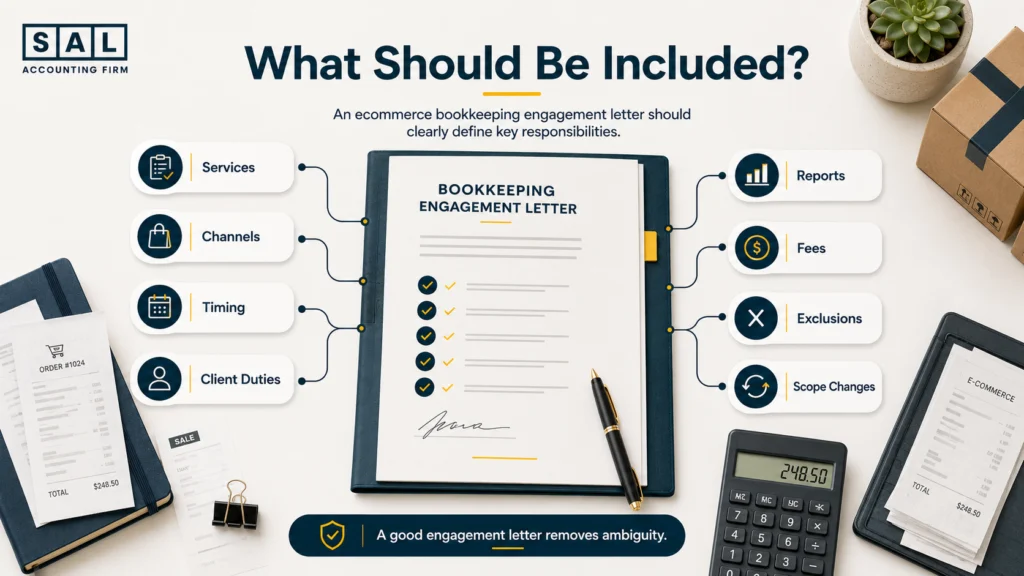
An engagement letter sets the boundaries of the bookkeeping relationship. After reading it, you should be able to answer one simple question: who is responsible for what?
CPA Ontario specifically points to scope, fees, deliverables, and each party’s responsibilities as important parts of an engagement letter.
For ecommerce, those areas need a little more detail because one monthly close may involve several sales channels, payment processors, inventory reports, and accounting systems.
| Engagement Area | What Should Be Clear | Ecommerce Example |
|---|---|---|
| Services | Exact monthly tasks | Bank + payout reconciliation |
| Channels | Platforms included | Shopify + Amazon |
| Timing | Close/reporting schedule | Monthly close |
| Client duties | Records and access | Inventory report |
| Deliverables | Reports received | P&L + balance sheet |
| Fees | Base fee + extras | Cleanup priced separately |
| Exclusions | Work not covered | Tax filing |
| Scope changes | What triggers review | Adding Amazon |
Define the Exact Monthly Bookkeeping Work
“Monthly bookkeeping” is too broad on its own. The engagement should say whether the bookkeeper handles:
- Bank and credit-card reconciliation
- Expense categorization
- Shopify payout reconciliation
- Amazon settlement reconciliation
- Accounts payable
- Inventory and COGS entries
- Month-end adjustments
- Financial statements
The ecommerce bookkeeping checklist gives you a useful benchmark for what may sit behind a proper month-end process.
Reconciliation deserves specific wording too. Recording a $40,000 marketplace deposit is not the same as reconciling the sales, refunds, fees, taxes, and adjustments that produced it.
- Also read: “Ecommerce Reconciliation Best Practices”
Ready to hand off the recurring close? See what’s included in our Ecommerce Bookkeeping Services.
Spell Out the Reports and Timing
The engagement should name the reports you receive. A basic package may include a P&L and balance sheet, while cash flow reports, channel reporting, or deeper management reports may be separate. That matters because standard ecommerce financial statements are not automatically the same as ecommerce management reporting.
Timing should be clear too. “Monthly” does not tell you whether July will be closed on August 8 or sometime in September.
Pro tip: Ask for the actual deliverables and expected close process in writing. “Monthly reports included” still leaves too much open to interpretation.
Clarify What You Need to Provide
Your responsibilities belong in the engagement too. The bookkeeper may need:
- Bank and credit-card access
- Shopify or Amazon access
- Supplier invoices
- Loan statements
- Inventory reports
- Payroll reports
- Answers to month-end questions
The CRA makes clear that using a third party does not remove the business’s responsibility for its records.
System permissions should also match the work being done. QuickBooks user roles allow different levels of access rather than requiring every outside user to have full administrative control.
This is one reason poor ecommerce bookkeeping is not always just about incorrect entries. Missing documents, incomplete access, and unclear responsibilities can cause problems too.
- Read more: “How to Choose the Right Ecommerce Bookkeeper”
Which Ecommerce Bookkeeping Tasks Should Be Named Specifically?
This is where an ecommerce engagement letter should differ from a generic small-business template.
Shopify and Payment Reconciliation
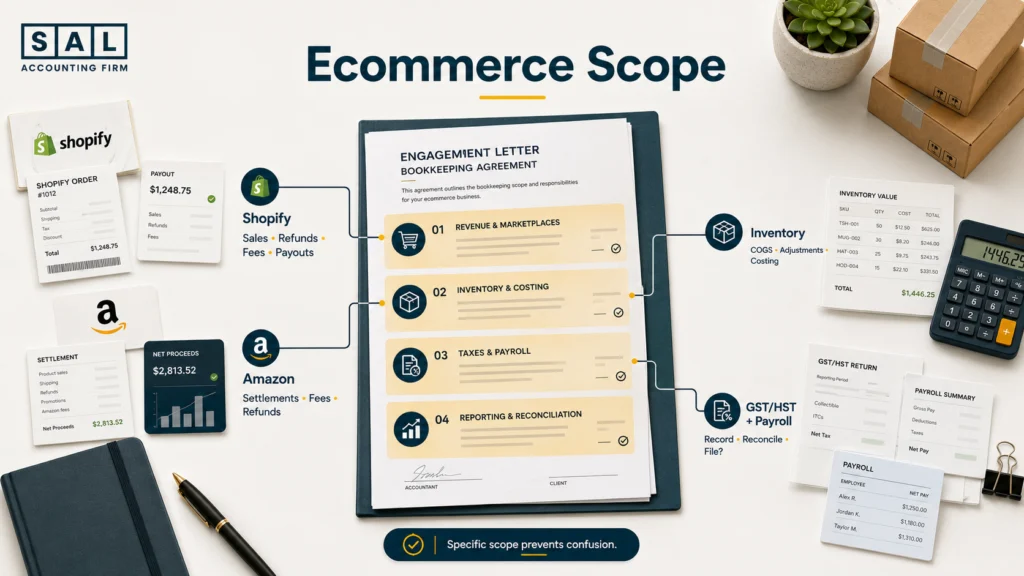
For Shopify, the agreement should say whether the provider is simply recording payouts or reconciling the underlying activity.
A proper Shopify payment reconciliation can involve gross sales, refunds, discounts, fees, taxes, adjustments, and the final bank deposit.
Shopify also identifies some financial permissions as sensitive permissions, so the engagement and onboarding process should be clear about what access is actually required.
For a Shopify-heavy business, Shopify Accounting Services put payout reconciliation and the monthly books under the same accounting process.
Amazon and Other Marketplaces
Amazon should be named separately when it is included. An Amazon settlement can contain sales, refunds, marketplace fees, FBA charges, reimbursements, and other adjustments. That makes Amazon FBA bookkeeping a different workload from adding another bank feed.
If you begin with Shopify and add Amazon six months later, the agreement should explain whether the new channel triggers a scope review.
Amazon settlements piling up? Bring them into a defined monthly workflow with Amazon Bookkeeping Services.
Inventory and COGS
“Inventory included” is another phrase worth questioning. Does the bookkeeper:
- Post an inventory balance you provide?
- Calculate COGS?
- Reconcile the inventory system?
- Record write-offs?
- Maintain product costs?
Those are different jobs. For brands importing products, landed cost accounting may affect what cost information the bookkeeper needs from you. The distinction between capitalizing inventory costs and expensing operating costs should also be clear if inventory entries form part of the engagement.
Pro tip: Replace “inventory included” with the actual task. “Post monthly inventory and COGS entries from the client-approved inventory report” is much harder to misunderstand.
GST/HST and Payroll
Bookkeeping and filing are not automatically the same service. For GST/HST, clarify whether the provider is:
- Recording the tax
- Reconciling the tax account
- Preparing the return
- Filing the return
The CRA treats GST/HST return filing as its own process, so “GST/HST bookkeeping” should not be assumed to include filing.
The same applies to payroll. Recording a payroll journal entry is not necessarily the same as handling deductions and remittances covered in the CRA’s payroll guide.
That is why GST/HST compliance for ecommerce stores should be treated as distinct responsibilities rather than hidden inside one broad bookkeeping line.
What Should Be Outside the Monthly Bookkeeping Scope?
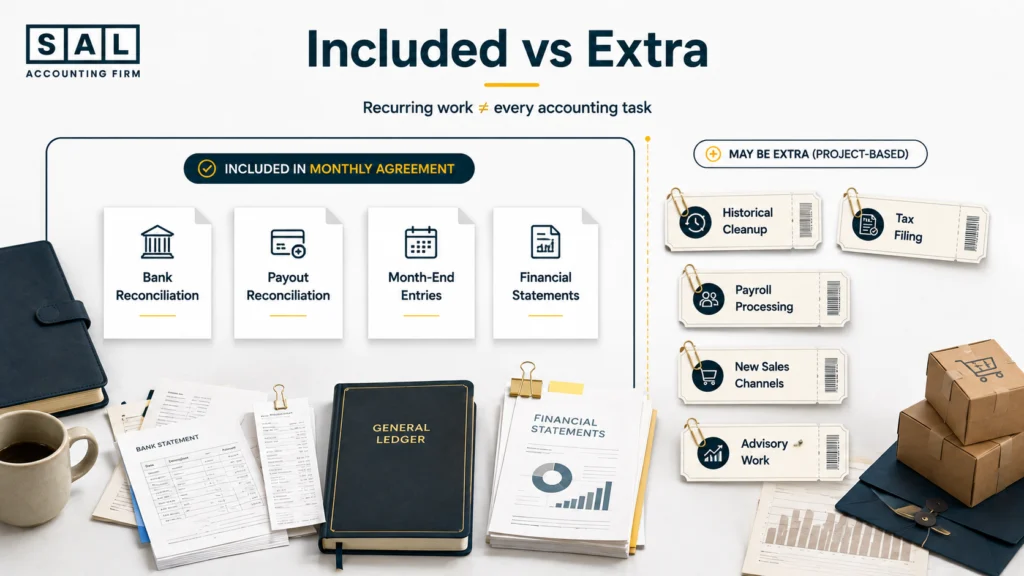
A good engagement letter should explain exclusions as clearly as inclusions. Common items that may sit outside monthly bookkeeping include:
- Historical cleanup
- Corporate tax returns
- GST/HST filing
- Payroll processing
- Forecasting or advisory work
- New entities
- New sales channels
- Large one-off projects
Historical cleanup is particularly easy to misunderstand. Shopify cleanup and ongoing bookkeeping are different workloads even when the same provider handles both.
Case Study: Natalie in Bloor West Village Defines “Monthly Bookkeeping”1
Natalie runs a skincare brand from Bloor West Village in Toronto. Her proposal says “monthly bookkeeping and reporting,” so she assumes Shopify reconciliation, inventory entries, GST/HST filing, and financial statements are all included.
The Problem
The bookkeeper intends to reconcile the bank, categorize expenses, and prepare the P&L and balance sheet. Shopify reconciliation and GST/HST filing sit outside that quote.
What We Do
The scope is rewritten task by task. Shopify sales, refunds, fees, and payouts are reconciled monthly. Inventory and COGS entries are posted from Natalie’s approved inventory report. GST/HST balances are reconciled, while return preparation and filing are listed separately.
The Result
Natalie can now compare competing proposals properly. Instead of comparing two monthly prices that cover different work, she can see exactly what each provider is responsible for.
The lesson is simple: a good engagement letter turns “monthly bookkeeping” into a service you can actually compare.
How Should Fees and Scope Changes Work?
The engagement should explain what the current fee covers and what could cause it to change.
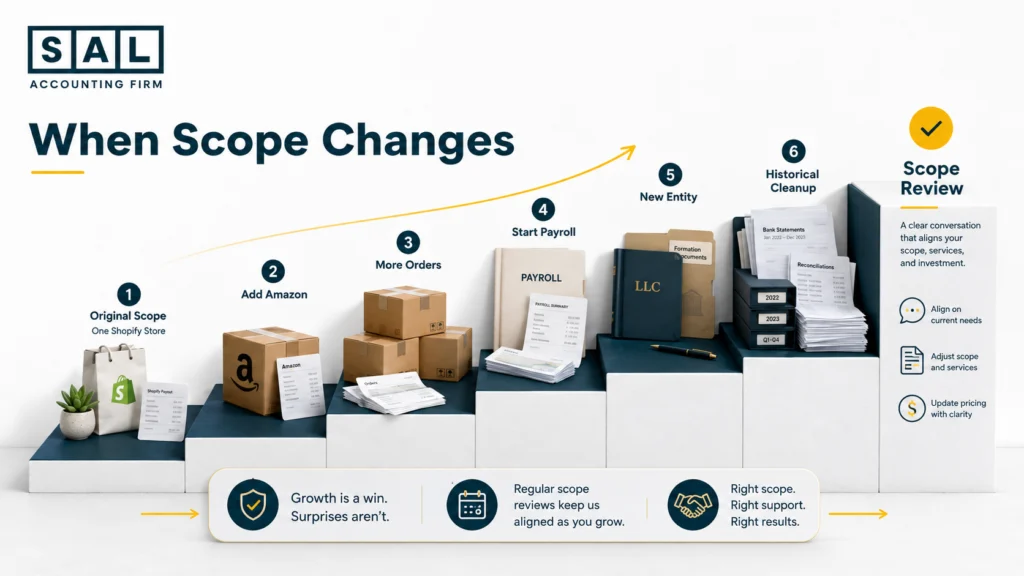
Suppose you sign for $800 per month for one Shopify store. Six months later, you add Amazon, double your order volume, start payroll, or open another company. The workload has changed. The letter should explain whether that leads to:
- A scope review
- A revised monthly fee
- A separate project quote
- Approval before additional work starts
Looking at ecommerce accounting costs makes more sense when you compare the work behind the monthly price rather than the headline number alone.
The same principle applies when a business outgrows its current bookkeeper. The original engagement may simply no longer describe the business being served.
Case Study: Connor in Lakeview Separates Cleanup From Monthly Work2
Connor runs a pet-products store from Lakeview in Mississauga and is changing providers after adding Amazon.
The Problem
Eight months of Amazon settlements were never properly reconciled. Connor assumes repairing them is part of “onboarding,” while the new bookkeeper expects recurring bookkeeping to begin with clean opening balances.
What We Do
The work is split into two scopes. One project covers the eight months of historical settlements, fees, refunds, and opening-balance corrections. The second begins on an agreed date and covers ongoing Shopify and Amazon reconciliation, bank reconciliation, month-end entries, and financial statements.
Any extra historical work requires Connor’s approval before it begins.
The Result
Connor can see the one-time cost of fixing the past separately from the recurring cost of keeping the books current. “Onboarding” is no longer an undefined bucket that can turn into an unexpected invoice.
What Should You Check Before Signing?
Before you sign, run through these questions:
- Are the exact monthly tasks named?
- Are all major sales channels listed?
- Is payout reconciliation included or excluded?
- Is responsibility for inventory and COGS clear?
- Are GST/HST and payroll responsibilities specific?
- Do you know which reports you receive?
- Is month-end timing explained?
- Is historical cleanup separate?
- Are additional-fee triggers clear?
- Are the important exclusions listed?
- Does the agreement explain termination and handoff?
These belong alongside the broader questions to ask an ecommerce accountant before you commit.
If the relationship later ends, the handoff matters too. CRA guidance on electronic records held by third parties makes clear that outsourcing recordkeeping does not remove the business’s responsibility for maintaining access to required records.
That makes the transition process worth defining before there is ever a reason to use it. A structured accounting-record transfer can also prevent access and historical-data problems when providers change.
Pro tip: Read the exclusions, assumptions, and extra-fee language with the same attention you give the service list. Those sections often tell you more about the real scope than the headline package name.