
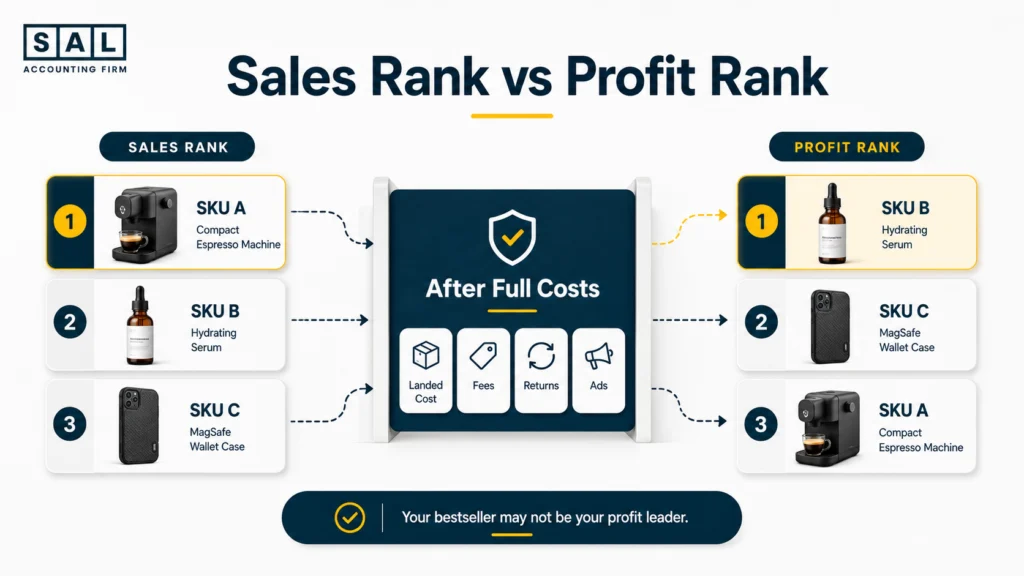
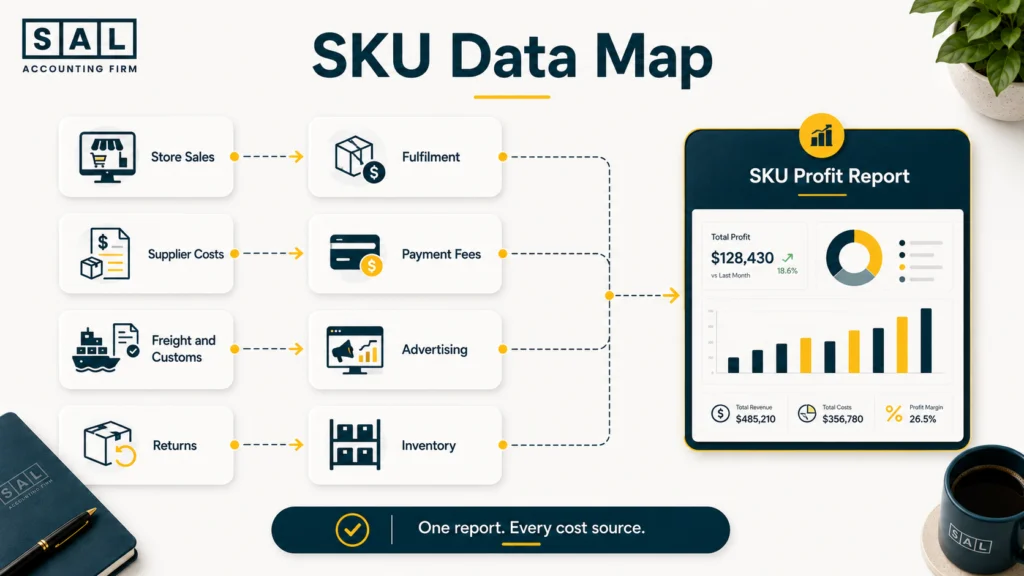
Your bestselling SKU may be the product quietly draining your cash. Revenue leaves out landed cost, fees, fulfilment, discounts, returns, and advertising. At SAL Accounting, product-level reporting follows the full ecommerce cost trail, not just the payout reaching your bank.
We will explain what your accountant should calculate, report, and recommend. Read it before your next major reorder. the product receiving the most cash may be the one keeping the least.
Calculate your ecommerce EBITDA first, then use SKU analysis to identify the products driving—or weakening—the result.
Quick Takeaways
- SKU profitability measures what each product keeps, not simply what it sells.
- Supplier price alone does not show complete product cost.
- A useful analysis includes landed COGS, fees, fulfilment, returns, discounts, and advertising.
- Profit should be shown before and after advertising.
- Your accountant should explain estimated costs and allocation methods.
- The final report should support pricing, inventory, and marketing decisions.
For reporting built around your products, sales channels, fees, and inventory, review SAL’s ecommerce accounting and bookkeeping services.
What Should SKU Profitability Analysis Tell You?
An ecommerce SKU profitability analysis should show how much each product or variation earns after its relevant costs are deducted. It should answer:
- Which SKUs generate the most contribution profit?
- Which bestsellers have weaker margins than expected?
- Which products are expensive to fulfil or advertise?
- Which variations have unusually high return rates?
- Where should you raise prices or reduce discounts?
- Which products deserve more inventory?
- Which SKUs may need to be bundled, reduced, or removed?
The point is not to create another complicated spreadsheet. It is to turn product data into decisions.
What Is Ecommerce SKU Profitability Analysis?
A SKU, or stock keeping unit, identifies a specific product or variation.
A medium black T-shirt and a large black T-shirt should normally have separate SKUs. Their supplier costs may be similar, but their sales, return rates, stock levels, and discounts can differ.
Shopify recommends unique SKUs because they improve inventory tracking, reporting, fulfilment, and third-party integrations. (Shopify Help Center)
SKU profitability analysis connects each product’s net revenue with the costs involved in buying, selling, fulfilling, and promoting it.
SKU contribution profit = Net SKU revenue − SKU-level variable costs
This goes beyond gross profit. Gross profit usually removes product cost, while ecommerce contribution margin also accounts for variable selling costs.
A Simple SKU Profitability Example
Suppose a portable blender generates $72 in net revenue after discounts. Its costs are:
- Landed COGS: $23
- Fulfilment and payment fees: $10
- Return allowance: $8
- Advertising: $17
The SKU leaves $14 in contribution profit, or about 19% of net revenue, before fixed overhead.
Looking only at the $23 product cost would make the margin appear much stronger.
Pro tip: Ask for margins in both dollars and percentages. A high percentage on very low sales may contribute less total profit than a slightly lower-margin bestseller.
Which Costs Should Be Included?
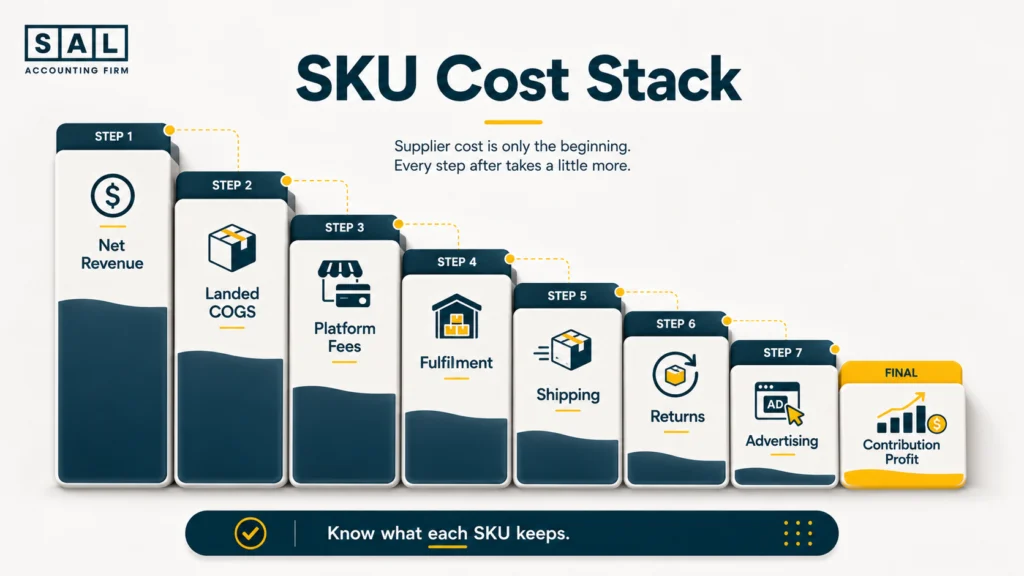
A reliable analysis starts with the full product cost stack. Inventory landed cost accounting becomes especially important when products are imported, purchased at changing prices, or stored in multiple locations. The main costs should stay easy to identify.
| Cost | Included? | Main Source | Why It Matters |
|---|---|---|---|
| Landed product cost | Yes | Supplier and freight records | Shows the real inventory cost |
| Platform and payment fees | Yes | Shopify, Amazon, gateways | Reduces each sale’s value |
| Fulfilment and packaging | Yes | 3PL or FBA reports | Varies by product size |
| Outbound shipping | Yes | Carrier or 3PL invoices | Can weaken bulky-product margins |
| Discounts and refunds | Yes | Store reports | Reduces net revenue |
| Return-related costs | Yes | Store and warehouse data | Captures the full return burden |
| Advertising | Usually | Meta, Google, Amazon Ads | Shows profit after acquisition |
Landed cost may include supplier price, inbound freight, customs duty, brokerage, and direct receiving costs. A clean ecommerce COGS calculation prevents these costs from being mixed with unsold inventory or general overhead.
CRA uses inventory to calculate cost of goods sold and business net income. It also requires businesses to apply an accepted inventory valuation method consistently. (CRA inventory guidance)
Your accountant should also capture:
- Payment-processing fees
- Marketplace commissions
- Pick-and-pack charges
- Packaging
- Currency conversion
- Chargebacks
- Product-specific shipping costs
These hidden ecommerce expenses can change which products are worth scaling.
Returns need more than the refund amount. Return postage, inspection, non-refundable fees, damaged packaging, and unsellable inventory may also reduce profit.
Advertising should normally be shown separately. That way, you can compare product profitability before and after customer-acquisition costs.
Pro tip: For recent sales, use a documented historical return allowance. Otherwise, a high-return product may look profitable until the refunds arrive next month.
- Also read: “Why Your Online Store Isn’t Making Money”
What Should Your Accountant Do During the Analysis?
Exporting a product report is only the starting point.
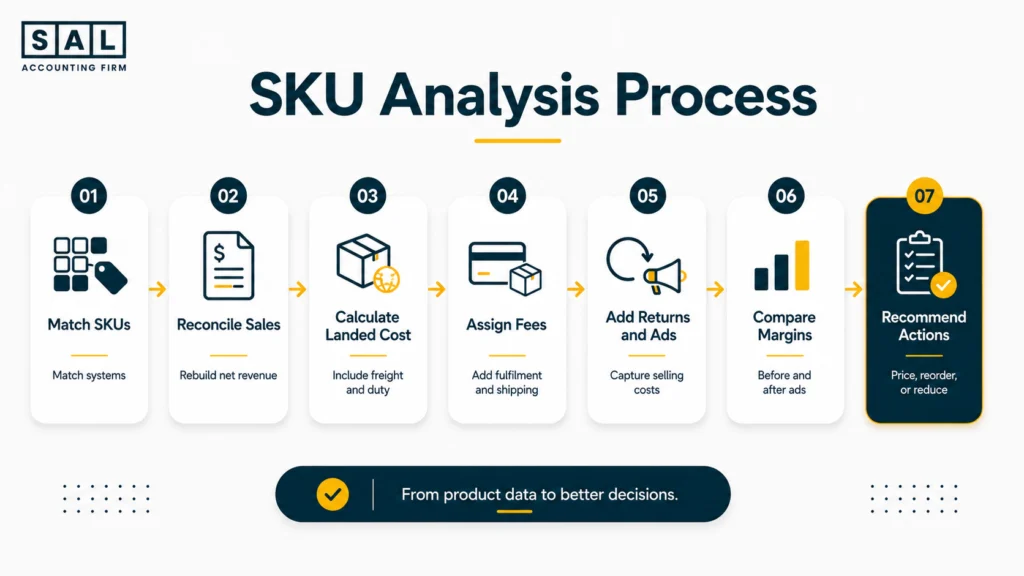
Organize and Match Your SKUs
Your accountant should create a master list connecting each SKU across:
- Shopify or another storefront
- Amazon Seller Central
- Inventory software
- The warehouse or 3PL
- Accounting software
- Supplier records
For example, PAN-BLK-12, BLACK-PAN-12, and BP12 may all refer to the same item. Leaving them unmapped can split one product’s sales and costs across several rows.
Reconcile Sales, Refunds, and Payouts
Net SKU revenue should come from transaction data—not the bank deposit.
The accountant should account for:
- Gross product sales
- Discounts
- Refunds
- Shipping income
- Chargebacks
- Sales tax
- Platform adjustments
- Payout timing
A proper ecommerce payment reconciliation explains how platform activity becomes a deposit without treating that deposit as revenue.
For Shopify stores, Shopify payout reconciliation keeps fees, refunds, chargebacks, and timing differences visible.
If the starting revenue is incomplete, the final margin will also be unreliable.
Calculate the Landed Cost of Each SKU
The accountant should match units sold with the correct inventory cost. Extra care is needed when:
- Supplier prices change
- Several SKUs arrive in one shipment
- Freight rates fluctuate
- Duty varies by product
- Inventory moves between warehouses
- Old and new stock have different costs
Shared shipment costs may be allocated by units, weight, volume, or product value. The method should be reasonable and used consistently.
Assign Fees, Fulfilment, and Shipping
Some costs can be matched directly to a sale. Others require an allocation method. For example:
- Payment fees may be assigned by transaction.
- Pick-and-pack charges may be assigned by unit.
- Packaging may be tracked by package type.
- Shipping may use actual label cost or a weight-based average.
One average cost across the entire catalogue can hide expensive products. The hidden costs of running a Shopify store rarely affect every SKU equally.
Account for Returns
Returns should be matched to the original product where possible. Your accountant should determine:
- Which SKU was returned
- Whether it returned to inventory
- Whether it was damaged
- Which fees were retained
- Who paid the return postage
- Whether a replacement was shipped
Allocate Advertising Carefully
Advertising may be assigned through:
- Product-attributed spend
- Campaign data
- Landing-page revenue
- Revenue share
- Units sold
- Blended customer-acquisition cost
No method is perfect for every store. What matters is that the method is documented and applied consistently. The report should show:
- Gross profit
- Contribution profit before advertising
- Contribution profit after advertising
These totals should also reconcile with the store’s ecommerce financial statements.
Explain What the Numbers Mean
Your accountant should finish with clear actions, such as:
- Raise the price
- Reduce discounting
- Negotiate supplier costs
- Change packaging
- Review fulfilment charges
- Shift advertising spend
- Lower a purchase order
- Bundle the product
- Remove a weak variation
Reliable ecommerce transaction categorization makes these recommendations possible because the underlying costs are already separated correctly.
- Read more: “Ecommerce Profit Calculation Mistakes”
Case Study: How Maya in Liberty Village Finds the Real Profit Behind Her Bestseller1
Maya runs a Shopify activewear brand from Liberty Village, Toronto. Her bestselling hoodie generates the most revenue, so she keeps increasing its advertising budget and placing larger supplier orders. Her spreadsheet subtracts only the supplier price, leaving out freight, fulfilment, fees, discounts, advertising, and returns.
The Problem
The hoodie generates $82 in average net revenue. Maya believes it makes about $55 because the supplier charges $27. Once all variable costs are included, it contributes closer to $13 per unit.
What We Do
We combine Shopify sales, supplier invoices, freight, fulfilment charges, payment fees, returns, and product-level advertising. The report compares the hoodie’s profit before and after advertising with the rest of the catalogue.
Result
Maya improves the sizing information, reduces broad discounting, changes the free-shipping threshold, and moves part of the ad budget to a lighter product with a stronger margin. She keeps the hoodie but stops scaling it on revenue alone.
SAL’s Shopify accounting services cover payout reconciliation, inventory, fees, refunds, and monthly profit reporting.
What Should the Final Report Include?
The final deliverable should be a repeatable management report, not an unexplained data export.
| Report | What It Shows | Frequency | Decision Supported |
|---|---|---|---|
| SKU profit summary | Revenue, cost, and contribution | Monthly | Scale, fix, or reduce |
| Margin trend | Current and previous margins | Monthly | Find cost increases |
| Returns report | Return rate and cost by SKU | Monthly | Improve product or listing |
| Ad profitability | Profit before and after ads | Monthly | Reallocate marketing spend |
| Inventory performance | Margin, velocity, and stock | Monthly or quarterly | Plan purchase orders |
| Action summary | Issue and recommended step | Monthly | Set priorities |
The report should identify:
- Actual figures
- Estimated figures
- Missing information
- Allocation methods
- Changes from the previous period
- Recommended actions
A consistent ecommerce reconciliation process keeps product totals tied to platform reports, payment processors, inventory, and the bank.
- Also read: “The Ecommerce Bookkeeping Checklist”
How to Turn SKU Results Into Decisions
A low-margin product does not always need to be removed. It may attract new customers, complete a bundle, or support repeat purchases.
| SKU Pattern | What It May Mean | First Move | Avoid |
|---|---|---|---|
| High sales, high margin | Strong core product | Protect stock and scale | Preventable stockouts |
| High sales, low margin | Revenue hides weak economics | Review price and costs | Scaling on sales alone |
| Low sales, high margin | Profitable but underexposed | Test placement or bundles | Removing it too early |
| Low sales, low margin | Weak catalogue fit | Reduce or discontinue | Reordering from habit |
| Strong before ads, weak after | Acquisition is expensive | Review campaigns | Blaming the product first |
| High returns, good initial margin | Product-fit issue | Improve listing or quality | Ignoring post-return profit |
Product-level results may lead you to:
- Raise a price
- Change packaging
- Negotiate supplier terms
- Reduce discounts
- Test a bundle
- Shift ad spend
- Lower the next purchase order
- Remove an unproductive variation
Your ecommerce pricing strategy should reflect the complete product cost—not simply supplier price or competitor pricing.
The best-performing SKUs are also the strongest starting point for scaling an ecommerce brand.
Pro tip: Start with your top 20 SKUs by revenue. They often represent most of the financial impact and make the first review easier to manage.
Case Study: How Daniel in Meadowvale Stops Reordering the Wrong Amazon SKU2
Daniel operates an Amazon home-organization brand from Meadowvale, Mississauga. One oversized storage product generates the highest unit sales, so he keeps placing large orders and increasing Amazon Ads spend. However, it also carries high FBA fees, storage charges, and returns from customers who misunderstand its dimensions.
The Problem
The product sells for $34 and has an $8.50 landed cost. After FBA fees, advertising, storage, and returns, it contributes only about $5 per unit.
What We Do
We match sales, refunds, FBA fees, advertising, storage charges, reimbursements, landed COGS, and returns to the SKU. We then compare it with the smaller variations in the same product family.
Result
Daniel reduces the next purchase order, improves the product dimensions on the listing, tests a higher price, and shifts advertising toward a smaller variation that earns more profit per unit.
SAL’s Amazon seller bookkeeping services cover settlements, FBA fees, inventory, and product-level reporting.
Strong Amazon FBA accounting practices also keep inventory and marketplace costs in the correct period.
What Information Will Your Accountant Need?
Your accountant will normally request:
- Product and variant exports
- SKU mapping files
- Sales, refund, and return reports
- Supplier invoices
- Freight and customs documents
- 3PL or FBA invoices
- Carrier reports
- Payment-processor statements
- Advertising exports
- Inventory by location
- Foreign-currency records
The data does not need to be perfect before the work begins. The accountant should explain what is reliable, what needs cleaning, and which figures require estimates.
A clean transfer of ecommerce accounting records should also include inventory balances, SKU costs, unresolved reconciliations, and outstanding shipments.
How Often Should SKU Profitability Be Reviewed?
For most growing stores:
- Monthly: Review revenue, landed COGS, fees, returns, advertising, and contribution margin.
- Quarterly: Revisit allocation methods, supplier costs, and catalogue performance.
- Before major purchase orders: Confirm the latest product margin.
- After cost changes: Recalculate after supplier, freight, platform, or fulfilment changes.
- After a launch: Wait until enough sales and return data exist.
- Before promotions: Confirm how much discount each SKU can support.
The timing should also match the business’s accounting method. Cash versus accrual accounting for ecommerce affects when sales and inventory costs appear.
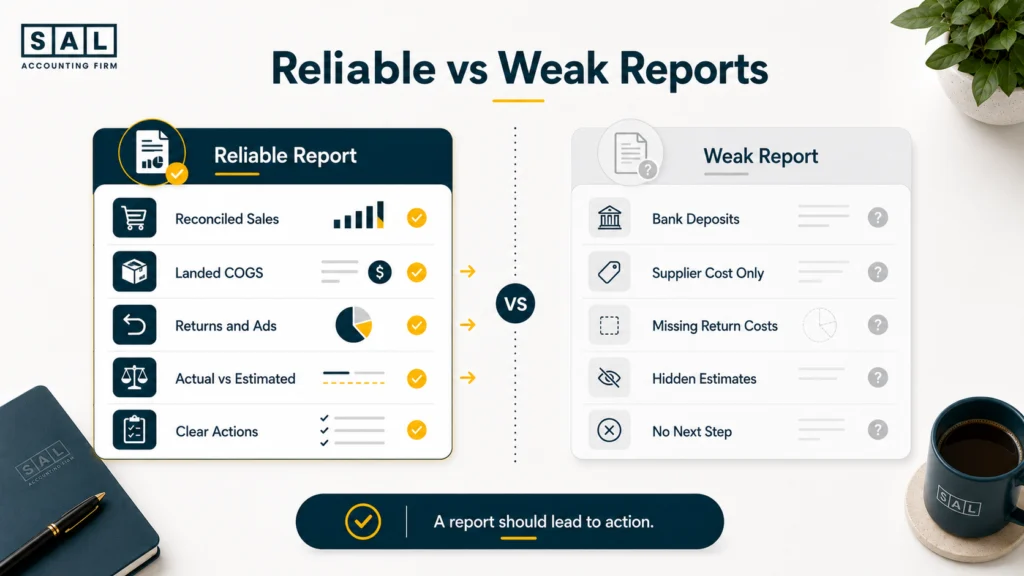
Warning Signs the Report Is Not Reliable
Take a closer look when the report:
- Starts with deposits instead of reconciled sales
- Uses supplier price instead of landed COGS
- Ignores returns or retained fees
- Applies one fulfilment cost to every product
- Excludes payment or marketplace fees
- Shows ROAS without contribution margin
- Mixes GST/HST into revenue
- Hides estimates
- Has no period comparison
- Ends without a recommendation
These problems are common and usually fixable. They often mean the reporting process was designed for basic bookkeeping, not ecommerce decision-making.
Missing reconciliations and unexplained assumptions are common ecommerce accountant red flags.
Questions to Ask Your Accountant
Ask:
- How are SKU sales reconciled to platform reports and payouts?
- How do you calculate landed cost?
- Which costs are treated as variable?
- How are shared freight and fulfilment costs allocated?
- How are returns matched to products?
- How is advertising assigned?
- Can I see profit before and after advertising?
- Which figures are actual, estimated, or missing?
- What actions should we take from this month’s report?
A strong ecommerce accountant should answer these questions in plain English.
- Read more: “Questions to Ask an Ecommerce Accountant”