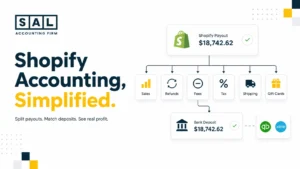

Your ecommerce brand needs a better bookkeeper when reports stop explaining what happened between the sale and the bank deposit. Canadian retail ecommerce revenue reached $73.7 billion in 2024 and grew 9.0%, so clean books matter as stores scale.
SAL Accounting looks at ecommerce numbers the way owners experience them: sales, payouts, fees, tax, inventory, and profit. Read our post to the end before you decide. Find out if your books need a cleanup, or a new bookkeeper.
Start with the profit gap. Run one recent month through the SAL Ecommerce EBITDA Calculator before you review the books.
Quick Takeaways:
A bookkeeper may be fine for a simple business. But ecommerce has moving parts that basic bookkeeping often misses. Here are the early signs when ecommerce bookkeeping starts falling behind:
- Payouts are booked as sales. Fees, refunds, and tax may be hidden inside the deposit, so revenue starts looking cleaner than it really is.
- COGS is unclear. Product costs may be incomplete, which means your margins can look better than reality.
- Reports arrive late. The numbers may still help with tax, but they do not help much with pricing, inventory, cash flow, or ad spend decisions.
- Tax records are scattered. GST/HST support becomes harder to prove when sales, refunds, platform reports, and expense records are not organized monthly.
- Profit is hard to explain. If no one can clearly tell you why profit changed, you may be making decisions on guesses.
Ecommerce Bookkeeping Health Check: Has Your Store Outgrown the Current Setup?
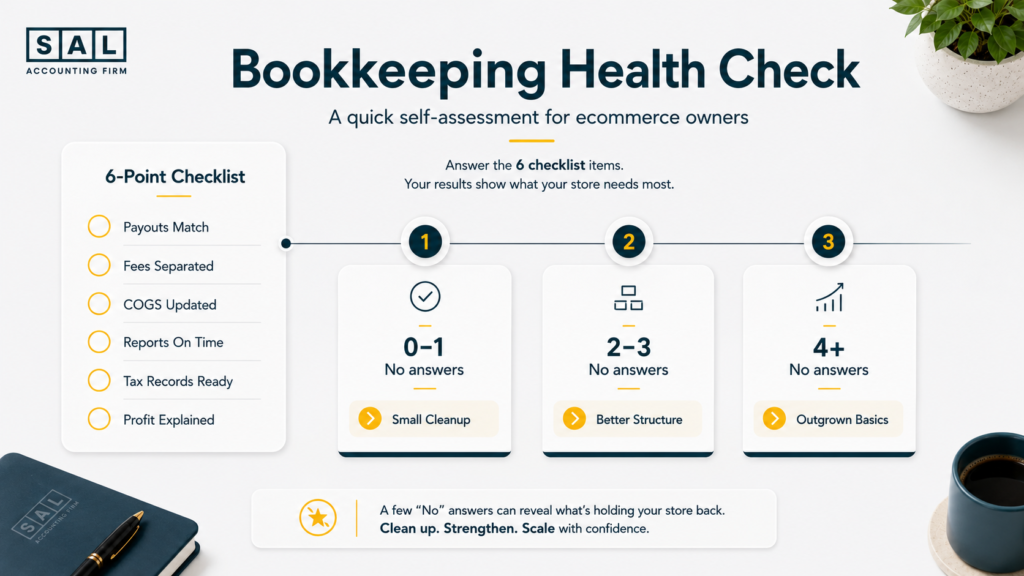
Before you blame the bookkeeper, check the process. Sometimes the person is not the main issue. The setup is just too basic for how your store works now. Use this quick scorecard.
| Question | Yes | No |
| Do your Shopify, Amazon, Stripe, or PayPal numbers match your accounting reports? | ||
| Are fees, refunds, discounts, and tax separated from payouts? | ||
| Is COGS updated monthly instead of guessed at year-end? | ||
| Can your bookkeeper explain why profit changed this month? | ||
| Do your reports arrive early enough for pricing, inventory, and cash decisions? | ||
| Are GST/HST records organized before filing season? | ||
| Can you clearly see what each platform sold, deducted, and paid out? |
Now count your “No” answers.
- 0–1 No answers: Your bookkeeping may only need a small cleanup or tighter review process.
- 2–3 No answers: Your books probably need a better ecommerce structure. The numbers may still be usable, but they are not giving you the full picture.
- 4 or more No answers: Your ecommerce brand has likely outgrown basic bookkeeping. This is usually where sales, payouts, tax, inventory, and profit start moving faster than the books can explain.
The point is not to panic. The point is to know where the system is breaking.
Several “No” answers usually mean the books need ecommerce structure, not another generic cleanup. Bring the process closer to your platform data with SAL ecommerce bookkeeping services in Toronto.
7 Signs Your Ecommerce Brand Needs a Better Bookkeeper
The signs usually show up in small ways first. A payout that does not match. A margin that feels off. A report that arrives too late. Here is what to look for:
1. Your Bookkeeper Records Net Payouts as Sales
This is one of the most common signs.
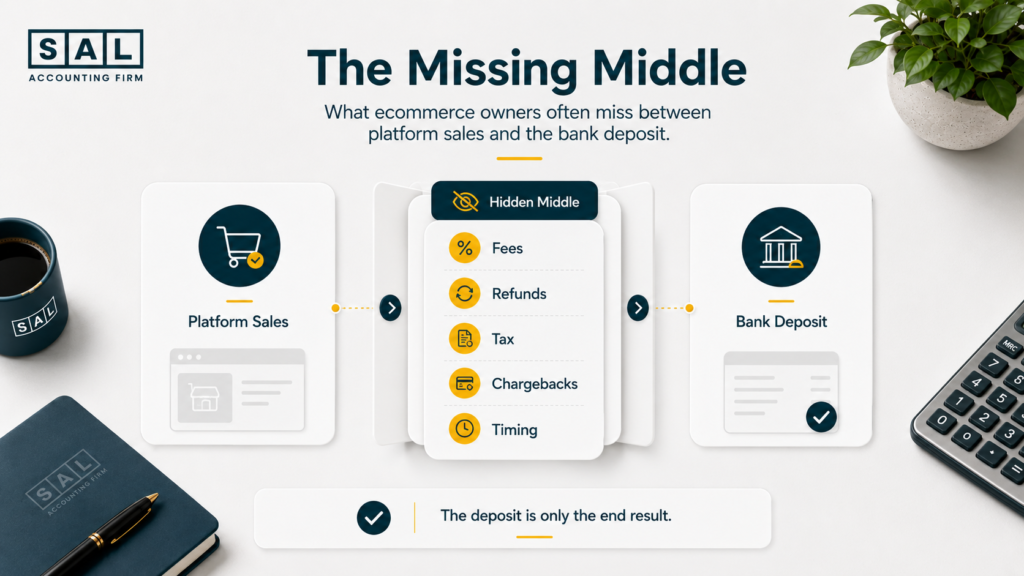
Let’s say Shopify shows $50,000 in sales, but only $43,000 hits your bank account.
A basic bookkeeper may record the $43,000 as income because that is what appears in the bank feed. It looks simple. It feels clean. Technically, it is not enough. That $7,000 difference may include:
- payment fees
- refunds
- chargebacks
- sales tax
- reserves
- shipping adjustments
- timing differences
Shopify’s payout reconciliation report breaks down balance activity, transactions, fees, and payouts so sellers can match Shopify activity to bank deposits. Shopify’s finance reports also cover sales, payments, gift cards, tips, and gross profit. Your bank deposit is not your revenue.
Pro tip: A clean Shopify month should show gross sales, discounts, refunds, tax collected, fees, and the final deposit. If those are blended together, your margin is harder to trust.
- Also read: “Shopify Payment Reconciliation Guide”
2. Shopify, Amazon, Stripe, and Bank Numbers Do Not Reconcile
Your ecommerce numbers should connect. Shopify should connect to payouts. Amazon should connect to settlement reports. Stripe and PayPal should connect to deposits. Then everything should connect to the bank. When those numbers do not match, the answer should not always be, “It is probably timing.” Sometimes it is timing.
But sometimes it is one of these:
- missing platform fees
- refunds posted to the wrong month
- chargebacks not separated
- duplicate sales imports
- deposits sitting in a clearing account
- sales tax mixed into revenue
A strong reconciliation process also makes ecommerce payment reconciliation gaps easier to catch before they become year-end cleanup problems.
3. Your Cost of Goods Sold Is a Guess
Sales do not tell you if a product is profitable. Let’s say you sell a product for $100.
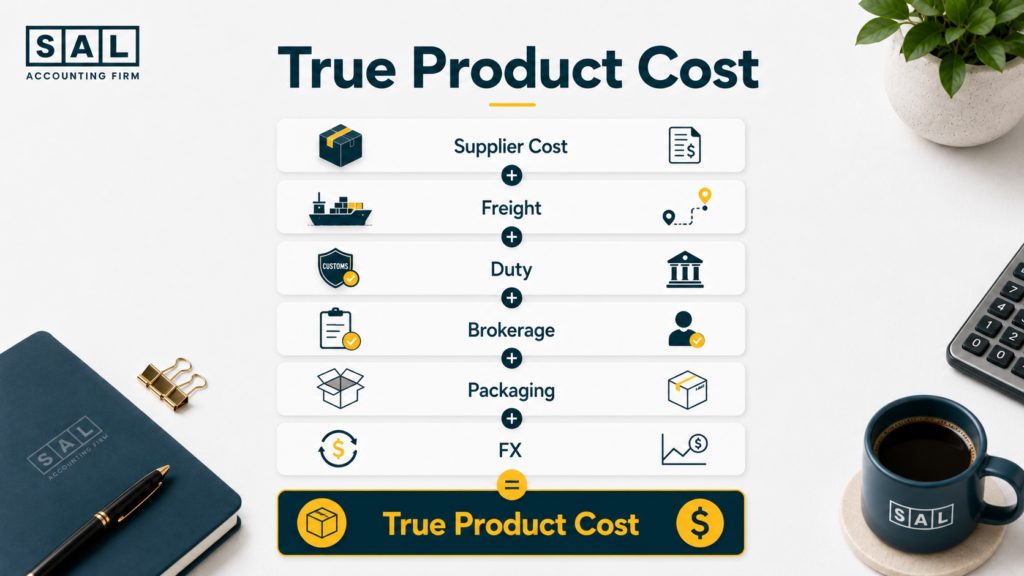
Your supplier cost is $38. But then you add freight, duty, brokerage, packaging, exchange rate changes, 3PL handling, Amazon FBA costs, and damaged units. Now your real cost may be much higher. That changes the whole margin.
A better ecommerce bookkeeper should show the real cost of selling a product, not just the supplier invoice. The same problem shows up in ecommerce profit calculation mistakes when sellers focus on sales but miss the costs underneath.
If COGS is guessed, profit is guessed too. That is where a lot of store owners get stuck. Sales look strong, but cash still feels tight.
The issue is not always revenue. Sometimes the issue is that product cost was never clear in the first place.
- Read more: “Calculate COGS for Ecommerce Stores”
Case Study: How a Shopify Brand in King West, Toronto Fixed Payout Confusion1
Sarah runs a growing skincare brand from King West in Toronto. Sales look strong in Shopify, but her bank deposits always feel smaller than expected. Her bookkeeper records Shopify deposits as sales, then adds expenses separately whenever they appear in the bank feed. At first, the books look clean enough. But as orders increase, Sarah cannot clearly see gross sales, refunds, discounts, processing fees, sales tax collected, or true monthly profit.
The Problem
The bookkeeping is based on bank deposits instead of Shopify activity. Payment fees, refunds, and timing differences are hidden inside each payout. Sarah’s profit looks smoother than reality, and her monthly reports do not explain where the money went.
What We Do
We rebuild the bookkeeping process around Shopify payout reconciliation. Gross sales, discounts, returns, shipping income, taxes collected, payment fees, and deposits are separated properly. Then the Shopify reports are matched against the bank so each payout has a clear trail.
The Result
Sarah can now see what her store sold, what Shopify deducted, what reached the bank, and what profit remained. Her reports are easier to trust, tax season is cleaner, and pricing decisions are based on real margins instead of rough bank deposits.
Clean Shopify payouts at the source with SAL Shopify accounting services.
4. Inventory Does Not Match Your Accounting Reports
Inventory is not just a warehouse issue. It affects profit, cash flow, COGS, your balance sheet, and tax planning.
If your accounting report says you have $80,000 in inventory, but your warehouse, Shopify, or Amazon FBA report says something else, the numbers need a closer look. Common inventory issues include:
- returns that are not adjusted
- damaged products still sitting in inventory
- freight and duty treated as regular expenses
- Amazon FBA inventory not matched to the books
- stock counts skipped before month-end
A better bookkeeper does not need to run your warehouse. But they should understand how inventory affects the numbers. Shopify inventory accounting becomes especially important once product cost, returns, landed cost, and stock movement all affect the same monthly report.
Pro tip: Inventory should not be reviewed only when something feels off. A simple month-end inventory check can catch margin problems before they show up as cash flow stress.
5. GST/HST, Sales Tax, and Marketplace Tax Are Not Clearly Tracked
Tax gets messy when sales move through different platforms. Shopify, Amazon, Etsy, Stripe, PayPal, Canadian sales, US sales, marketplace tax, GST/HST, refunds, and chargebacks can all touch the same month.
CRA says GST/HST registrants must keep GST/HST records that support returns and claims, including sales invoices, purchase invoices, and other business records. CRA also explains broader record-keeping rules for businesses.
Basically, tax support should not be a last-minute folder before filing. It should be part of the monthly bookkeeping process.
Get a faster tax reality check with the SAL GST/HST Refund Calculator for Ecommerce Stores.
For Canadian sellers, GST/HST compliance for ecommerce stores gets easier when sales tax collected, input tax credits, refunds, and platform reports are reviewed throughout the year.
- Also read: “GST/HST Compliance for Ecommerce Stores”
6. Monthly Reports Arrive Too Late to Help
If January’s reports arrive in April, they may still help with tax. But they are not very useful for running the store.
Ecommerce decisions move quickly. You may need to adjust ad spend, reorder inventory, review returns, change pricing, or slow down cash spending before the next month is over. Late reports create delayed decisions.
A better bookkeeper should close the month while the numbers still matter. For Shopify stores, a Shopify month-end close checklist keeps payouts, fees, refunds, inventory, and sales tax from drifting into “we’ll fix it later” territory.
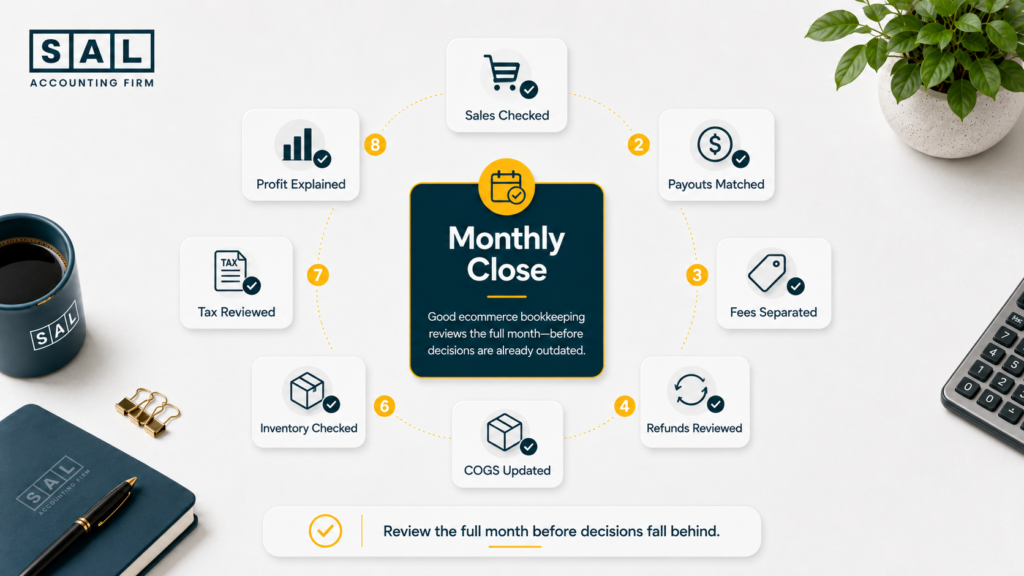
7. Your Bookkeeper Cannot Explain Profit in Plain English
This one matters more than people think. If your bookkeeper sends reports but cannot explain why sales are up and cash is tight, you still do not have clarity. You should be able to ask:
- Why did profit drop?
- Why is the bank lower than Shopify sales?
- Which fees increased?
- Did COGS change?
- Are returns hurting margin?
And you should get a clear answer. Not jargon. Not a confusing accounting explanation.
A clear answer.
When reports feel hard to trust, the problem often shows up in ecommerce financial statements first. The P&L may look clean, but it does not explain the real movement behind sales, fees, inventory, and cash.
The point is, your bookkeeper should make the business easier to understand, not just send reports.
Regular Bookkeeper vs Ecommerce Bookkeeper: What Changes?
A regular bookkeeper may handle simple income and expenses. But ecommerce bookkeeping needs more detail because sales do not move in a straight line from customer to bank. Here is the difference in practice.
| Area | Regular Bookkeeper | Ecommerce Bookkeeper | Why It Matters |
| Revenue | Records bank deposits | Starts with platform sales | Shows real sales |
| Fees | Groups expenses broadly | Separates payment and marketplace fees | Shows margin leaks |
| Inventory | Records purchases | Tracks COGS and landed cost | Improves profit accuracy |
| Tax | Reviews basic tax accounts | Tracks GST/HST, marketplace tax, and channels | Reduces filing stress |
| Reporting | Gives standard P&L | Explains sales, payouts, margins, and cash | Supports better decisions |
This does not mean every ecommerce brand needs a huge finance team. It means your bookkeeping has to match the way your business actually works.
A generalist may do fine for a simple business. But once your store has multiple platforms, cross-border sales, more refunds, and tighter cash flow, the gap between a specialist Shopify accountant and a general accountant becomes easier to feel.
The same idea applies beyond Shopify. An ecommerce accountant vs general accountant comparison usually comes down to one question: can they explain what happened before the money reached the bank?
Case Study: How a Mississauga Ecommerce Seller Cleaned Up Inventory and GST/HST Records2
Omar runs a home goods ecommerce brand near Square One in Mississauga. He sells through Shopify and Amazon FBA, with products moving between suppliers, Amazon warehouses, and a local 3PL. Sales are growing, but his reports are hard to trust. Inventory value changes every month, supplier invoices are not always attached, and GST/HST records are scattered across emails, platform exports, and bookkeeping software.
The Problem
The books do not connect sales, inventory, landed cost, and tax records clearly. Amazon fees are grouped too broadly, some freight costs are treated as general expenses, and GST/HST support documents are not organized well enough for a clean review.
What We Do
We clean up the chart of accounts, separate Amazon and Shopify activity, organize supplier invoices, review GST/HST records, and connect landed costs to inventory. Then we create a monthly close checklist so sales, fees, COGS, inventory, and tax records are reviewed in the same rhythm.
The Result
Omar gets cleaner monthly reports, better product margin visibility, and stronger GST/HST support. He can see which products are carrying the brand, which costs are reducing profit, and what needs attention before the next filing period.
How to Fix Ecommerce Bookkeeping Before It Gets More Expensive
The fix does not always mean starting over. Sometimes the books need cleanup. Sometimes the process needs better structure. Sometimes the bookkeeper needs ecommerce support. Start with the areas that affect trust the fastest.
| Step | What to Review | What to Fix First | Owner Benefit |
| 1 | Sales channels | Shopify, Amazon, Stripe, PayPal mapping | Cleaner revenue |
| 2 | Payouts | Fees, refunds, chargebacks, deposits | Better reconciliation |
| 3 | COGS | Supplier cost, freight, duty, packaging | Clearer margin |
| 4 | Inventory | Stock reports and accounting balance | Better cash planning |
| 5 | Tax | GST/HST and sales tax records | Cleaner filing support |
| 6 | Close process | Monthly checklist and deadline | Faster decisions |
The goal is not just clean books. The goal is to know what happened, what changed, and what to do next.
A good ecommerce bookkeeping process should give you cleaner answers every month. Not just at year-end. Not only when tax season gets stressful. Every month.
Pro tip: Fix payout reconciliation first. Once sales, refunds, fees, tax, and deposits are separated properly, the rest of the cleanup becomes easier to diagnose.
The right process also makes categorizing ecommerce transactions much cleaner because sales, fees, refunds, tax, COGS, and software costs are not being forced into generic accounts.
For stores that already feel messy, choosing the right ecommerce bookkeeper often comes down to whether they can explain your platforms, not just your accounting software.
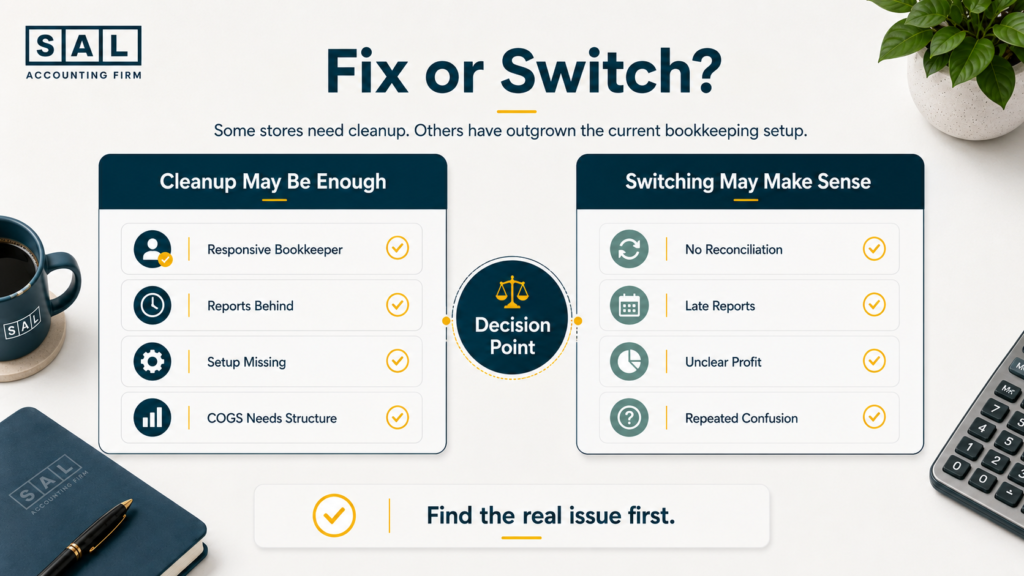
Should You Fix the Process or Switch Bookkeepers?
You may not need to switch bookkeepers right away. Sometimes the issue is not the person. It is the process.
A bookkeeper can be responsive, organized, and still struggle with ecommerce if the setup was built around bank feeds instead of platform reports. Start by looking at what is actually broken.
A cleanup may be enough when:
- your bookkeeper responds quickly
- the books are behind but not completely unreliable
- Shopify or Amazon reports were never set up properly
- COGS needs structure, but the sales data is available
- GST/HST records exist, but they are scattered
- reports need better categories, not a full rebuild
In that case, the first move is usually a cleanup plan. The goal is to separate sales, payouts, fees, refunds, tax, COGS, and inventory so the reports start making sense again.
Switching may make more sense when:
- your bookkeeper avoids platform reconciliation
- reports are late every month
- you keep explaining how Shopify or Amazon works
- COGS is still guessed after multiple reviews
- tax records are not organized during the year
- profit changes, but no one can explain why
- you no longer trust the numbers before making decisions
That is usually the bigger sign. Not one mistake. A pattern.
At that point, staying with the same process can cost more than changing it. Not always in obvious ways, either. It can show up as unclear profit, poor pricing decisions, tax stress, slow reporting, or inventory choices made without real margin data.
A better ecommerce bookkeeping setup should make the business easier to understand each month. That is the quiet test.
If the books create more questions than answers, move toward a bookkeeper who understands how ecommerce money actually moves.
The decision often overlaps with when to switch accountants for ecommerce. The issue is usually not one dramatic mistake. It is a pattern: late reports, unclear margins, weak platform reconciliation, and no clear explanation.
Questions to Ask Before Hiring a Better Ecommerce Bookkeeper
Before you switch bookkeepers, ask questions that show whether they understand ecommerce. You can ask:
- Do you reconcile Shopify payouts against bank deposits?
- Do you review Amazon settlement reports?
- Do you separate gross sales, fees, refunds, tax, and payouts?
- Do you track COGS and landed cost?
- Do you review GST/HST records during the year?
- Do you have a monthly close checklist?
- Can you explain why profit changed this month?
A better bookkeeper should make you feel clearer after the conversation. If the answers are vague, that is useful information too. The right questions also reveal ecommerce accountant red flags before you hand over your books.