
Your supplement store can have clean books and still have a chart of accounts that makes the P&L hard to use. A good setup separates sales, inventory, product costs, fees, fulfillment, tax, and overhead without creating an account for every SKU.
That ecommerce-specific structure is central to how SAL Accounting approaches online-store accounting. In this guide, you’ll see exactly what belongs in your chart, what doesn’t, and which setup mistakes become much harder to fix as the business grows.
Want to see what happens once cost layers are separated? Run the Ecommerce EBITDA Calculator using the categories above.
Quick Takeaways: Supplement Ecommerce Chart of Accounts
- Separate assets, liabilities, revenue, product costs, selling costs, and operating expenses.
- Don’t create a general ledger account for every SKU, ingredient, sales channel, or ad campaign.
- Keep gross sales, discounts, refunds, fees, and tax visible instead of recording only the payout.
- Manufacturing deposits, inventory, clearing accounts, and taxes need proper balance-sheet accounts.
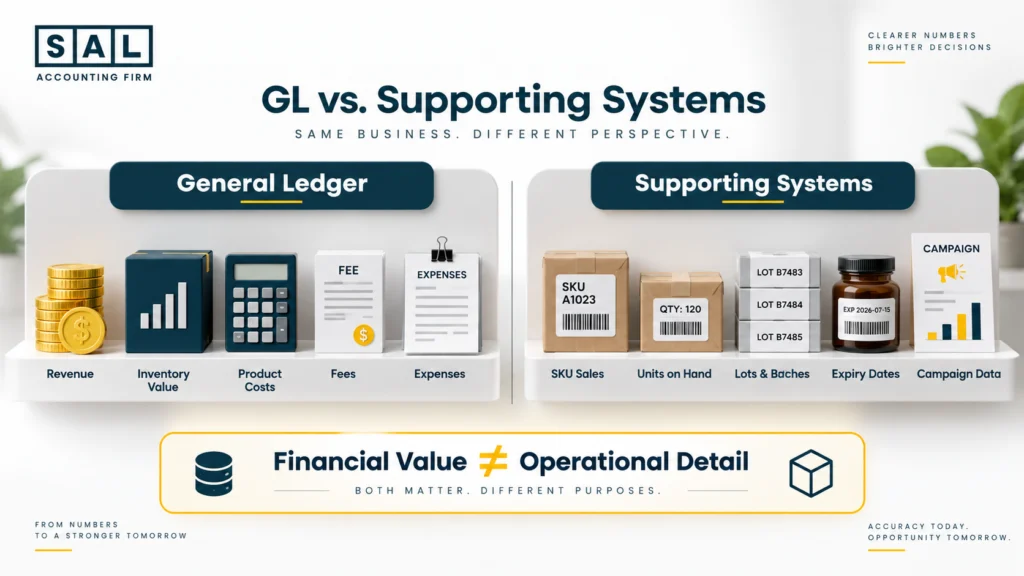
- Keep SKU quantities, batches, expiry dates, and campaign-level data in supporting systems.
- Your chart should give you enough detail to understand the business without making the books difficult to maintain.
What Is a Chart of Accounts for a Supplement Ecommerce Business?
A chart of accounts is the list of financial accounts your business uses to organize transactions. Basically, it decides where everything goes. For an online supplement business, the P&L may broadly move through:
Sales → Product Costs → Gross Profit → Selling Costs → Operating Expenses → Profit
The balance sheet then holds things such as cash, receivables, inventory, deposits, payables, tax, and equity. That structure matters because it determines what you can actually understand from your reports. Let’s say your P&L shows:
- Sales: $200,000
- COGS: $80,000
- Expenses: $105,000
- Profit: $15,000
You know the final number. But you don’t necessarily know what caused it.
Did fulfillment increase? Were discounts higher? Did payment fees jump? Was there an inventory write-off? Is cash already committed to the next manufacturing run?
That’s the difference between books that balance and ecommerce financial statements you can actually understand.
Supplement businesses add another layer because the accounting often has to deal with manufacturing, inventory, expiry, ecommerce platforms, payment processors, and product costs at the same time. That wider picture is covered in our online supplement business accounting guide.
How Detailed Should a Supplement Ecommerce Chart of Accounts Be?
This is where businesses usually end up at one of two extremes.
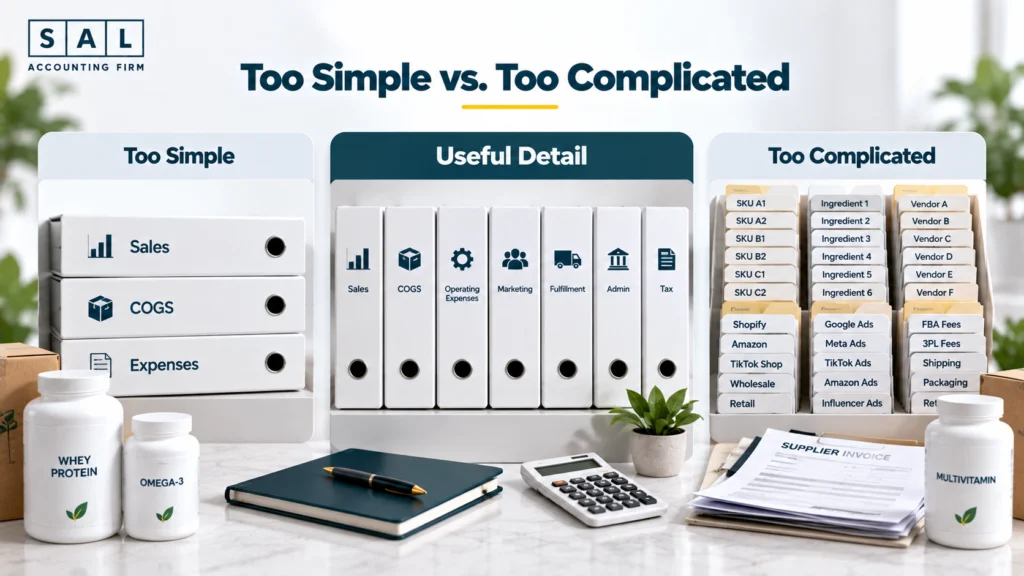
Too Little Detail
A chart with only:
- Sales
- COGS
- General Expenses
is easy to maintain. But suppose General Expenses increase from $45,000 to $61,000. What happened? Advertising? 3PL storage? Processing fees? Shipping? Software? You need to dig through the transactions to find the answer.
Too Much Detail
The opposite problem looks like this:
- Vanilla Protein — Shopify Sales
- Chocolate Protein — Shopify Sales
- Vanilla Protein — Amazon Sales
- Chocolate Protein — Amazon Sales
- Meta Prospecting Ads
- Meta Retargeting Ads
- Google Shopping Ads
- Bottle Supplier
- Label Supplier
- Magnesium Ingredient
- Vitamin C Ingredient
There’s plenty of detail. There’s also plenty of room for inconsistent bookkeeping. A better approach is to create a separate account when the information is:
- financially meaningful;
- useful for reporting;
- consistently classifiable;
- important enough to review separately.
Ask yourself one question:
Would you make a different business decision if this number changed materially?
If yes, separating it may make sense. If not, that detail may belong somewhere else.
This is the same principle behind properly categorizing ecommerce transactions: capture what actually happened without creating unnecessary accounting complexity.
Pro tip: Before adding an account, ask who will look at it every month. If nobody needs the number separately, the account probably doesn’t need to be separate either.
Which Chart of Accounts Categories Does a Supplement Brand Need?
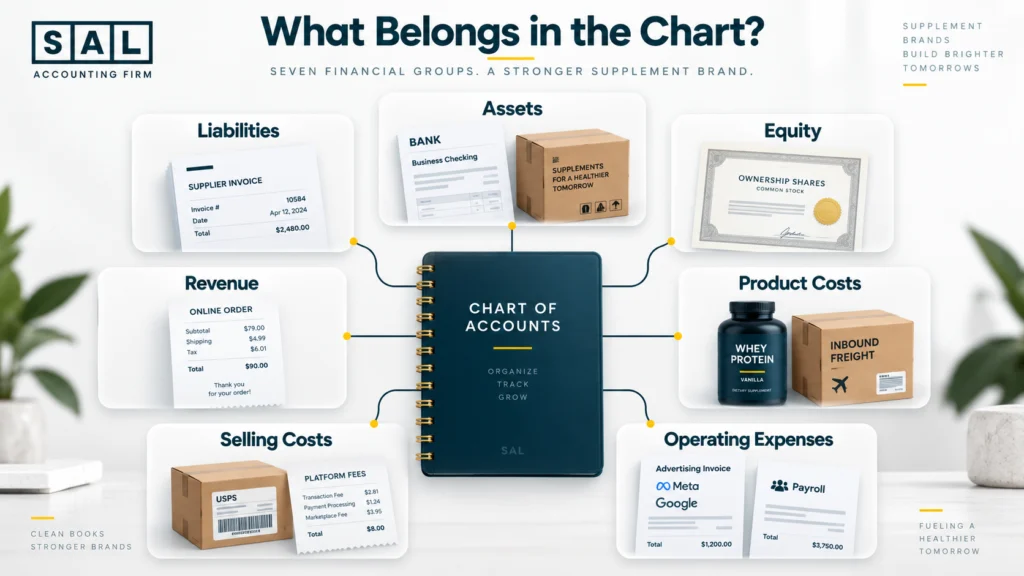
Most supplement ecommerce businesses can start with seven major account groups. Here’s the purpose of each one:
| Account Group | Examples | What It Tells You | Detail Better Kept Elsewhere |
|---|---|---|---|
| Assets | Bank, inventory, clearing, deposits | What the business owns | SKU counts, lots, expiry |
| Liabilities | Payables, cards, tax | What the business owes | Vendor workflow |
| Equity | Share capital, retained earnings | Owner/shareholder position | Management KPIs |
| Revenue | Product sales, wholesale, discounts | What you actually sold | Order analytics |
| Product Costs | Manufacturing, freight, duties | What products cost | SKU costing schedules |
| Selling Costs | Fees, fulfillment, shipping | What selling orders costs | Order-level data |
| Operating Expenses | Ads, payroll, software | What running the company costs | Campaign analytics |
The accounts underneath those groups depend on the business.
A Shopify-only brand working with one co-packer won’t need exactly the same setup as a supplement seller using Shopify, Amazon, wholesale, and several fulfillment locations.
The point is to create enough separation that your P&L tells a useful story.
Which Balance Sheet Accounts Should an Online Supplement Business Have?
The P&L tends to get most of the attention. But some of the biggest accounting issues for supplement sellers sit on the balance sheet. That includes:
- cash;
- receivables;
- inventory;
- ecommerce clearing;
- manufacturing deposits;
- prepaid expenses;
- supplier bills;
- tax payable.
If those accounts are wrong, profit can look reasonable while the rest of the books make very little sense.
Cash and Bank Accounts
Your actual business bank balances need clear accounts. Depending on your setup, that may include:
- CAD operating account;
- USD operating account;
- savings account;
- dedicated tax account.
You don’t need a new GL account for every banking feature. Separate accounts where doing so makes reconciliation and reporting easier. For businesses working across currencies and payment platforms, your choice of business bank accounts for ecommerce can also affect how easy those balances are to manage.
Ecommerce Clearing Accounts
A clearing account bridges the timing difference between making a sale and receiving the payout.
Sale → Clearing Account → Payout → Bank
That matters because a $75,000 deposit from Shopify does not automatically mean you made $75,000 in sales.
Shopify’s official payout reporting breaks the movement into transactions, fees, payouts, and other activity rather than treating the final bank deposit as the whole story.
Your clearing account gives those movements somewhere to sit until everything reconciles.
For Shopify sellers, Shopify payment reconciliation explains how the order, payout, and bank deposit fit together.
SAL’s Shopify accounting services are built around keeping those sales, refunds, fees, payouts, and inventory movements properly connected.

Accounts Receivable
If most customers pay at checkout, accounts receivable may be small. Wholesale changes that. Suppose a retailer places a $30,000 order on net-30 terms. The sale has happened. The cash hasn’t. Accounts receivable keeps the amount visible until the customer pays.
Inventory
Inventory accounts may include:
- finished goods;
- raw materials where relevant;
- packaging where appropriate;
- inventory in transit where appropriate.
CRA’s inventory and COGS guidance explains that inventory can include raw materials, work in progress, and finished goods depending on the business.
But that doesn’t mean every SKU needs a separate GL account. Your accounting system needs to know the financial value of inventory. Your inventory system needs to know which products and units make up that value. Those are different jobs.
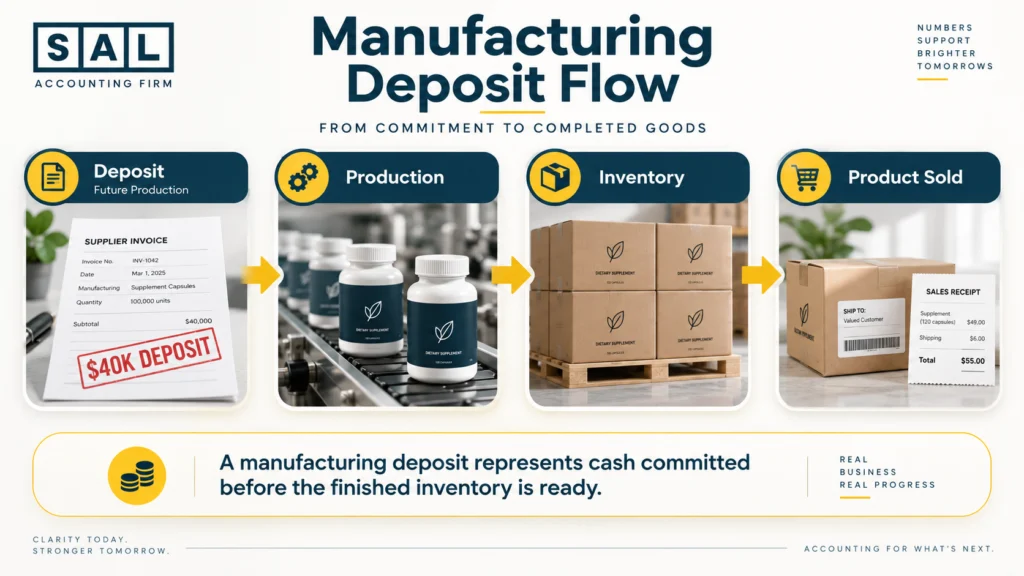
Manufacturing Deposits and Prepayments
This is especially important for supplement brands. Say your next production run costs $80,000. The manufacturer asks for 50% upfront. You pay $40,000 now, while production won’t finish for another six weeks. Cash left the bank.
That doesn’t automatically mean the entire $40,000 belongs in this month’s operating expenses.
Depending on the facts and accounting treatment, the payment may need to remain identifiable as a deposit, prepayment, inventory-related balance, or another appropriate asset.
This is one reason cash versus accrual accounting can produce very different pictures of the same ecommerce business.
The chart-of-accounts point is simpler: Don’t bury the deposit. You should be able to see how much cash is already committed to future production.
Case Study: How a North York Supplement Brand Handles Manufacturing Deposits1
Maya runs an online supplement company from North York, Toronto. Her manufacturer requires a 50% deposit before each production run. When the business is smaller, those payments are around $10,000. Now a normal deposit can be $40,000 or more.
The Problem
Her books record each deposit as manufacturing expense as soon as the money leaves the bank. One $40,000 payment makes the month look dramatically less profitable even though the related inventory hasn’t been completed or sold. She also can’t quickly tell how much money is currently tied up in production.
What We Do
We create a separate structure for manufacturing deposits and define how amounts move into the appropriate inventory or expense accounts based on the transaction and accounting treatment. Deposits, finished inventory, payables, and manufacturing costs no longer run through one broad account.
The Result
Maya can now distinguish normal operating expenses from cash already committed to future inventory. Her month-to-month P&L becomes easier to compare, and the balance sheet tells her where that $40,000 actually went.
Accounts Payable and Other Liabilities
Accounts payable shows bills the business already owes but hasn’t paid yet. For a supplement seller, that may include:
- manufacturers;
- packaging suppliers;
- freight providers;
- 3PLs;
- contractors;
- other vendors.
That distinction matters. A company may have $120,000 in the bank and $85,000 of supplier bills due soon. The bank balance alone doesn’t tell you that.
GST/HST and Other Tax Liabilities
Tax collected from customers should not disappear inside revenue. CRA’s GST/HST collection guidance explains the responsibility businesses have for the GST/HST they collect.
So when a customer pays tax on top of the product price, that tax amount should remain separately identifiable from actual sales. That’s also why GST/HST accounting for ecommerce stores needs to connect back to the books instead of only being looked at when a tax return is due.
Canadian brands selling into the U.S. may eventually need separate sales-tax liability accounts as registrations and collection obligations arise.
Selling across the border too? The US Economic Nexus Threshold Checker gives you a quick first look at where sales thresholds may need attention.
How Should Sales, Inventory, and Product Costs Be Categorized?
These accounts determine whether you can actually understand gross profit. The goal is to keep the important pieces visible without turning the GL into a product database.
Sales, Discounts, and Refunds
A useful revenue section may include:
- Product Sales
- Wholesale Sales, where material
- Shipping Revenue, where useful
- Discounts
- Returns & Refunds
Imagine this order:
Gross product sale: $100
Discount: $10
Payment-processing fee: $2.70
Cash ultimately received: $87.30
If $87.30 is recorded as revenue, you’ve lost two important pieces of information. You can’t clearly see the discount. And you can’t clearly see the processing fee. That makes it harder to understand why profit moved.
This is one of the most common issues behind ecommerce reconciliation problems.
Pro tip: Start with the sale and reconcile down to the payout. Don’t start with the payout and work backward trying to rebuild the sale.
Inventory and Product Costs
Product-related costs should stay distinguishable from normal operating expenses.
Depending on the business and proper accounting treatment, relevant categories may include:
- product or manufacturing cost;
- freight-in;
- duties;
- qualifying packaging or preparation;
- inventory adjustments;
- inventory write-offs.
The important point is that a cost appearing on a manufacturer or 3PL invoice does not automatically tell you where it belongs.
A single invoice could include receiving, preparation, storage, fulfillment, shipping, and other charges with different purposes.
The actual cost behind your inventory may also include more than the manufacturer’s invoice price. Landed cost accounting looks at the freight, duties, and other costs that may sit behind what inventory really costs.
Should Ingredient and Packaging Costs Be Separate?
Sometimes. Suppose your co-packer charges one all-in amount per finished bottle.
Creating separate GL accounts for whey, flavouring, sweetener, bottle, cap, label, and scoop may not improve the financial statements at all.
That detail belongs in your production or costing records. But imagine packaging costs suddenly become material after you switch to premium bottles, custom boxes, and inserts.
Now management may genuinely need to see packaging separately. The rule isn’t: Separate everything. It’s: Separate what actually matters.
How Should Samples and Giveaways Be Recorded?
Samples, influencer packages, retail samples, and promotional giveaways shouldn’t simply disappear from inventory.
If 1,000 units leave inventory during a launch but none were sold, you want the books to distinguish that activity from normal customer sales.
The final accounting treatment depends on the facts, but your chart should give material promotional inventory usage somewhere clear to go.
How Should Expired or Unsellable Inventory Be Recorded?
Supplement inventory can become:
- expired;
- damaged;
- obsolete;
- recalled;
- otherwise unsellable.
Say $20,000 of inventory can no longer be sold. That is different from $20,000 of product being sold normally to customers. Your chart should make material write-offs or inventory adjustments visible.
Inventory issues are one reason a supplement brand’s profit can look wrong even when sales reports appear fine.
- Read more: “How to Calculate COGS for an Ecommerce Store”
How Should Ecommerce Fees, Fulfillment, and Operating Expenses Be Categorized?
This is where broad accounts like “Miscellaneous Expenses” start causing problems. Different ecommerce costs move for different reasons, so the important ones should remain visible.
Payment Processing and Marketplace Fees
Depending on your channels, this may include:
- payment-processing fees;
- marketplace referral or selling fees;
- platform-specific transaction charges.
Suppose sales stay flat while processing fees increase by $4,000. You want to notice that. If the fees are buried inside general expenses, you probably won’t.
Shopify exposes fee information within its payout reporting, which is another reason those deductions shouldn’t simply reduce your recorded revenue. These deductions are also part of the hidden ecommerce costs that can quietly reduce profit margins.
For Amazon-heavy supplement brands, SAL’s Amazon accounting services keep settlements, marketplace fees, FBA costs, and inventory movements from being treated like simple bank deposits.
Fulfillment, Storage, and Shipping
You may want separate accounts for:
- fulfillment or pick-and-pack;
- storage;
- outbound customer shipping.
Why? Because each number tells you something different. Suppose fulfillment rises from $8 to $11 per order. That’s worth investigating. But if fulfillment, storage, shipping, and payment fees are all inside one ecommerce expense account, the increase disappears.
Advertising and Other Operating Expenses
Normal operating accounts may include:
- advertising and marketing;
- payroll;
- contractors;
- software;
- professional fees;
- insurance;
- rent;
- office and administration.
You usually don’t need separate GL accounts for Meta Prospecting, Meta Retargeting, Google Shopping, TikTok Creators, and every other campaign. Your books can show Advertising & Marketing.
Your marketing platforms can handle CAC, ROAS, campaign, and creative-level reporting.
The same principle applies to ecommerce business expenses: the accounting should be detailed enough to manage the business without becoming an operating dashboard.
What Information Should Stay Outside a Supplement Ecommerce Chart of Accounts?
Your general ledger is built for financial reporting. It does not need to replace every system in your business. Information that will often make more sense outside the chart includes:
- SKU-level sales;
- SKU-level margins;
- unit quantities;
- batch numbers;
- lot information;
- expiry dates;
- warehouse-level inventory;
- customer records;
- campaign performance;
- creative performance;
- detailed channel analytics.
For example, you may absolutely need to know which supplement batch expires in four months. But you probably don’t need:
Inventory — Batch A
Inventory — Batch B
Inventory — Batch C
as separate general ledger accounts. The inventory system handles the operational detail. The accounting system carries the financial value.
Should Every Sales Channel Have Its Own Account?
Not necessarily. Suppose you sell through Shopify, Amazon, and wholesale. Duplicating the whole chart could quickly create:
- Shopify Sales
- Amazon Sales
- Wholesale Sales
- Shopify Refunds
- Amazon Refunds
- Wholesale Refunds
- Shopify Fees
- Amazon Fees
And it keeps growing. Sometimes separate accounts make sense.
But software can also use reporting dimensions such as classes, locations, or other tracking fields. QuickBooks, for example, supports class tracking to separate business segments without necessarily rebuilding the full chart.
Should Every Supplement SKU Have Its Own Account?
Usually not. Imagine you sell 60 SKUs.
If each product has its own sales, COGS, inventory, refund, discount, and write-off account, you could create hundreds of accounts. Your GL has now become your product catalogue. SKU-level information is important. It just usually belongs in:
- ecommerce platforms;
- inventory software;
- costing schedules;
- warehouse reporting;
- management reports.
You can still perform SKU profitability analysis without building a separate GL account for every product. Bringing those operational and financial numbers together is what ecommerce management reporting is for.
Pro tip: Let the GL tell you what happened financially. Let your ecommerce and inventory systems tell you which SKU, batch, order, or channel created it.
Case Study: How a Port Credit Supplement Brand Simplifies an Overbuilt Chart2
Daniel runs a growing supplement company from Port Credit, Mississauga. He starts on Shopify, later adds Amazon, and eventually begins selling wholesale. Each time the business expands, new sales, fee, refund, and SKU-specific accounts get added.
The Problem
The same cost starts landing in different places. Amazon storage might be posted to fulfillment one month, marketplace fees the next, and a generic Amazon expense account after that. His reports contain plenty of detail, but month-to-month comparisons become less reliable.
What We Do
We rebuild the chart around the financial categories that matter: sales, discounts, refunds, product costs, processing fees, fulfillment, storage, shipping, advertising, inventory, and liabilities. Channel and SKU detail stays in the ecommerce, inventory, and reporting systems instead of being duplicated inside the GL.
The Result
Daniel still gets Shopify, Amazon, wholesale, and SKU-level reporting when he needs it, but his financial statements now use one consistent structure. The P&L becomes shorter, cleaner, and much easier to compare from one month to the next.
What Does a Supplement Ecommerce Chart of Accounts Look Like?
There isn’t one universal chart every supplement seller should copy. But this gives you a practical starting point:
| Account Range | Example Accounts | Type | Main Purpose | Keep Elsewhere |
|---|---|---|---|---|
| 1000–1099 | CAD Bank, USD Bank | Asset | Cash balances | Transaction detail |
| 1100–1199 | Accounts Receivable | Asset | Unpaid invoices | Customer CRM |
| 1200–1299 | Ecommerce Clearing | Asset | Payout timing | Order analytics |
| 1300–1399 | Finished Goods, Raw Materials | Asset | Inventory value | SKU/lot counts |
| 1400–1499 | Manufacturing Deposits, Prepaids | Asset | Future-period value | Production workflow |
| 2000–2099 | Accounts Payable | Liability | Supplier bills | Vendor notes |
| 2100–2199 | Credit Cards | Liability | Card balances | Receipt storage |
| 2200–2299 | GST/HST, Sales Tax Payable | Liability | Tax owed | Filing schedules |
| 3000–3999 | Share Capital, Retained Earnings | Equity | Owner equity | Management KPIs |
| 4000–4099 | Product Sales, Wholesale | Revenue | Gross revenue | SKU analytics |
| 4100–4199 | Discounts, Returns | Contra-Revenue | Net-sales adjustments | Return reasons |
| 5000–5099 | Manufacturing, Freight-In, Duties | Product Cost | Product cost | Formula detail |
| 5100–5199 | Inventory Adjustments | Product Cost | Write-offs/losses | Lot investigation |
| 6000–6099 | Processing, Marketplace Fees | Selling Cost | Selling fees | Processor detail |
| 6100–6199 | Fulfillment, Storage, Shipping | Selling Cost | Delivery costs | Shipment data |
| 7000–7199 | Ads, Payroll, Software, Admin | Operating Expense | Business overhead | Campaign data |
The account numbers themselves are optional. The logic is what matters. Your chart should make the P&L and balance sheet easier to understand without trying to store every piece of operational data the business produces.
What Are the Most Common Chart of Accounts Mistakes for Ecommerce Sellers?
Most chart-of-accounts problems don’t look dramatic. They just make your reports slightly less useful every month. These are the mistakes worth checking first:
| Mistake | What Happens | What Gets Lost | Better Setup | First Check |
|---|---|---|---|---|
| Recording payouts as sales | Net cash becomes revenue | Fees, refunds, gross sales | Record underlying activity | Compare sales to payout |
| Mixing tax with revenue | Sales are overstated | True revenue | Separate tax liability | Review tax accounts |
| Expensing inventory inconsistently | Profit timing changes | Reliable gross margin | Consistent inventory treatment | Review supplier bills |
| Product costs mixed with overhead | COGS becomes unclear | Gross margin | Separate product costs | Review COGS |
| Fees buried in miscellaneous | Selling costs disappear | Fee trends | Separate material fees | Review misc. accounts |
| One account per SKU | Chart becomes huge | Maintainability | Keep SKU detail elsewhere | Count SKU accounts |
| Chart duplicated by channel | Coding becomes inconsistent | Comparability | Use reporting dimensions | Review duplicates |
| Too many “other” accounts | Reports lose meaning | Useful detail | Rename or merge | Search “other” |
| Duplicate accounts | Same costs go different places | Consistency | Clean account list | Compare similar names |
| Accounts with no purpose | More work, no insight | Readability | Keep useful categories | Ask who uses it |
If three people consistently choose three different accounts for the same transaction, the problem may be the chart itself.
Poor account structure is also one of the patterns behind messy ecommerce bookkeeping.
Need the whole structure cleaned up around ecommerce activity? SAL’s ecommerce accounting services cover sales, payouts, inventory, product costs, fees, and balance-sheet cleanup together.
How Do You Set Up a Supplement Ecommerce Chart of Accounts Step by Step?
You don’t need to start by creating 100 accounts. Start with the financial questions you need the books to answer.
1. Build the Major Financial Groups
Start with:
- Assets
- Liabilities
- Equity
- Revenue
- Product Costs
- Selling & Fulfillment Costs
- Operating Expenses
Then work down into the accounts you actually need.
2. Decide Which Numbers Matter Every Month
Ask what management genuinely needs to monitor. Fulfillment may deserve its own account. A small software subscription probably doesn’t.
Packaging might deserve separation if it has become a major product cost. The test is usefulness, not maximum detail.
3. Fix the Balance Sheet Before Adding More Expense Accounts
Pay particular attention to:
- inventory;
- clearing balances;
- manufacturing deposits;
- receivables;
- payables;
- taxes;
- prepaid expenses.
Adding more P&L accounts won’t fix a balance sheet that doesn’t make sense.
4. Separate Sales From Payouts
Your structure should be able to distinguish:
- gross sales;
- discounts;
- refunds;
- tax;
- fees;
- clearing activity;
- cash received.
The payout should be explainable from those pieces. It shouldn’t replace them.
5. Decide Which Detail Lives Somewhere Else
Choose where you will maintain:
- SKU margins;
- unit quantities;
- batches;
- expiry dates;
- channel analytics;
- marketing campaigns.
Then keep that information there consistently.
6. Document What Each Account Is For
Similar accounts should have clear rules. For example:
Freight-In: appropriate inbound product transportation
Outbound Shipping: delivery of customer orders
Fulfillment: pick-and-pack or order processing
Storage: warehousing inventory
Manufacturing Deposit: identifiable payment made before related production is completed, subject to proper accounting treatment
Now your team has a rule instead of a guess. A consistent supplement ecommerce month-end close becomes much easier once those account rules are documented.
Pro tip: Keep a simple account-mapping sheet with four things: account name, what belongs there, what doesn’t, and one example transaction.
Before tax season arrives, the Tax Document Checklist for eCommerce Stores is a quick way to make sure the records behind those accounts are actually there.
What Should Your Supplement Ecommerce Chart of Accounts Actually Show?
Your chart doesn’t need to track everything. It needs to show the financial parts of the business clearly.
You should be able to see what you sold, what products cost, what selling and fulfilling those orders cost, what the company spends to operate, what inventory is still sitting on the balance sheet, and what the business still owes.
That’s the balance you’re looking for. Not Sales, COGS, Expenses. And not 400 accounts for every SKU, platform, supplier, ingredient, and campaign.
For ecommerce brands thinking about what comes after the accounting structure is cleaned up, the financial growth roadmap lays out the next financial priorities.