A few cents more for a label or a scoop of collagen can quietly cost a supplement brand thousands in gross profit. The fix is knowing what each finished unit costs, which component changed, and how much margin that change took.
SAL Accounting tracks this at the component level for supplement brands. Give this five minutes before your next production run, and you’ll know exactly where your margin is going.
Want to see how a smaller gross margin flows through to operating profit? Run your numbers through the Ecommerce EBITDA Calculator.
Quick Takeaways
- Gross margin depends on what each finished unit costs, not your total supplier invoices.
- Track ingredients and every packaging component separately, so you can see what changed.
- At a $50 price, every $0.50 added to unit cost takes 1 point off gross margin.
- Minimum order quantities can make unit costs look higher than they are if you don’t separate purchased from used.
- Protecting your margin percentage takes a bigger price increase than protecting your profit per unit.
- Review component costs after every production run.
Clear unit costs start with clean books. Our ecommerce bookkeeping team tracks product costs by SKU and component, so a margin change never comes as a surprise.
How Do Ingredient and Packaging Costs Affect Gross Margin for an Online Supplement Brand?
They lower gross margin directly, because every dollar they add to unit cost comes straight out of gross profit.
Gross margin compares what you keep after product cost to what you sell for:
Gross Margin = (Selling Price − Product Cost) ÷ Selling Price
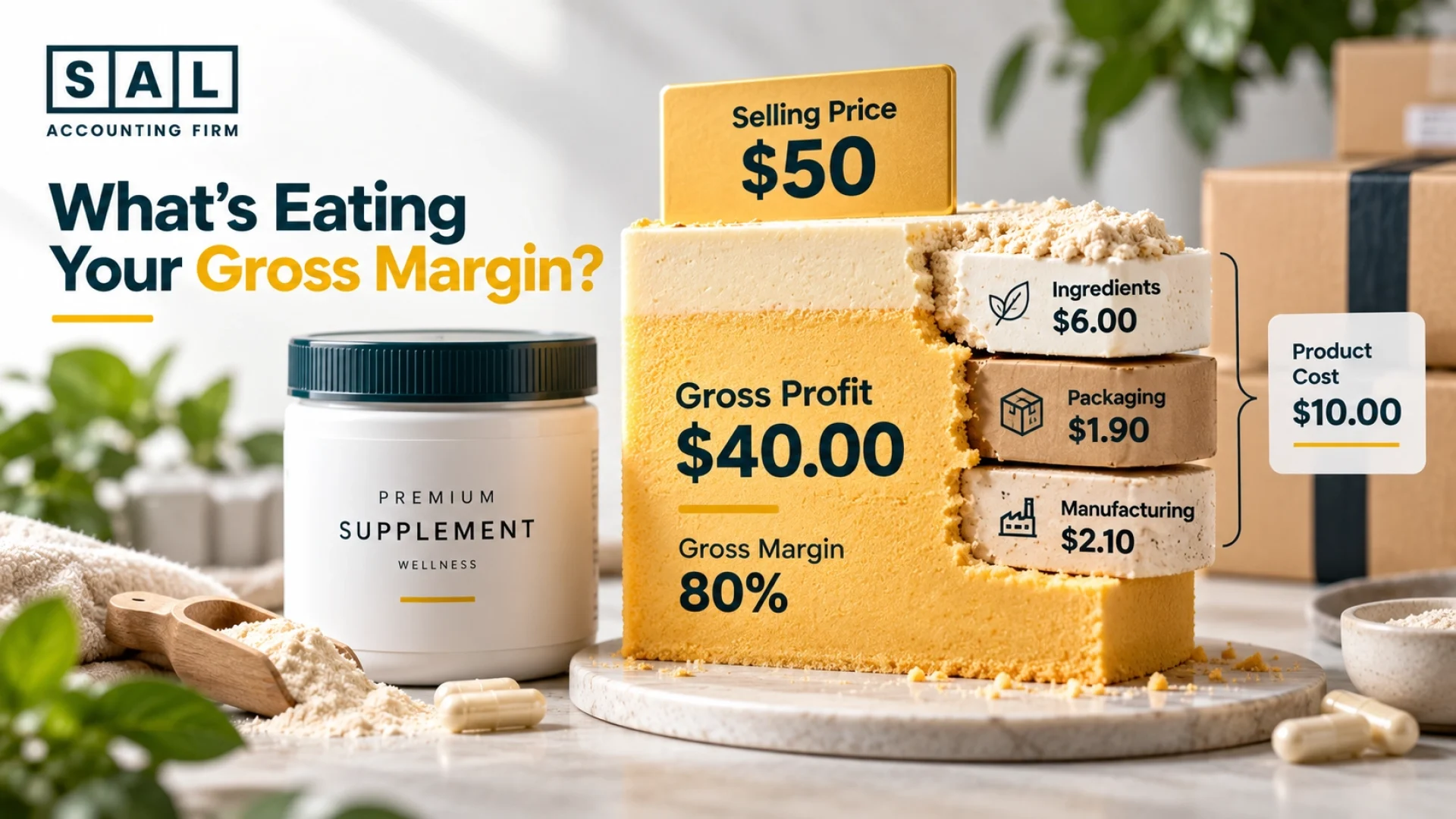
Here’s the running example for this article: a collagen tub that sells for $50.
| Cost Component | Cost per Unit |
|---|---|
| Ingredients | $6.00 |
| Packaging | $1.90 |
| Co-packer manufacturing fee | $2.10 |
| Product cost | $10.00 |
| Gross profit | $40.00 |
| Gross margin | 80% |
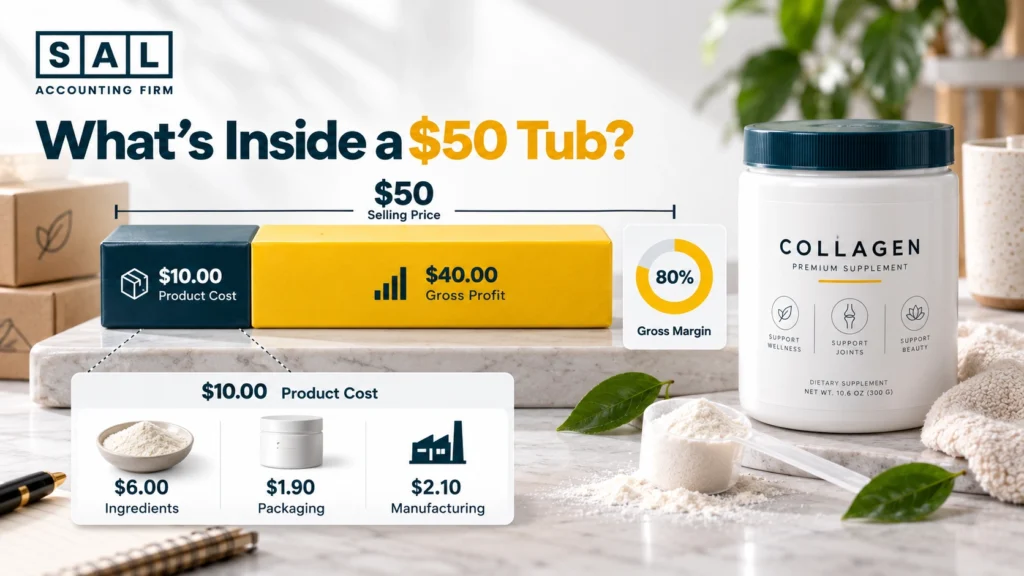
Ingredients and packaging make up $7.90 of the $10 product cost here, so they’re where most margin changes start. Which costs belong in product cost in the first place is set out in COGS for supplement brands. Keep in mind that gross margin stops before selling costs like fees, shipping, and ads, which is where ecommerce contribution margin picks up.
How Do You Break Down Ingredient and Packaging Costs per Unit for a Supplement SKU?
List every ingredient and packaging component separately, then add them up per finished unit. Packaging is more than the container. For a tub, it usually includes:
| Packaging Component | Cost per Unit |
|---|---|
| Tub | $0.90 |
| Lid | $0.18 |
| Label | $0.22 |
| Seal and scoop | $0.15 |
| Product carton | $0.45 |
| Total packaging | $1.90 |
Ingredients work the same way. Divide the ingredient cost for a production run by the finished units it produced. A run that uses $30,000 of ingredients to make 5,000 tubs works out to $6.00 per tub. Two habits make this breakdown useful:
- Keep each component on its own line, so one price change doesn’t hide inside a total
- Use finished units, not units ordered, since units lost in production raise the real cost per tub
Your full unit cost also includes freight, duties, and other costs to get the product ready for sale. How to build that complete number is covered in calculating landed cost for an online supplement business. This post focuses on what ingredient and packaging changes do to your margin.
Pro Tip: Ask your co-packer for a bill of materials with a price for each component. It makes every future cost comparison a five-minute job.
How Much Does a Cost Increase Lower Gross Margin for Supplement Products?
At a $50 price, every $0.50 added to unit cost takes 1 point off your gross margin.
That’s because a cost increase comes straight out of gross profit, while the price stays the same. Here’s how different increases affect the $50 tub:
| Unit Cost Increase | New Product Cost | Gross Margin | Margin Lost |
|---|---|---|---|
| None | $10.00 | 80.0% | |
| $0.25 | $10.25 | 79.5% | 0.5 points |
| $0.50 | $10.50 | 79.0% | 1.0 point |
| $1.05 | $11.05 | 77.9% | 2.1 points |
| $2.00 | $12.00 | 76.0% | 4.0 points |
A $1.05 increase looks small on one tub. Across a run of 5,000 tubs, it’s $5,250 less gross profit, assuming the price and everything else stay the same.
This is also why margin often slips without anyone noticing. Small increases stack up across components and runs. When your overall margin has already dropped and you need to trace every cause, the full method is in why an online supplement profit margin drops.
How Do You Find Which Ingredient or Packaging Cost Changed?
Compare each component’s cost per unit from the last production run with the latest one. Here’s the collagen tub’s next run:
| Component | Previous Run | Latest Run | Change |
|---|---|---|---|
| Ingredients | $6.00 | $6.70 | +$0.70 |
| Tub | $0.90 | $1.15 | +$0.25 |
| Label | $0.22 | $0.32 | +$0.10 |
| Other packaging | $0.78 | $0.78 | $0.00 |
| Manufacturing fee | $2.10 | $2.10 | $0.00 |
| Product cost | $10.00 | $11.05 | +$1.05 |
Ingredients explain $0.70 of the $1.05 increase. The tub and label explain the other $0.35. Now you know which supplier conversations to have.
Compare like with like. Batch size, yield, packaging specs, and currency can all change the result. If you buy in US dollars, a weaker Canadian dollar raises your cost even when the supplier’s price doesn’t change, and the Bank of Canada’s daily exchange rates show how much of the jump came from currency. For a wider signal on ingredient prices, Statistics Canada’s Raw Materials Price Index tracks what Canadian manufacturers pay for key raw materials.
Case Study: How Jessica’s Collagen Brand in Scarborough, Toronto Finds Its Real Cost Driver1
Jessica sells collagen powder online from a small office in Scarborough, Toronto. After her latest production run, her gross margin drops by about 2 points. Her ingredient supplier raised prices last quarter, so she assumes that’s the whole story.
The problem: Jessica only tracks total product cost per tub. She can’t see that her packaging costs rose too. Without a component breakdown, she plans to negotiate only with her ingredient supplier.
What we do: We break her product cost into ingredients, each packaging component, and the co-packer fee, then compare the two runs line by line. Ingredients explain two-thirds of the increase. A new tub supplier and a label reprint explain the rest.
The result: Jessica negotiates with her ingredient supplier and gets new quotes for tubs. She also asks her co-packer for a costed bill of materials, so every future run can be compared component by component.
How Do Minimum Order Quantities Affect Supplement Packaging Costs?
Minimum order quantities make you buy more packaging than one run uses, so separate what you bought from what you used.
Packaging suppliers often require large orders. Say your label printer’s minimum is 10,000 labels at $0.22 each, for $2,200. Your next run only makes 5,000 tubs.
| Approach | Label Cost Charged to the Run | Label Cost per Tub |
|---|---|---|
| Charge the whole purchase to this run | $2,200 | $0.44 |
| Charge only the labels used | $1,100 | $0.22 |
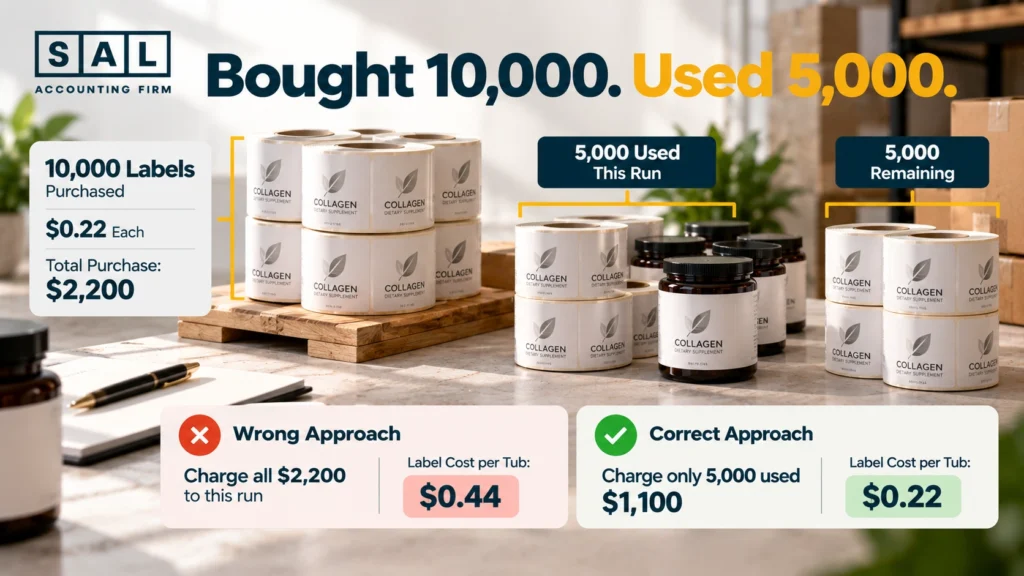
Charging the whole purchase to one run doubles the label cost per tub and makes your margin look 0.44 points worse than it is. The 5,000 unused labels are still yours for the next run. Track three numbers for every packaging order: quantity purchased, quantity used, and quantity remaining.
Production waste needs similar care. Under IAS 2, abnormal amounts of wasted materials aren’t part of inventory cost. Normal production losses are a different matter, so record how much waste happened and why. If your co-packer holds packaging for you, the same purchased, used, and remaining check belongs in your co-packer production run reconciliation.
Case Study: How Kevin’s Supplement Brand in Erin Mills, Mississauga Stops a False Margin Drop2
Kevin sells pre-workout powder online from a warehouse unit in Erin Mills, Mississauga. To meet his supplier’s minimum, he orders 20,000 tubs, enough for four production runs. His bookkeeper charges the full tub order to the first run of 5,000.
The problem: The first run’s tub cost per unit looks four times higher than normal. Kevin’s gross margin report shows a steep drop, and he starts planning a price increase to fix it.
What we do: We split the tub order into purchased, used, and remaining quantities. Only the 5,000 tubs used are charged to the first run. The other 15,000 stay in inventory for future runs.
The result: Kevin’s real margin barely moved. He skips the price increase and now tracks every bulk packaging order by quantity used, not quantity bought.
What Price Increase Protects Gross Margin When Supplement Costs Rise?
It depends on whether you want to protect your margin percentage or your profit per unit. Using the latest run, product cost is now $11.05:
| Goal | Formula | New Price |
|---|---|---|
| Keep $40 gross profit per tub | $11.05 + $40 | $51.05 |
| Keep an 80% gross margin | $11.05 ÷ (1 − 0.80) | $55.25 |
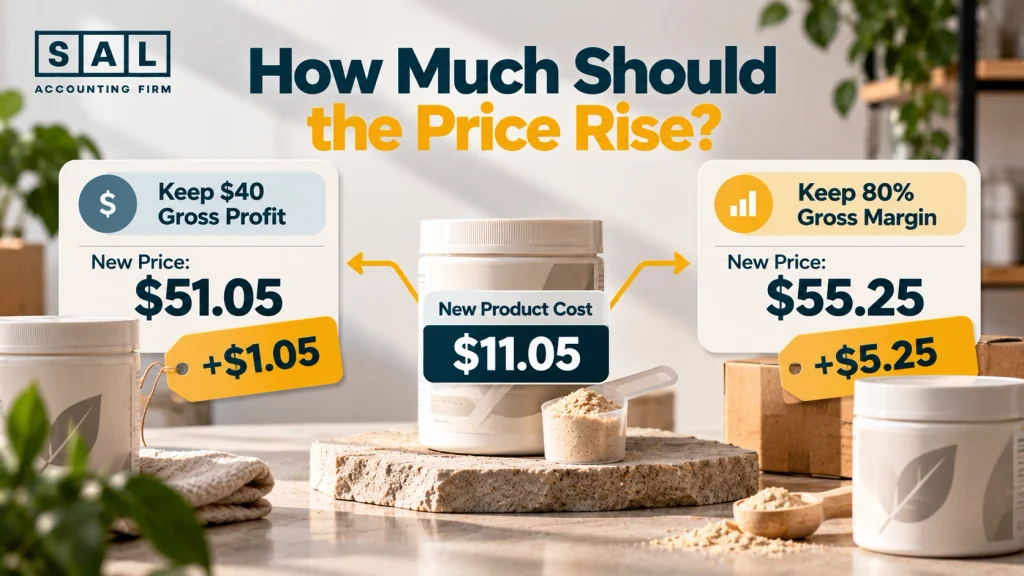
Keeping the same dollars per tub takes a $1.05 increase. Keeping the same percentage takes $5.25. That gap surprises a lot of founders, and it matters because a big price jump can cost you sales.
You don’t have to raise prices at all. You can renegotiate with suppliers, change packaging specs, or accept a lower margin on one SKU while others carry more. Weighing those options is part of your ecommerce pricing strategy, and seeing which products can absorb the hit starts with SKU-level profitability for supplement brands.
How Should Online Supplement Brands Track Ingredients and Packaging Costs Over Time?
Update a simple component cost tracker after every production run, and review it before you reorder.For each SKU, track:
- Ingredient cost per finished unit
- Each packaging component’s cost per unit
- Manufacturing fee per unit
- Units produced and units saleable
- Packaging purchased, used, and remaining
- The exchange rate, if you buy in US dollars
Then check the result against your selling price and margin target each time. Keep the documents behind every number: supplier invoices, purchase orders, the bill of materials, production reports, and co-packer statements.
The best time to update the tracker is when you close the books each month. Building it into your month-end close for supplement brands keeps it from falling behind.
Final Thought: Do You Know Which Cost Is Moving Your Supplement Margin?
Ingredient and packaging costs rarely jump all at once. They creep up a few cents at a time, across components and runs, until your margin is noticeably lower. Track each component per finished unit, separate packaging purchased from packaging used, and compare every run with the last. Then decide whether to negotiate, redesign, or reprice.
Once your unit costs are clear, our free roadmap for margin-smart growth helps you decide where your next production dollar should go.