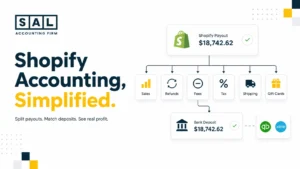
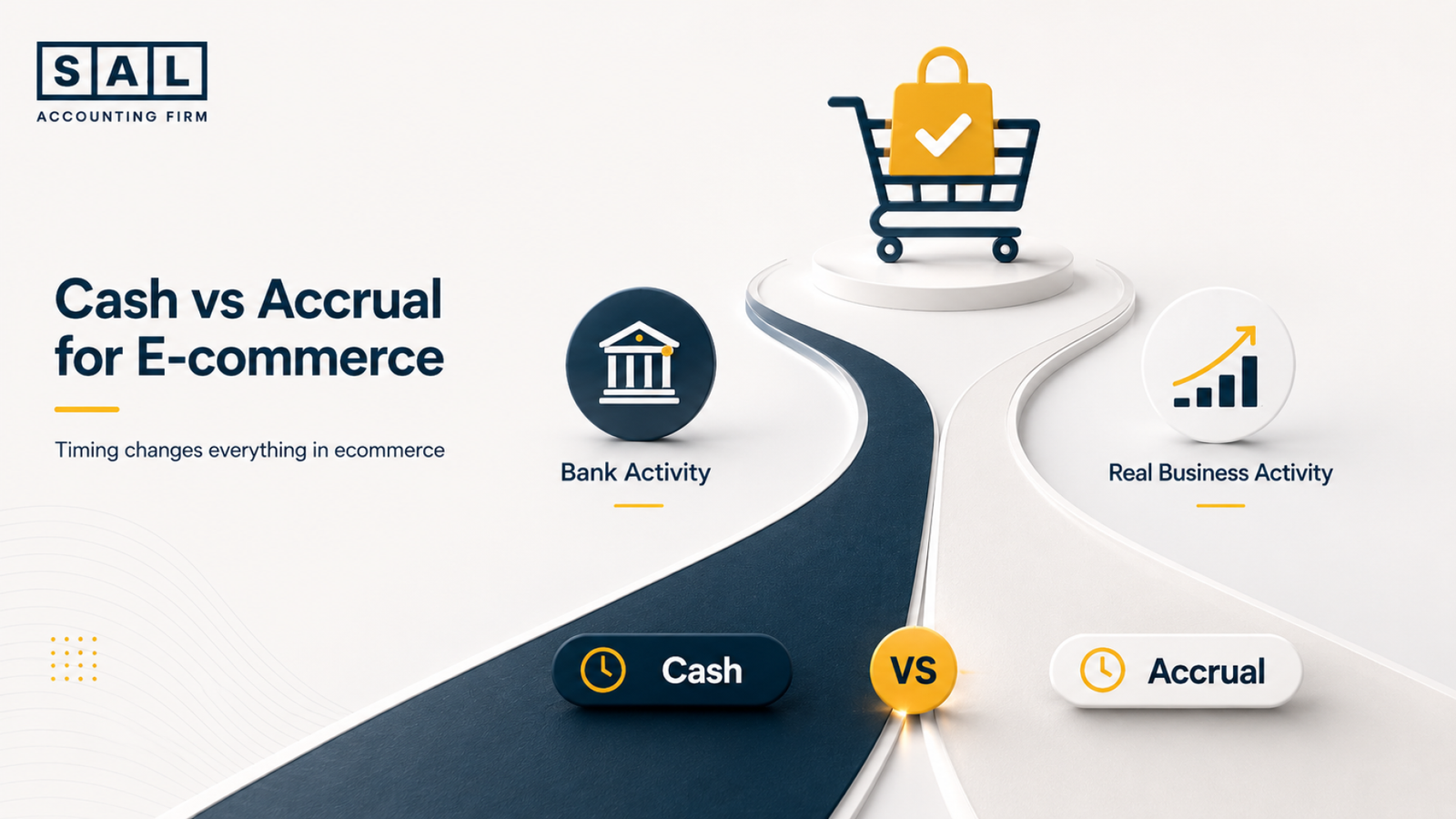
Cash vs accrual accounting can completely change how your ecommerce store’s profit looks. Statistics Canada reported that Canadian retail ecommerce revenue reached $73.7 billion in 2024 and grew 9.0%, which means more sellers are dealing with inventory, refunds, platform fees, tax timing, and payout delays.
At SAL Accounting, we believe your numbers should explain what actually happened. Read to the end to know which method gives you cleaner profit.
Start with the profit picture first: run your numbers through SAL’s Ecommerce EBITDA Calculator before reviewing whether cash or accrual accounting is giving you the right story.
Quick Takeaways
- Cash accounting records income when money enters your bank account and expenses when money leaves.
- Accrual accounting records income when it is earned and expenses when they happen.
- For ecommerce stores, accrual accounting usually gives a clearer picture of profit because sales, fees, refunds, inventory, COGS, and taxes do not always happen at the same time.
- Shopify and Amazon payouts are not the same as revenue. They are deposits after platform activity.
- In Canada, CRA generally expects business income to be reported using the accrual method, with specific exceptions for farmers, fishers, and self-employed commission agents.
Ready for cleaner ecommerce books? Get SAL’s ecommerce bookkeeping team on your numbers so sales, fees, refunds, inventory, taxes, and payouts stop sitting in one messy pile.
Cash vs Accrual Accounting for Ecommerce Stores: What’s the Difference?
The main difference is timing. Cash accounting follows money in and out of the bank. Accrual accounting follows when the sale, cost, or business activity actually happens.
That difference sounds small. For ecommerce, it is not.
A Shopify sale, payment fee, refund, sales tax amount, inventory cost, and bank payout can all happen on different dates. Shopify’s finance reports separate sales data into pieces like gross sales, discounts, returns, net sales, taxes, shipping, and fees. That alone tells you why one bank deposit rarely explains the full story.
1. When Income and Expenses Are Recorded
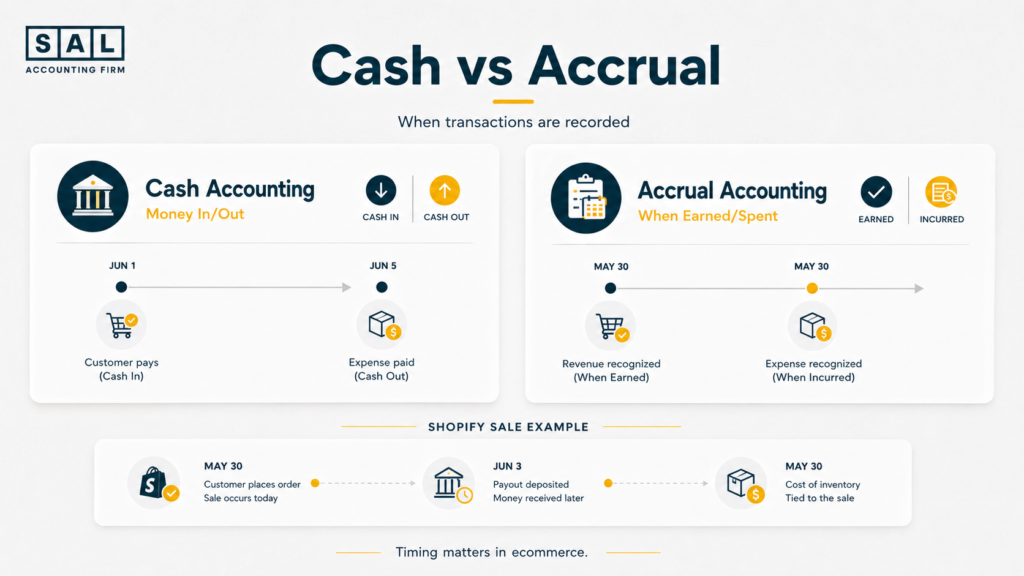
Cash accounting records income when money arrives and expenses when money leaves. Accrual accounting records income when the sale happens and expenses when the cost belongs to that period. Basically:
- Cash accounting answers: “What moved through the bank?”
- Accrual accounting answers: “What did the business actually earn and spend?”
That is why two ecommerce stores can make the same sales but show very different monthly profit depending on the method used.
2. Cash Accounting Tracks Bank Activity
Cash accounting is simple because it starts with your bank statement.
Let’s say $8,000 lands in your account. Your books record $8,000 of income. Then $3,000 leaves for inventory, software, or shipping. Your books record $3,000 of expenses.
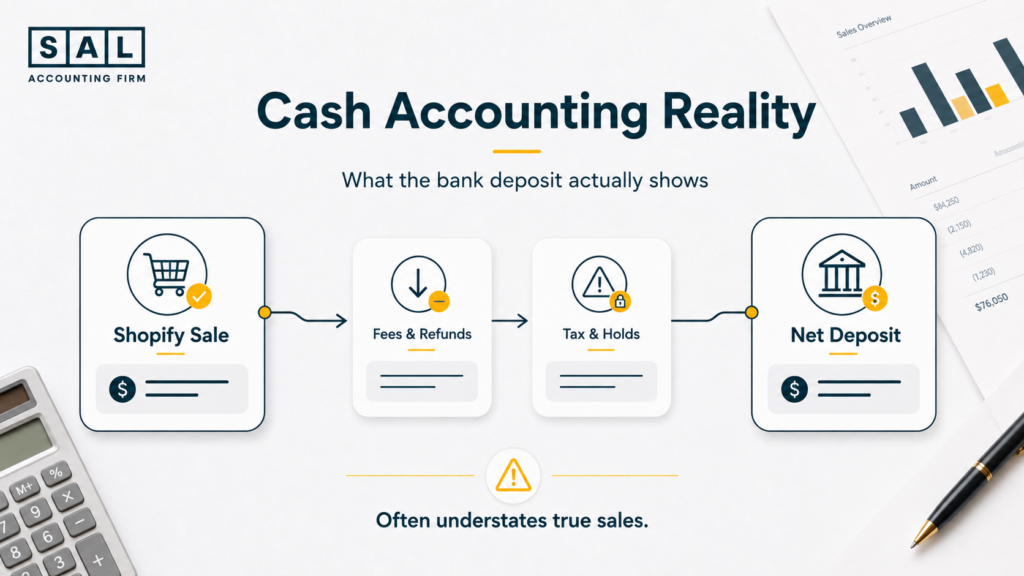
That can work for a very small store with simple transactions. But ecommerce gets messy fast. A bank deposit may already have several things removed before it reaches your account:
- platform fees
- payment processor fees
- refunds
- chargebacks
- shipping adjustments
- tax amounts
- reserve holds
So if the deposit is recorded as revenue, your books may understate sales and hide costs. That is one reason inaccurate ecommerce financial statements can look clean at first. The report may be formatted well, but still miss the activity behind the deposit.
3. Accrual Accounting Tracks Real Business Activity
Accrual accounting looks beyond the deposit. Instead of treating the bank transfer as the full story, it separates what happened inside the store first. That usually means:
- sales are recorded when the order happens
- fees are shown as separate costs
- sales tax is tracked separately
- inventory sits as an asset until sold
- COGS is recorded when the product sells
That gives you a better view of gross margin. And for ecommerce, gross margin is one of the numbers you need to trust. A store can look busy, but if COGS, fees, shipping, and ads are not matched properly, the profit story is still incomplete.
The same issue shows up in ecommerce profit calculation mistakes, especially when owners look at sales volume before checking what the store actually keeps.
4. How Each Method Handles Ecommerce Sales, Payouts, and Fees
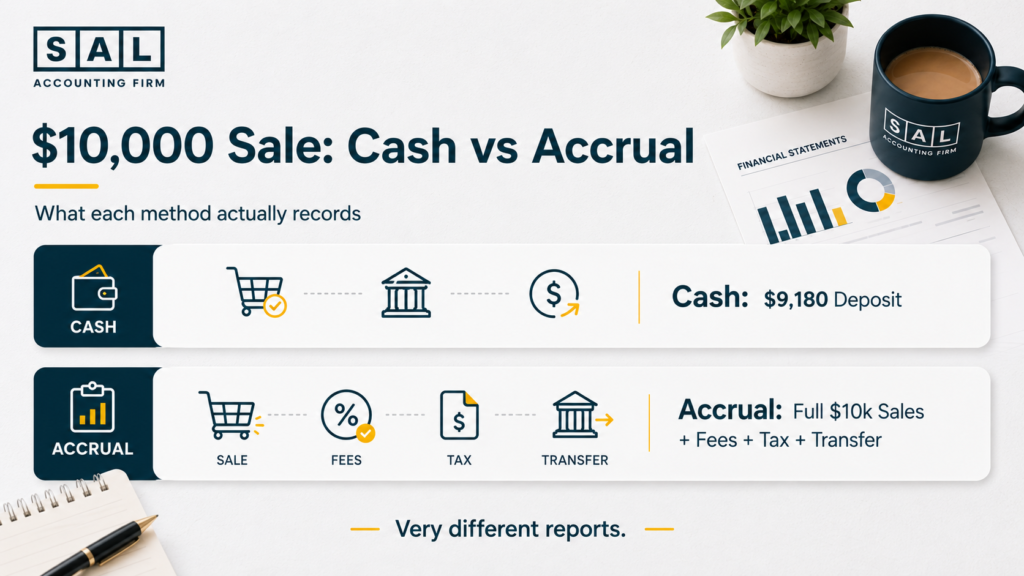
Let’s say Shopify shows $10,000 in sales, but only $9,180 lands in your bank. That $9,180 is not your revenue. It may be the payout after:
- payment fees
- refunds
- chargebacks
- tax amounts
- payout timing differences
- other adjustments
Under cash accounting, that $9,180 deposit may get recorded as sales. Under accrual accounting, your books should show the full sales activity first. Then they should separate the fees, refunds, taxes, and payout transfer.
That is a very different report. This table shows where the difference usually appears first.
| Ecommerce Item | Cash Accounting | Accrual Accounting | Why It Matters |
| Shopify sale | Recorded when payout lands | Recorded when sale happens | Better sales timing |
| Platform fees | Often hidden in deposit | Shown separately | Cleaner margin |
| Refunds | Recorded when money leaves | Matched more clearly | Better net revenue |
| Sales tax | Can mix with deposits | Tracked as liability | Cleaner tax records |
| Payout deposit | May be treated as income | Treated as transfer | Avoids duplicate revenue |
Pro Tip: Shopify fees can quietly shrink profit. See the fee gap with SAL’s Shopify Fee Calculator before deciding whether your reports show the full cost of each sale.
- Also read: “Shopify Payment Reconciliation Guide”
5. How Each Method Handles Inventory and COGS
Inventory is where cash accounting often becomes misleading. Let’s say you buy $30,000 of inventory in January.
Under simple cash accounting, January may look terrible because the money left the bank. February may look better when sales start coming in. March may look stronger again when payouts arrive. But that does not show the real product cost timing. Under accrual accounting:
- inventory is recorded as an asset first
- the cost moves into COGS when the product sells
- gross margin becomes easier to understand
- monthly profit looks less random
This matters because inventory affects pricing, ad spend, restocking, cash planning, tax reporting, and product-level profit.
The same logic applies to Shopify inventory accounting and COGS for Shopify stores, especially when inventory purchases happen months before the products actually sell.
- Read more: “How to Calculate COGS for Ecommerce Stores”
6. Why the Difference Matters for Ecommerce Profit
The point is not to make accounting more complicated. The point is to stop making decisions from numbers that do not explain reality. Cash accounting may tell you:
- money came in
- money went out
- the bank balance changed
Accrual accounting can show:
- what you sold
- what those products cost
- which fees were deducted
- how refunds affected sales
- what tax was collected
- what profit was actually earned
That is the difference ecommerce owners feel when they say:
“Sales are strong, but I still don’t know where the money went.”
The deeper issue is usually the same one covered in ecommerce contribution margin: sales are only useful when you understand what is left after the costs attached to those sales.
Why Ecommerce Payouts Make Cash Accounting Hard to Trust
Shopify, Amazon, Stripe, PayPal, Etsy, and other platforms do not always deposit one clean sales number. They move money through reports, fees, refunds, adjustments, reserves, transfers, and timing delays.
Amazon Seller Central’s transactions page says a transaction can be an Amazon-initiated charge or credit, an order, a refund, or an adjustment. Amazon Pay also notes that transaction and settlement reports can include captures, refunds, settlements, transfers, and reserve charges in the same reporting flow.
So when only the bank deposit is recorded, the report may miss the activity behind the payout. The first cleanup step is usually ecommerce payment reconciliation. Without that, sales reports, payout reports, and bank deposits can all tell slightly different stories.
Platform deposits usually need to be broken apart like this.
| Platform Activity | What the Owner Sees | What the Books Should Show | Risk if Missed |
| Gross sales | Sales report total | Revenue by channel | Sales understated |
| Refunds | Lower payout | Refunds or returns | Net sales unclear |
| Fees | Smaller deposit | Platform/payment fees | Margin hidden |
| GST/HST collected | Mixed in payout | Tax payable | Tax confusion |
| Payout transfer | Bank deposit | Clearing transfer | Revenue duplicated |
Case Study: How a Liberty Village Shopify Store Cleaned Up Misleading Monthly Profit1
A Shopify apparel store based in Liberty Village, Toronto is growing quickly, but the owner does not trust the monthly reports. Some months look profitable. Other months look terrible. The store is making sales, but the profit report never seems to match what is happening inside Shopify. Inventory purchases, delayed payouts, refunds, and platform fees are all getting mixed together.
The Problem
The business uses cash-based reporting for decisions. Large inventory purchases make some months look worse than they really are, while delayed Shopify payouts make other months look stronger. Revenue, fees, refunds, taxes, and COGS are not separated clearly.
What We Do
We move the store toward accrual-based ecommerce reporting. Shopify sales, refunds, fees, taxes, inventory, and COGS are separated properly. Inventory is treated as an asset until products are sold, and monthly reports show sales and related costs in the right period.
The Result
The owner gets a clearer view of gross margin, product performance, and monthly profit. Instead of reacting to bank deposits, they can plan inventory, pricing, and ad spend with numbers that make more sense.
Cash vs Accrual Accounting for Inventory, COGS, and Gross Margin
Inventory changes the whole conversation. Without inventory, cash accounting may feel easier to manage. With inventory, it can make profit swing up and down for reasons that are not actually about performance. Let’s say this happens:
- You buy inventory in January.
- You sell part of it in February.
- You receive payouts in March.
- You restock in April.
If your books follow only cash movement, the profit report can look random. January looks expensive. March looks strong. April looks weak again.
Accrual accounting smooths this out by matching the cost of inventory to the period when the product is sold.
That is why ecommerce reconciliation best practices should include platform activity, inventory movement, payment processors, and bank deposits. Here is the simpler way to compare the two methods.
| Question | Cash Accounting View | Accrual Accounting View | Better For |
| Did cash leave the bank? | Yes | Yes, but separately tracked | Cash planning |
| Is inventory still unsold? | Often unclear | Shown as inventory asset | Balance sheet |
| What did sold products cost? | Often distorted | Shown as COGS | Gross margin |
| Which month was profitable? | Can be misleading | More accurate | Monthly review |
| Should we reorder? | Harder to judge | Easier to compare | Inventory decisions |
Pro Tip: Review gross margin before increasing ad spend. If COGS is wrong, your ads may look like the problem when the real issue is product cost, shipping, or platform fees.
The same pattern shows up in hidden Shopify costs. Small deductions feel harmless one by one, but they can change the store’s real margin.
Cash vs Accrual Accounting for Taxes in Canada
For Canadian ecommerce stores, cash vs accrual is not just a reporting preference.
CRA says business income is generally reported using the accrual method. Under accrual accounting, income is reported in the fiscal period it is earned, even if payment comes later. Expenses are deducted in the fiscal period they are incurred, even if they are paid later. CRA notes specific exceptions for farmers, fishers, and self-employed commission agents in its business income guidance.
CRA’s accounting methods page also explains that business income is reported using cash or accrual based on a fiscal period. For ecommerce, the practical issue is usually this:
- GST/HST collected is not sales.
- Refunds are not random expenses.
- Inventory is not always a simple purchase expense.
- Payouts are not the same thing as revenue.
- Platform fees should not disappear inside deposits.
GST/HST can get messy fast when Canadian and U.S. sales sit in the same reports. CRA’s GST/HST and e-commerce page gives the official starting point for how GST/HST applies to electronic commerce, and its small supplier rules explain when small supplier status may no longer apply.
Pro Tip: Keep GST/HST, sales revenue, refunds, and platform fees in separate accounts. When everything sits inside one income line, tax season becomes harder than it needs to be.
When Should an Ecommerce Store Switch From Cash to Accrual Accounting?
A small store may start with cash-style reporting because it feels easy. That is common. But once the store grows, the question changes.
You are no longer just asking, “Did money come in?”
You are asking, “Is this store actually profitable?”
That is when accrual accounting becomes much more useful. A switch usually makes sense when the store has:
- inventory
- delayed payouts
- Shopify or Amazon fees
- frequent refunds
- multiple sales channels
- GST/HST filings
- U.S. sales
- financing plans
- month-end reports that do not make sense
The reporting issue is often visible before the owner names it. Many of the warning signs overlap with when an ecommerce business needs a CPA, especially when the business has outgrown basic bookkeeping. Here are the common triggers.
| Sign | What You Notice | Why Cash Gets Messy | Better Next Step |
| Inventory is growing | Profit jumps month to month | Costs hit at odd times | Track inventory and COGS |
| Shopify payouts do not match sales | Deposits look lower | Fees and refunds are hidden | Reconcile payout reports |
| Amazon settlements feel unclear | Reports are hard to read | Credits and fees mix together | Review settlement reports |
| U.S. sales are increasing | Tax exposure feels unclear | Sales tax rules vary | Review nexus risk |
| Financing is coming up | Lenders ask for clean reports | Cash reports look uneven | Prepare accrual statements |
| Reports feel unreliable | Decisions feel like guesses | Timing gaps increase | Rebuild monthly reporting |
Case Study: How a Port Credit Ecommerce Brand Cleaned Up Inventory and Tax Timing2
A home goods ecommerce brand near Port Credit in Mississauga sells through Shopify and Amazon. The business looks healthy from the outside, but the owner keeps running into the same problem: the bank balance does not match the profit shown in reports. Amazon fees, Shopify payouts, refunds, GST/HST, and inventory purchases are being recorded too broadly, so the financial statements do not explain what is really happening.
The Problem
The store records deposits too simply. Amazon settlements and Shopify payouts are treated like clean revenue, while platform fees, refunds, sales tax, and inventory costs are not matched to the right period. This makes tax planning and profit review harder than it needs to be.
What We Do
We rebuild the reporting around ecommerce activity instead of bank deposits alone. Sales, refunds, platform fees, taxes, shipping, and COGS are separated by channel. The accounting system is adjusted so inventory and expenses appear in the correct period.
The Result
The owner can see which channel performs better, how much inventory is tied up in stock, and whether profit is actually improving. Tax records become cleaner, and the business has stronger numbers for planning, financing, and year-end reporting.
Which Accounting Method Is Better for Ecommerce Stores?
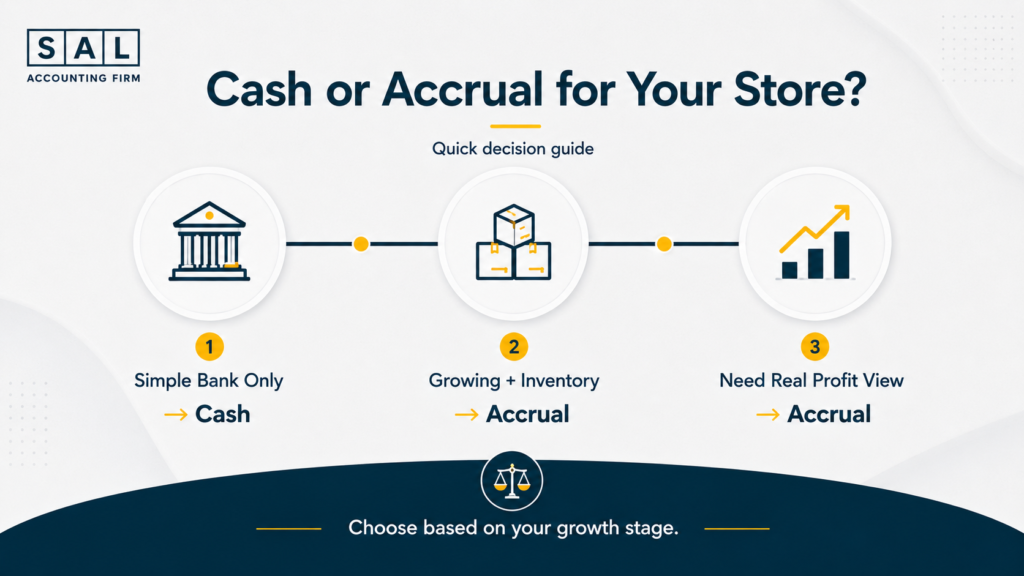
Accrual accounting is usually better for growing ecommerce stores. That is the direct answer.
Cash accounting may be fine when the store is very small, has limited inventory, and has simple transactions. But once you have Shopify payouts, Amazon settlements, payment fees, refunds, GST/HST, inventory, and multiple sales channels, cash accounting can make reports harder to trust. The best setup is not “ignore cash.”
You still need cash flow tracking. Accrual accounting explains profit. Cash flow tracking explains what you can actually spend.
The difference is clear in ecommerce financial statements. Profit and cash are related, but they are not the same number.
| Business Question | Cash Accounting | Accrual Accounting | What to Use |
| What hit the bank? | Strong | Visible through reconciliation | Cash flow |
| What did we actually sell? | Weak | Strong | Accrual |
| What did products cost? | Weak with inventory | Stronger | Accrual |
| Are we profitable? | Often unclear | Clearer | Accrual |
| What is our tax picture? | Limited | Stronger | Accrual |
| Can we afford inventory? | Useful | Needs cash view too | Both |
For incorporated stores, profit timing can affect the tax conversation too. Estimate the corporate side with SAL’s Corporate Income Tax Calculator after your revenue, COGS, and expenses are cleaned up.
For Shopify businesses, Shopify accounting best practices usually come down to the same point: platform data, payment data, bank data, and inventory data need to tell one story.
How to Move From Cash to Accrual Without Making a Mess
Switching from cash to accrual should be done carefully. You do not want to “fix” the books and create a new problem. A clean move usually starts with a review of your current setup:
- Compare platform sales with bank deposits.
- Separate sales, refunds, discounts, fees, and taxes.
- Reconcile Shopify, Amazon, Stripe, PayPal, and bank activity.
- Set up inventory and COGS properly.
- Record unpaid bills and receivables where needed.
- Separate GST/HST from revenue.
- Adjust opening balances.
- Document the change clearly.
This is also a good time to look at your accounting stack. The best ecommerce accounting software can support cleaner records, but software alone will not fix the method behind the books.
A regular accountant may understand bookkeeping. But ecommerce books need someone who understands how platform payouts, inventory, tax, refunds, and COGS work together.
That is why the choice between a Shopify specialist accountant and a general accountant becomes more important as the store grows.
How SAL Accounting Approaches Ecommerce Numbers
Ecommerce accounting starts with a simple question:
“Do the reports explain what actually happened?”
For many store owners, the answer is not always clear. The books may show deposits. Shopify may show sales. Amazon may show settlements. The bank may show cash. Inventory may sit in another system entirely. Accrual accounting brings those pieces closer together.
At SAL Accounting, the goal is not to make the reports more complicated. The goal is to separate the right things so the owner can make better decisions. That usually means reviewing:
- sales by channel
- refunds and discounts
- platform and payment fees
- GST/HST
- inventory
- COGS
- payout transfers
- month-end adjustments
A store that has already outgrown basic reporting may also need to think through questions to ask an ecommerce accountant before switching firms or rebuilding the books.