
Yes, most Shopify sellers need a specialist accountant once payouts, fees, refunds, inventory, and tax make the numbers hard to trust. In Q1 2026, ecommerce made up 16.9% of total U.S. retail sales, according to the U.S. Census Bureau’s ecommerce data.
SAL Accounting can help you see what your store actually keeps. In this post, we explain where general accountants miss details, what specialists do differently, and how to choose the right support.
If your Shopify payouts feel lower than expected, try the Shopify Fee Calculator to see what fees may be coming off each order.
Quick Takeaways
- A Shopify payout is not the same thing as revenue.
- A general accountant may handle standard tax filing, but Shopify sellers often need deeper ecommerce cleanup.
- Specialist accountants separate sales, fees, refunds, chargebacks, taxes, inventory, and product costs.
- Canadian Shopify sellers also need to watch GST/HST, QST, and U.S. sales tax if they sell across borders.
- The right accountant should help you trust your numbers, not just file your return.
Shopify Specialist Accountant vs General Accountant: What’s the Difference?
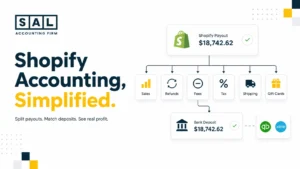
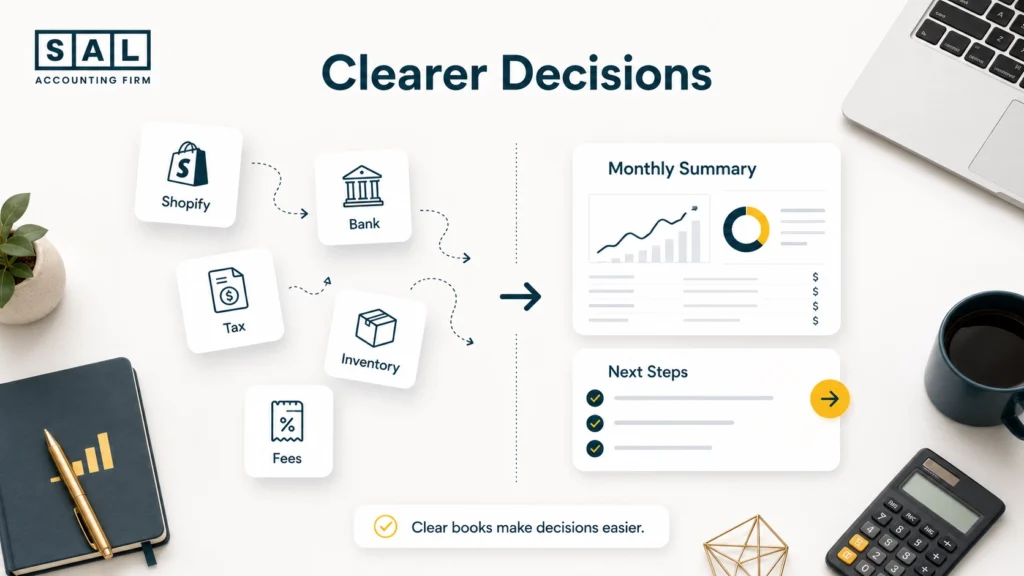
A Shopify specialist accountant looks beyond bank deposits. They connect sales, payouts, refunds, fees, inventory, and tax so your books show what actually happened.
A general accountant may be enough for simple filing. But once your store has regular orders, inventory, cross-border sales, or messy payouts, you usually need someone who understands ecommerce numbers properly.
- A general accountant often works from bank deposits and year-end reports.
- A Shopify specialist looks at the sale before it becomes a payout.
- A general accountant may tell you what to file.
- A Shopify specialist helps you see what your store actually kept.
- A general accountant may clean things up later.
- A Shopify specialist helps you catch issues before they turn into bigger problems.
If your Shopify reports already feel hard to trust, accounting support built for Shopify sellers at SAL connects your dashboard, payouts, bank deposits, refunds, fees, taxes, and product costs into numbers you can actually use. Here’s what that difference looks like in practice:
| Area | General Accountant | Shopify Specialist Accountant | Why It Matters |
|---|---|---|---|
| Revenue | Often records deposits | Tracks gross sales, refunds, discounts, tax, and fees | Shows real sales |
| Payouts | Uses bank deposits | Reconciles Shopify payouts | Explains cash gaps |
| Inventory | Tracks basic purchases | Reviews COGS and landed cost | Shows real margins |
| Tax | Focuses on filing | Reviews GST/HST, QST, and U.S. sales tax | Reduces surprises |
| Reporting | Gives standard reports | Builds ecommerce reports | Helps better decisions |
- Also read: “Shopify Inventory Accounting Guide”
Why Shopify Accounting Gets Messy So Fast
Shopify makes selling feel simple, but the accounting can get messy fast. A store might show $40,000 in monthly sales, but Shopify Payments, refunds, chargebacks, discounts, gift cards, shipping adjustments, sales tax, and third-party transaction fees can all change what actually lands in the bank.
That is why Shopify payment reconciliation matters. It helps you understand what happened between the customer order and the final payout.
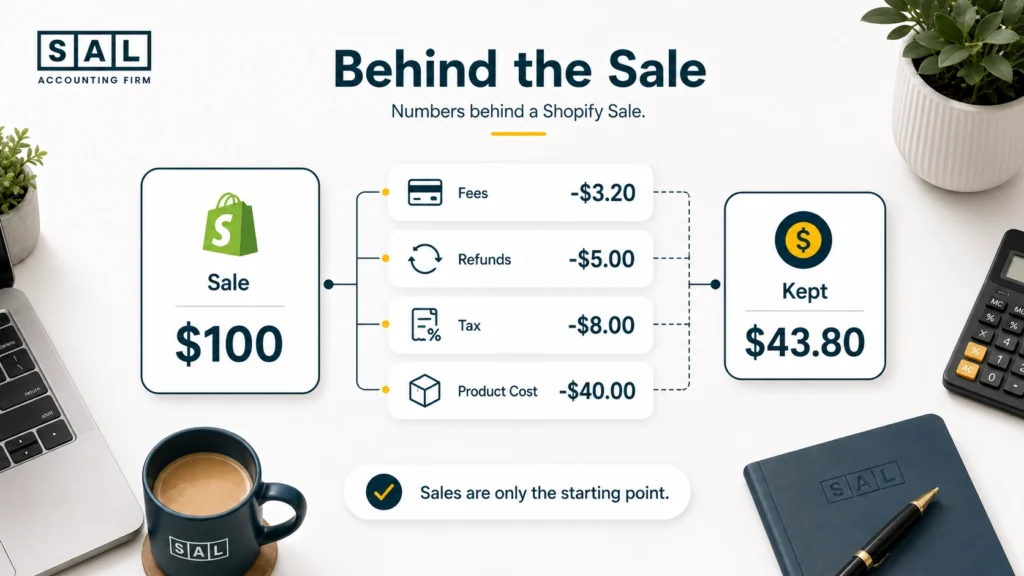
Example: If Shopify shows a $100 sale and only $82 reaches the bank, that $18 difference should not disappear. It may include:
- payment processing fees
- refunds
- chargebacks
- sales tax collected
- shipping adjustments
- discount codes
- currency conversion
- app or transaction fees
That same issue often shows up across other platforms too. With e-commerce payment reconciliation, the goal is to follow the money from the sale, through the platform and processor, into the bank, without losing track of what was deducted along the way.
Pro Tip: Do not force Shopify reports and bank deposits to match by guessing. The difference usually tells you where the real issue is: fees, refunds, chargebacks, tax, or timing.
- Also read: “Shopify Payment Reconciliation Guide”

Where General Accountants Usually Get Shopify Wrong
The issue is not that general accountants are “bad.” The issue is that Shopify accounting has extra layers most traditional businesses do not have.
A regular business might send an invoice, get paid, and record the deposit. Shopify is different. One payout can include sales, refunds, chargebacks, processing fees, shipping adjustments, discounts, gift cards, and collected tax. So if your accountant only looks at the bank deposit, a lot of important details can disappear. This is usually where Shopify sellers start asking questions like:
- Why do my sales look strong, but cash feels tight?
- Why does Shopify show one number and the bank show another?
- Are fees and refunds being tracked properly?
- Is collected tax being separated from income?
- Do my reports show real profit or just sales activity?
That is why e-commerce reconciliation matters so much for Shopify sellers. It helps separate what was sold, what was deducted, what was tax, and what actually landed in the bank.
The same problem shows up in Shopify profit calculation mistakes. A store can look healthy in the dashboard while still having unclear profit if fees, refunds, tax, and product costs are not tracked properly. Here’s where the mistakes usually show up:
| Mistake | What Happens | Why It Hurts | Better Approach |
|---|---|---|---|
| Recording payouts as revenue | Bank deposits become sales | Revenue gets distorted | Reconcile gross sales to payouts |
| Ignoring fees | Fees disappear inside deposits | Profit looks better than it is | Track fees separately |
| Mixing tax with income | Collected tax looks like revenue | Tax reports become unreliable | Separate sales tax from sales |
| Weak COGS tracking | Product cost is too basic | Margins look inflated | Use landed cost |
| Year-end cleanup only | Problems sit for months | Decisions are made late | Close monthly |
Why COGS and Landed Cost Matter for Shopify Sellers
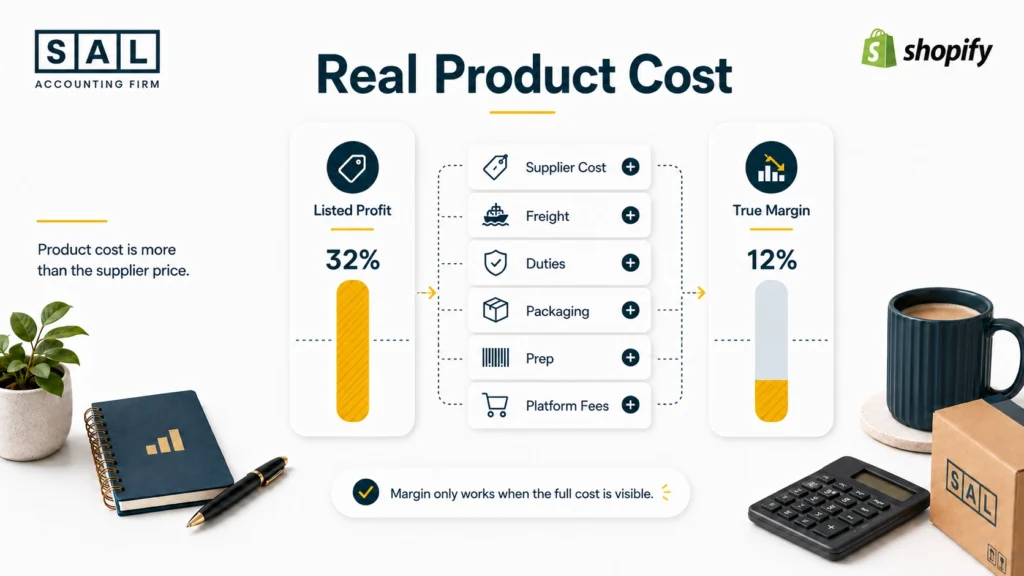
COGS means the cost of goods sold. In simple terms, it is what the product costs you once it is sold. For Shopify sellers, that cost is rarely just the supplier price. A product may cost $22 from the supplier, but the real cost could be closer to $31 once you add things like:
- freight
- duties
- packaging
- prep costs
- other costs needed to get the product ready to sell
If your books only show the $22 supplier cost, your margin can look better than it really is. That is why Shopify COGS tracking matters. It helps you see whether a product is actually profitable after the full cost is included.
For a wider store view, calculating COGS for ecommerce stores connects product cost, pricing, inventory, and margin. Basically, a product can sell well and still be weak if shipping, returns, ad spend, and payment fees quietly eat the profit.
Pro Tip: If a bestseller has weak margin after landed cost, more sales may not fix the problem. More sales can simply make the same margin leak bigger.
- Read more: “How to Track and Calculate COGS for Ecommerce Stores”
Canada and U.S. Tax Issues Shopify Sellers Cannot Ignore
Tax is one of the clearest signs that a Shopify store has outgrown basic accounting support. Once you sell across provinces, into Quebec, or into the U.S., your tax setup needs more attention. Shopify can help collect and organize tax data, but your books still need to show what was collected, what was refunded, and what may need to be remitted.
GST/HST in Canada
For Canadian Shopify sellers, GST/HST registration depends on taxable sales. The CRA checks whether you pass the small supplier threshold in one calendar quarter or over the previous four quarters, based on its small supplier rules.
Rates can also change by province. This is where Shopify GST/HST connects to bookkeeping: collected tax should not be treated like profit.
QST for Quebec Sales
Quebec adds another layer because QST is separate from GST. Revenue Québec explains the two-step calculation using 5% GST and 9.975% QST under its tax calculation rules.
If you sell to Quebec customers, QST needs to fit cleanly into your Shopify sales, refunds, and tax reports. The GST/HST Refund Calculator for eCommerce Stores is for you to roughly compare what you collected and what you paid before final review.
U.S. Sales Tax for Canadian Shopify Sellers
U.S. sales tax is not one national rule. Sales Tax Institute explains that states with sales tax have economic nexus rules for remote sellers in its economic nexus chart.
One U.S. order usually does not create a problem. But if U.S. sales are growing, you need to track where customers are buying from and whether state thresholds are getting close. That is why sales tax nexus matters before the issue becomes urgent.
Shopify Reports Help, But They Still Need Review
Shopify can help organize tax data. Its Help Center says tax reports can include details like gross sales, net sales, taxes, returns, and shipping charges through Shopify tax reports. But reports are not the same as clean books. A Shopify specialist accountant still needs to check:
- what tax was collected
- what tax was refunded
- what was recorded in the books
- what may need to be filed
- whether tax is being separated from income
That is where Shopify seller tax becomes useful, especially when sales, refunds, tax reports, and payouts do not line up neatly.
Pro Tip: Do not treat Shopify tax settings as tax advice. They can help with setup and reporting, but your books still need to show what belongs to the business and what may need to be remitted.
- Also read: “U.S. Sales Tax Requirements for Canadian Sellers”
Case Study: How a Queen West Shopify Seller Found the Profit Behind Strong Sales
A Shopify apparel founder near Queen West in Toronto is seeing steady growth. Sales look good, ads are working, and Shopify payouts are landing every few days. But the owner still feels unsure. Some months look profitable inside Shopify, while the bank account tells a different story. Their general accountant records deposits as income and cleans things up once a year, but nobody is breaking down refunds, payment fees, discounts, shipping, taxes, and inventory costs month by month.
The Problem
The store is making decisions from incomplete numbers. Shopify payouts are being treated like revenue, fees are buried inside deposits, and COGS does not include the full landed cost of products. The owner can see sales growing, but cannot clearly tell which products are actually worth pushing.
What We Do
SAL would rebuild the books around how the store actually works. That means matching Shopify sales to payouts, separating fees, refunds, tax, discounts, and chargebacks, reviewing COGS, and creating monthly reports that show real margin. The goal is not just cleaner bookkeeping. It is helping the founder understand what is making money, what is quietly leaking profit, and what to fix next.
The Result
The owner gets a clearer view of what the store actually keeps after fees, refunds, taxes, and product costs. Instead of guessing which products are working, they can review margins more confidently and make better decisions about ads, pricing, inventory, and discounts.
What Shopify Specialist Accountants Do Differently
A Shopify specialist accountant does not only ask for your bank statements. They usually look at:
- Shopify sales reports
- Shopify Payments payouts
- PayPal, Stripe, Shop Pay, and other gateways
- refunds and chargebacks
- gift cards and discounts
- inventory and landed cost
- GST/HST, QST, and U.S. sales tax
- marketplace activity if you also sell on Amazon
- month-end reports and owner-facing KPIs
If Shopify and Amazon both matter to your store, Amazon and Shopify integration becomes part of the bigger accounting picture. The two platforms have different reports, payout timing, fee structures, and inventory issues, so treating them like one simple sales channel usually creates confusion.
That does not mean the seller can ignore the accounting. It means the accountant has to understand which platform collected what, what was remitted, and what still needs to be reported.
- Read more: “Amazon FBA Bookkeeping Guide”
Case Study: How a Port Credit Shopify Brand Cleaned Up Cross-Border Tax Confusion
A home goods seller near Port Credit in Mississauga starts with Canadian customers, then begins getting more U.S. orders through Shopify. At first, the owner assumes Shopify’s tax settings are enough. But as sales grow, the reports become harder to trust. Some tax is collected, some is not, and the owner is not sure whether they have crossed any U.S. sales tax thresholds. Their accountant handles regular filings, but does not explain how GST/HST, QST, and U.S. sales tax should connect to the books.
The Problem
The business has sales coming from different provinces and U.S. states, but no clean system for reviewing tax obligations or separating collected tax from income. The owner is worried about missing registrations, overpaying, or finding out about a problem too late.
What We Do
SAL would review where the sales are coming from, check whether GST/HST, QST, and U.S. sales tax rules may apply, and clean up how tax is recorded in the books. From there, the seller gets a clearer monthly process: what was sold, what tax was collected, what fees came out, what landed in the bank, and what needs attention before it turns into a bigger issue.
The Result
The owner gets a clearer tax picture before growth creates more pressure. Instead of relying only on Shopify settings, they can see which sales need review, what tax was collected, and what should be watched before expanding further into the U.S.
How to Find the Right Shopify Accountant
The right Shopify accountant should make your numbers easier to understand, not more confusing.
Before you hire someone, listen for how they explain Shopify payouts, fees, refunds, tax, COGS, and monthly reporting. If they only talk about bank deposits and year-end filing, they may not be looking closely enough at how your store actually works. A good Shopify accountant should be able to help you understand:
- why Shopify sales and bank deposits do not always match
- how refunds, chargebacks, and payment fees are being tracked
- whether GST/HST, QST, or U.S. sales tax needs attention
- whether product costs and landed cost are showing real margin
- what reports you should review each month
This is where ecommerce accountant red flags are worth knowing before you commit. If the accountant treats your Shopify store like a regular local business, you may not get the detail you need. Here are the questions worth asking:
| Question to Ask | Strong Answer | Red Flag | Why It Matters |
|---|---|---|---|
| Do you reconcile Shopify payouts? | Yes, by payout and gateway | “We use deposits” | Avoids hidden errors |
| Do you track refunds and fees? | Yes, separately | “They net out” | Keeps revenue clean |
| Do you handle GST/HST and QST? | Yes, with filing review | “Shopify handles it” | Avoids tax confusion |
| Do you review U.S. sales tax? | Yes, by state | “Only at year-end” | Reduces surprises |
| Do you track landed cost? | Yes, beyond supplier price | “Inventory is just an expense” | Shows real margin |
| What reports do I get? | Monthly ecommerce reports | “At tax time” | Helps decisions sooner |
If your store has inventory, cross-border sales, tax questions, or reports you no longer trust, the real question may be whether your business has outgrown basic support. That is where knowing when your ecommerce business needs a CPA instead of a general accountant can help you think about the next step more clearly.
Pro Tip: A good Shopify accountant should be able to explain your payout gap in plain English. If every answer sounds vague or overly technical, you may not get the clarity you need.
90-Day Shopify Accounting Cleanup Plan
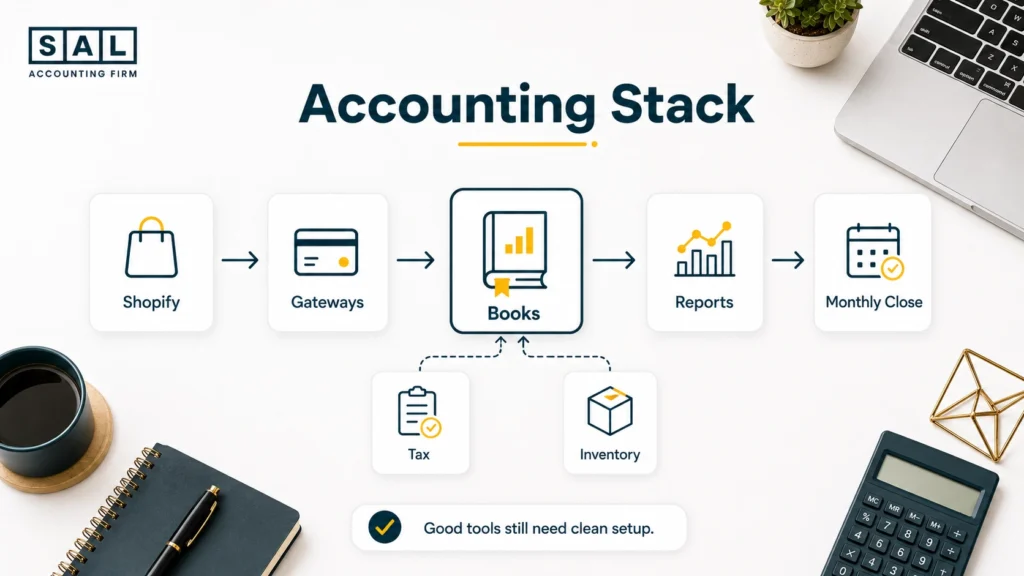
Switching to a Shopify specialist accountant does not have to feel chaotic. The first 90 days should be about finding the gaps, cleaning up the biggest issues, and building a monthly rhythm you can actually keep.
Before the cleanup starts, the Tax Document Checklist for eCommerce Stores can help you gather the basics: platform access, bank statements, sales reports, tax details, and payment gateway records. Here’s what a simple cleanup plan can look like:
| Timeline | Focus | What Gets Reviewed | Outcome |
|---|---|---|---|
| Days 1-15 | Discovery | Shopify, bank, gateways, apps, tax settings | Find the gaps |
| Days 16-30 | Payouts | Sales, fees, refunds, chargebacks, deposits | Clean revenue |
| Days 31-45 | Inventory | COGS, landed cost, product margins | Better margin view |
| Days 46-60 | Tax | GST/HST, QST, U.S. sales tax | Fewer surprises |
| Days 61-90 | Reporting | Monthly close, KPIs, owner dashboard | Clear next steps |
After the cleanup, the goal is not to go back to messy reports. A Shopify month-end close checklist helps keep the habit going so sales, fees, refunds, inventory, and tax do not pile up again.
If sales look strong but profit still feels unclear, the Ecommerce EBITDA Calculator gives you a starting point for looking beyond revenue. It is not a replacement for clean books, but it can help you ask better questions.
Pro Tip: Do not try to fix every accounting issue at once. Start with payouts, tax, and product costs first. Those three usually explain why Shopify sales look good but the bank account feels different.
Is a Shopify Specialist Accountant Worth the Cost?
A Shopify specialist accountant may cost more than a general accountant, but the real question is not just the monthly fee. It is what unclear numbers may already be costing you.
When fees are hidden, tax is mixed into revenue, landed cost is missing, or payouts are treated like sales, you may be making decisions from numbers that do not match reality. That can affect:
- pricing
- inventory orders
- ad spend
- cash planning
- tax filings
- product decisions
So online store accounting cost should be judged against the size of the problem, not just the price of the service. A cheaper accountant may save money upfront. But bad numbers can cost more through weak margins, overstocking, missed tax issues, or products that look profitable when they are not.
Ecommerce accounting and bookkeeping at SAL turns messy Shopify numbers into clear reports you can actually use.
Conclusion: Shopify Specialist Accountant or a General Accountant?
A general accountant may be enough when your Shopify store is still simple. But once sales, fees, refunds, inventory, tax, and cross-border orders start piling up, basic bookkeeping usually stops giving you the full picture.
At that point, the real question is not whether your books are “done.” It is whether your numbers show what your store actually kept, what is reducing profit, and what needs to be fixed next.
For a clearer look at what your Shopify numbers are really saying, talk to the SAL Accounting team.