
E-commerce profit calculation mistakes usually start with one problem: sales look clear, but profit doesn’t. Refunds, fees, shipping, inventory costs, ad spend, and tax collected all sit between what the customer pays and what the business keeps. That’s why growing ecommerce sellers often turn to SAL Accounting when the numbers stop feeling easy to trust.
By the end of this post, you’ll know which hidden costs to check before trusting your sales numbers, pricing, or profit decisions.
Use the Ecommerce EBITDA Calculator to see profit beyond the sales number.
Quick Takeaways
- E-commerce profit calculation should start with net revenue, not gross sales. Refunds, discounts, chargebacks, and tax collected can change the real number fast.
- Payouts do not show full revenue. Shopify, Amazon, Stripe, and PayPal deposits often hide fees, refunds, and adjustments.
- ROAS does not equal profit. Ads can drive sales while shipping, COGS, fees, and returns shrink the margin.
- Product cost means more than supplier price. Freight, duties, packaging, storage, and prep costs can all affect profit.
- Clean profit tracking leads to better decisions. Pricing, inventory, ads, tax planning, and growth become easier to judge.
Your store may be growing, but your numbers should not feel like guesswork. SAL’s ecommerce accounting services help separate the pieces that decide real profit.
What Are the Most Common E-commerce Profit Calculation Mistakes
The most common e-commerce profit calculation mistakes happen when store owners look at sales without tracking what happens after the sale. A $100 order is not always a $100 win.
You may still need to remove product cost, shipping, payment fees, platform fees, discounts, return risk, fulfillment, ad spend, and tax collected. The question is not only, “What did we sell?” The better question is, “What did we actually keep?” Here are the mistakes that usually distort ecommerce profit first:
1. Shipping and Fulfillment Cost Mistakes
Shipping costs can quietly shrink profit on every order. You may charge the customer $8, but pay $13 to the carrier. Add packaging, fulfillment, and return shipping, and the margin changes fast. Watch for:
- underestimating shipping costs
- ignoring fulfillment fees
- not including return shipping costs
- overlooking storage fees
- FBA fee calculation errors
For sellers shipping between Canada and the U.S., cross-border ecommerce shipping can change the real cost of a sale because duties, carrier charges, and delivery adjustments may all affect margin.
Shopify’s own guidance on duties and import taxes is a useful reminder that international orders need more than a basic postage check.

2. Marketing Cost Mistakes
ROAS can look good while profit stays weak. That usually happens when ad spend is reviewed on its own, instead of being measured against product cost, shipping, fees, discounts, and returns. Common mistakes include:
- ignoring ad spend
- miscalculating customer acquisition cost
- excluding agency or freelancer costs
- not tracking channel-specific profitability
- attribution errors
A Meta campaign, Google campaign, Amazon ad, email flow, and affiliate campaign can all produce different profit levels. That is why ecommerce business expenses should not be thrown into one general bucket if you are trying to understand what is actually working.
Pro Tip: ROAS tells you what ads brought in. It does not tell you what the business kept.
3. Revenue Tracking Mistakes by Online Stores
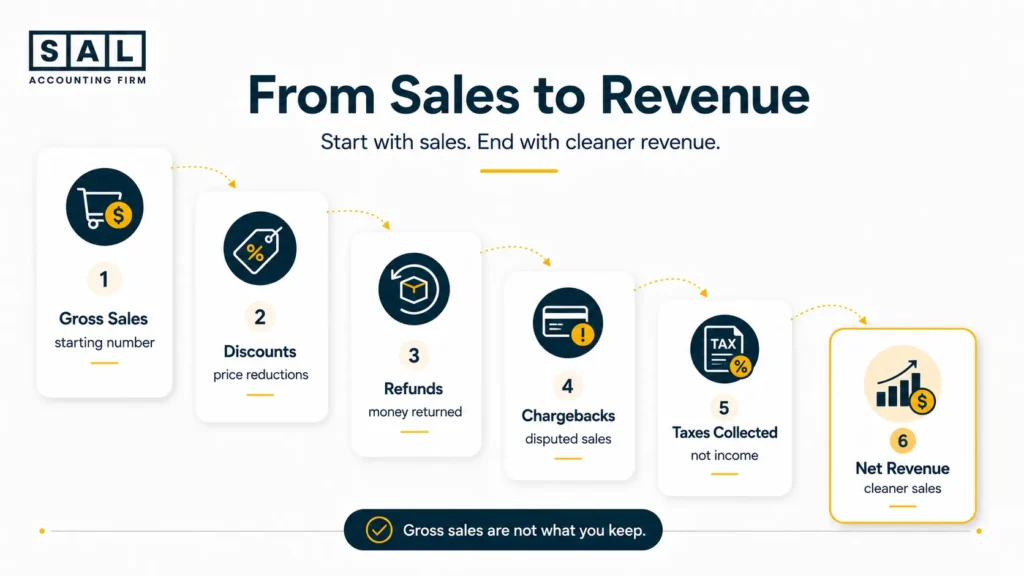
Gross sales are the easiest number to notice, but they are not the cleanest number to use. Shopify’s sales reports separate gross sales, discounts, returns, taxes, and shipping because each one changes the revenue story. The common issues are:
- not accounting for refunds
- ignoring chargebacks
- misreporting discounts and coupons
- incorrect sales tax treatment
- double counting revenue
Double counting is especially common when platform sales and bank deposits are both recorded as income. This is where Shopify payment reconciliation becomes more than a bookkeeping clean-up task. It is how you stop fees, refunds, taxes, and deposits from distorting revenue.
If Shopify is your main sales channel, Shopify accounting in Toronto keeps sales, payouts, refunds, and tax from being treated like one simple bank deposit.
- Read more: “E-commerce Payment Reconciliation”
4. Financial Reporting Mistakes
Financial reports should make the business clearer.If they only create more questions, something is probably off. The common mistakes are:
- cash flow vs profit confusion
- mixing personal and business expenses
- accrual vs cash accounting errors
- incorrect profit margin calculations
- inaccurate financial statements
A store can be profitable on paper and still short on cash because inventory, tax, loan payments, and payout timing all affect the bank account differently.
Shopify’s profit reports can give useful product-level information, but the books still need complete costs. Otherwise, ecommerce financial statements may look formal without actually helping the owner make decisions.
5. Inventory-Related Profit Mistakes
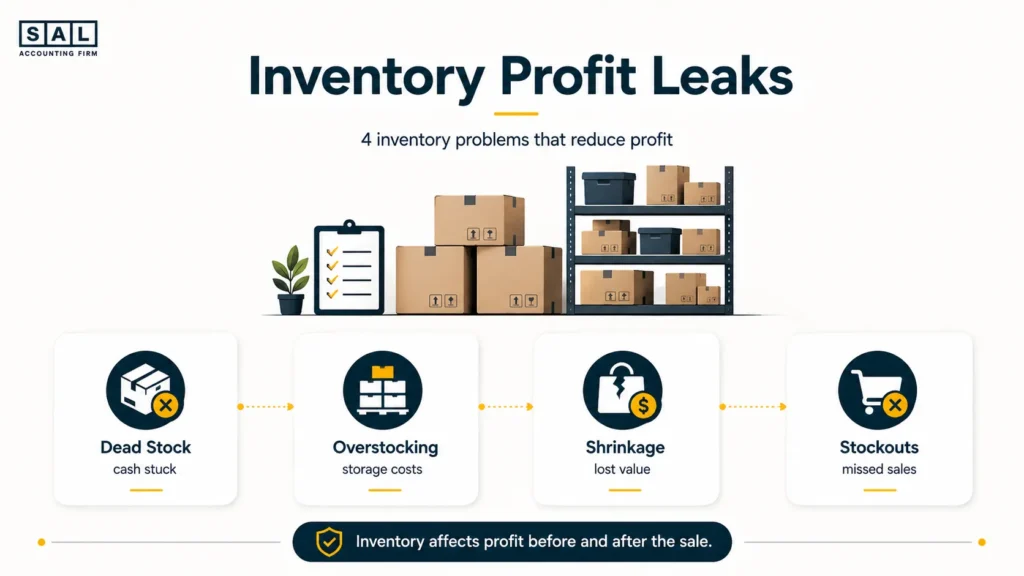
Inventory can make profit look better than cash feels. You may have money sitting in products that have not sold yet, products that need discounts, or products that are no longer sellable. The common mistakes are:
- ignoring inventory shrinkage
- failing to account for dead stock
- overstocking costs
- stockout-related profit losses
- inventory write-off errors
A store can have strong sales and still run into cash pressure if too much money is tied up in slow inventory. That is one reason many ecommerce stores fail even when the storefront looks active.
6. Platform and Payment Fee Mistakes
Payment fees, marketplace fees, app fees, and currency conversion costs can quietly reduce every order. The common mistakes are:
- ignoring payment processing fees
- overlooking marketplace fees
- subscription software costs
- currency conversion fees
- transaction fee miscalculations
A bank deposit may already have deductions inside it. That means recording the deposit alone can hide what payment processors, marketplaces, and platforms are taking.
For Amazon sellers, Amazon FBA accounting best practices are useful because settlement reports need to be broken down before profit makes sense.
7. Tax-Related Profit Calculation Mistakes
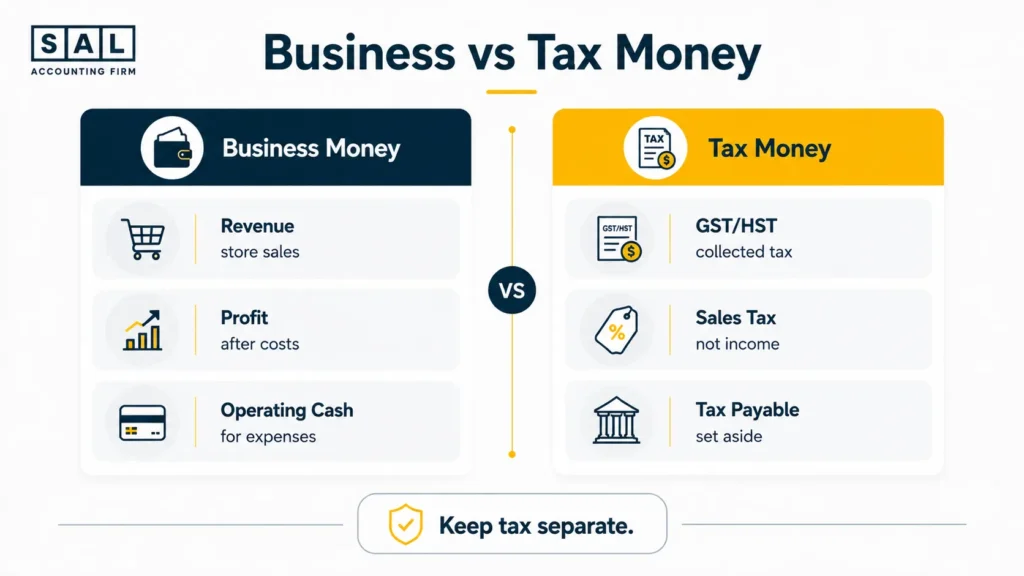
Tax collected can make cash look stronger than it really is. The money may sit in your account, but that does not mean it belongs to the business. The common mistakes are:
- ignoring sales tax liabilities
- VAT calculation errors
- missing tax-deductible expenses
- income tax estimation errors
- multi-state tax compliance issues
The CRA’s GST/HST e-commerce guidance explains how GST/HST applies to many ecommerce situations in Canada. The CRA also explains when businesses need to register under its GST/HST registration rules.
For U.S. marketplace sales, Amazon’s Marketplace Tax Collection may affect what is collected and remitted through Amazon. Direct Shopify sales still need their own review.
- Also read: “GST/HST Compliance for Ecommerce Stores”
8. Profit Analysis and Decision-Making Mistakes
Bad profit numbers lead to bad decisions.
The common mistakes are:
- focusing on revenue instead of profit
- ignoring product-level profitability
- misinterpreting gross vs net profit
- not tracking profit trends
- making decisions with incomplete data
A bestseller may be great for revenue but weak for profit. A smaller product may be less exciting on the dashboard but better for cash.
That is why Shopify profit calculation mistakes often start with missing context, not lack of effort. The store owner is making decisions from numbers that do not show the full picture.
9. Cost of Goods Sold Mistakes
COGS should not stop at the supplier invoice. If your supplier charges $20 per unit, that may not be the full cost of getting the product ready to sell. The common mistakes are:
- excluding product costs
- ignoring import duties and customs fees
- miscalculating landed costs
- not allocating packaging costs
- inventory valuation errors
Landed cost can include freight, duties, customs fees, packaging, prep, inspection, and inbound shipping. Calculating COGS for ecommerce stores is where this becomes practical because incomplete COGS makes margin look better than it is.
Pro Tip: If your product cost does not include what it took to get the product ready to sell, your margin is probably too high.
How Ecommerce Profit Calculation Mistakes Hurt Profitability
Profit mistakes do not stay inside reports. They affect real decisions. This table shows how the wrong numbers can turn into pricing, cash flow, ad, and growth problems:
| Mistake | What Happens | Warning Sign | Check This |
| Missing Costs | Profit is overstated | Sales rise but cash doesn’t | Net Profit |
| Inventory Issues | Cash gets trapped in stock | Constant cash shortages | Cash Flow Forecast |
| Incorrect Product Costs | Margins look larger than they are | Products priced too low | Landed Cost |
| Poor Reconciliation | Reports become unreliable | Numbers don’t match | Reconciliation |
| Weak Profit Analysis | Budget goes to low-profit products | High sales, weak returns | Contribution Margin |
| Premature Expansion | Growth creates financial pressure | Scaling feels difficult | Monthly Financial Review |
A simple cash flow forecast can show pressure before it becomes urgent.
Importance of Calculating Ecommerce Profit Accurately
Accurate profit calculation helps you make better decisions before the business gets harder to manage. It affects:
- pricing
- inventory buying
- ad budgets
- tax planning
- cash flow
- hiring
- expansion
For Canadian sellers moving into the U.S., Canadian ecommerce U.S. expansion setup becomes much easier when product profit, tax exposure, and cash movement are already clear. Without that, growth can make the numbers less reliable, not more reliable.
Case Study: How an Amazon Seller Near Port Credit, Mississauga Fixed FBA Fee and Inventory Profit Mistakes1
Daniel runs an Amazon and Shopify store near Port Credit, Mississauga. He sells small fitness accessories.
Amazon sales look steady, but monthly profit keeps dropping. He increases ads, gets more sales, and still does not see better profit.
The Problem
Daniel is missing FBA fulfillment fees, referral fees, storage fees, return costs, and aged inventory costs. Slow-moving inventory is still being treated like it has full value.
What We Do
We review profit by SKU, compare Amazon and Shopify margins, and separate storage, fulfillment, referral fees, returns, and ad spend.
The Result
Daniel can see which products are worth scaling and which ones are quietly draining cash. In a setup like this, Amazon seller bookkeeping gives settlement reports the detail they need before decisions are made.
Ecommerce Financial Metrics to Consider to Avoid Profit Mistakes
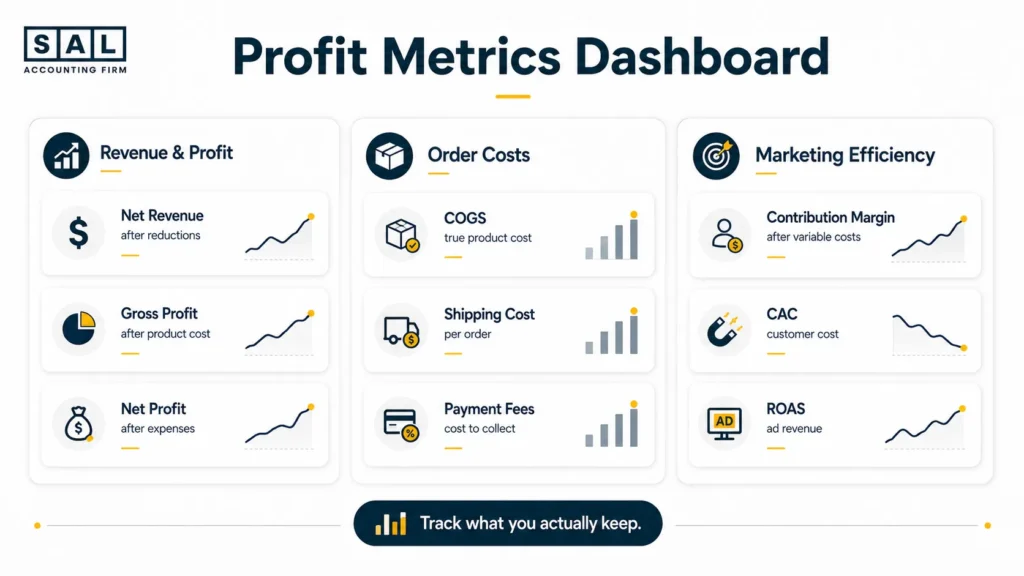
You do not need dozens of metrics to understand profitability. A few key numbers can reveal where profit is being lost and help you make better business decisions.
| Metric | What It Tells You | Warning Sign | Action |
| Net Revenue | Revenue kept after refunds | Large sales-revenue gap | Review refunds |
| Gross Profit | Profit after product costs | Falling margins | Check COGS |
| Net Profit | Overall profitability | Strong sales, weak profit | Review expenses |
| Contribution Margin | Profit per sale | Weak product returns | Prioritize winners |
| COGS Accuracy | Complete product costs | Margins seem too high | Review landed costs |
| Shipping Cost per Order | Delivery cost per sale | Rising shipping costs | Audit fulfillment |
| Payment Fees | Cost of getting paid | Low net deposits | Review fees |
| CAC | Customer acquisition cost | Rising acquisition costs | Optimize marketing |
| ROAS | Ad revenue performance | High ROAS, low profit | Compare to margins |
Shopify’s finance reports can support this review, but the platform data still needs to match bank deposits, tax, inventory, and expenses.
A clean Shopify month-end close checklist keeps that monthly review from becoming guesswork.
Case Study: How a Shopify Seller in Liberty Village, Toronto Found the Profit Missing From Her Bestseller2
Maya runs a Shopify store from Liberty Village, Toronto. She sells home organization products across Canada and the U.S.
Her dashboard looks strong, and one product brings in the most revenue every month. But every time she increases ads, sales rise and cash still feels tight.
The Problem
Maya compares selling price to supplier cost and calls the difference profit. She is not including packaging, payment fees, return shipping, discounts, U.S. duties, or ad spend.
What We Do
We rebuild product-level profit using net revenue, landed cost, shipping, fees, return costs, and ad spend. Canadian and U.S. orders are reviewed separately because the costs are different.
The Result
Maya can see that her bestseller is not automatically her best profit product. With clearer numbers, she can adjust pricing, reduce discounting, and focus budget on products that actually leave money in the business.
Ecommerce Accounting Support to Stay Away From Profit Mistakes
The goal is not just cleaner bookkeeping. The goal is clearer decisions. A strong ecommerce accounting setup separates:
- sales
- payouts
- refunds
- fees
- taxes
- COGS
- shipping
- inventory
- ad spend
For many growing stores, the problem is not that the owner is careless. It is that a general accounting setup was never built for ecommerce. That is where the difference between an ecommerce accountant and a general accountant starts to show.
The same warning signs often appear in ecommerce accountant red flags: messy payouts, vague inventory numbers, unclear tax balances, and reports that do not match how the store actually works.
Final Thoughts: Clean Profit Numbers Make Better Ecommerce Decisions
Your sales dashboard is not the full story. It can show what came in, but not always what you kept. That is why ecommerce profit calculation needs to include refunds, fees, shipping, fulfillment, taxes, inventory, ads, and operating costs.
Once those numbers are clear, pricing, marketing, inventory, tax planning, and growth decisions become easier to trust.
If your store is growing but profit still feels unclear, book a 30-minute consultation at SAL Accounting and get a clearer sense of what needs to be fixed, tracked, or set up next.