
Yes, as soon as your store is registered. There’s no provincial sales tax in Edmonton, since Alberta doesn’t charge one, so local customers pay just 5% GST. But the rate depends on where your customer lives, not where your store is. A buyer in Ontario or Nova Scotia pays HST instead.
Stores under the $30,000 small supplier limit may not need to register yet. Below, SAL Accounting maps out what an Edmonton store should charge in every province.
Quick Takeaways
- Edmonton online stores charge 5% GST to local customers, with no provincial sales tax.
- Once your taxable sales pass $30,000, you generally have to register for GST.
- You charge based on where the customer receives the order, not where your store is.
- Customers in HST provinces pay HST, at rates from 13% to 15%.
- BC, Saskatchewan, Manitoba, and Québec have their own provincial taxes on top of GST.
- Your receipts should show the GST charged, or state that prices include it.
- Registered stores can claim back GST paid on business costs through input tax credits.
Is There PST in Edmonton?
No. Edmonton follows Alberta’s rules: 5% GST and no provincial sales tax. It’s one of the simplest sales tax setups in Canada.
Other provinces add more:
- Ontario and the Atlantic provinces: charge HST, which combines GST and a provincial part
- BC, Saskatchewan, and Manitoba: add their own provincial sales tax on top of GST
- Québec: adds QST on top of GST
What this means for an Edmonton online seller is simple. At home, it’s just 5% GST. Once you ship across Canada, it gets more complex, because many of your customers live in provinces with different rules.
When Does an Edmonton Online Store Have to Register for GST?
Once your worldwide taxable sales pass $30,000. That’s the small supplier limit, and you can cross it in two ways:
- In a single calendar quarter
- Over four calendar quarters in a row
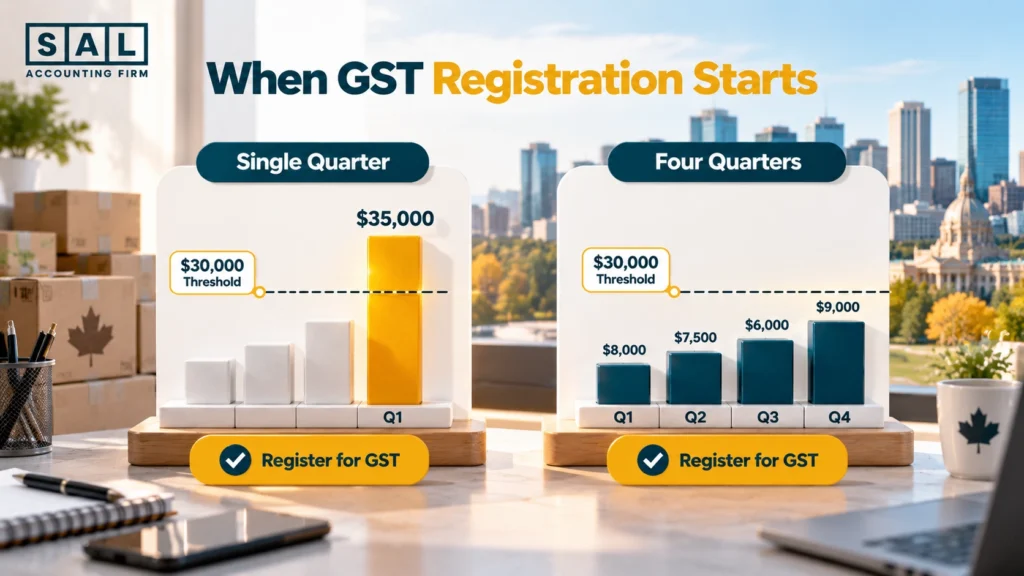
If you go over in a single quarter, you need to start charging GST on the sale that put you over. If you cross it over four quarters, you generally have a short window to register and start charging.
Some new Edmonton online businesses register early on purpose, even below $30,000. Once registered, you can claim back the GST you pay on startup costs like inventory, packaging, and equipment. If you’re not registered, you can’t claim it, which is why it pays to understand what happens when an ecommerce seller isn’t registered for GST.
Most Edmonton sellers register online through CRA’s Business Registration Online service or My Business Account. You’ll get a GST number to show on your invoices.
What GST or HST Rate Does an Edmonton Online Store Charge?
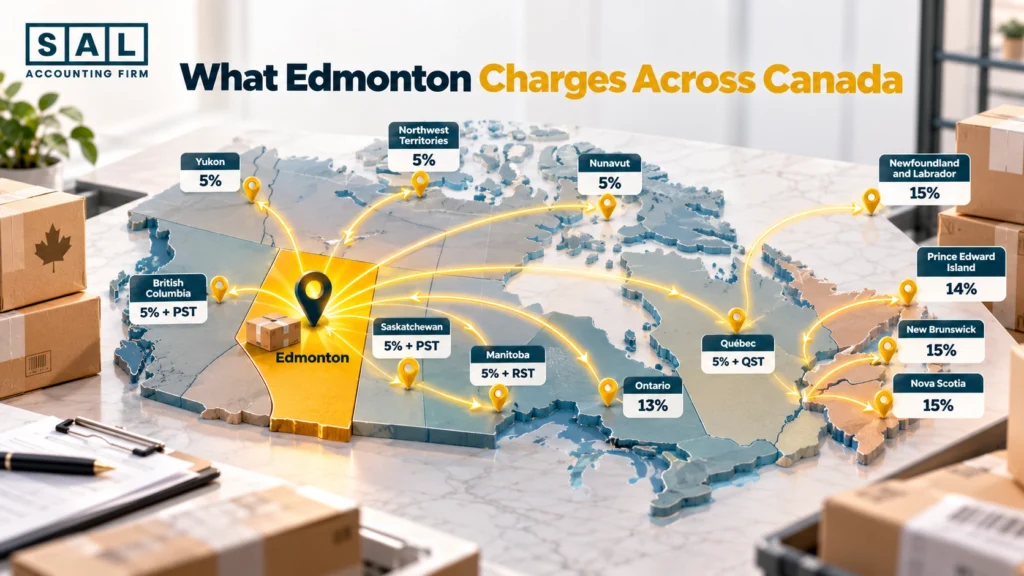
It depends on where your customer lives. For physical products you ship, the rate is generally set by the province where the order is delivered, not by where your Edmonton store is based.
Here’s what an Edmonton seller charges in each province.
| Customer’s Province | Tax Type | Rate | What an Edmonton Seller Charges |
|---|---|---|---|
| Edmonton and the rest of Alberta, NWT, Nunavut, Yukon | GST | 5% | 5% GST |
| Ontario | HST | 13% | 13% HST |
| Nova Scotia | HST | 14% | 14% HST |
| New Brunswick, Newfoundland and Labrador, PEI | HST | 15% | 15% HST |
| BC, Saskatchewan, Manitoba | GST + provincial tax | 5% GST | 5% GST, provincial tax handled separately |
| Québec | GST + QST | 5% GST | 5% GST, QST handled separately |
Rates can change. Nova Scotia dropped from 15% to 14% in April 2025, for example. You can confirm every current rate with CRA’s GST/HST calculator and rates table.
Customers in Edmonton and Other GST-Only Areas: 5%
For customers in Edmonton, elsewhere in the province, and in the Northwest Territories, Nunavut, and Yukon, you charge 5% GST and nothing else.
Customers in HST Provinces: 13% to 15%
For Ontario, Nova Scotia, New Brunswick, Newfoundland and Labrador, and PEI, you charge HST at that province’s rate. This is where many Edmonton sellers slip, because they assume their home rate applies everywhere.
Customers in BC, Saskatchewan, Manitoba, and Québec: 5% GST
For these provinces, you charge 5% GST. Their provincial taxes are separate systems with their own registration rules, covered in the next section.
Case Study: How an Edmonton Candle Brand Learns It Owed HST on Ontario Orders1
Emma runs a small candle brand from a studio in Old Strathcona, Edmonton. She sells through her own online store and ships across Canada. When she registered for GST, she set her store to charge 5% on every order. It seemed right, since Edmonton customers only pay GST. Over the past year, her sales to Ontario customers have grown to about $40,000.
The Problem
Emma’s Ontario customers should have been charged 13% HST, not 5% GST. Because her store only charged 5%, she collected about $3,200 less tax than she should have on those orders. That tax is still owed, and she can’t go back and charge her customers for it.
What She Does
Emma updates her store settings so tax follows the customer’s delivery province. She works with her accountant to correct her past returns and pay the HST shortfall. She also checks her sales into BC and Manitoba to see whether provincial tax needs a separate look.
The Result
Every new order now carries the right rate for where it’s going. The shortfall is paid and her filings are clean. Emma now runs a quick check of her sales by province every quarter, so a new gap can’t build up for a whole year.
Do Other Provinces’ Sales Taxes Apply to Edmonton Online Sellers?
Sometimes. GST registration covers GST and HST everywhere in Canada. But BC PST, Saskatchewan PST, Manitoba RST, and Québec QST are separate systems. An Edmonton business may need to register for one of them once its sales into that province grow.
| Province | Provincial Tax | Separate From GST? | What to Check |
|---|---|---|---|
| British Columbia | PST | Yes | Your sales into BC and whether your products are taxable there |
| Saskatchewan | PST | Yes | Your direct sales into Saskatchewan |
| Manitoba | RST | Yes | Your annual taxable sales into Manitoba |
| Québec | QST | Yes | Your taxable sales to Québec consumers over 12 months |
Each province sets its own registration threshold, and those thresholds can change. Québec, for example, expects sellers outside the province who are registered for GST to register for QST once their taxable sales to Québec consumers pass $30,000 in 12 months. Always confirm the current rules with each province before you register.
Edmonton sellers who ship nationwide often find the out-of-province sales tax rules for Canadian ecommerce are where most mistakes happen.
How Does GST Work on Shipping, Discounts, and Refunds for Edmonton Stores?
The basic rule is simple: GST follows the actual sale. Here’s how that plays out at checkout.
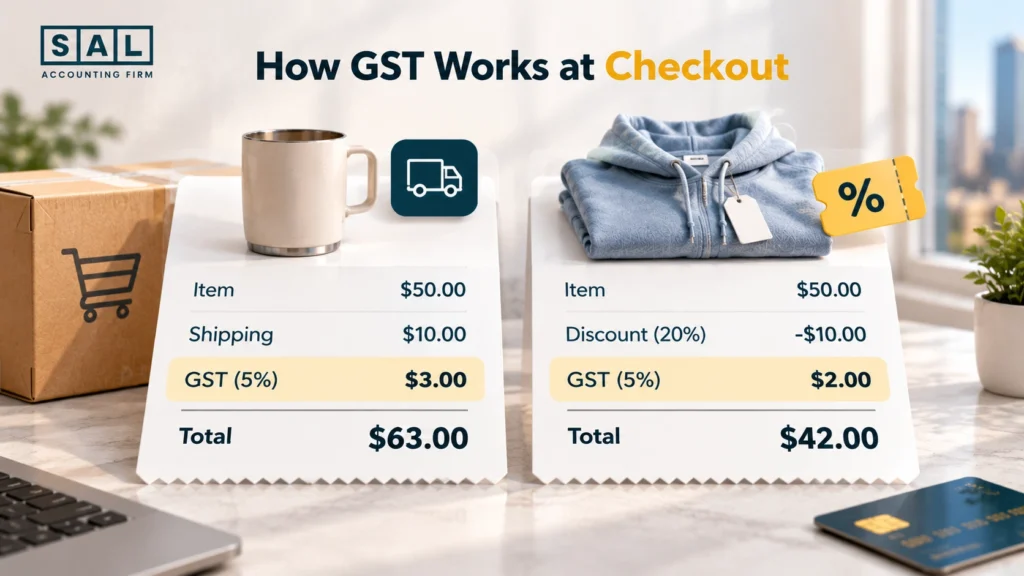
Shipping Charges
If you charge shipping as part of the order, it’s usually taxed the same way as the products. Ship a $50 order to a customer across town in Edmonton with $10 shipping, and you charge 5% GST on $60, which is $3.00.
Discount Codes
GST is charged on the price after your own discount. A $50 product with a 20% code sells for $40, so you charge GST on $40, which is $2.00.
Refunds and Credit Notes
When you refund an order, you generally refund the GST you collected too. Keep a credit note or refund record, because it lets you reduce the GST you owe on your return. Clear rules for returns, like a written refund policy, make these adjustments much easier to track.
Pro Tip: Test a discount code and a refund on a real order before a big sale. Check that the tax adjusts the way you expect.
How Do You Set Up GST in Your Edmonton Online Store?
Your store platform applies the tax rules you give it. It doesn’t decide what you owe. Three things to get right:
- Tax settings by province: Set your store to charge tax based on the delivery address, not your Edmonton address.
- Your GST number on invoices: Show your GST registration number on receipts and invoices.
- Checkout testing: Place test orders to addresses in Edmonton, Ontario, and Nova Scotia, and check that each one gets the right rate.
If you sell on Shopify, getting the Shopify GST/HST settings right from the start saves a lot of cleanup later.
Should Your Online Prices Include GST?
You can choose either way. Most Edmonton online shops show prices before tax and add GST at checkout. That’s usually simpler, because the tax changes with the customer’s province.
Showing tax-included prices is allowed too. But then the same product may need a different price for each province, since an Ontario customer pays 13% and an Edmonton customer pays 5%.
Whichever you choose, your receipt or invoice should do one of two things:
- Show the GST or HST charged as a separate amount
- State clearly that the price includes GST or HST
Pro Tip: Add a short line near your prices, such as “Taxes calculated at checkout.” It sets expectations and cuts down on surprised customers.
How Do Edmonton Online Sellers File a GST Return?
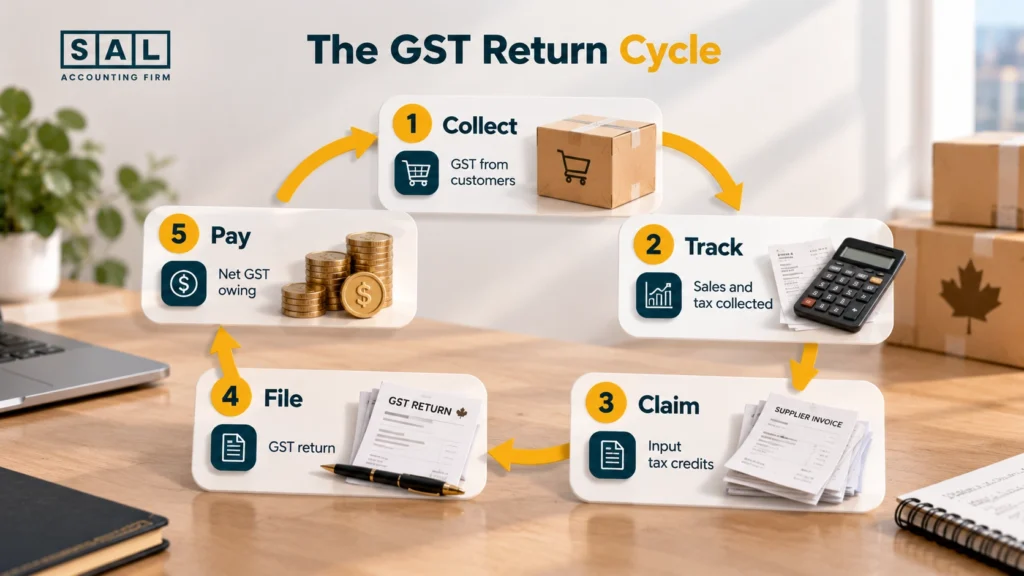
You report the GST and HST you collected, subtract the GST you paid on business costs, and pay the difference to CRA.
Filing Periods
CRA assigns your filing period based on your sales:
- Up to $1.5 million: annual filing
- Over $1.5 million up to $6 million: quarterly filing
- Over $6 million: monthly filing
You can choose to file more often if you’d like.
Input Tax Credits
Input tax credits (ITCs) let you claim back GST paid on business costs, such as:
- Inventory and packaging
- Ads billed with GST
- Apps and software
- Equipment and office costs
This is where many small Edmonton online stores lose money. If you don’t claim the GST you paid, you’re simply overpaying. Before you file, you can estimate what you’re owed with the GST/HST Refund Calculator.
The Quick Method
Some small businesses can use CRA’s Quick Method, which simplifies how GST is calculated. It’s generally open to businesses with annual taxable sales of $400,000 or less, including tax. It isn’t always a better deal for stores that resell products, so check whether you qualify and compare both methods first.
Walking through each line of the return itself is easier once you understand how a GST/HST return is put together.
Case Study: How an Edmonton Apparel Brand Stops Overpaying GST2
Daniel runs an online apparel brand from a small warehouse in the Ritchie area of Edmonton. He’s registered for GST and files on time every year. Each year, he reports the GST he collected and pays it in full. His bookkeeping is simple: sales go in, payments go out.
The Problem
Daniel has never claimed input tax credits. Last year, he paid GST on about $90,000 of inventory, plus his packaging, apps, and Canadian ad spend. That’s thousands of dollars of GST he could have claimed back but didn’t. He’s been paying CRA more than he owed.
What He Does
Daniel’s bookkeeper sorts his expenses so the GST paid on each purchase is tracked separately. They review past invoices to see which GST can still be claimed, since ITCs can usually be claimed for a few years back. From now on, each return includes his ITCs.
The Result
Daniel’s GST bill drops sharply on his next return. Some of the past ITCs are recovered too. He now sees GST tracking as part of his monthly bookkeeping, not a once-a-year task.
Final Thought: Edmonton GST Is Simple at Home, Less So Across Canada
Selling online from Edmonton starts simply: 5% GST and no provincial sales tax. But once you ship across Canada, the customer’s province decides what you charge. HST provinces need their own rates, four provinces have separate provincial taxes, and your receipts need to show the tax clearly. Claiming input tax credits keeps you from overpaying. Good sales tax habits go hand in hand with clean books, and seeing how ecommerce bookkeeping is set up shows how the two fit together.
Ready to see what else could strengthen your numbers? Start with our free financial growth blueprint for Canadian online stores.