
Plenty of bookkeepers say they handle ecommerce. Far fewer can reconcile a Shopify payout, track stock held at a co-packer, and keep GST/HST out of your revenue. For an online supplement brand, that gap shows up months later as wrong COGS and a messy year-end.
That’s why SAL Accounting treats bookkeeper fit as one of the first things to get right. Use the tests below before you sign anyone.
Before your first call with any bookkeeper, pull your records together with the Tax Document Checklist for eCommerce stores.
Quick Takeaways
- A reliable supplement bookkeeper reconciles your records. They don’t just categorize transactions.
- Test them on payouts first: sales, fees, refunds, and tax rarely match the bank deposit.
- They should know inventory and COGS need more than expensing supplier bills.
- Co-packer deposits, production runs, and 3PL stock should sound familiar to them.
- GST/HST you collect should never sit in revenue.
- A good bookkeeper knows which issues to pass to an accountant.
What Does “Reliable” Mean for an Online Supplement Store Bookkeeper?
It means your books can be traced back to the real records, every month. A reliable bookkeeper produces numbers that tie to:
- Sales reports
- Payout reports
- Payment processors
- Bank accounts and credit cards
- Supplier and co-packer invoices
- Inventory records
In practice, reliability looks like this:
- Transactions aren’t just categorized and forgotten
- Accounts are reconciled
- Unexplained differences are investigated
- Missing records are flagged
- Reports arrive on a steady schedule
- Issues that need accounting judgment are escalated
Here’s the key distinction. Someone can be friendly, fast, and organized and still produce unreliable ecommerce books. Responsiveness is nice. Reconciled numbers are what you’re paying for.
General advice on choosing an ecommerce bookkeeper covers the basics. The rest of this article focuses on what a supplement store specifically needs.
Does the Bookkeeper Understand Ecommerce Payout Reconciliation?
Make this your first test. A supplement store’s bank deposits almost never equal its sales, and a good bookkeeper knows why.
They should understand the difference between:
- Gross sales
- Discounts
- Refunds
- Platform and payment fees
- Sales tax collected
- Adjustments and chargebacks
- Payouts
- Bank deposits
Ask them this:
“How would you reconcile a payout that doesn’t equal the sales shown in the store?”
A weak answer sounds like: “I record whatever reaches the bank.” That treats a net deposit as revenue and hides fees, refunds, and tax inside it.
A strong answer walks from gross sales down to the payout, line by line. For example, $10,000 of Shopify sales might become a $8,900 deposit after $400 of fees, $500 of refunds, and $200 of adjustments, with tax shown separately. A good bookkeeper records each piece, not just the $8,900.
This is the core of revenue vs payout reconciliation for supplement stores. If a candidate can’t explain it clearly, keep looking.

Can a Bookkeeper Handle Inventory and COGS for an Online Supplement Business?
They should at least understand that a product business works differently from a service business.
Your books may include:
- Inventory purchases
- Finished products
- Packaging
- Supplier and co-packer invoices
- Inventory receipts and transfers
- Samples and giveaways
- Damaged or expired stock
- Inventory moving into COGS as it sells
You’re not testing whether they can design inventory policy on their own. That’s an accountant’s call. You’re testing whether they know inventory and COGS need more than coding every supplier payment as an expense.
Ask how they’d record a $30,000 batch of finished product. If the answer is “as an expense when you pay for it,” your COGS will swing wildly from month to month. What belongs in product cost is explained in this breakdown of COGS for supplement brands, and a good candidate should be comfortable with the ideas behind supplement inventory accounting.
Do They Understand How Supplement Production Affects the Books?
This is where general ecommerce bookkeepers often fall short. Supplement brands deal with production in ways a clothing reseller doesn’t.
Ask about their experience with:
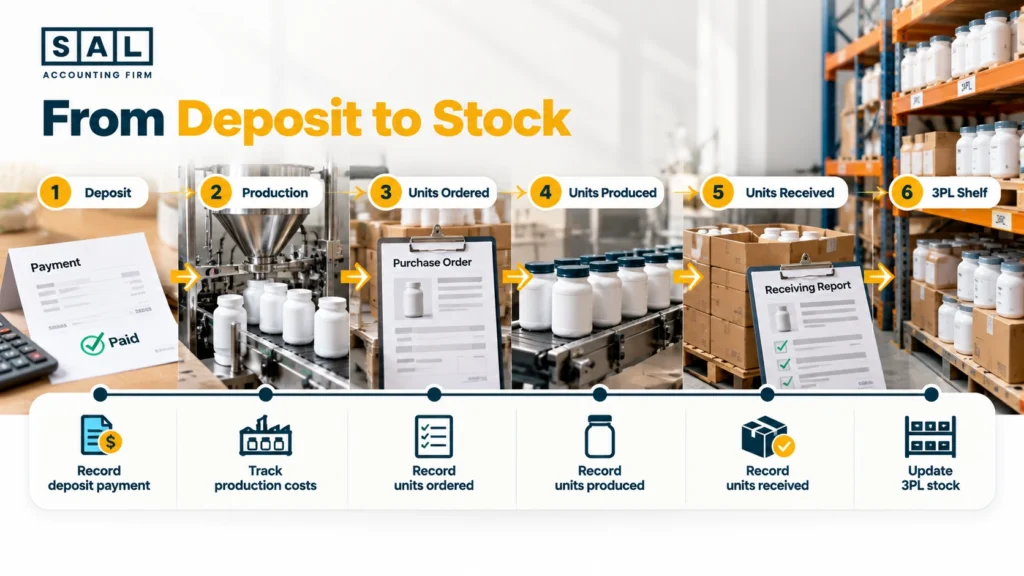
- Manufacturers or co-packers
- Manufacturing deposits
- Final production invoices
- Brand-supplied ingredients or packaging
- Stock received after a production run
- Differences between units ordered, produced, and received
- Inventory stored at a 3PL
The bookkeeper doesn’t need to make every judgment call here. But they should capture and organize these transactions so your accountant has clean records to work with. A bookkeeper who knows how to reconcile a co-packer production run from order to shelf is far less likely to leave deposits sitting open for months.
Case Study: How Caleb’s Supplement Brand in Bloor West Village, Toronto Learns What “Ecommerce Experience” Really Means1
Caleb runs an online magnesium and sleep supplement brand from a small office in Bloor West Village, Toronto. He hired a bookkeeper who said they “do ecommerce.” The monthly reports arrived on time, and the bookkeeper always answered emails quickly. Caleb assumed everything was fine.
The Problem
At year-end, his accountant finds three issues. Revenue equals Shopify payouts, so fees and refunds are buried. Two co-packer deposits were recorded as expenses. And GST/HST collected was mixed into sales. The bookkeeper was responsive and organized, but the books weren’t reliable.
What We Do
We rebuild revenue from gross sales, fees, refunds, and tax for each month. We move the deposits to inventory and match them to the production runs they paid for. Then we separate GST/HST collected from revenue.
The Result
Caleb’s profit for the year turns out to be quite different from what his monthly reports showed. He now knows what to test for, and when he hires his next bookkeeper, he asks about payouts, deposits, and tax before anything else.
Can They Keep GST/HST Separate From Your Online Store’s Revenue?
They must. The GST/HST you collect from customers isn’t your money, and it shouldn’t sit in sales.
Ask how they handle:
- GST/HST collected on sales
- GST/HST paid on business expenses
- The tax accounts in your books
- The information needed for your GST/HST filings
A good bookkeeper also keeps the paperwork that backs up your input tax credits. The Input Tax Credit Information Regulations set out what details a supplier invoice needs before you can claim GST/HST back, and a careful bookkeeper flags invoices that fall short.
They don’t need to decide how each product is taxed. That classification question is tied to your GST/HST setup for online supplement stores. But they should keep the records clean and work smoothly with whoever files your returns.
Can They Work With Your Ecommerce and Accounting Systems?
Your financial data likely comes from several places:
- Ecommerce platforms
- Marketplaces like Amazon
- Payment processors
- QuickBooks or Xero
- Inventory software
- 3PL reports
- Bank and credit card feeds
Ask them:
“Which system do you use as the source of truth for sales, payouts, inventory, and accounting?”
A good answer shows they know each system has a different job. Your store holds orders. Your inventory tool holds stock counts. Your accounting software holds the final books. A bookkeeper who treats the bank feed as the only source will miss a lot.
If you use a dedicated stock tool, ask whether they’ve worked with inventory software for supplement brands before. Familiarity speeds up the first few months considerably.

What Should You Ask About Their Month-End Process?
You’re checking for a repeatable process, not someone who works through transactions whenever they show up. Ask:
- When do you collect monthly records?
- When do you reconcile bank and payout accounts?
- How do you handle unexplained differences?
- What happens when inventory reports don’t agree?
- When do you request missing documents?
- When will the books be ready for review?
- What happens to issues you can’t resolve?
Specific dates are a good sign. “The books are closed by the 15th, and anything unresolved goes on a list for you” beats “I’ll get to it as things come in.”
A dependable month-end close for supplement brands follows the same steps every month. Ask the candidate to walk you through theirs.
Does the Bookkeeper Know When to Escalate to an Accountant?
This is one of the most useful tests, and many hiring guides skip it. A strong bookkeeper knows what they should and shouldn’t own. The table below shows a typical split.
| Area | Bookkeeper Usually Owns | Usually Escalated |
|---|---|---|
| Transactions | Recording and categorizing | Unusual or one-off items |
| Reconciliations | Bank, card, and payout reconciliations | Differences they can’t explain |
| Inventory | Recording receipts and transfers | Valuation and large write-downs |
| Tax | Clean GST/HST records | Tax advice and complex tax questions |
| Cross-border | Recording US sales and costs | US sales tax and cross-border tax issues |
| Reporting | Monthly reports | Final balance sheet review |
| Planning | Supplying accurate data | Forecasting and strategy |
Be wary of anyone who says they handle all of it alone. You want someone who knows where their role ends. How bookkeeping, controller, and CFO work fit together is laid out in this comparison of controller vs fractional CFO for online supplement businesses.
Keep in mind, the owner stays on the hook either way. CRA notes that you’re responsible for keeping adequate records even when a bookkeeper or accountant keeps them for you.
What Questions Should You Ask Before Hiring a Bookkeeper for an Online Supplement Business?
Here are ten questions that cover the essentials:
- How do you reconcile ecommerce payouts to sales?
- How do you handle inventory and COGS?
- Have you worked with product-based ecommerce businesses?
- How would you record manufacturing deposits and supplier invoices?
- How do you handle refunds, fees, and chargebacks?
- How do you keep GST/HST separate in the books?
- Which ecommerce and accounting systems have you worked with?
- What is your month-end process?
- What happens when something doesn’t reconcile?
- Which issues would you escalate to an accountant?
The table below shows what good and weak answers tend to sound like.
| Question | Strong Answer Sounds Like | Weak Answer Sounds Like |
|---|---|---|
| Payout reconciliation | “I break each payout into sales, fees, refunds, and tax” | “I record what hits the bank” |
| Inventory and COGS | “Stock goes to inventory and moves to COGS as it sells” | “Supplier bills go to expenses” |
| Manufacturing deposits | “I track deposits until goods arrive” | “It’s just a payment to the supplier” |
| GST/HST | “Tax collected sits in its own liability account” | “It’s included in sales” |
| Escalation | “I flag valuation and tax questions for the accountant” | “I can handle all of it” |
Many of the same principles apply when you’re hiring an accountant, and these questions to ask an ecommerce accountant pair well with the list above.
Case Study: How Jenna’s Protein Brand in Applewood, Mississauga Interviews Three Bookkeepers2
Jenna sells protein powder and pre-workout online from a warehouse unit in Applewood, Mississauga. Her business has outgrown DIY bookkeeping. She shortlists three bookkeepers, and all three say they have ecommerce experience.
The Problem
On paper, the three look the same. They have similar prices, good reviews, and quick replies. Jenna doesn’t know how to tell which one can actually handle her co-packer runs, her Amazon and Shopify payouts, and her inventory.
What She Does
Jenna asks each bookkeeper the same ten questions. The first says payouts are “just recorded as sales.” The second handles payouts well but has never worked with inventory. The third walks through a payout line by line, explains how deposits are cleared once stock arrives, and names the issues she’d pass to an accountant.
The Result
Jenna hires the third bookkeeper. Her first month-end report includes a short list of open items, including an old co-packer deposit nobody had cleared. For the first time, she trusts her monthly numbers.
What Are the Warning Signs of the Wrong Bookkeeper for a Supplement Store?
Watch for these during interviews:
- Treats every payout as revenue
- Has no process for reconciling ecommerce activity
- Treats inventory purchases as ordinary expenses
- Can’t explain how refunds or fees are handled
- Ignores inventory records
- Mixes sales tax into revenue
- Relies only on bank feeds
- Can’t describe a month-end timeline
- Claims to handle tax, accounting, forecasting, and everything else, with no clear scope
- Can’t explain what happens when the numbers don’t agree
Some of these overlap with general ecommerce accountant red flags, but in a supplement store, inventory and production mistakes cost the most.
- Also read: “Signs Your Ecommerce Brand Needs a Better Bookkeeper”

What Evidence Should You Look for Before Choosing a Supplement Store Bookkeeper?
Claims of “ecommerce experience” aren’t enough. Look for proof:
- Real experience with ecommerce clients
- Experience with inventory-based businesses
- A clear explanation of how they reconcile
- A month-end process they can describe step by step
- A written scope of work
- Who reviews the bookkeeping, if anyone
- How errors and exceptions are handled
- Client examples or references, where available
- Realistic expectations about response times
Don’t choose based on testimonials alone. A great review from a service business tells you little about how someone handles co-packer deposits.
Pro Tip: Ask a candidate to walk you through a sample month-end report from a product-based client, with names removed. How they explain it tells you more than any review.
These standards apply to every provider, and Ontario supplement brands should hold any ecommerce bookkeeping team to them, ours included.
Final Thought: Can This Bookkeeper Keep Your Online Supplement Store’s Books Reliable?
Finding a reliable bookkeeper comes down to one question: can this person reconcile your ecommerce activity, understand your inventory and production, keep clean Canadian books, spot problems, and know when to escalate?
Use the questions and warning signs above in every interview. The right answers are easy to recognize once you know what to listen for.
Strong books are the foundation for every decision that follows. Map out what comes next with our financial roadmap for online supplement brands.