
You’ve outgrown the spreadsheet stage. Orders are coming in from Shopify, Amazon FBA, and other channels, but the numbers still don’t feel clear. Shopify shows one total, Amazon shows another, and your bank deposits don’t match either. That’s usually where things start to get confusing.
For many Canadian e-commerce founders, this happens somewhere between $300K and $800K in revenue, when COGS, sales tax, fees, refunds, and cross-border sales get harder to track. This guide from SAL Accounting shows you how to choose the right e-commerce bookkeeper for Shopify, Amazon, other platforms, and Canada-U.S. cross-border operations.
Quick Takeaways
- A true ecommerce bookkeeper understands platform payouts, inventory costing, and multi-channel reconciliation, skills most general bookkeepers lack.
- Expect to pay $450–$1,800+ per month in Canada, depending on your transaction volume and complexity.
- Prioritize specialists who know Shopify, Amazon FBA, GST/HST/QST, and US sales tax nexus.
- Always ask for specific platform experience and request a detailed scope of work before signing.
- The best time to hire is before your books become a mess; a proper cleanup can take 4–10 weeks.
- Book a free consultation with our ecommerce accounting team if you want help evaluating your current setup.
If fees are part of the reason your payouts don’t match what you expected, our Shopify Fee Calculator can help you get a clearer idea of what may be coming out before the money hits your bank.
Why a General Bookkeeper Isn’t Enough for eCommerce Stores?
E-commerce is not like a café or consulting business. Your revenue comes from platforms that report data differently, fees that change often, returns that may hit later, and inventory that can move across borders. A general bookkeeper may be fine when things are simple. But once you’re dealing with Shopify payouts, Amazon fees, inventory, refunds, and cross-border sales, the books can get confusing fast.
The issue usually isn’t effort. It’s that e-commerce data doesn’t behave like regular bank transactions. Let’s say Shopify shows $40,000 in sales for the month, but only $34,500 hits your bank after fees, refunds, and payment processing costs. If your bookkeeper records only the bank deposit, your reports won’t show what actually happened. That’s why expert e-commerce bookkeeping needs a different setup.
General Bookkeeper vs. eCommerce Specialist: What Are the Differences?
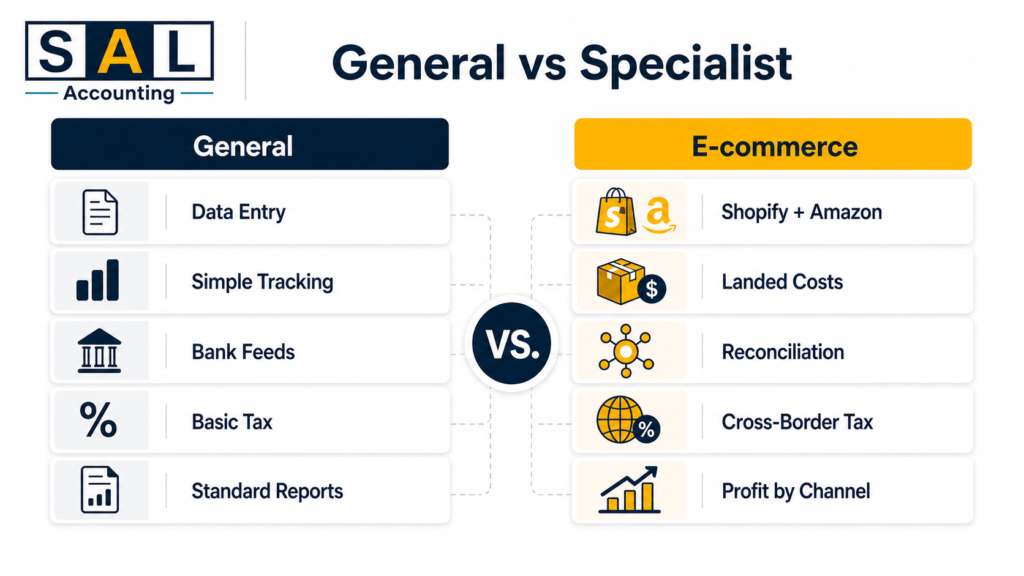
General bookkeepers can handle basic business records. But e-commerce adds platform data, inventory movement, payment processors, sales tax, and sometimes cross-border rules into the mix. Here’s where the difference usually shows up:
- Platform Knowledge: General bookkeepers do basic data entry. Specialists have deep Shopify, Amazon, and platform experience.
- COGS & Inventory: Generalists use simple tracking. Specialists handle landed costs, FBA fees, returns properly, and track COGS for your online store.
- Payment Reconciliation: Generalists rely on bank feeds. Specialists use e-commerce bookkeeping software and tools for clean multi-channel matching.
- Sales Tax Expertise: Generalists handle basic Canadian taxes. Specialists know the US nexus and cross-border rules.
- Reporting Quality: Generalists give standard P&L reports. Specialists provide detailed channel profitability.
- Monthly Cost (CAD): Generalists: $300–$700. Specialists: $450–$1,800+.
Here’s a clear side-by-side comparison of what sets a general bookkeeper apart from an experienced ecommerce specialist:
| Aspect | General Bookkeeper | eCommerce Specialist |
| Platform Knowledge | Basic data entry | Deep Shopify, Amazon, Etsy, WooCommerce experience |
| COGS & Inventory | Simple tracking | Accurate landed cost, FBA fees, returns adjustment |
| Payment Reconciliation | Bank feeds only | Multi-channel (Stripe, PayPal, Amazon payouts, Shopify Payments) |
| Sales Tax | Basic GST/HST | US state sales tax nexus + Canadian cross-border rules |
| Reporting | Standard P&L | Gross margin by channel, inventory turns, true profitability |
| Typical Monthly Cost (CAD) | $300–$700 | $450–$1,800+ |
If your bookkeeper treats Amazon settlements like regular bank deposits, or can’t explain where Shopify fees are showing up, your reports may not be telling the full story. That makes it harder to see your real margins.
Case Study: How a Liberty Village Shopify Store Gets Clear on Its Real Margins1
A growing apparel brand in Liberty Village, Toronto sells through Shopify, Amazon, and a small wholesale channel. Sales look strong, but the owner still can’t explain why cash feels tight at the end of the month. Shopify shows healthy revenue, Amazon deposits come in regularly, and the business looks profitable on the surface. But once platform fees, refunds, shipping costs, ad spend, and inventory costs are factored in, the numbers tell a different story.
The Problem
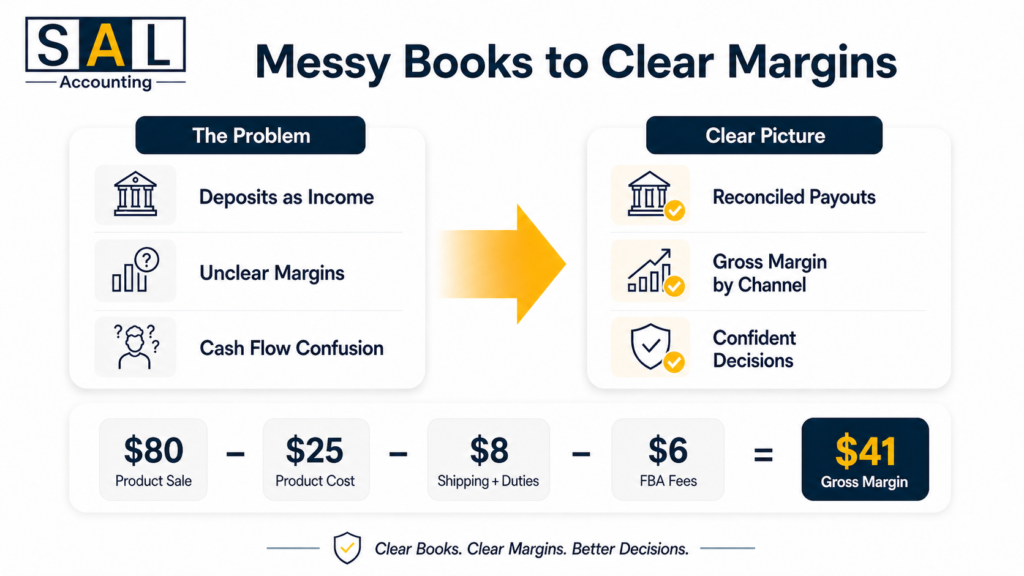
The bookkeeper records bank deposits as income instead of matching each payout back to the actual sales, fees, refunds, and taxes behind it. COGS is also tracked too simply, so the owner can’t see true product margins.
What We Do
We review the Shopify and Amazon payout setup, separate sales from fees and refunds, and clean up how inventory and landed costs are recorded. The goal is to make the reports match what actually happens in the store, not just what lands in the bank.
The Result
The owner gets a clearer view of gross margin by channel, understands where fees eat into profit, and can make better decisions about pricing, inventory, and which products are actually worth pushing.
What Should an E-commerce Bookkeeper Actually Know?
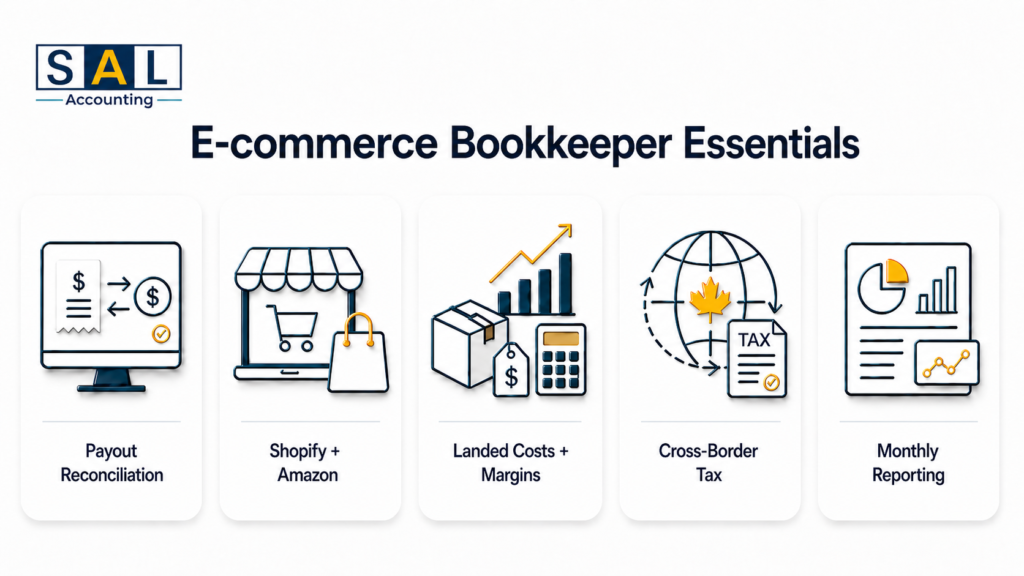
When you’re hiring for an e-commerce business, you need someone who understands what happens before the money hits the bank. Here’s what to look for.
Platform & Marketplace Integrations
Look for hands-on experience with Shopify, Amazon Seller Central, and tools like A2X, Synder, or similar apps.
The goal is to make sure each payout can be matched back to the right sales, fees, refunds, taxes, and deposits. Without that, your reports may look clean on the surface but still miss what actually happened in the store. The best bookkeepers automate reconciliation for e-commerce platforms.
COGS, Inventory & Gross Margin Accuracy
This is where a lot of e-commerce stores lose track of profit. Your bookkeeper should understand landed costs, FBA inventory accounting, returns, shrinkage, and inventory adjustments.
Let’s say you sell a product for $80. The product itself costs $25, shipping and duties add another $8, and Amazon FBA fees add $6. If only the $25 product cost is recorded, your profit looks better than it really is. That’s why landed cost matters. It helps you see what you actually keep after the full cost of selling the product.
Sales Tax & Cross-Border Compliance
For Canadian sellers, sales tax can get confusing once you’re selling across provinces or into the U.S. A good e-commerce bookkeeper should know when GST/HST/QST applies, when U.S. sales tax might become an issue, and how to keep the records clean enough for filing.
This does not mean every store has a major tax problem. It just means the bookkeeper needs to know what to check, especially if you’re selling into the U.S.
Payment Reconciliation & Multi-Channel Complexity
Basically, the bank deposit is only part of the story. Shopify Payments, Amazon, PayPal, Apple Pay, and Klarna can all hit your account at different times, with different fees already taken out. The right bookkeeper reconciles those payouts monthly so your numbers are easier to trust.
KPI Reporting That Helps You Run the Business
You need more than reports that only your accountant understands. Ask for gross margin by product or channel, customer acquisition cost trends, inventory turnover, cash flow, and profit after platform fees. These are the numbers that help you understand what’s working and what needs attention.
Pro Tip: Ask potential bookkeepers: “Walk me through how you would handle a Shopify store that also sells on Amazon FBA with some U.S. sales.” Their answer will show you how much they really understand.
How Much Does E-commerce Bookkeeping Really Cost in Canada?
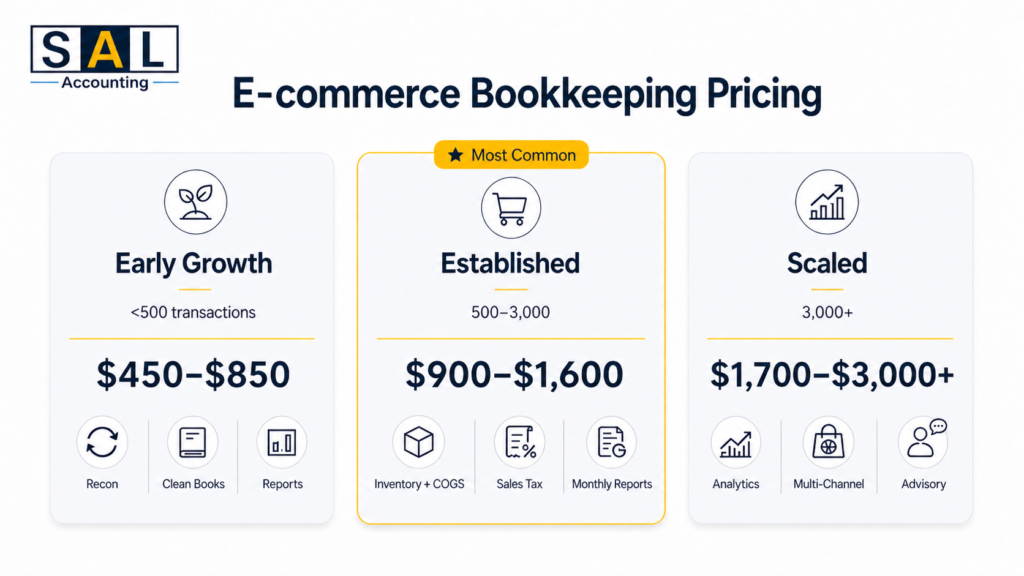
Most Canadian e-commerce businesses pay between $900 and $1,600 per month for specialized bookkeeping once they reach steady growth. The cost of starting an ecommerce store is different.
Pricing depends on transaction volume, sales channels, inventory complexity, and whether you sell across borders. Simpler setups can start around $450–$850 per month, while high-volume or multi-channel stores with heavier tax and reporting needs can go up to $1,700–$3,000+ per month. Below are the typical monthly pricing bands in CAD:
| Business Stage | Monthly Transactions | Typical Cost | What’s Usually Included |
| Early Growth | <500 | $450 – $850 | Reconciliation, basic financials |
| Established (Most Common) | 500 – 3,000 | $900 – $1,600 | Full bookkeeping, COGS, sales tax, reporting |
| Scaled / Multi-Channel | 3,000+ | $1,700 – $3,000+ | Advanced reporting, tax prep support, CFO-level insights |
One-time cleanup projects usually cost $2,500–$8,000, depending on the number of platforms, accounts, transactions, and months that need to be reviewed. The goal is not just to have someone categorize transactions. The goal is to know whether your sales, fees, inventory, taxes, and profit actually make sense each month.
Pro Tip: Price matters, but it should not be the only factor. If the setup is wrong, you may spend more later cleaning things up, fixing sales tax issues, or trying to understand reports that do not match your store.
Case Study: How a Port Credit Amazon Seller Cleans Up Messy Books Before Expanding to the U.S.2
An Amazon FBA seller based in Port Credit, Mississauga is preparing to expand more seriously into the U.S. The business has grown quickly, but the bookkeeping has not kept up. Amazon settlements are being entered as simple deposits, inventory costs are not always updated, and sales tax questions are starting to pile up. The owner does not need more reports. They need to know whether the numbers can actually be trusted.
The Problem
The books are behind, Amazon fees are not clearly separated, and the owner can’t tell how much profit is left after FBA fees, returns, product costs, and cross-border expenses. U.S. sales also make the tax side feel more confusing.
What We Do
We clean up the Amazon payout activity, review how COGS and inventory are being tracked, and organize the records so sales tax and cross-border activity are easier to review. We also make sure the monthly reports show the numbers the owner actually needs to run the business.
The Result
The seller gets cleaner books, a better understanding of true profit, and a clearer picture of what needs to be handled before expanding further into the U.S. Instead of guessing from deposits, they can see what the business is really keeping after fees, refunds, inventory, and tax-related costs.
10 Must-Ask Questions Before You Hire an eCommerce Bookkeeper
These questions will help you see whether a bookkeeper actually understands e-commerce.
- How many Shopify and Amazon sellers do you currently work with?
- Walk me through how you reconcile Amazon FBA payouts.
- What’s your process for calculating accurate COGS and handling inventory?
- Do you have experience with Canadian GST/HST returns and U.S. sales tax for cross-border sellers?
- Which tools do you use, such as A2X, QuickBooks, Xero, or similar apps? (Check out the Shopify-A2X guide)
- How do you handle multi-currency and cross-border transactions?
- Can you provide sample reports or KPI dashboards?
- What does your monthly close process look like?
- How quickly do you respond to questions during the month?
- Are you willing to do a paid test month or review of my current books?
You’re not looking for perfect answers. You’re looking for clear, specific answers that match how your store actually works.
Red Flags to Watch Out For When Hiring an eCommerce Bookkeeper
Not sure if your current bookkeeper really understands your store, or just keeps the books moving month to month? These are the signs to watch for. Some warning signs are easy to spot once you know what to look for. If a bookkeeper gives vague answers about Shopify, Amazon, sales tax, or inventory, they may not be the right fit for your store. Watch for these red flags:
- They treat all revenue the same, no matter the platform
- No experience with tools like A2X or similar automation
- Vague answers about sales tax and cross-border e-commerce shipping rules
- No references from other e-commerce sellers
- Offers a very low monthly price without a clear scope
- Slow replies or unclear communication
- Can’t clearly explain cash vs. accrual for an inventory business
If you notice a few of these during your conversations, it’s worth slowing down before you sign anything. The right specialist should make you feel clearer, not more confused.
- Also Read: “8 Signs It’s Time to Upgrade your eCommerce Accountant: Red Flags which Hurt Your Business“
How to Find the Right E-commerce Bookkeeper
Here’s a simple way to compare bookkeepers and find someone who actually understands your store.
1. Define Your Needs
Start by getting clear on where you are right now. Write down your main sales platforms, average monthly order volume, biggest bookkeeping headaches, and what you want to understand better over the next 6–12 months. Think of this as your simple bookkeeping checklist.
2. Create a Simple Scope of Work
Put together a short document that explains what you expect. Include:
- Monthly tasks
- Key deliverables
- When the books should be ready each month, for example by the 10th
- Any reporting you want to see regularly
A clear scope helps everyone stay on the same page.
3. Search in the Right Places
Talk to other e-commerce sellers in Facebook groups, Slack communities, and founder networks. Look for specialists who understand Canadian e-commerce and cross-border rules. You can also reach out to reputable firms directly or check platforms like Upwork, but vet them carefully.
Look for someone who can explain how they handle e-commerce financial reports, payouts, inventory, and sales tax.
4. Send an RFP
Send each bookkeeper the same scope and questions. That makes it easier to compare their answers, pricing, and process.
5. Evaluate & Test
Go through their answers and sample reports. Ask for references from other e-commerce clients. The smartest move is to do a paid trial month or a cleanup review of your current books. This shows you exactly how they work in real life.
6. Onboard Properly
Once you pick someone, set them up for success.
For an e-commerce store, this usually means access to Shopify, Amazon Seller Central, payment processors, bank accounts, accounting software, inventory tools, and any sales tax apps. Use a clear onboarding checklist so nothing gets missed in the first month.
E-commerce Bookkeeper vs Accountant vs Fractional CFO — When to Upgrade
As your e-commerce business grows, your needs change. Here’s a simple breakdown to help you know when it’s time to level up.
- Bookkeeper: Handles day-to-day records, e-commerce payment reconciliations, and keeps your books clean each month.
- Accountant: Goes further with tax planning, preparing and filing returns, and making sure the right tax rules are handled properly. Many good firms handle both bookkeeping and accounting.
- Fractional CFO: Helps with cash flow forecasting, budgeting, pricing decisions, and bigger growth questions. You usually need this level once you’re over $1M–$2M in annual revenue.
Basically, bookkeeping helps you see what happened. Accounting helps you handle tax and filing properly. CFO support helps you use the numbers to make bigger decisions. Most Canadian e-commerce sellers start with a specialized bookkeeper and then grow into full accounting and advisory support as things get more complex.
At SAL Accounting, we help e-commerce owners understand what their numbers are really saying as the business grows, from cleaner Amazon and Shopify bookkeeping to cross-border tax support and bigger financial decisions.
Want to Know If Your Current Bookkeeping Setup Makes Sense?
The right e-commerce bookkeeper should make your numbers easier to trust. You should understand what came in, what went out, what fees cost you, and whether your store is actually profitable. If you’re not sure whether your Shopify or Amazon numbers actually make sense, book a consultation with SAL Accounting. We’ll help you understand what’s working, what looks off, and what to fix next.
At the end of the day, the right bookkeeper should help you understand your store more clearly. Not just what sold, but what you actually kept after fees, refunds, inventory, taxes, and platform costs.