
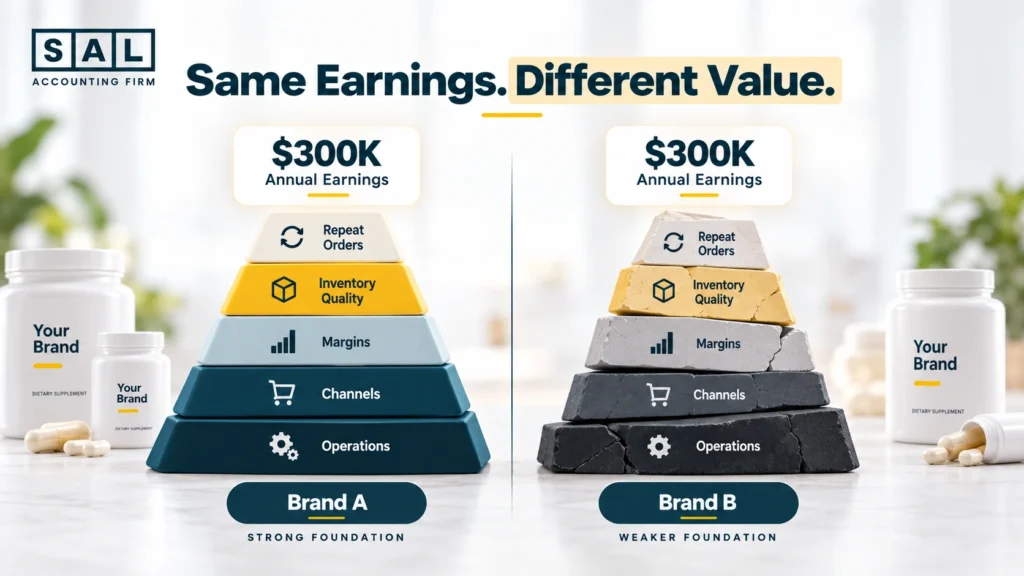
Two supplement brands can earn the same $300,000 a year and still be viewed very differently by a buyer. What matters is how dependable those earnings are. That comes down to repeat orders, inventory with real shelf life left, steady margins, and a business that doesn’t hang on one SKU, one co-packer, or one founder.
Reading the numbers behind that gap is everyday work at SAL Accounting. Here’s what buyers look at first, so you can see it before they do.
Start with the earnings number itself. Run it through the Ecommerce EBITDA Calculator, then use this guide to test how durable it really is.
Quick Takeaways
- Earnings are only part of the picture. The risk around keeping those earnings shapes how a buyer sees the brand.
- A brand that relies on one hero SKU, one channel, or one co-packer carries more risk than one with a spread-out business.
- Inventory near its expiry date may be worth much less than its balance sheet number suggests.
- Repeat orders without heavy discounts make demand more predictable.
- A brand that needs a lot of cash tied up in inventory to grow is less efficient than one that doesn’t.
- Licensing gaps or founder-only knowledge can put future earnings at risk.
Why Can Two Supplement Brands With the Same Earnings Have Different Values?
Picture two online supplement brands. Both earn $300,000 a year.
Brand A:
- Customers reorder often
- Several products earn real money
- Inventory is fresh and selling steadily
- Margins hold month to month
- Sales come from more than one channel
Brand B:
- One product brings in most of the profit
- Customers rarely come back
- A big chunk of stock is close to expiry
- One paid ad channel drives most sales
- One manufacturer makes the main product
On paper, they look the same. But a buyer isn’t only buying last year’s earnings. They’re buying the chance of earning them again next year, and the year after.
Here’s the principle. Earnings show part of the financial picture. The risk around keeping those earnings shapes how a buyer views the business.
Keep in mind, this article explains what affects value. It doesn’t calculate a formal valuation. That’s specialist work, and our guide to fair market value for small businesses explains the basics. It also doesn’t cover how to prepare for a sale, which is covered in our guide to preparing a Shopify business for sale.
How Dependable Are the Brand’s Earnings?
The first question isn’t “how much do you sell?” It’s “how much of this profit will still be here next year?” Two terms are easy to mix up:
- High revenue shows how much the business sells.
- Maintainable earnings show how much the business may keep earning from normal operations.
Earnings are more dependable when:
- Sales are steady, not driven by one great month
- Gross and contribution margins stay fairly stable
- Profit doesn’t depend on one-time promotions
- Growth didn’t come from a single viral moment
- All recurring expenses are in the numbers
- The financial records back up the earnings
That last point matters more than most founders expect. If your books don’t match your payouts, or costs sit in the wrong place, a buyer can’t trust the earnings number. Inaccurate financial statements weaken the whole picture before anyone looks at growth.
Here’s a simple example. A brand earns $300,000, but $90,000 came from one Black Friday push that was never repeated. A buyer will likely see the “normal” earnings as closer to $210,000.
At the end of the day, dependable earnings come from normal operations you can repeat.
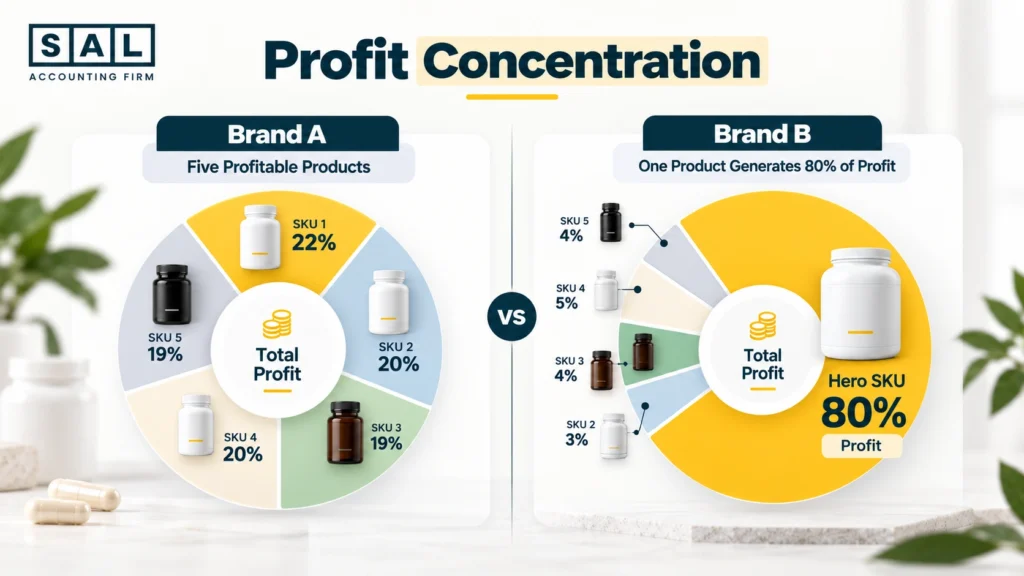
How Concentrated Is the Brand’s Profit Across Its Products?
This section isn’t about calculating profit per SKU. It’s about one question: how much of the business rests on one product? Ask yourself:
- Does one hero SKU produce most of the brand’s earnings?
- Would losing that product change the business in a big way?
- Do several SKUs bring in meaningful sales and profit?
- Does growth depend on launching new products again and again?
- Are weak products tying up inventory without adding much?
Say one brand has five products that each earn real money. Another brand gets 80% of its profit from one product. If a competitor copies that one product, or its main ingredient doubles in price, the second brand feels it far more.
There’s no single “safe” percentage. But the more your profit leans on one product, the more a buyer will ask what happens if that product slips.
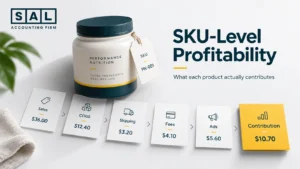
To see which products actually earn their keep, our guide to SKU-level profitability for supplement brands walks through it.
- Also read: “The Ecommerce Product Profitability Test”
How Much of the Inventory Is Genuinely Valuable to a Buyer?
The inventory number on your balance sheet is not the whole answer. A buyer may look at:
- How old the stock is
- How much shelf life is left
- How fast it sells
- Excess stock beyond normal demand
- Slow-moving batches
- Damaged or unsellable units
- Stock stuck in weak SKUs
- Production already ordered but not yet sold
Here’s the simple contrast. $250,000 of inventory on the balance sheet is not the same as $250,000 of inventory that sells steadily and has plenty of shelf life left.
The table below shows how the same dollar amount can mean very different things.
| Inventory Type | What a Buyer Sees | Risk Level | Question They’ll Ask |
|---|---|---|---|
| Fresh, fast-selling stock | Cash that comes back soon | Low | Is demand steady? |
| Slow-moving batches | Cash stuck for months | Medium | Will it sell at full price? |
| Near-expiry stock | Stock that may need discounts or disposal | High | How much time is left? |
| Stock in weak SKUs | Money in products that barely earn | Medium to high | Why keep making it? |
| Committed but unsold production | Future inventory already paid for | Varies | Will demand be there when it lands? |
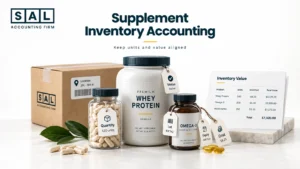
How inventory is valued in your books is a separate topic, covered in our guide to supplement inventory accounting. Costing methods like FIFO vs weighted average belong there too. Here, the question is simpler: how useful is this stock to whoever owns the business next?
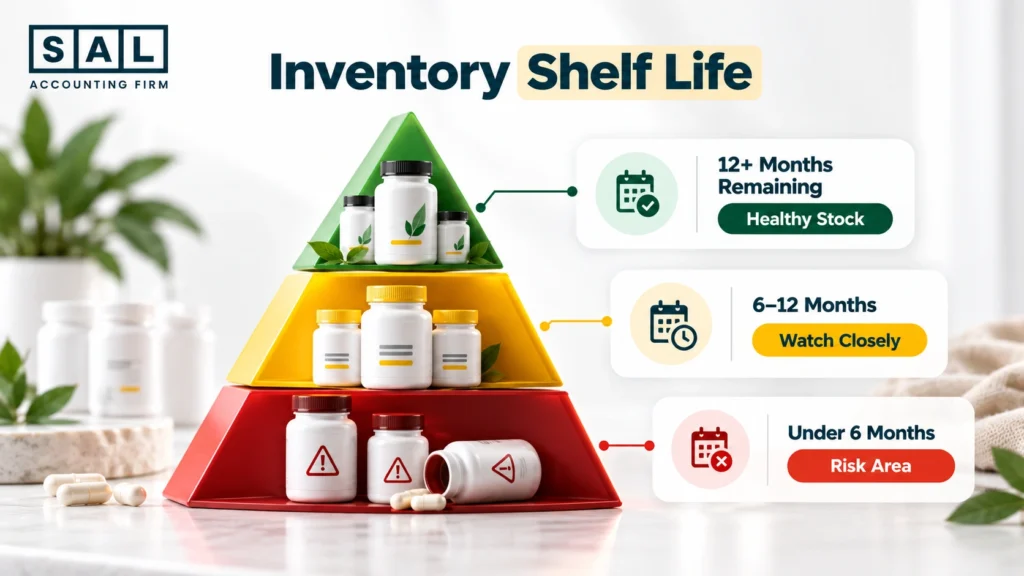
How Do Expiry Dates Change the Quality of a Supplement Brand’s Inventory?
Expiry is what makes supplement inventory different from most ecommerce stock. A t-shirt can sit for a year. A bottle of probiotics can’t.
In Canada, the Natural Health Products Regulations require the label to show a lot number and expiry date. So every unit on your shelf has a clock on it. Questions worth asking:
- How much stock is getting close to expiry?
- Is the aging stock concentrated in certain SKUs?
- Is there enough shelf life left to sell it normally?
- Will older stock need discounts to clear?
- Does expired stock keep showing up, which may point to weak purchasing or forecasting?
- Is new production arriving before old batches have sold?
The point isn’t how to record expired stock in your books. It’s how much confidence anyone can place in inventory that may have little time left to sell at a normal margin.
Pro Tip: Track inventory by lot and expiry month, not just by SKU. Good inventory software for supplement brands can show you exactly how much stock expires in the next 3, 6, and 12 months.
Case Study: How Tyler’s Probiotic Brand in Leaside, Toronto Finds Out What Its Inventory Is Really Worth1
Tyler runs a probiotic and gut-health brand from a small unit in Leaside, Toronto. He sells on Shopify and Amazon, and his balance sheet shows about $220,000 of inventory. He’s been approached by a larger brand about a possible partnership. He feels good about the numbers, especially the inventory, which he thinks of as money in the bank.
The Problem
Tyler has never looked at his stock by expiry date. He orders large batches to get a better unit price. But his slower SKUs sell at about half the pace of his bestsellers, so older lots keep piling up. He doesn’t know how much of that $220,000 can actually sell at full price before it expires.
What We Do
We break his inventory down by SKU, lot, and expiry month. We compare each lot’s remaining shelf life with how fast that SKU actually sells. That shows which stock will sell normally, which will likely need discounts, and which is at risk of expiring. This kind of inventory review is part of the monthly work our ecommerce bookkeeping team in Toronto does for product brands.
The Result
Tyler sees that about a third of his inventory expires within six months, and most of it sits in two slow SKUs. He cuts the batch size on those SKUs and runs a planned clearance on the oldest lots. When the partnership talks continue, he can explain his inventory with real numbers instead of one balance sheet total.
Do Customers Keep Coming Back?
Now the focus moves from what the business owns to who keeps buying.
Repeat purchases make demand easier to predict. They also mean the brand doesn’t have to keep paying to replace every customer it loses.
For a supplement business, look at:
- Repeat purchase rate
- How often customers reorder
- Customer groups by the month they first bought
- Share of customers on subscriptions
- Repeat orders that happen without heavy discounts
- Whether repeat behaviour is getting stronger or weaker
Here’s the most useful question. Are customers coming back because they want the product, or because the brand keeps buying the next sale with a discount code?
A brand where 40% of customers reorder at full price looks very different from one where 40% reorder only after a 30%-off email. The repeat rate is the same. The quality isn’t.
Tracking this over time is easier with regular financial reports for supplement businesses that split first orders from repeat orders.
Does Subscription Revenue Make the Brand More Predictable?
It can. But having a subscribe button doesn’t make demand durable. Look at:
- How much revenue comes from active subscriptions
- Whether subscribers stay subscribed
- How heavily subscriptions are discounted
- Whether subscriptions depend on one SKU
- Whether subscribers keep ordering on schedule
Recurring billing is not the same as durable recurring demand. A subscription base that cancels after two orders, or only stays because of a deep discount, adds less predictability than it seems.
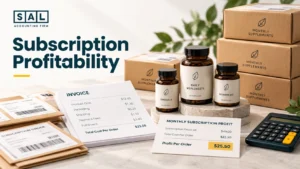
Whether each subscriber actually pays back what it cost to win them is covered in our guide to online supplement subscription profitability. How to record subscription revenue in your books is a separate topic, covered in our guide to subscription accounting for supplement brands.
How Stable Are the Brand’s Margins?
A buyer cares about today’s margin. But they care just as much about how easily that margin could change. For supplement brands, pressure can come from:
- Ingredient prices
- Co-packer pricing
- Packaging
- Freight and duties
- Fulfilment
- Marketplace fees
- Promotional discounts
Imports add two more. CBSA notes that duties and GST can apply at the time of importation. And if you pay a US manufacturer, the Bank of Canada’s daily exchange rates show how much a weaker Canadian dollar can raise your cost per unit.
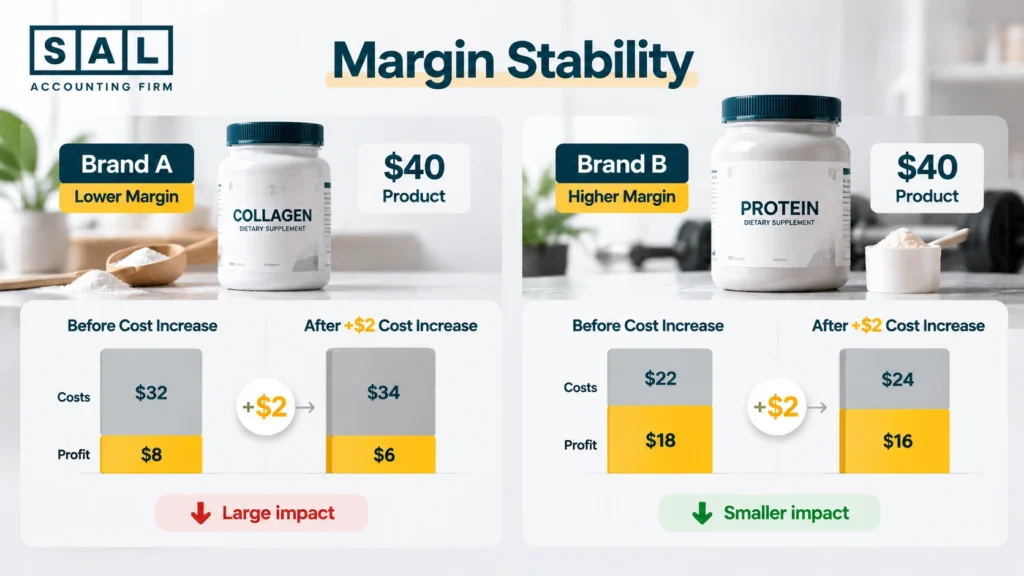
Here’s a simple example. A brand keeps $8 on a $40 product. If its manufacturer raises the unit cost by $2, a quarter of its profit on that product disappears. A brand keeping $18 on the same product would feel it much less.
Another useful question: has the brand held its earnings because the economics are stable, or because price increases and promotions have covered rising costs for now?
Platform costs are part of this too. Plug your selling price into the Shopify Fee Calculator and see how much each order keeps. The wider effect of Shopify fees on profit margins is covered separately, as is which costs belong in COGS for supplement brands.
How Much Cash Does the Brand Need to Keep Growing?
This is a value factor most “earnings” articles skip. Supplement brands often need a lot of cash before products earn anything, because of:
- Manufacturing deposits
- Minimum order quantities
- Long production lead times
- Large batch sizes
- Packaging commitments
- Inventory held before it sells
Here’s the contrast:
- Brand A earns $300,000 but needs another $400,000 tied up in inventory to keep growing.
- Brand B earns $300,000 with far less cash tied up in stock.
The earnings are equal. The cash needed to keep them going is not. A buyer of Brand A has to fund that $400,000 on top of the purchase price.
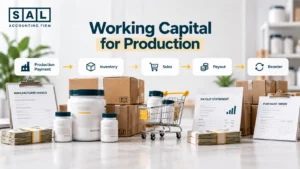
How much cash your production cycle ties up is covered step by step in our guide to working capital for online supplement businesses.
How Dependent Is the Brand on Its Co-Packer and Suppliers?
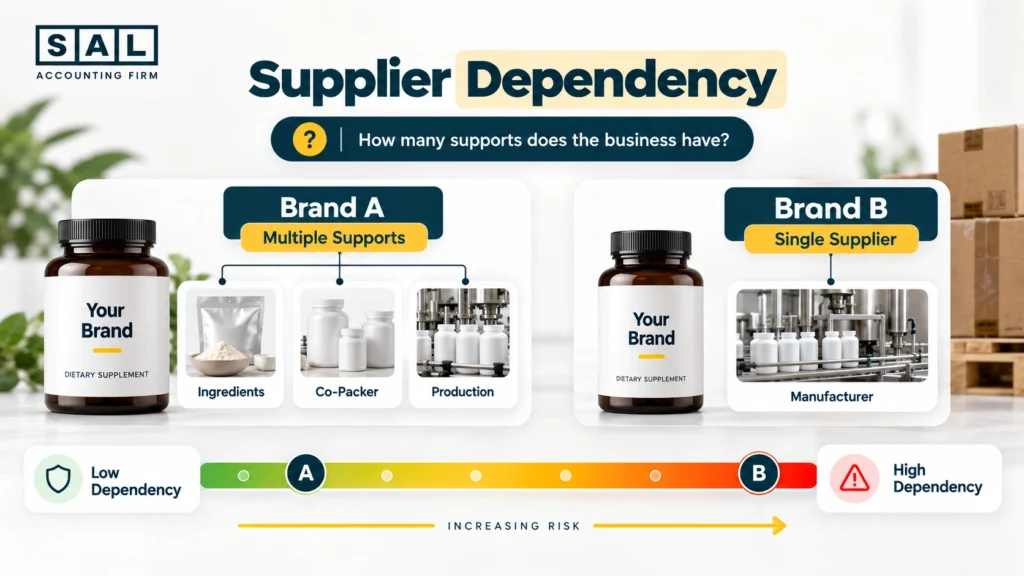
For many supplement brands, one manufacturer makes almost everything. That’s normal early on. It’s also a real risk. Consider:
- One co-packer making most products
- Whether another manufacturer could step in
- How many key ingredient suppliers there are
- Lead times and MOQs
- How exposed the brand is to price increases
- Who owns or controls the formulas
- What happens if the relationship changes
There’s a regulatory layer too. Health Canada requires that companies that manufacture, package, label, or import natural health products hold site licences. So switching manufacturers isn’t just about finding someone cheaper. The new partner needs the right licences as well.
The question to ask: if your current manufacturer stopped making your bestselling SKU tomorrow, how hard would it be to keep selling?
Does the Brand Depend Too Heavily on One Sales or Acquisition Channel?
Product concentration is one risk. Channel concentration is another. A supplement brand may lean heavily on:
- Meta ads
- Amazon
- Shopify or direct-to-consumer sales
- One influencer
- One wholesale customer
- One affiliate
The question is simple. What happens to earnings if the biggest source of customers gets more expensive, or disappears?
A brand with 85% of sales from Meta ads could see its profit shrink fast if ad costs rise. A brand with sales spread across Shopify, Amazon, email, and wholesale is more resilient.
Getting a clean view of each channel is its own job, covered in multichannel accounting for supplement brands. And if your ad platform and your store never agree, here’s why Meta, Shopify, and Triple Whale numbers don’t match.
Case Study: How Kayla’s Greens Brand in Erin Mills, Mississauga Maps Its Concentration Risk2
Kayla sells a daily greens powder and two smaller products from a warehouse unit in Erin Mills, Mississauga. Her brand earns about the same as a competitor she knows well, and she assumes that means the two businesses are about equal. She’s thinking about bringing in an investor next year.
The Problem
When she looks closer, one greens SKU brings in about 75% of her profit. One co-packer makes it, and about 80% of new customers come from Meta ads. Her competitor sells five products through three channels and uses two manufacturers. The earnings match, but Kayla’s business rests on far fewer supports.
What We Do
We map her profit by product, sales by channel, and production by supplier on a single page. For each one, we ask what would happen to earnings if that support weakened. That turns a general worry into a clear list of which risks are biggest.
The Result
Kayla starts qualifying a second licensed manufacturer for her hero SKU, and she launches on Amazon to reduce her reliance on Meta. Her earnings don’t change overnight. But when she talks to investors, she can show where the risks are and what she’s already doing about them.
How Can Regulatory and Product-Licensing Risk Affect a Supplement Brand?
This is where Canadian supplement brands differ from most ecommerce businesses.
Natural health products sold in Canada need a product licence and a Natural Product Number (NPN). Anyone can check a product in Health Canada’s Licensed Natural Health Products Database. The database shows the licence holder and whether the licence is active, suspended, or cancelled. From a value point of view, ask:
- Are the products licensed for sale?
- Who holds each licence: the brand, or someone else?
- Does the brand depend on licences or arrangements controlled by a third party?
- Do product labels and marketing claims match what was licensed?
- Could a regulatory issue stop the sale of a major SKU?
The second question surprises many founders. If your co-packer holds the product licence for your bestseller, your brand may depend on a relationship it doesn’t fully control.
Product claims also affect more than licensing. The same label wording can change how a product is taxed, which is covered in our guide to GST/HST for online supplement stores.
The point is, regulatory continuity protects future earnings. A gap here can put a whole product line at risk.
What Makes Earnings More Transferable to a New Owner?
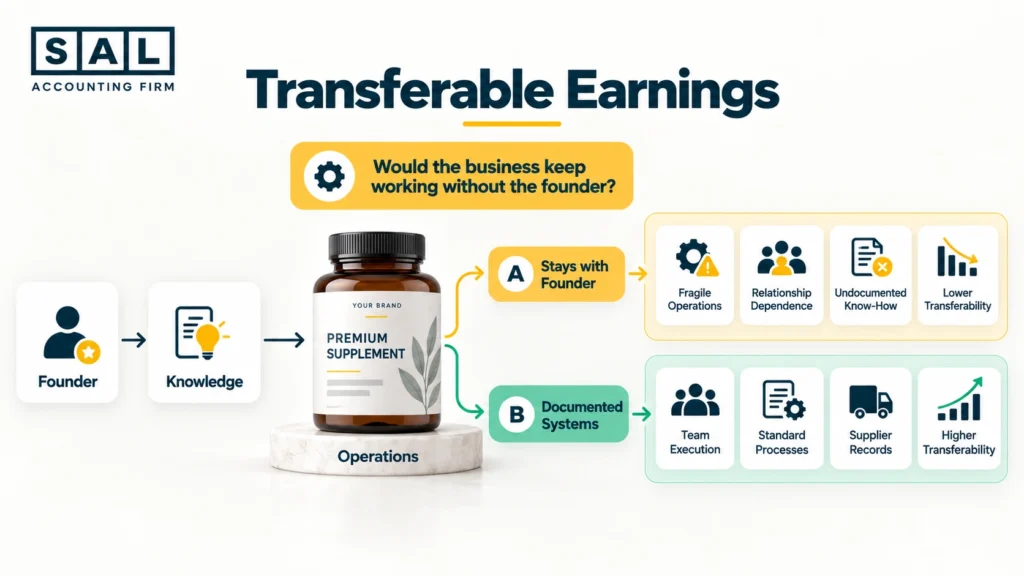
Would similar earnings continue if someone else owned the business? Earnings may be less transferable when they rely heavily on:
- The founder’s personal relationships
- Content the founder creates and appears in
- One person’s knowledge of suppliers
- Formulation or manufacturing decisions that were never written down
- One person running ads or operations alone
Take a brand where the founder is the face of every video, holds every supplier relationship, and runs all the ads. A buyer has to ask how much of the business walks out the door when the founder does.
How to document and hand over a business is a separate topic, covered in our sale-preparation guide. The question here is only whether the earnings would survive the change.
Pro Tip: Ask yourself one question each quarter: “If I took three months off, what would stop working?” The answer shows where your earnings depend on you.
What Can Make the Same $300,000 of Earnings Look Very Different?
Here’s everything together. Two brands, the same $300,000 of annual earnings.
| Factor | Brand A | Brand B | Why It Matters |
|---|---|---|---|
| Products | Several profitable SKUs | One hero SKU | Losing one product hurts B far more |
| Margins | Consistent | Rising costs, heavy discounts | B’s profit is easier to erode |
| Inventory | Healthy shelf life | Older stock near expiry | B’s stock may not sell at full price |
| Repeat orders | Strong, at full price | Weak, discount-driven | A’s demand is easier to predict |
| Cash to grow | Manageable production needs | Big cash need every run | B needs more money to keep going |
| Channels | More than one source | One ad channel | B is exposed to ad cost changes |
| Suppliers | Stable, with options | One co-packer | B’s supply is more fragile |
| Founder role | Limited dependence | Founder runs everything | B’s earnings are harder to transfer |
Neither brand has a price on it here, and this isn’t a valuation. The point is that the same earnings number can carry very different levels of durability, cash need, and risk.
- Read more: “Why Your Supplement Brand’s Profit Looks Wrong”
At the end of the day, buyers don’t just ask how much a brand earns. They ask how likely it is to keep earning it.