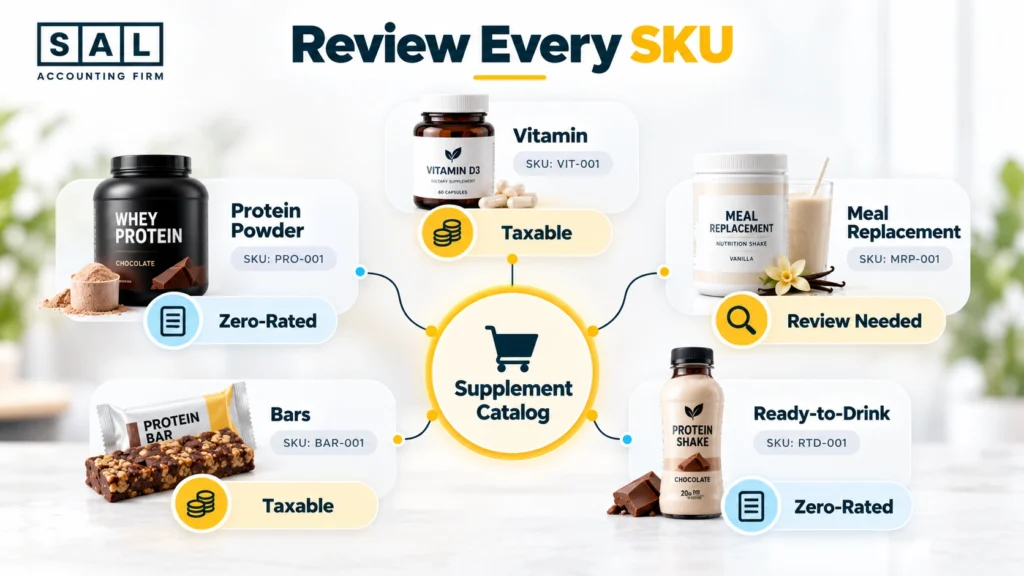
Do you charge GST/HST on vitamins, protein powder, and meal replacements? It depends on the product, not the name in your store. CRA treats products sold as dietary supplements, including vitamins and most protein powders, as taxable.
Meal replacements that meet federal food rules are usually zero-rated. Product-level tax reviews like this are core work for SAL Accounting with Canadian supplement brands. Stay with us, because one wrong setting repeats on every order that SKU ever gets.
Wrong tax on a product changes more than one invoice. Run your numbers through the GST/HST Refund Calculator and see where your balance stands.
Quick Takeaways
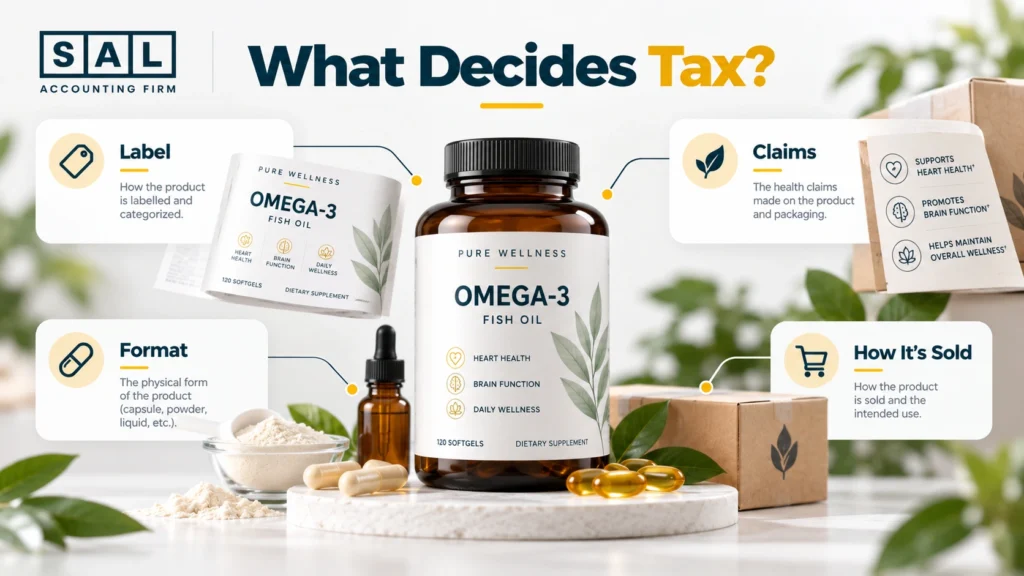
- GST/HST treatment follows the product itself: its label, claims, format, and how you sell it.
- CRA generally treats vitamins, minerals, and protein powders sold as supplements as taxable.
- Meal replacements that meet the Food and Drug Regulations are generally zero-rated.
- Two products with the same main ingredient can get different treatment.
- A change to a label, claim, or format should trigger a fresh tax review.
- Keep a written note of why each product is treated the way it is.
Why Is GST/HST Classification Complicated for Supplement Products?
Picture two tubs on your Shopify store. Both say “protein” in big letters. One is a whey isolate with a scoop, a daily dose, and a line about muscle recovery. The other is a meal replacement shake with a full nutrition panel, sold to replace breakfast. To a shopper, they look like cousins. For GST/HST, they can land in different places.
Here’s what’s actually happening. In Canada, most “basic groceries” are zero-rated, which means tax at 0%. Dietary supplements are not basic groceries, so they’re generally taxable. Supplement stores sell a lot of products that sit right on that line:
- Foods
- Beverages
- Dietary supplements
- Meal replacements
- Nutritional products
So the question isn’t “what did we call it in Shopify?” It’s “what is this product, based on how it’s made, labelled, and sold?” The things that can matter include:
- Ingredients and formulation
- Packaging and format
- Label wording
- Product claims
- Directions and dosage
- How you market it
Keep in mind, this article is only about classification: deciding whether a product is taxable or zero-rated. Charging tax at all depends on being registered, which our guide on what happens when an ecommerce seller isn’t registered for GST/HST explains. Filing and wider rules are covered in our breakdown of GST/HST compliance for ecommerce stores.
This is the simple version. Quebec, BC, Manitoba, and Saskatchewan also have provincial sales taxes with their own rules, which are part of the wider types of taxes an ecommerce business deals with.
The point is, similar-looking products don’t always get similar tax treatment.
Are Vitamins Sold Through an Online Supplement Store Subject to GST/HST?
In most cases, yes. CRA’s info sheet on products commonly described as dietary supplements names vitamins and minerals as examples of dietary supplements. It says these are not basic groceries, so registrants charge GST/HST on them.
Why? Basically, CRA looks at why people buy a product. Food is eaten because you’re hungry, thirsty, or enjoy it. Vitamins are taken for a health or wellness effect. Format is a big clue. CRA lists forms that are not commonly linked with food, including:
- Tablets and capsules
- Gels
- Liquids in dropper bottles
- Powders and concentrates
Label details point the same way. A dose (“take 1 capsule daily”), a warning (“not for children”), or a Natural Product Number (NPN) all suggest a supplement.
Now, don’t jump to “every vitamin product is always taxable.” A food that has vitamins added, like a fortified cereal, is still a food. The question is what the product is, not whether it contains vitamins.
At the end of the day, a vitamin sold as a capsule or tablet with a dose and an NPN will usually be taxable. Anything unusual deserves a closer look at the label and marketing.
Is Protein Powder Subject to GST/HST?
This is where a lot of supplement founders get stuck.
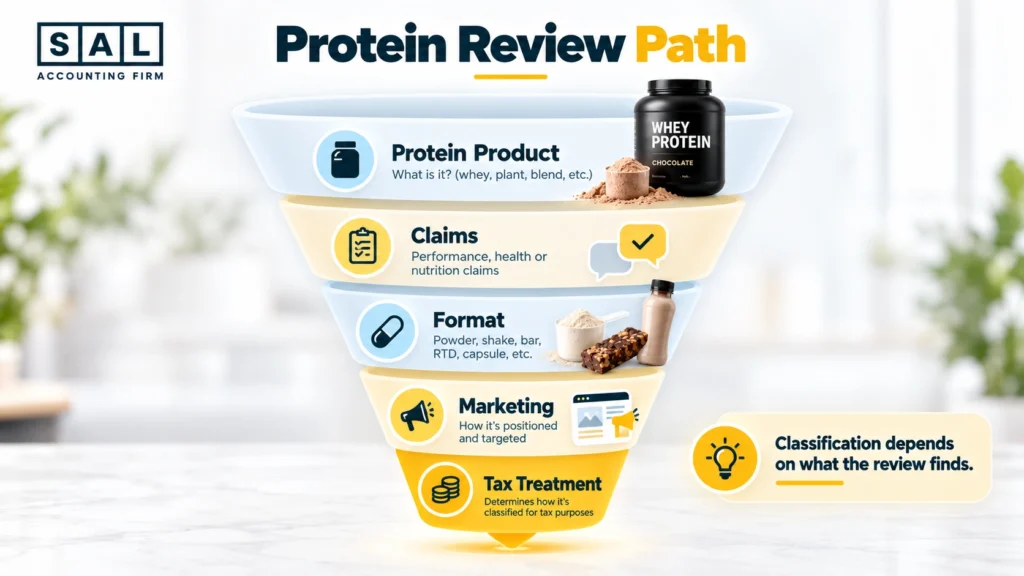
CRA lists protein powders by name as an example of a dietary supplement. So a protein powder sold as a supplement is generally taxable. But protein products are tricky, because some are sold and labelled like food.
CRA’s factors help sort this out. A protein product leans toward “supplement” when the label or marketing:
- Calls it a “supplement” or “dietary supplement”
- Claims it builds muscle, boosts performance, or improves physique
- Highlights a special nutrient, like whey protein isolate (CRA uses this exact example)
- Gives a serving dose and how often to take it
- Focuses on the benefits of taking it
It can lean toward food when it’s sold, labelled, and used like a regular grocery item. It can also be zero-rated if it truly qualifies as a meal replacement, which is covered in the next section.
Here’s a simple example. A 2 lb whey isolate tub with “Build lean muscle” on the front and a scoop guide on the back looks like a supplement. A protein pancake mix labelled as a breakfast food, with a full nutrition panel and cooking directions, looks much more like a food.
Technically, even a small wording change can move a protein product between categories. That’s why accounting for an online supplement business starts with knowing exactly what each SKU is.
Pro Tip: Read your label the way CRA would. Ignore your internal product name. Look only at what the customer sees: the front of the pack, the claims, the directions, and your product page.
How Are Meal Replacements Treated for GST/HST?
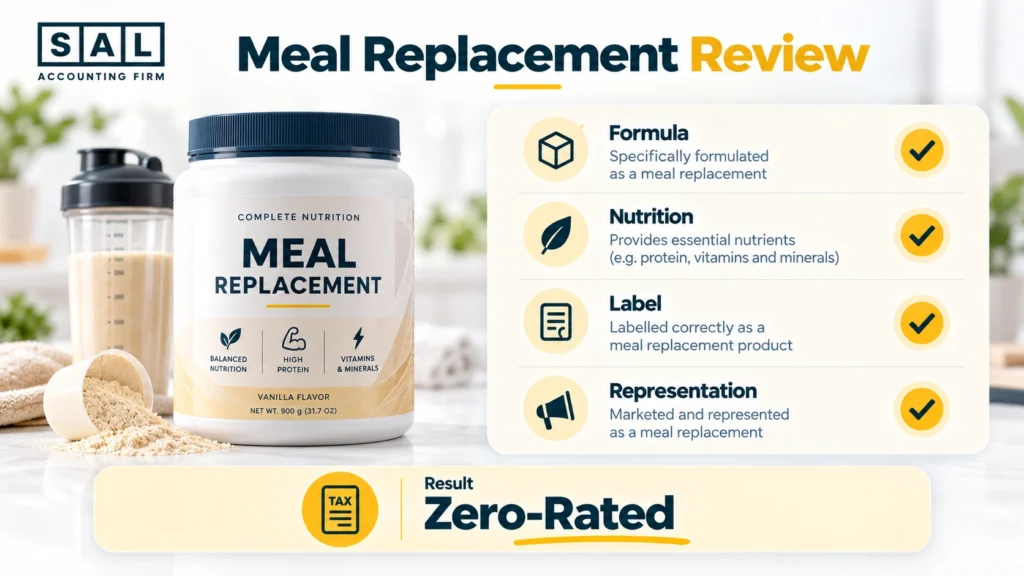
Meal replacements get their own rule. CRA says products labelled as a “meal replacement” or “nutritional supplement” that meet the requirements of the Food and Drugs Act and Regulations count as basic groceries. That means they’re generally zero-rated.
The key words are “that meet the requirements.” Writing “meal replacement” on your website isn’t enough.
The Food and Drug Regulations set out what a meal replacement must provide, including a minimum amount of energy per serving and set levels of nutrients. The product also has to be labelled and represented as a meal replacement. So a meal replacement review usually checks:
- Formulation: does it meet the nutrient and energy requirements?
- Nutritional purpose: is it built to replace a meal, not to boost performance?
- Labelling: does the label present it as a meal replacement?
- Representation: does your marketing match the label?
Here’s where it gets confusing. A shake can meet the meal replacement rules, but if the brand then markets it mainly as a muscle-building supplement, the picture can change. Label and marketing need to tell the same story.
The point is, a meal replacement can be zero-rated, but only when the product actually qualifies and is sold that way.
What Product Information Should a Supplement Seller Review Before Applying GST/HST?
This is the most practical part. Before you set a tax rule for any SKU, gather four types of information.
Product Label
Look at:
- Product name
- Ingredients
- Directions and dosage
- Nutrition facts or medicinal ingredient panel
- Claims and warnings
Product Format
Examples:
- Capsules and tablets
- Powders
- Liquids
- Bars
- Ready-to-drink products
Bars deserve a special mention. CRA has separate guidance on bars, and many snack-type bars, like granola, fruit, and nut bars, are taxable even when they’re food.
Product Representation
How is your business presenting the product? As a:
- Dietary supplement
- Meal replacement
- Food
- Beverage
Check your product page, ads, emails, and packaging, not just the label.
Supporting Documentation
Keep what backs up your decision: label files, the NPN if there is one, and your notes.
The table below shows how CRA’s factors play out across common supplement products.
| Product | Often Points to Taxable | Often Points to Zero-Rated | What to Check First |
|---|---|---|---|
| Vitamins and minerals | Capsules, tablets, dose, NPN | Rare; fortified foods are different | Format, NPN, directions |
| Protein powder | “Supplement,” muscle claims, isolate focus | Sold and labelled like a food | Label claims, marketing |
| Meal replacement shake | Performance or physique claims | Meets Food and Drug Regulations and labelled as meal replacement | Nutrient panel, label wording |
| Bars | Snack bars; supplement claims | Qualifying meal replacement bars | Bar type, label, claims |
| Ready-to-drink | Benefit claims, dosage, warnings | Sold as a regular beverage or qualifying meal replacement | Label, how it’s sold |
The core point: tax treatment follows the product itself, not the category you picked inside your store.
How Should Supplement Brands Manage GST/HST Across Their Product Catalog?
One product is easy. Two hundred SKUs across flavours and sizes is where mistakes creep in. Now, the goal is consistency. The same kind of product should get the same treatment every time. A simple system looks like this:
- Create tax categories: for example, “Taxable: supplement” and “Zero-rated: meal replacement.”
- Review new products before launch: decide the category before the first order ships.
- Record each decision: one line per SKU explaining why.
- Update your store settings after the review: not before.
- Recheck when a product changes: formulation, packaging, or claims.
Shopify, for example, applies default Canadian rates unless you tell it otherwise. Its help centre explains how to set up product tax overrides using a manual collection when the default rate doesn’t apply. The settings side is covered in our Shopify GST/HST tax guide. The part this article cares about comes first: getting the classification right before anything goes into settings.
Selling on more than one channel? Each platform needs the same decision applied, which is one reason multichannel accounting for supplement brands takes extra care.
Case Study: How Graham’s Supplement Store in Roncesvalles, Toronto Sorts Out Its Tax Categories1
Graham runs an online supplement store from a small studio in Roncesvalles, in Toronto’s west end. He sells about 90 SKUs on Shopify: vitamins, a whey isolate line, a greens powder, and a high-protein pancake mix he added last spring. When he set up the store, he left Shopify’s default settings on, so HST applies to everything. Then a customer emails to ask why she’s paying HST on a pancake mix she’d buy tax-free at the grocery store.
The Problem
Every product gets the same treatment, no matter what it is. The vitamins and whey isolate look like supplements and are likely taxable. But the pancake mix is labelled and sold as a breakfast food, with cooking directions and a full nutrition panel. It may well be a zero-rated basic grocery. Graham has no record of how any product was classified, because none of them ever were.
What We Do
We go through the catalog SKU by SKU against CRA’s dietary supplement factors: label, claims, format, dosage, and marketing. We sort every product into a small set of tax categories and write one line explaining each decision. Then Graham updates his Shopify overrides to match, and we work out how to deal with tax already collected on the pancake mix. It’s the kind of product-level cleanup our ecommerce bookkeeping team in Toronto handles alongside the monthly books.
The Result
Graham now has a one-page tax map for his whole catalog. New products go through the same check before launch. The customer gets her answer, and Graham knows why every product is charged the way it is.
What Happens If a Supplement Seller Applies the Wrong GST/HST Treatment?
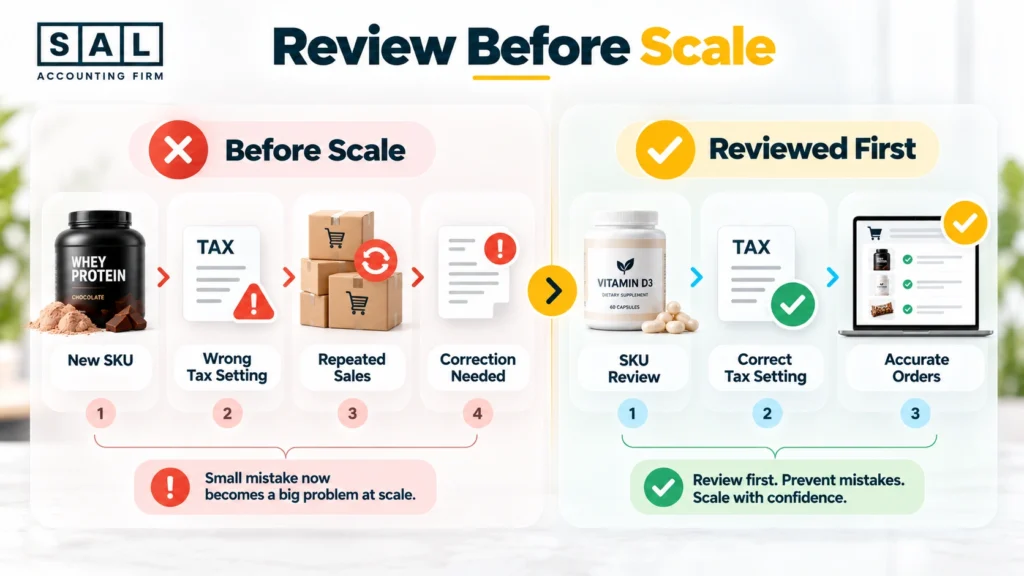
A classification mistake doesn’t happen once. It repeats on every sale of that SKU until someone catches it.
Undercharging Tax
This is when you treat a taxable product as zero-rated.
- The tax you should have collected is generally still owed.
- You often can’t go back and collect it from customers.
- Fixing it means adjustments, and interest can apply.
Say you sell 3,000 units of a $50 protein powder at 0% when it should carry 13% HST in Ontario. That’s about $19,500 of tax that may come out of your own pocket.
Overcharging Tax
This is when you charge tax on a zero-rated product.
- Customers pay more than they should.
- Tax you collect, even by mistake, generally has to be sent to CRA or refunded to the customer.
- Your records need correcting.
Corrections usually show up in your next GST/HST return. Wrong classifications can also draw questions if CRA reviews your file, which our guide to CRA audits for ecommerce sellers covers. And if you ever sell the business, a buyer will look closely at sales tax risk.
A lot of store owners only find these issues months later. It’s a common mistake, not a sign you did something reckless.
- Also read: “Ecommerce Accounting Mistakes”
The key message: review tax treatment before a product sells at scale, not after.
What Product Changes Should Trigger a GST/HST Review?
Tax treatment follows the product. So when the product changes, the treatment might too. The table below shows the changes that should send a SKU back for review.
| Change | Why It Can Shift Treatment | Example | What to Do |
|---|---|---|---|
| New product launch | No decision made yet | New collagen powder | Classify before first sale |
| Ingredient or formula change | Can change nutrient profile | Meal replacement drops below requirements | Recheck against rules |
| New packaging or format | Format is a CRA factor | Powder becomes capsules | Review label and format |
| New claims | Claims point toward supplement | “Now builds muscle” added | Recheck representation |
| Powder to ready-to-drink | New format, new label | Shake sold in cans | Treat as a new product |
| Bundles | Mix of taxable and zero-rated items | Vitamin + meal replacement kit | Review the bundle as sold |
| Subscription version | New listing and settings | Monthly auto-ship SKU | Confirm same category carries over |
| New sales channel | New platform settings | Launch on Amazon | Apply the same decision there |
Subscriptions are an easy one to miss. The product inside the box drives the tax, not the fact that it’s a subscription. How you record those recurring orders is covered in our guide to subscription accounting for supplement brands. Keep in mind, the rate itself also depends on where the customer lives, which is why out-of-province sales tax is its own topic.
Case Study: How Nicole’s Shake Brand in Streetsville, Mississauga Catches a Label Change Before Launch2
Nicole runs a meal replacement shake brand from a shared warehouse near Streetsville in Mississauga. Her original chocolate shake is labelled as a meal replacement and has been set to 0% in her store since day one. This fall, her marketing team wants to reposition the line for gym-goers. The new label says “Performance Protein Supplement,” adds claims about muscle recovery, and swaps the meal replacement panel for a scoop-per-workout guide.
The Problem
The new label changes the story. Calling it a “supplement,” adding performance claims, and giving workout dosing are all CRA factors that point toward a dietary supplement. But her store still has the 0% override from the old version. When the new packaging hits the site, every order will likely go out with no tax when it should be taxable.
What We Do
We compare the new label against CRA’s dietary supplement factors and the meal replacement requirements. We flag that the repositioned product likely no longer qualifies for zero-rating. Nicole’s team then chooses: keep the meal replacement positioning, or launch the new version as a taxable supplement with the right settings from day one.
The Result
Nicole launches the performance version as a separate, taxable SKU and keeps the original meal replacement at 0%. Because the review happens before launch, there are no past orders to fix. Her team now sends every label change to a tax check before it goes to the printer.
Pro Tip: Add “tax review” as a step in your label approval process. Marketing changes a claim. Tax treatment can change with it.
How Should Supplement Sellers Document GST/HST Classification Decisions?
Think of this as your “why” file. If someone asks why a product is taxed a certain way, you should be able to answer in two minutes. Useful records include:
- Product labels (keep every version, with dates)
- Ingredient lists
- Product descriptions and marketing copy
- Classification notes: which factors you weighed
- The tax treatment you applied, and when
- Professional advice or a CRA ruling, where you have one
A simple spreadsheet works: one row per SKU, with the category, the date, and one or two lines of reasoning.
For products that are truly borderline, CRA’s own guidance says a ruling should be requested for certainty. It takes time, but it gives you something firm to rely on.
This file also helps when people change. A new bookkeeper, or moving your records to a new accountant, goes much smoother when the reasoning is written down. It’s also one less thing to scramble for when you prepare your ecommerce business for tax season.
- Read more: “Ecommerce Bookkeeping Checklist”
At the end of the day, good documentation turns a tax decision into something you can explain and defend.
Final Thought: Does Your Supplement Catalog Have the Right GST/HST on Every SKU?
Vitamins, protein powders, and meal replacements can look similar on your store. For GST/HST, they often aren’t. The label, claims, format, and how you sell each product decide the treatment, not the category name.
Check each SKU against CRA’s factors. Write down why. Review it again whenever the product changes. Do that, and one wrong setting won’t quietly repeat across thousands of orders.
Ready to put the rest of your numbers in order too? Start with our growth blueprint for Canadian Shopify brands.