
Preparing your Shopify business for sale means making its profit, inventory, operations, and risks easy for a buyer to verify. Strong revenue may attract interest, but unclear books or founder-dependent systems can lower the offer or stall the deal.
This guide shows Canadian Shopify founders what to clean up, document, value, and transfer before due diligence begins. Read it before listing, because the issues uncovered late are usually the ones that cost the most.
Before discussing a price, calculate your ecommerce EBITDA to get a clearer view of the operating profit a buyer may examine.
Quick Answer: How Do You Prepare a Shopify Business for Sale?
To prepare a Shopify business for sale:
- Reconcile Shopify sales, payouts, refunds, fees, and bank deposits.
- Confirm inventory quantities, landed costs, and COGS.
- Calculate a supportable normalized profit.
- Organize financial, tax, legal, and operational records.
- Reduce the store’s dependence on the founder.
- Confirm that contracts, accounts, domains, and intellectual property can transfer.
- Plan for Canadian tax and privacy requirements before closing.
Basically, the buyer should be able to understand the business without you sitting beside them explaining every number.
If your Shopify dashboard, payouts, and accounting reports still tell different stories, prepare your financials for buyer review.
What Makes a Shopify Business Ready for Sale?
A buyer isn’t only purchasing a Shopify website. They may also be acquiring inventory, supplier relationships, customer demand, brand assets, operating systems, marketing accounts, and future cash flow.
| Area | Buyer’s main question | What to prepare | Main warning sign |
|---|---|---|---|
| Financials | Is the profit real? | Reconciled reports | Shopify and the books disagree |
| Inventory | What stock is included? | Count, cost, and aging records | Stock is old or overstated |
| Operations | Can the store run without you? | SOPs and assigned roles | Founder controls every task |
| Growth | Where do customers come from? | Channel and retention reports | One channel drives most sales |
| Transfer | Can the assets move? | Contracts and account plan | Consent or ownership is unclear |
Good sales create interest. Clear evidence keeps the buyer moving forward.
1. Decide What You Are Actually Selling
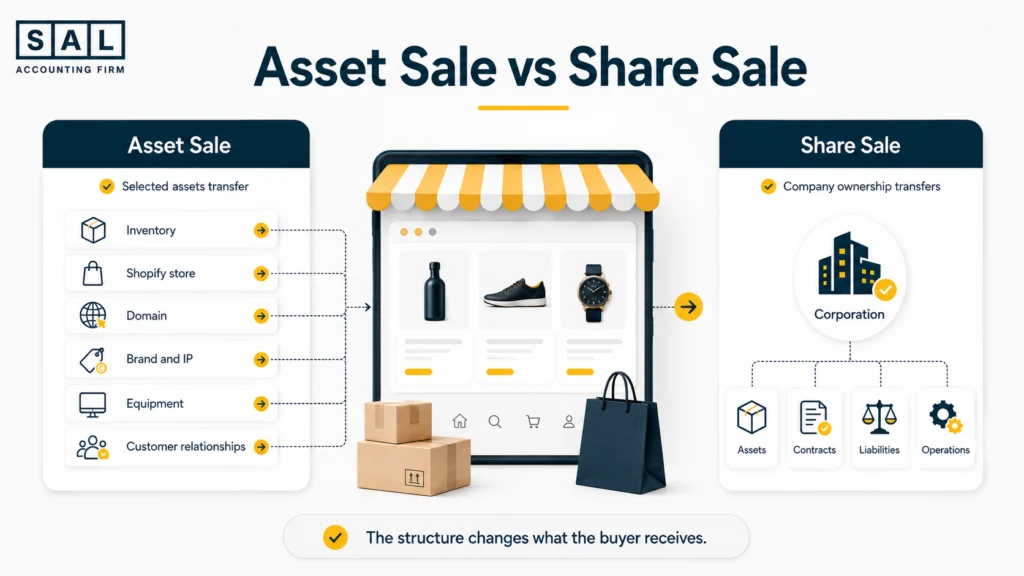
A Shopify business can be sold in different ways. In an asset sale, the buyer purchases selected assets, such as:
- Inventory
- The Shopify store and domain
- Brand names and trademarks
- Product designs and photography
- Supplier and customer relationships
- Equipment and operating systems
- Goodwill
In a share sale, the buyer purchases shares of the corporation that owns the business. The corporation generally continues to own its assets and carry its liabilities.
A founder may also sell one brand, product line, or part of a larger ecommerce operation.
The structure affects what the buyer receives, which liabilities stay behind, how the price is allocated, and how the transaction may be taxed. CRA distinguishes between the purchase of business assets and corporate shares, so the structure should be reviewed before accepting an offer. (CRA guidance)
Do not focus only on the headline offer. Work backwards from what you may keep after:
- Taxes
- Debt repayments
- Broker fees
- Legal and accounting costs
- Working-capital adjustments
- Holdbacks or earnouts
Pro tip: Ask your accountant to model more than one deal structure. Two offers with the same purchase price can produce very different after-tax results.
2. Clean Up Your Shopify Financial Records
Not sure whether a buyer could recreate your profit calculation? That is where preparation should begin.
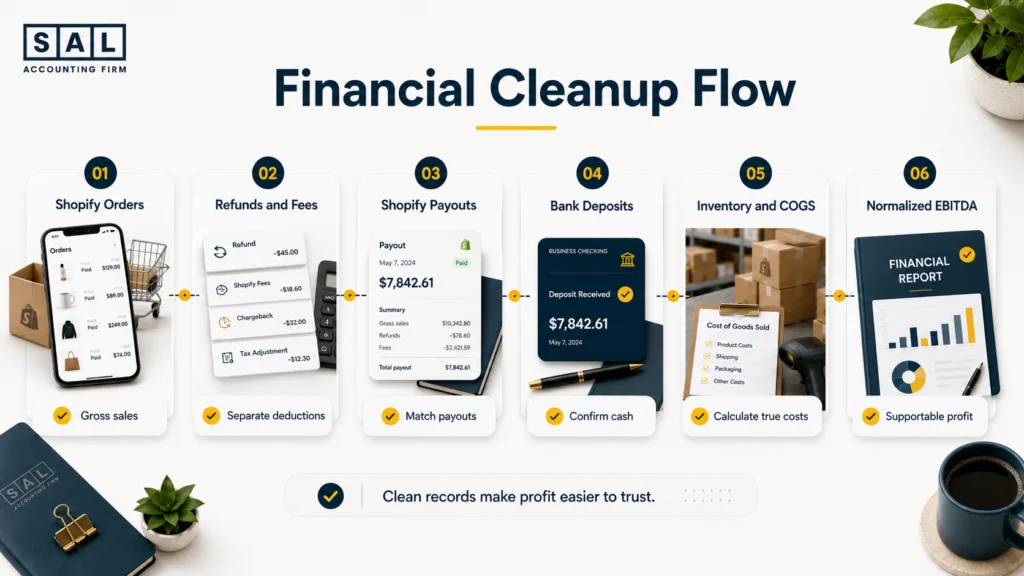
Reconcile Sales, Payouts, and Bank Deposits
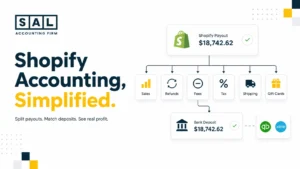
A Shopify payout is not your total revenue. It is the amount transferred after different parts of the store’s activity have been deducted or adjusted.
For example, one month may show:
- Gross Shopify sales: $86,400
- Refunds: $3,250
- Payment fees: $2,410
- Taxes and other adjustments: $6,740
- Amount deposited: $74,000
If the $74,000 deposit is recorded as sales, the books lose visibility over $12,400 of refunds, fees, taxes, and adjustments. Your records should show the full trail:
Shopify orders → payment activity → payouts → bank deposits
Any difference should have a short, clear explanation.
- Also read: “How Shopify Payment Reconciliation Works”
Pro tip: Reconcile Shopify every month. Rebuilding two years of payout activity after a buyer submits an offer is slower, more expensive, and much more stressful.
See how much platform pricing affects your margins: Check your Shopify fees.
Confirm Inventory and COGS
Inventory is the stock the business still owns. Cost of goods sold, or COGS, is the cost of the stock customers have already purchased. Let’s say the business purchased 5,000 units for $20 each and sold 3,500.
The supplier was paid $100,000, but only $70,000 belongs in COGS. The remaining $30,000 should stay on the balance sheet as inventory. Recording the full supplier payment as an expense would:
- Make profit look $30,000 lower
- Remove 1,500 units from the balance sheet
- Create a difference between the books and the stock the buyer receives
Before listing the business, confirm:
- Physical quantities match the SKU report.
- Major products use accurate landed costs.
- Damaged products are separated.
- Slow-moving inventory is clearly identified.
- The final inventory value agrees with the balance sheet.
Keep in mind that landed costs may include freight, duty, brokerage, insurance, and receiving costs, not only the supplier’s invoice price.
Pro tip: Prepare a simple inventory aging report. Group stock into current, slow-moving, damaged, and obsolete inventory so the buyer can see what is genuinely saleable.
Calculate a Supportable Normalized Profit
Buyers may look at normalized profit or EBITDA rather than relying only on the reported net income.
The calculation may remove expenses that are personal, unusual, or unlikely to continue after the sale. Possible examples include:
- A one-time legal dispute
- A discontinued product launch
- Personal expenses paid through the company
- Above-market owner compensation
- A non-recurring consulting project
That does not mean every inconvenient expense becomes an add-back.
Regular payroll, software, advertising, fulfilment, and professional fees are usually ongoing business costs. Removing them without a strong reason makes the profit calculation harder to trust.
Each adjustment should have an invoice, payroll record, contract, or written explanation behind it.
Case Study: How Maya in Liberty Village Prepared Her Shopify Financials for Buyer Review1
Maya operates a Shopify home-goods brand from Liberty Village, Toronto. The store generates approximately $1.05 million in annual sales, and she plans to sell it before starting another business. Her Shopify dashboard looks healthy, but deposits are recorded as revenue. Refunds, payment fees, inventory purchases, and foreign-currency adjustments are mixed together.
The Problem
Her financial statements show $182,000 in annual profit, but a potential buyer cannot connect that figure to Shopify sales, payout reports, or bank deposits. Inventory is also recorded when suppliers are paid rather than when products are sold.
What We Do
We reconcile sales through to cash, separate refunds and fees, rebuild the inventory calculation, and review every proposed profit adjustment. Monthly reports then show exactly how the final operating profit was calculated.
Result
The normalized profit is $151,000 rather than $182,000. The number is lower, but it is supportable. The buyer can trace the activity without repeatedly asking why Shopify, the bank, and the books disagree.
3. Improve the Business Before You List It
Preparing for a sale is not only about correcting old records. You may still have time to make the business stronger. Start with the issues that affect repeatable profit:
- Remove unused or overlapping Shopify apps.
- Review products with weak contribution margins.
- Renegotiate supplier or fulfilment costs.
- Reduce unnecessary discounting.
- Clear damaged and obsolete inventory.
- Track repeat purchases and customer retention.
- Reduce dependence on one product or advertising campaign.
A store with steady profit and several reliable sales channels will usually be easier to explain than one built around a single viral product.
Do not stop investing in the business just to make the last few months look more profitable. Cutting necessary inventory, advertising, staff, or customer support may improve short-term cash while damaging the performance the buyer is evaluating.
Pro tip: Focus on profit quality, not a final burst of revenue. Heavy discounts may increase sales while lowering margins and attracting customers who never return.
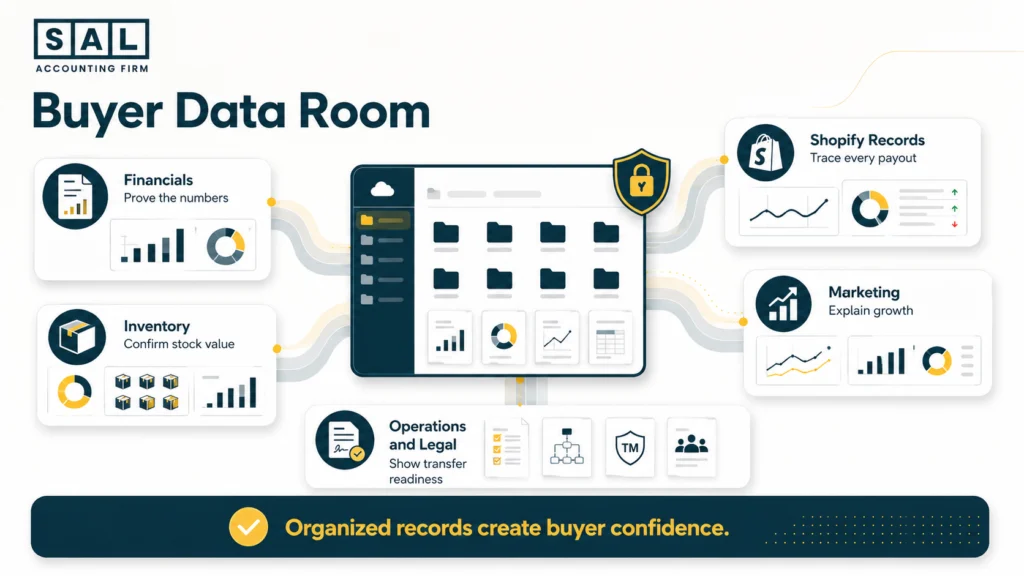
4. Build a Simple Buyer Data Room
A data room is an organized collection of the records a serious buyer will review during due diligence. Create clear folders for:
Financial records
- Monthly profit and loss statements
- Balance sheets
- Tax returns
- Bank and credit-card statements
- Shopify payout reconciliations
Inventory and suppliers
- Current inventory count
- SKU-level landed costs
- Inventory aging
- Supplier terms and contact information
- Purchase commitments
Marketing and customers
- Advertising spend by channel
- Traffic and conversion reports
- Customer acquisition costs
- Repeat-purchase data
- Email and subscriber metrics
Operations and legal records
- Standard operating procedures
- Staff and contractor responsibilities
- App and software list
- Material contracts
- Intellectual property records
- Known disputes or claims
Not sure what records are missing? Build your ecommerce document list.
Do not give the complete data room to every person who expresses interest. Start with summarized or anonymized information. Release sensitive customer, supplier, employee, and account details only after the buyer is qualified and confidentiality terms are in place.
Clear file names also matter. A buyer should understand what 2026-05-Shopify-Payout-Reconciliation.xlsx contains without opening five similar files.
When your books need more than a final tidy-up, organize your ecommerce records before due diligence.
- Also read: “How to Read Ecommerce Financial Statements”
5. Prepare for Buyer Due Diligence
Due diligence is where the buyer checks whether the business matches what has been presented. Expect questions about:
- Why Shopify revenue differs from bank deposits
- Whether tax returns agree with the financial statements
- How inventory was counted and valued
- Which products create the most profit
- How much sales depend on paid advertising
- Whether customers purchase more than once
- Whether one supplier controls a key product
- Which liabilities remain after closing
- Whether contracts and accounts can transfer
- What will happen when the founder leaves
Do not hide a known weakness and hope the buyer misses it.
If one supplier manufactures your bestselling product, explain the contract, lead time, backup options, and what happens if prices increase. If one Meta campaign drives most of the store’s revenue, show the historical performance and what other channels are being developed.
A clear risk with a sensible plan is normally easier to discuss than a surprise discovered halfway through the transaction.
See which states may need attention: Check your US economic nexus.
Check US Sales-Tax Exposure
Canadian Shopify businesses selling into the United States may need to review state-level economic nexus exposure before a sale.
A buyer may ask whether the store has crossed registration thresholds, where sales tax is being collected, and whether previous filings are complete.
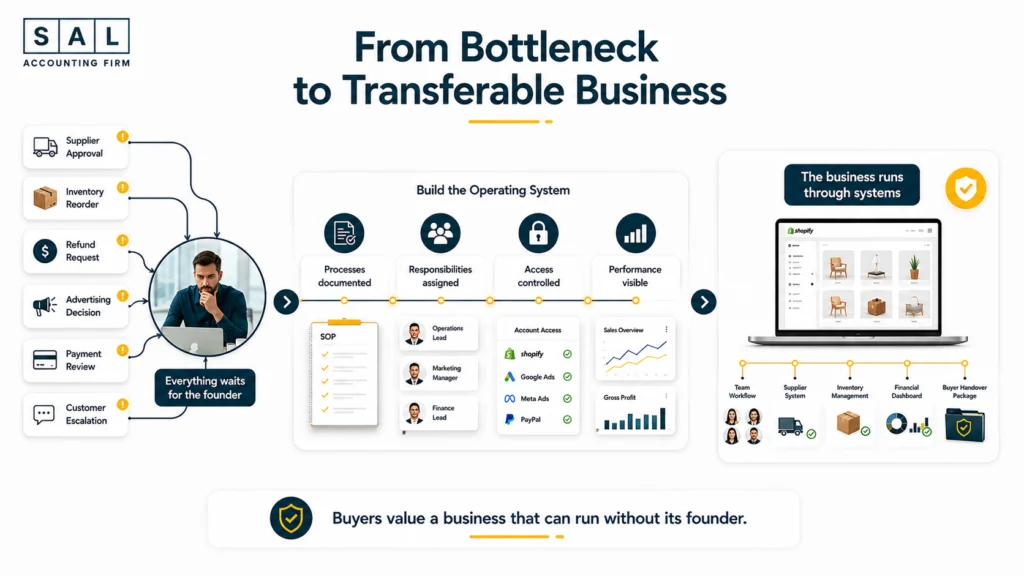
6. Make the Store Less Dependent on You
A buyer may hesitate if the business stops functioning whenever the founder steps away. Start with the tasks you still control personally:
- Approving inventory orders
- Speaking with key suppliers
- Changing advertising budgets
- Issuing large refunds
- Reviewing cash flow
- Resolving fulfilment problems
- Completing month-end reporting
For each task, document:
- Who is responsible
- When it happens
- Which system is used
- What approval is required
- What happens when something goes wrong
Then ask someone else to follow the process without your help. Any procedure that still ends with “ask the founder” needs more detail.
Reducing founder dependence does not mean leaving the business immediately. It means showing that the store has systems the buyer can continue using after the handover.
Case Study: How Daniel in Port Credit Made His Shopify Store Easier to Transfer2
Daniel runs a Shopify pet-accessories brand from Port Credit, Mississauga. The store generates approximately $720,000 in annual sales, but Daniel still approves orders, manages suppliers, adjusts advertising, and handles fulfilment problems himself.
The Problem
A potential buyer likes the business but worries that performance will decline after Daniel leaves. Passwords are stored in different places, supplier terms are informal, and no one else understands the inventory reorder process.
What We Do
We map the connected accounts, document the main workflows, assign team responsibilities, and organize supplier and 3PL information. We also prepare a handover schedule showing which accounts need consent, updated billing details, or new ownership information.
Result
Within ten weeks, Daniel’s routine involvement falls from more than 30 hours per week to approximately eight. The buyer receives an operating manual and transition plan instead of a business that depends entirely on the founder.
7. Confirm What Can Actually Transfer
Do not assume every account, contract, or digital asset automatically moves to the buyer. Review the transfer position for:
- Shopify store ownership
- Domain names and DNS access
- Business email accounts
- Shopify Payments and other gateways
- Advertising accounts
- Google Analytics and Search Console
- Social media profiles
- Email-marketing software
- Review platforms
- Supplier and 3PL accounts
- Accounting software
- Cloud storage
- Product photography and custom code
- Trademarks and other brand assets
Some accounts can be transferred. Others require the buyer to create a new account and move the data or settings.
Shopify says only the current store owner can initiate an ownership transfer. Its preparation guidance also recommends reviewing inventory, domains, billing, payouts, permissions, contracts, retained records, and third-party obligations before the transfer is completed. Review the full Shopify ownership-transfer checklist before closing.
Do not transfer ownership during early discussions. Complete the legal agreement, due diligence, payment arrangements, and closing conditions first.
Pro tip: Create one handover spreadsheet listing each account, its current owner, billing method, recovery email, two-factor authentication method, transfer requirement, and completion date.
8. Plan for Canadian Tax, Privacy, and Legal Requirements
The advertised sale price is not automatically what you keep. Before signing, review:
- Asset sale versus share sale
- Purchase-price allocation
- Inventory included in the transaction
- Goodwill and intellectual property
- Capital gains
- Debt repayments
- GST/HST treatment
- Working-capital adjustments
- Holdbacks and earnouts
- Professional and brokerage fees
For qualifying asset transactions, the buyer and seller may be able to make a joint GST/HST election when the purchaser acquires at least 90% of the property reasonably necessary to continue the business. The buyer normally files Form GST44 by the applicable return deadline.
Review your current sales-tax position: Estimate your GST/HST balance.
Customer information also needs careful handling. Under PIPEDA’s business-transaction rules, personal information may be disclosed during a prospective transaction only when it is necessary and the parties have an agreement governing its use, protection, and return or destruction if the transaction does not proceed.
Do not place a full customer export in an unrestricted folder simply because a buyer asked for it.
Your accountant and lawyer should review the structure, tax consequences, confidentiality process, intellectual property, representations, warranties, and closing documents before you sign.
9. Follow a Focused Sale-Preparation Timeline
| Timing | Main focus | Key work | Ready when |
|---|---|---|---|
| Days 1–30 | Financial cleanup | Reconcile sales, cash, tax, and inventory | Major gaps are identified |
| Days 31–60 | Operations | Document processes and reduce founder tasks | Team can handle daily work |
| Days 61–75 | Buyer records | Complete data room and profit support | Due diligence files are organized |
| Days 76–90 | Transfer planning | Review accounts, contracts, and handover | The business is ready to market |
Some Shopify businesses need longer. If the books are behind, inventory is unclear, tax filings are incomplete, or the founder controls every decision, six to twelve months of preparation may produce a stronger outcome.
- Read more: “The Shopify Month-End Close Checklist”

Common Mistakes When Preparing a Shopify Business for Sale
Avoid these common problems:
- Waiting for an offer before cleaning the books
- Recording Shopify payouts as total revenue
- Claiming unsupported profit add-backs
- Valuing obsolete inventory at full cost
- Sharing customer information too early
- Hiding tax notices or supplier disputes
- Assuming every contract transfers automatically
- Giving the buyer owner access before closing
- Reducing essential spending to inflate short-term profit
- Accepting an offer without calculating the after-tax result
Transparency does not mean giving unrestricted access to everything. It means presenting accurate information through a controlled and organized process.