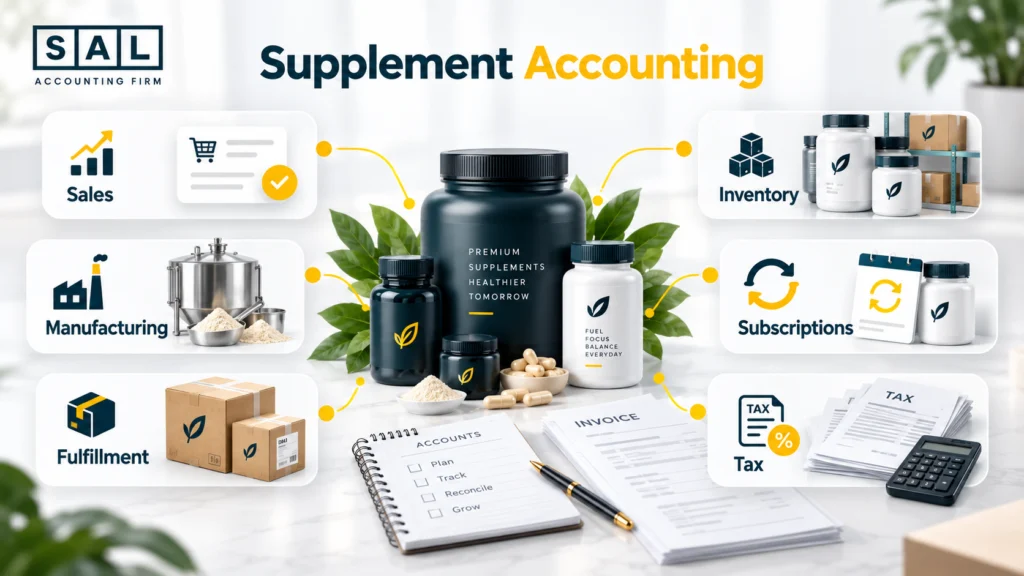
Online supplement business accounting needs to track more than sales and expenses. Inventory, manufacturing deposits, expiry dates, subscriptions, platform fees, tax, and product costs all affect what the business actually keeps.
SAL Accounting works with ecommerce brands where those numbers need to tie together, not sit in separate reports. Miss one of the areas below, and your next reorder, pricing decision, or growth push could be based on profit that isn’t really there.
See what the business is actually earning with the Ecommerce EBITDA Calculator
Quick Takeaways
- Track gross sales separately from Shopify, Amazon, and payment processor payouts.
- Keep inventory costs accurate, including manufacturing, packaging, freight, and other direct costs.
- Track expiry dates, damaged stock, samples, and unsellable inventory.
- Keep manufacturing deposits and upcoming supplier payments visible.
- Separate marketplace fees, fulfillment costs, refunds, discounts, and sales tax from revenue.
- Review product profitability and available cash every month—not just total company profit.
Why Is Supplement Ecommerce Accounting Different?
A supplement store has many of the same accounting issues as other ecommerce businesses, but inventory adds another layer.
Production may be paid for weeks or months before the finished batch is ready. Packaging, freight, duties, testing, subscriptions, 3PL charges, samples, marketplace fees, refunds, and advertising can then hit different systems at different times.
Expiry dates make inventory more sensitive too. For natural health products, lot and expiry information are part of Health Canada’s current labelling requirements. For the exact requirements, see the Health Canada labelling guidance. Here’s where the biggest accounting differences usually appear:
| Area | What Happens | What Needs Tracking | Common Blind Spot |
|---|---|---|---|
| Sales | Multiple channels and payouts | Sales, refunds, fees, tax | Deposit treated as revenue |
| Inventory | Batches age differently | Units, cost, lot, expiry | Old stock stays at full value |
| Production | Cash leaves before stock arrives | Deposits, balances, freight | Payment expensed too early |
| Subscriptions | Orders repeat automatically | Discounts, refunds, failures | Gross recurring sales mislead |
| Fulfillment | Several providers charge fees | Storage, pick-pack, shipping | Costs buried together |
| Tax | Collected with customer payments | Tax collected and payable | Tax mixed into sales |
This is why a supplement brand’s profit can look wrong even when the P&L itself looks tidy.
Once sales, inventory, production costs, and payouts stop fitting into a basic bookkeeping setup, SAL’s ecommerce accounting and bookkeeping brings those moving pieces into the same monthly process.
Where Do Online Supplement Businesses Lose Visibility in Their Numbers?
A common warning sign is that Shopify, the P&L, and the bank seem to be describing three different businesses.
Say the store records $60,000 in sales. Less than $60,000 may reach the bank after refunds, fees, tax, adjustments, and payout timing. That difference is normal. Recording the bank deposit itself as revenue is where the numbers start going wrong. Other gaps look like this:
- Freight is paid separately and never reaches product cost.
- Expiring stock stays buried in total inventory.
- Samples leave the warehouse but stay in the inventory report.
- Manufacturer deposits are mixed with normal expenses.
- Amazon or 3PL costs disappear into large expense accounts.
- Subscription discounts and refunds are hard to see.
- Total profit is available, but SKU-level profit is not.
For supplement stores, reconciling revenue against payouts is often one of the first places to look when sales and bank deposits stop making sense.
What Should Supplement Bookkeeping Track Each Month?
Good supplement bookkeeping should answer five basic questions: what sold, what each product actually cost, what inventory still has value, what cash is already committed, and what remains after the costs of selling.
Track Sales Separately From Payouts
Start with gross sales, not the deposit. Product sales, shipping income, discounts, refunds, chargebacks, sales tax, processor fees, marketplace fees, and net payouts should remain identifiable.
Example: $50,000 in Shopify sales and a $44,000 deposit do not mean $6,000 disappeared. Refunds and payout timing alone can move activity between settlements; Shopify explains how that works in its Shopify Payments refund guidance.
The point is simple: the books should explain the $6,000 rather than calling $44,000 revenue.
That same principle sits behind good ecommerce reconciliation practices. Every difference should have somewhere to go.
Track Supplement Inventory Properly
Knowing there are 8,000 bottles in a warehouse is not enough. Depending on the setup, inventory records should identify:
- Units purchased and sold
- Units remaining
- Warehouse or fulfillment location
- Lot or batch
- Expiry date
- Damaged units
- Unsellable units
- Stock held at Amazon or a 3PL
CRA’s current inventory and COGS guidance covers how inventory feeds into cost of goods sold and income. The practical takeaway for a supplement brand is that the warehouse report and accounting balance should not live separate lives.
When costs change between production runs, FIFO versus weighted-average costing also affects how those costs eventually reach COGS.
Pro Tip: Compare accounting inventory with the warehouse report monthly. A 500-unit difference is much easier to investigate now than ten months later.
Know What Actually Belongs in Supplement COGS
The manufacturer’s price per bottle is rarely the whole product cost. Say production costs $12 per unit. Add $1.10 of packaging, $0.90 of inbound freight, and $0.50 of directly attributable prep. The product is already costing $14.50 before it reaches the customer. Here’s the distinction to keep clear:
| Cost | Usually Relates To | Inventory/COGS? | Common Issue | Review |
|---|---|---|---|---|
| Manufacturing | Product production | Usually | Old unit cost used | Each run |
| Packaging/labels | Finished product | Often | Left in supplies | Each run |
| Freight/duties | Bringing stock in | Often | Expensed separately | Each shipment |
| Production testing | Specific production | Depends | Automatically classified | Each run |
| Advertising | Selling | No | Mixed into COGS | Monthly |
| Platform fees | Sales channel | No | Added to product cost | Monthly |
The biggest gap is often the landed cost. When freight, duties, packaging, and prep sit outside the manufacturer’s invoice, inventory landed cost accounting keeps those costs from quietly disappearing.
Testing needs more judgment. Batch-specific testing may be treated differently from broader compliance or business-level costs, so it should not automatically be pushed into COGS.
- Read more: “How to Calculate COGS for Ecommerce Stores”

Track Manufacturing Deposits and Production Payments
This is where a profitable supplement business can still get squeezed for cash. Imagine the next production run costs $60,000:
- $30,000 deposit now
- $20,000 before completion
- $6,000 freight
- $4,000 duties and other inbound costs
The cash starts leaving well before those products generate sales.
A manufacturing deposit should not automatically be pushed straight into COGS because it was paid. The treatment depends on what the payment represents and when the related inventory or service is received. Capitalizing versus expensing ecommerce inventory costs becomes especially important when production crosses accounting periods.
Track Expired, Damaged, and Promotional Inventory
Inventory does not stay equally valuable forever. Supplement bookkeeping should identify products that expire, become damaged, can no longer be sold, go out as samples, are sent to influencers, or are used in promotions.
Basically, a bottle that can no longer be sold should not stay buried inside the same inventory total as fresh stock. Free samples matter too. If 300 units leave the warehouse for a launch campaign, both the inventory system and the books need to know those units are gone.
Case Study: How Emma in Leslieville Finds Which Supplement Is Actually Worth Reordering1
Emma runs a collagen and wellness supplement brand from Leslieville, Toronto. She sells five main SKUs through Shopify, with subscriptions making up a growing share of revenue. Her accounting shows about $96,000 of inventory, and her manufacturer is asking for a $52,000 deposit for the next production run. Based on the books, reordering the same quantities looks reasonable.
The Problem
The inventory total is there, but it is not telling Emma enough. Around $21,000 at cost belongs to slower-moving batches with less shelf life remaining, while increases in freight and packaging from the last two production runs were never added to the latest unit costs.
One SKU appears to cost $12.80 per unit in the books. Once the current packaging and inbound freight are included, the updated cost is closer to $15.10. The product looks much more profitable on paper than it really is.
What We Do
We break inventory down by SKU and batch, compare stock on hand with recent sell-through, and separate older inventory from the products that are actually moving. Then we rebuild the current landed cost using the latest manufacturing, packaging, freight, and directly related costs.
The next reorder is reviewed against:
- Units already on hand
- How quickly each batch is selling
- Current margin by SKU
- Cash required for the next production run
Result
One product that appeared to have a margin near 39% is closer to 27% using the updated cost. Another SKU produces less revenue but has a stronger margin and faster sell-through.
Emma reduces the slower SKU, puts more of the next order into the better-performing product, and works through the older batch first.

Separate Marketplace and Fulfillment Costs
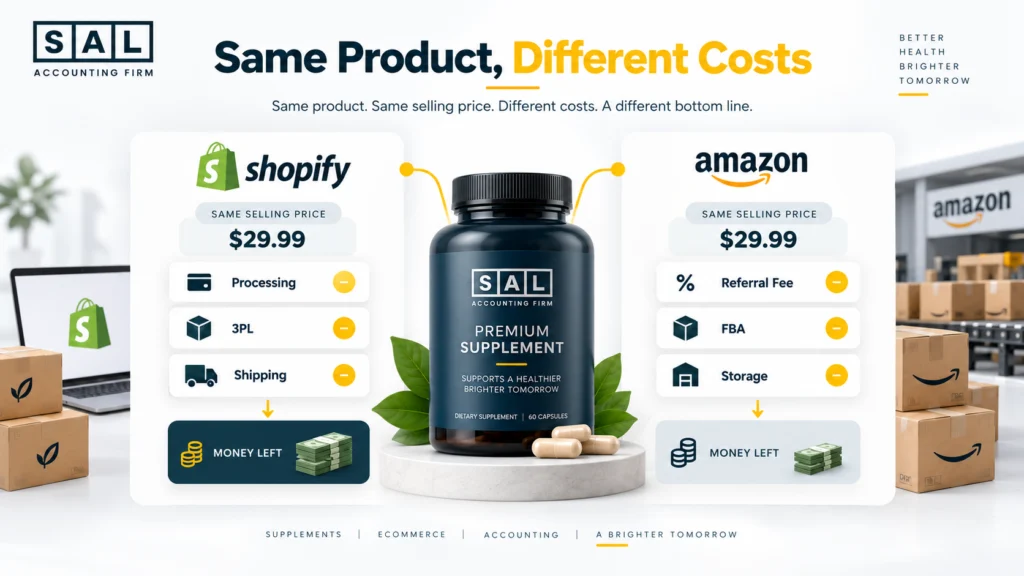
Gross margin only tells part of the story. A Shopify order can still carry payment processing, 3PL pick-and-pack, storage, shipping, and return costs before the business sees what it actually keeps.
Those costs should stay visible instead of disappearing into one fulfillment or marketplace expense. This is especially important when comparing channels because the same product can produce very different margins on Shopify and Amazon.
For Shopify sellers, platform fees can have a noticeable impact on ecommerce profit margins, particularly as order volume grows.
Pro Tip: Compare fulfillment and selling costs by channel, not just in total. A product that works well on Shopify may leave much less behind on Amazon after FBA and marketplace fees.
Want to put the Shopify side into numbers? Use the Shopify Fee Calculator.
Track Subscription Sales, Discounts, Refunds, and Cancellations
Recurring revenue can look strong while the amount the business actually keeps is moving in the opposite direction. For supplement subscriptions, keep these pieces separate:
- Successful recurring charges
- Subscription discounts
- Failed payments
- Skipped orders
- Cancellations
- Refunds
- Chargebacks
Let’s say a brand reports $40,000 in recurring billings, but $5,000 is lost through discounts, failed payments, cancellations, and refunds. The $40,000 still matters, but it does not tell the full story.
Subscription revenue should show both what customers were billed and what the business actually kept.
Track Marketing Spend by Channel
One large “advertising” account works until the founder needs to know which products or channels are actually worth putting more money into.
When the spend is meaningful, separate major channels such as Meta, Google, TikTok, Amazon Ads, affiliates, and influencers. That gives the accounting enough detail to compare sales with the costs required to generate them.
For example, two supplements may each have a 60% gross margin. But if one requires $18 in advertising to produce a sale while the other requires $7, their economics are very different.
That is why ecommerce contribution margin becomes more useful than gross margin alone once acquisition and fulfillment costs start getting significant.
The useful question is not just “Which product sells more?” It is “Which product leaves more behind after the costs required to sell it?”
Track Sales Tax Separately From Revenue
GST/HST collected from customers is not ordinary sales revenue. It is money collected on behalf of the government, so it needs to stay separate in the books.
For Canadian supplement businesses, the first thing to understand is whether and when GST/HST registration is required. CRA explains the current $30,000 small-supplier threshold and timing rules in its GST/HST registration guidance. Once registered, the books should clearly separate:
- Tax collected from customers
- GST/HST payable
- Eligible recoverable tax
- Amounts already remitted
- Remaining tax balances
This is where GST/HST accounting for ecommerce stores becomes important, especially when sales are coming through several provinces or platforms.
- Also read: “US Sales Tax Requirements for Canadian Sellers”
Reconcile Shopify, Amazon, Payment Processors, and the Bank
At month-end, every major sales channel should eventually tie through to the books and bank. The reconciliation should explain:
- Gross sales
- Discounts
- Refunds
- Sales tax
- Processing fees
- Marketplace fees
- Chargebacks
- Adjustments
- Net payouts
- Bank deposits
The goal is not to make Shopify sales equal the bank. The goal is to explain exactly why they do not.
Keep Manufacturer and Supplier Balances Accurate
A large bank balance can be misleading when much of it already belongs somewhere else. Imagine the account shows $120,000, but the business also has:
- $55,000 manufacturer balance
- $18,000 freight and duties coming
- $16,000 reserved for tax
- $12,000 of unpaid operating bills
Suddenly, $120,000 looks very different. Deposits paid, balances owing, due dates, and supplier terms should stay current so committed cash does not get mistaken for money available for another reorder.
Track Product-Level Profitability
Company profit tells you whether the business made money overall. It does not tell you which supplement deserves the next production run.
A useful SKU view brings together product revenue, COGS, discounts, refunds, fulfillment, selling fees, and relevant acquisition costs.
A bestseller can still leave less behind than a smaller product with better margins and fewer returns. SKU profitability analysis is far more useful for reinvestment decisions than simply ranking products by revenue.
What Should Month-End Bookkeeping Look Like for a Supplement Business?
Month-end is where all of those moving pieces get pulled together while the activity is still recent enough to explain. A useful close should include:
- Reconcile banks and credit cards.
- Reconcile Shopify, Amazon, and processor payouts.
- Review refunds and chargebacks.
- Update inventory quantities.
- Identify expired, damaged, sampled, or unsellable units.
- Update product costs when they change.
- Review manufacturer and supplier balances.
- Reconcile sales tax.
- Review significant marketing spend.
- Compare SKU margins.
- Check upcoming production and cash commitments.
A consistent ecommerce bookkeeping checklist is much easier to manage than discovering several months of problems at year-end.
Pro Tip: Close the month before approving the next large production run. Reordering from a three-month-old margin is still guessing.
Which Financial Reports Should an Online Supplement Business Review?
The P&L matters, but it is not enough by itself.
| Report | Key Numbers | Main Question | Review | Red Flag |
|---|---|---|---|---|
| Profit & Loss | Sales, COGS, expenses | Are we profitable? | Monthly | Margin moves unexplained |
| Balance Sheet | Cash, inventory, payables | What do we own and owe? | Monthly | Inventory keeps rising |
| Cash Flow | Cash in and out | Where is cash going? | Monthly | Reorders create surprises |
| Inventory Report | Units, age, expiry | What is saleable? | Monthly | Old batches stay high |
| SKU Profitability | Margin by product | What deserves cash? | Monthly/quarterly | Bestseller earns little |
Good ecommerce management reporting should answer those questions without making the founder dig through pages of accounting detail.
Case Study: How Daniel in Port Credit Finds His Real Available Cash Before Hiring2
Daniel runs a sports nutrition brand from Port Credit, Mississauga. The business sells through Shopify and Amazon, uses a 3PL, and generates about $130,000 in monthly sales. With $110,000 in the bank, Daniel is considering a larger inventory order and another employee.
The Problem
Shopify and Amazon deposits are not fully reconciled, some sales tax is mixed into revenue, and the books do not clearly show the manufacturer balance due next month. The company is profitable, but the $110,000 bank balance gives Daniel the wrong idea about what is actually available.
What We Do
We separate sales tax and fulfillment costs, reconcile platform payouts, bring supplier balances into the monthly close, and add a simple schedule of upcoming cash commitments beside the financial reports.
Result
Daniel can see that $64,000 is already committed to manufacturing, about $21,000 is reserved for tax, and another $18,000 is due across advertising and operating bills. The hiring and reorder decisions are now based on what is actually left—not the number at the top of the banking app.
When Has a Supplement Brand Outgrown Basic Bookkeeping?
Basic bookkeeping starts falling short when recording transactions no longer answers the questions needed to run the business. Common signs include:
- Bank deposits are still being recorded as sales.
- Shopify or Amazon payouts regularly fail to reconcile.
- Inventory in the books does not match the warehouse.
- Nobody knows which batches are ageing.
- COGS has not changed even though supplier costs have.
- Manufacturing deposits are hard to explain.
- Sales tax is mixed into sales.
- SKU-level margins are unavailable.
- Subscription refunds are difficult to trace.
- The founder cannot tell how much cash is already committed.
That does not automatically mean someone has been doing a bad job. Often, the business has simply become more complicated than the bookkeeping setup it started with.
The warning signs become easier to spot once you know when an ecommerce brand needs a better bookkeeper.
What Should You Give Your Supplement Accountant Each Month?
Do not make the accountant reconstruct the store from the bank feed.
The monthly package should usually include sales-channel reports, payment processor reports, bank and credit card statements, manufacturer and supplier invoices, freight and duty documents, inventory and 3PL reports, expired or damaged stock records, advertising reports, refunds, and sales tax reports.
Pro Tip: Keep that package consistent each month. The Tax Document Checklist for Ecommerce Stores is a quick way to spot missing records before the review begins.