
Profitable ecommerce brands do not rely on an accountant to create demand. They rely on one to tell them what growth they can afford, where cash could get tight, and which decisions need better numbers first.
SAL Accounting works with ecommerce founders who need their numbers to keep up with the pace and complexity of growth. The five decisions below are where involving the accountant early can stop a profitable growth plan from turning into a cash problem.
Start with the Ecommerce EBITDA Calculator to see what the business is actually earning before planning the next stage of growth.
Quick Takeaways
- Fast growth can put pressure on cash even when the business is profitable.
- An accountant gives founders financial visibility before major growth decisions are made.
- Cash forecasting becomes especially important around inventory, advertising, and hiring.
- Product-level profitability helps decide where additional capital is worth reinvesting.
- US expansion should be modelled before major tax, entity, inventory, and cash commitments are made.
For brands reaching this stage, ecommerce accounting and bookkeeping needs to keep pace with the decisions the business is making, not just the transactions it has already made.
Why Growth Alone Doesn’t Make a Brand Profitable
Sales can climb while profit barely moves.
A growing brand may need larger inventory orders, more advertising, new employees, additional software, and bigger tax reserves. Each decision can make sense on its own while collectively using most of the extra cash and profit created by higher sales.
If revenue is growing but margins are not, what an ecommerce accountant checks when profit margins stall becomes just as important as the sales number itself.
The question is no longer simply “How fast are we growing?” It becomes “Can the business financially support the way we’re growing?”
The Real Role of an Accountant Once You’re Scaling Fast
At an earlier stage, accounting is heavily focused on what already happened: recording transactions, reconciling accounts, preparing financial statements, and filing taxes. As the business grows, founders start asking forward-looking questions:
- Can another large inventory order be placed?
- How much cash needs to stay available?
- Can the business afford another hire?
- Which products deserve more working capital?
- What happens if spending increases next quarter?
- Can the Canadian business comfortably fund US expansion?
The accountant does not make those decisions. The role is to put reliable numbers behind them before the founder commits the money.

Beyond Bookkeeping: What Actually Changes as Revenue Grows
The books are still the foundation. What changes is what needs to be built on top of them.
| Finance Area | Earlier Stage | As the Brand Scales |
|---|---|---|
| Bookkeeping | Record transactions | Analyse performance |
| Cash | Track balances | Forecast upcoming needs |
| Profit | Report overall profit | Review product and channel margins |
| Tax | Prepare filings | Plan cash for upcoming obligations |
| Decisions | Explain what happened | Model what could happen next |
This is also where the ecommerce accountant vs. general accountant distinction becomes more important. A growing ecommerce business has inventory, payouts, selling fees, returns, product margins, and cash timing issues that all affect the quality of those decisions.
When forecasting, budgeting, and scenario planning become regular needs, the virtual CFO role in ecommerce moves the finance function further beyond bookkeeping.
Why DIY Financial Tracking Breaks Down at Scale
DIY tracking often works while the business is relatively simple. The problem appears when every important answer starts requiring another spreadsheet.
More channels, payment processors, inventory locations, employees, and currencies make the numbers harder to keep aligned. The risks of DIY ecommerce bookkeeping become much more significant when the decisions attached to those numbers are also getting larger.
How Profitable Brands Use Cash Flow Forecasting to Fund Growth
Profit tells you whether the business made money. It does not tell you how much of today’s bank balance is free to spend.
Some of that cash may already be needed for inventory, payroll, tax, supplier payments, or upcoming operating costs. A forecast puts those commitments beside expected cash coming in so the founder can see what remains.
Predicting Inventory Reorders Before Cash Gets Tight
Suppose a brand has $180,000 in the bank and wants to place a $95,000 inventory order.
That looks affordable until the next six weeks also include a tax payment, payroll, operating costs, and another planned investment.
The accountant can model what the bank balance looks like after all of those commitments rather than treating the $180,000 as completely available.
That difference between reported profit and available cash is at the centre of the ecommerce profit-cash gap.
Timing Ad Spend and Reinvestment Around Cash Position
Advertising creates the same issue. Suppose the marketing team wants to increase monthly spend by $30,000 because sales are responding well. The accountant is not deciding whether the campaign deserves more money; the financial job is to model what another $30,000 does to cash, contribution margin, and the money needed elsewhere.
That gives the founder a financial boundary for the decision.

Case Study: How Forecasting Helped a Toronto Brand Scale Without Running Out of Cash1
A Toronto skincare brand had finished its strongest quarter with approximately $180,000 in the bank. Sales were growing, and the founder wanted to keep investing.
The Problem
| Commitment | Amount | Why It Matters |
|---|---|---|
| Inventory | $95,000 | Cash leaves before products sell |
| Growth spend | $40,000 | Adds pressure before returns arrive |
| Tax | $32,000 | Cash already committed |
| Total | $167,000 | Leaves little room for normal operations |
Those commitments would leave only $13,000 before normal payroll and operating expenses.
What Gets Checked
The forecast added expected Shopify payouts, regular operating costs, and the timing of each large payment. The founder could then compare what happened if everything went ahead immediately versus staggering part of the spending.
Result
The inventory order still moved forward, while some other spending was phased in later. Growth continued without leaving the business unnecessarily tight on cash.
Useful takeaway: Cash in the bank and cash available for growth are not always the same number.
How an Accountant Shapes Inventory and Reinvestment Decisions
Fast-growing brands are constantly deciding where the next inventory dollar should go. The bestseller is not automatically the best place to put it.
Knowing Which Products Are Worth Reinvesting In
Imagine Product A generates $120,000 in sales but leaves $18,000 after its main variable costs. Product B generates only $80,000 but leaves $24,000. Product A wins on revenue. Product B leaves more money behind.
That is why SKU profitability analysis becomes important before another large reorder is placed. The accountant can separate sales volume from the actual economics underneath each product.

Avoiding Overstock That Ties Up Growth Capital
Buying too much creates the opposite problem. The inventory is still an asset, but the cash sitting in slow-moving stock cannot also fund payroll, advertising, tax, or a stronger SKU.
An accountant can quantify how much working capital is tied up in inventory and how that position affects upcoming cash needs. The purchasing decision still belongs to management.
Using Real-Time Reporting to Make Faster Growth Decisions
Growing businesses do not need more reports simply because revenue is higher. They need the right information early enough to use it.
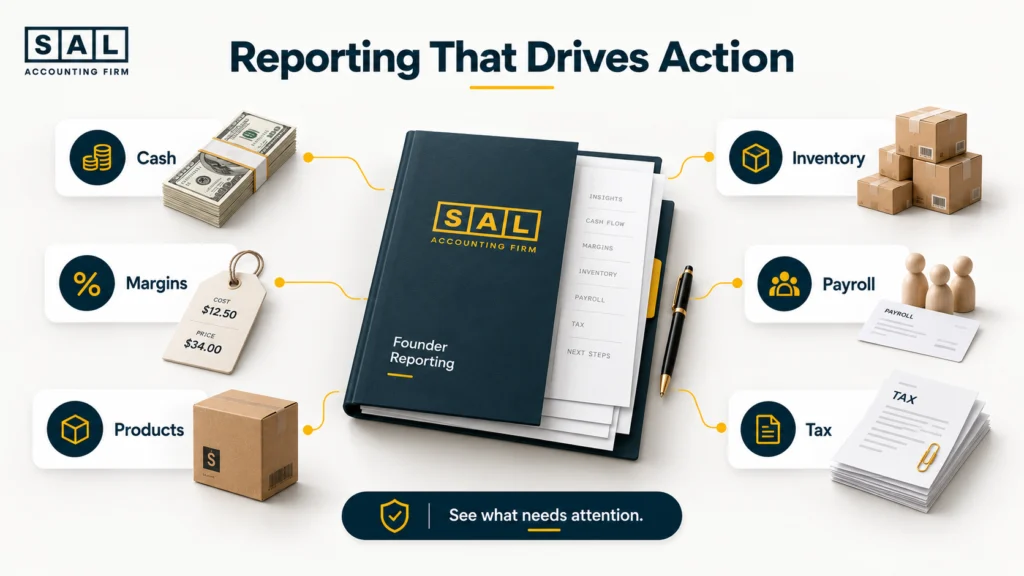
Management Reports That Actually Drive Action
Depending on the business, useful management reporting may include:
- Cash position and forecast
- Gross and contribution margin
- Product profitability
- Inventory position
- Operating costs against budget
- Payroll
- Upcoming tax liabilities
Good ecommerce management reporting should make a decision easier, not simply add another report to the monthly package.
Catching Problems Before They Show Up in Your Bank Balance
The bank account often reacts after the underlying problem has already been building. Margin may have been falling for three months. Inventory may have been accumulating for two seasons. Payroll may have grown faster than gross profit.
Timely ecommerce financial reporting makes those changes easier to catch before they become cash problems.
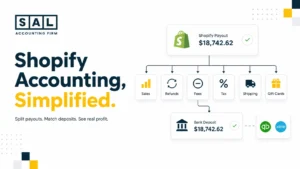
For businesses where Shopify is the centre of the operation, Shopify accounting services should keep sales, payouts, fees, inventory, and the books properly aligned.
How an Accountant Supports Hiring and Team Scaling
Hiring is not just a salary decision. It creates a recurring cash commitment:
Payroll Planning as Headcount Grows
A $70,000 employee may also bring employer payroll costs, benefits, commissions, software, equipment, and onboarding expenses.
Payroll planning also needs to account for employer remittances. The CRA’s payroll remittance requirements vary according to the employer’s remitter type, which affects remitting frequency and due dates. (canada.ca)
The accountant can put the full recurring cost into the forecast instead of treating the salary as an isolated number.
Knowing When You Can Actually Afford the Next Hire
A business may have enough cash to hire someone today while also having a major inventory order due three months from now. Modelling both commitments together gives the founder a better answer than simply checking the current bank balance.
The accountant provides the financial range. Management decides whether the hire should happen now.

Structuring for Cross-Border Growth Into the US
US expansion creates another set of decisions that are much easier to address before the launch than after it.
Tax and Entity Structure Decisions Before You Expand
The first question should not automatically be, “Should we open an LLC?” Start with how the business will actually operate:
- Where will inventory be stored?
- Which entity will make the sales?
- Will the business have people working in the US?
- How will cash move between Canada and the US?
- What additional tax and reporting obligations could arise?
- How much working capital will the US operation require?
The IRS notes that an LLC’s federal tax classification can differ depending on ownership and elections, so an LLC is not one universal tax structure (IRS LLC tax classification rules)
That makes the operating plan an important part of the structure decision.
Avoiding Cash Flow Surprises From Cross-Border Complexity
US expansion may require additional inventory, 3PL costs, advertising, currency conversion, professional fees, and tax compliance before the new market starts funding itself.
The cash-flow traps in cross-border ecommerce therefore need to be considered alongside the size of the sales opportunity.
The key question is: How much can the business put into US growth without putting the existing operation under pressure?
Case Study: How a Mississauga Brand Structured Its US Expansion Without Losing Momentum2
A profitable Mississauga home-goods brand wanted to hold inventory in the US and push further into American sales.
The Problem
The expansion required a new inventory commitment, 3PL costs, increased growth spending, and additional working capital. At the same time, the Canadian operation still needed cash for its own inventory, payroll, and taxes.
What Gets Checked
The accountant modelled the US cash requirement alongside the existing Canadian operation and reviewed how the planned operating structure could affect tax and reporting.
Instead of assuming the US launch needed to happen all at once, the founder could see the financial impact of a phased approach.
Result
The initial inventory commitment was reduced and increased as US sales developed. That left more working capital inside the Canadian operation while the new market was being established.
Useful takeaway: Decide how the US operation will work and how much cash it needs before deciding how aggressively to fund it.

What Fast-Growing Brands Actually Ask Their Accountant For
| Growth Decision | Accountant Provides | Founder Can Decide |
|---|---|---|
| Inventory | Cash needs + product profitability | How much and what to reorder |
| Advertising | Margin + cash impact | How much to reinvest |
| Hiring | Payroll + cash forecast | When to add headcount |
| Reporting | Timely financial insights | What needs attention first |
| US expansion | Tax + cash + structure analysis | How and when to expand |
| Overall growth | Forecasts + scenarios | Which plan the business can support |
The common thread is profitable brands bring the accountant into the decision early enough for the numbers to still influence what happens next.
Signs Your Current Financial Setup Can’t Keep Up With Growth
Your finance setup may be falling behind when:
- Reports arrive after the decisions they were supposed to support.
- Cash keeps getting unexpectedly tight despite reported profit.
- Inventory orders are based mainly on the current bank balance.
- Product profitability is difficult to calculate.
- Hiring happens without modelling the future cash impact.
- US expansion is moving ahead without financial and tax planning.
- Every major decision requires another spreadsheet.
- The accountant mostly becomes involved after the decision has already happened.
These do not automatically mean the bookkeeping is wrong. They can simply mean the business now needs more from its accountant than historical reporting.
The questions to ask an ecommerce accountant also change once forecasting, profitability, and growth planning become regular needs.
Reactive vs. Proactive Accounting: Which One Is Actually Driving Your Growth?
Reactive accounting explains what already happened. Proactive accounting uses the same numbers earlier, while management still has room to adjust the decision.
Reactive accounting:
- Explains why cash became tight
- Identifies why margins fell
- Shows where payroll or overhead increased
- Reports the impact after the decision was made
Proactive accounting:
- Models cash before a large inventory order
- Tests the impact of another hire
- Looks at what higher spending does to margin and cash
- Models expansion costs before the business commits
Both still depend on accurate books. The difference is timing: reactive accounting explains the result, while proactive accounting gives management a chance to influence it before the money is committed.
Ready to Put Better Numbers Behind Your Next Stage of Growth?
Rapid growth makes financial decisions bigger. The goal is not to add more reporting for the sake of it; it is to make sure cash, inventory, profitability, and future commitments are clear before more capital goes out the door.
Use the Financial Growth Roadmap to see what should become more structured as the business grows and where the current finance setup may be starting to fall behind.