

If you don’t trust last month’s inventory, COGS, or balance sheet, you need controller-level help. If the numbers are solid but you can’t tell whether you can afford the next production run, that’s fractional CFO work.
Many growing online supplement brands need both, in that order. Sorting out which problem you actually have is where SAL Accounting starts with ecommerce supplement founders. Figure it out here, before you pay for the wrong kind of help.
Good decisions start with a number you can trust. Check yours with the Ecommerce EBITDA Calculator.
Quick Takeaways
- A controller makes your numbers reliable. A fractional CFO uses reliable numbers to plan what comes next.
- “I don’t trust the numbers” is usually a controller problem.
- “I trust the numbers but don’t know what to do” is usually a CFO problem.
- CFO planning built on shaky accounting leads to shaky decisions.
- Many online supplement brands need both roles, working in sequence.
- A big production order is where the two roles most clearly meet.
Does Your Online Supplement Business Need Better Numbers or Better Decisions?
It depends on which problem you have. If your numbers aren’t reliable, start with a controller. If your numbers are reliable but your next move isn’t clear, a fractional CFO is the better fit.
Can You Trust the Numbers You Already Have?
Signs you can’t:
- Month-end reports arrive late, or not at all
- Inventory in the books doesn’t match what’s in the warehouse
- Balance sheet accounts carry balances nobody can explain
- COGS jumps around with no clear reason
- Shopify and Amazon sales don’t line up with the books
- Your bookkeeper’s work isn’t reviewed by anyone
If this sounds familiar, you need controller-level ownership.
Can You Trust the Numbers but Still Struggle With What Comes Next?
Signs you’re here:
- Should we place the next large co-packer order?
- Can we afford another production run before this batch sells through?
- How much cash can go into ads this quarter?
- What happens if ingredient costs rise?
- Can we start selling to US customers this year?
- Should we borrow to fund inventory?
If these are your questions, you need CFO-level planning.
Here’s the core difference. A controller strengthens the financial information your online store runs on. A fractional CFO uses that information to help you make forward-looking decisions.
The point is, name the problem first. The role follows.

Controller vs Fractional CFO: Who Owns the Numbers in an Ecommerce Supplement Production Run?
The controller owns whether the production run is recorded correctly. The fractional CFO owns whether the run makes sense, how big it should be, and when the cash should go out.
Picture an ecommerce supplement brand getting ready to place a new order with:
- A manufacturer deposit
- A packaging order
- A final production payment
- Freight and import costs
- Several months of inventory to sell online
- Sell-through that isn’t guaranteed
Import costs are part of the picture for many Canadian online brands. CBSA notes that duties and GST can apply when goods are imported, so the true cost of a run often lands in more than one payment.
The table below shows how the same production run splits into two different sets of questions.
| Controller Asks | Fractional CFO Asks | Why Both Matter |
|---|---|---|
| Are the deposits recorded correctly? | How big should this run be? | Size decisions need accurate current stock |
| Is inventory booked in the right period? | When does the cash actually leave? | Timing plans need clean payables |
| Do finished units match production records? | How long will this stock take to sell online? | Sell-through math needs real unit counts |
| Is the inventory value supportable? | What if sales come in 20% below plan? | Downside cases need a trustworthy starting point |
| Does COGS flow correctly when units sell? | Should we finance part of the order? | Financing needs real margins |
| Do co-packer balances match the books? | What spending gets cut if we go ahead? | Trade-offs need accurate liabilities |
Supplements add one more controller check. Under the Natural Health Products Regulations, labels carry a lot number and expiry date. That gives the controller a clear way to match units received against each production lot.
Forecasting matters most in inventory-heavy online businesses like this. The forecast has to follow production, inventory, and online demand, not just last year’s P&L.
At the end of the day, the controller makes sure the run is recorded right. The CFO decides whether the run should happen at all, and how big it should be.
What Does a Controller Do for an Online Supplement Business?
A controller makes sure an online supplement brand’s numbers can be trusted, from the monthly close to inventory, COGS, and platform payouts. In Canada, Job Bank groups controllers with financial managers, which is a good hint. This is a senior accounting role, not data entry.
Here are the problems a controller usually fixes.
Month-End Reliability
Making sure the P&L and balance sheet can be trusted before you use them. A dependable month-end close for supplement ecommerce brands is usually the first thing a controller fixes.
Inventory Accounting
Checking that quantities, inventory value, and accounting entries line up across your warehouse and sales channels. The mechanics are covered in our guide to supplement inventory accounting.
COGS Reliability
Making sure the cost moving from inventory into COGS is supported. What belongs in that cost is explained in our guide to COGS for supplement ecommerce brands.
Co-Packer and Supplier Accounting
Recording deposits, invoices, stock receipts, and outstanding balances the same way every time. A clean chart of accounts for supplement ecommerce brands makes this far easier.
Reconciliations
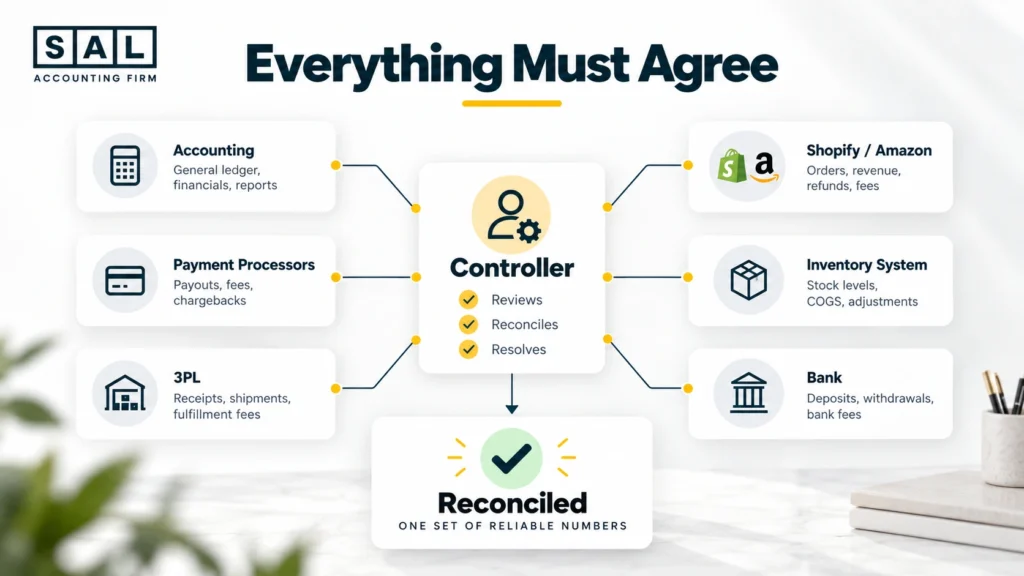
Resolving differences between:
- Your accounting system
- Shopify or Amazon
- Payment processors
- Your inventory system
- Your 3PL
- Your bank
For online sellers, the gap between sales and deposits alone deserves attention. Our guide to revenue vs payout reconciliation for supplement stores shows how.
Accounting Controls
A repeatable process for approvals, the close, adjustments, and reporting, so the numbers don’t depend on who happened to do them.
Bookkeeper Oversight
Reviewing the work, not just adding another person entering transactions. This matters more than many founders realize. CRA makes clear that you’re responsible for adequate records even if a bookkeeper or accountant keeps them for you.
When controller-level ownership tends to become useful as an online store grows is covered in our guide to building an ecommerce finance team by revenue stage. Here, the focus is on the problem, not the revenue number.
Which Ecommerce Supplement Brand Decisions Need a Fractional CFO?
A fractional CFO helps an ecommerce supplement brand decide about cash, production, margins, financing, and growth, once the numbers underneath are reliable. The focus moves from “are the numbers right?” to “what do we do next?”
Production and Inventory Commitments
How much cash can you safely commit before the stock sells online? For supplement brands, this is often the biggest question of the year. The cash side is covered step by step in our guide to working capital for online supplement businesses.
Cash Forecasting
When do deposits, final payments, ads, payroll, tax, and normal expenses all land at once? For online sellers, payout timing is part of this. In Canada, Shopify Payments pays out on a 3-day pay period, and Amazon usually takes longer. Building the forecast itself is covered in our guide to the supplement ecommerce cash flow forecast.
Scenario Planning
What happens if:
- Online sales slow down
- A production run is delayed
- Ingredient prices rise
- The next batch costs more
- A launch underperforms
- Ads get more expensive
For online brands buying from US manufacturers, currency is a scenario too. The Bank of Canada’s daily exchange rates show how quickly your cost per unit can move.
Margin Planning
What needs to change if gross or contribution margin falls? Product-level analysis sits in our guide to SKU-level profitability for supplement ecommerce brands. The CFO uses it to decide what to change.
Financing Decisions
Does the business need outside money for inventory, and how much? BDC describes working capital as current assets minus current liabilities, and a CFO helps you see how much of it your growth will need. Options range from Shopify Capital and other funding to government-backed bank lines of credit under the Canada Small Business Financing Program.
Growth Decisions
Can the business afford:
- Another hire
- Another warehouse or 3PL
- A new online sales channel
- A bigger production commitment
- Selling to US customers
For a full picture of what a virtual CFO does, see our guide to virtual CFO services for ecommerce. Here, the point is the contrast: CFO work starts where controller work ends.
How Do a Controller and Fractional CFO Work Together in an Online Supplement Business?
They split the same issues into two halves. The controller confirms what’s true today, and the CFO plans what to do next.
The table below shows how the two roles split five common areas.
| Area | Controller Asks | CFO Asks | What Breaks Without the Other |
|---|---|---|---|
| Inventory | Is the inventory number reliable? | How much should we buy next? | Buying plans based on wrong stock |
| Margins | Are revenue and costs recorded right? | What if margin drops 3 points? | Scenarios built on wrong margins |
| Cash | Are balances and payouts accurate? | What will cash look like in 8 to 12 weeks? | Forecasts that miss real bills |
| Production | Was the last run recorded correctly? | Can we afford the next one? | Decisions based on unclear costs |
| Reporting | Are reports accurate and on time? | What should we decide from them? | Good reports with no action, or action on bad reports |
Regular financial reports for online supplement businesses are where the two roles meet each month. The controller makes them right. The CFO makes them useful.
The central point: CFO-level analysis is only as good as the accounting underneath it.
Should an Ecommerce Supplement Brand Hire a Fractional CFO Before Its Books Are Clean?
Usually not. If the accounting underneath isn’t reliable, even a skilled CFO ends up planning with the wrong numbers. This is one of the most common and expensive mistakes online supplement brands make.
The forecast may look impressive. But it’s built on inputs like:
- Inventory that’s overstated
- COGS that isn’t consistent
- Refunds or marketplace fees that are missing
- Liabilities that were never recorded
- Monthly reports that arrive weeks late
Here’s a simple example. The forecast assumes $500,000 of usable inventory. After a proper reconciliation, only $380,000 is supportable. That’s a $120,000 gap. Every purchasing and cash decision built on the first number now changes: how much to reorder, when to pay, and whether you need financing.
Numbers like this often explain why a supplement brand’s profit looks wrong in the first place.
The lesson: more advanced finance doesn’t fix unreliable accounting underneath it. Fix the foundation first.
- Also read: “Inaccurate Ecommerce Financial Statements”
Case Study: How Jordan’s Pre-Workout Brand in the Junction Triangle, Toronto Fixes Its Numbers Before Planning1
Jordan runs an online pre-workout and BCAA brand from a shared warehouse in Toronto’s Junction Triangle. He sells on Shopify and Amazon and uses one co-packer. Online sales have doubled in a year, and he wants a 12-month forecast to plan his next two production runs and a possible push into the US market. He’s ready to bring in CFO-level help right away.
The Problem
Jordan’s month-end reports arrive about six weeks late. His inventory in the books is about 15% higher than what his 3PL reports. Two co-packer deposits sit in an expense account instead of against inventory, and nobody reviews his part-time bookkeeper’s work. Any forecast built on these numbers would start from the wrong place.
What We Do
We start with controller-level work: reconciling inventory with the 3PL count, correcting how the deposits are recorded, and tidying COGS so it follows actual units sold online. Then we set a regular close so reports land within two weeks of month-end. Only after that do we build the forecast.
The Result
Jordan’s usable inventory turns out to be much lower than his books showed, which changes the size of his next reorder. The forecast now starts from real numbers. He delays the US push by one quarter, because the corrected cash picture shows the timing would have been tight.

Does an Online Supplement Business Need Both a Controller and a Fractional CFO?
Often, yes. For many growing online supplement brands, having both is the most likely answer, because each role depends on the other.
Here’s how the finance work flows:
Bookkeeping → Controller Review → Reliable Reporting → CFO Planning → Management Decision
Each step depends on the one before it.
Controller Layer
Regular ownership of:
- The monthly close
- Inventory
- Reconciliations across sales channels
- Reporting
- Controls
Fractional CFO Layer
Periodic senior support for:
- Forecasting
- Scenario planning
- Major production orders
- Financing
- Hiring
- Expansion
The roles work together. One isn’t a cheaper replacement for the other, and you don’t have to choose exactly one.
How Do a Controller and Fractional CFO Handle an Ecommerce Supplement Inventory Order?
The controller prepares the numbers, the fractional CFO tests the decision, and management makes the final call. Here’s how that works on a $250,000 production commitment for an online supplement brand.
Step 1: The Controller Prepares the Decision Base
Confirm:
- Current inventory value
- Open balances with suppliers
- Current COGS per unit
- Bills already owed
- Cash balances and pending payouts
- Recent financial results
Step 2: The Fractional CFO Tests the Decision
Model:
- Expected online sell-through
- Timing of the deposit and final payment
- A downside case where sales come in lower
- How much ad spend is needed to sell the stock
- The minimum cash buffer to keep
- Whether financing is needed
Step 3: Management Decides
Possible outcomes:
- Place the full order
- Reduce the order
- Split the production into stages
- Renegotiate payment terms
- Arrange financing
- Delay another cash commitment
Clean inventory records make Step 1 much faster. Good inventory software for supplement ecommerce brands helps the controller pull those numbers in hours instead of days.
Pro Tip: Before any production order over a set amount, require a one-page summary with the controller’s numbers on top and the CFO’s scenarios below. It keeps big decisions from being made on gut feel.
Case Study: How Brooke’s Electrolyte Brand in Churchill Meadows, Mississauga Tests a Growth Plan2
Brooke sells electrolyte drink mixes online from a warehouse unit near Churchill Meadows in Mississauga. Her books are in good shape: the close is on time, inventory matches her 3PL, and her monthly reports are reliable. She wants to place her largest production order yet and launch on a second online marketplace in the same quarter.
The Problem
Brooke’s accounting is solid, but she has no forward view. The bigger order needs a large deposit two months before her busiest season, right when she also wants to spend more on ads for the new marketplace. She can’t tell whether the cash will stretch that far.
What We Do
We use her reliable reports as the starting point and build a cash forecast that follows each payment date and payout. We test three cases: sales on plan, sales 20% lower, and a one-month production delay. Then we show how each case changes her lowest cash point.
The Result
The lower-sales case shows cash dropping below her comfort level for about five weeks. Brooke splits the production order into two releases and staggers the new marketplace launch by a month. Her books didn’t need fixing. Her plan did.

Controller or Fractional CFO: Which Fits Your Online Supplement Business?
Match the problem you have today to the role that fixes it. Use this table as a quick check.
| The Problem | Role | Where to Start |
|---|---|---|
| “Our close is late every month.” | Controller | Set a fixed close process |
| “Inventory and COGS keep changing after reports go out.” | Controller | Reconcile inventory and review COGS flow |
| “Shopify, Amazon, and the books never match.” | Controller | Reconcile sales, fees, and payouts |
| “Nobody reviews the bookkeeper’s work.” | Controller | Add a monthly review |
| “Can we afford the next production run?” | Fractional CFO, if the accounting is reliable | Model cash timing and downside cases |
| “We need a 12-month cash and inventory plan.” | Fractional CFO | Build a forecast from production and online demand |
| “We want to model selling more to US customers.” | Fractional CFO, plus tax and legal specialists | Model the numbers, then check tax and legal |
| “The books are unreliable and we have big decisions coming.” | Both, controller first | Fix the foundation, then plan |
For a US move in particular, the financial model is only one part. Structure, registration, and tax need their own advice, which our guide to setting up a Canadian ecommerce business for US expansion walks through.
Final Thought: Should Your Online Supplement Brand Fix Its Numbers or Its Plan First?
A controller and a fractional CFO solve different problems. One makes sure your inventory, COGS, payouts, and balance sheet can be trusted. The other uses those numbers to decide how much to produce, when to spend, and how to grow your online store. For most ecommerce supplement brands, the smart order is simple: reliable numbers first, then forward-looking plans.
Name the problem you have today. Then bring in the kind of help that fixes that problem.
Want a clear path for your brand’s finances? Start with our growth blueprint for Canadian brands.