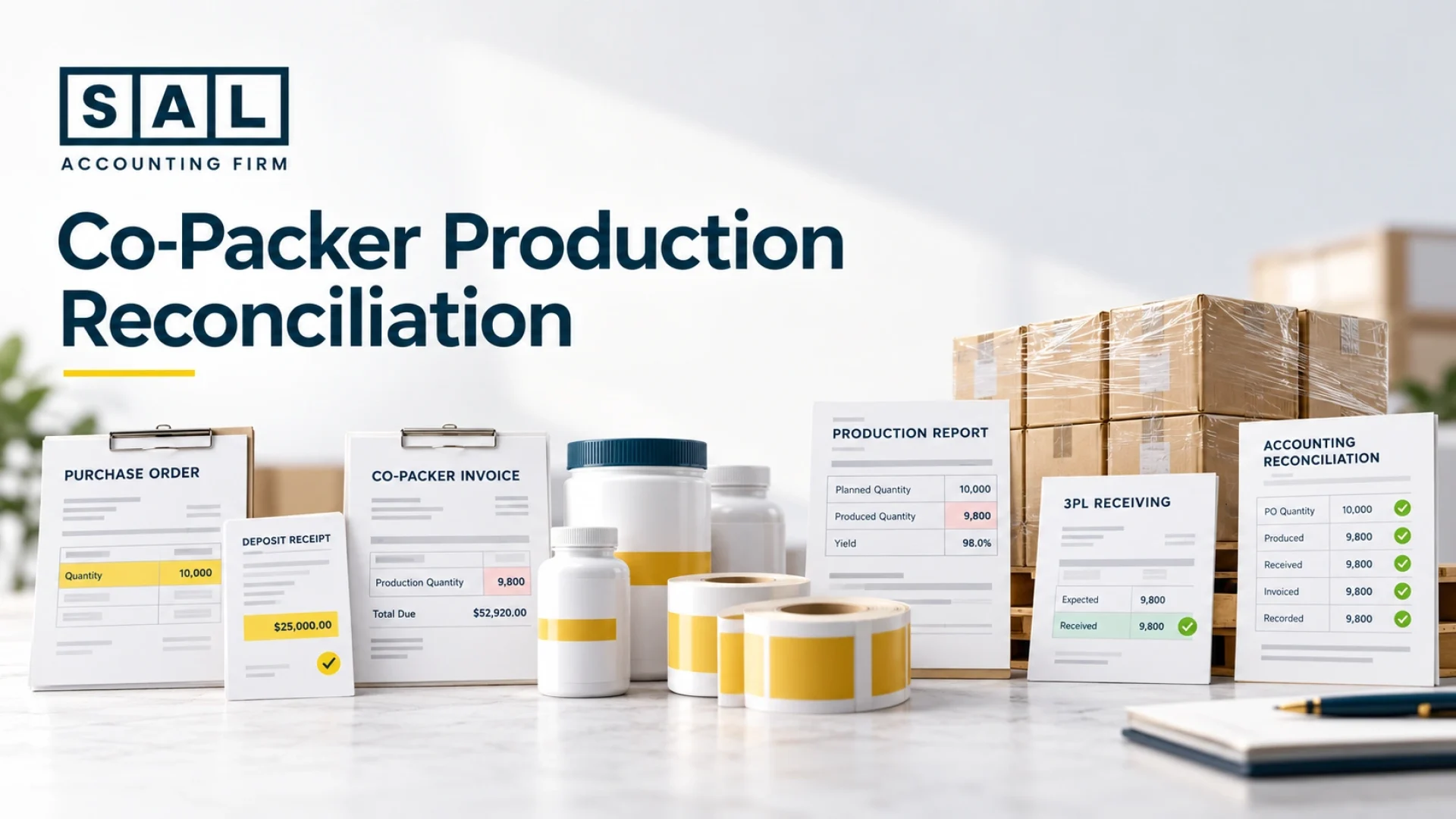
Paying the co-packer’s final invoice doesn’t close a production run. The run is only reconciled when you can explain every dollar, every material you supplied, and every unit from order to 3PL shelf. Many online supplement brands never check, and small gaps quietly turn into wrong COGS and wrong inventory.
It’s one of the first things SAL Accounting tests when it reviews a supplement brand’s books. Here’s the walkthrough, step by step.
Every co-packer invoice carries GST/HST you may be able to claim back. See what it adds up to with the GST/HST Refund Calculator.
Quick Takeaways
- A production run is reconciled when the order, payments, production, and received stock all agree, or the differences are explained.
- Start with the purchase order, not the final invoice.
- Every deposit should stay tied to one specific production run.
- Materials you supplied still need to be tracked after the co-packer uses them.
- Units produced are not the same as saleable units received.
- Don’t adjust the books to match. Find the reason for each difference.
What Should Reconcile in a Co-Packer Production Run for an Online Supplement Brand?
A finished production run should connect four things: what you ordered, what you paid for, what was produced, and what you received and recorded.
Here’s the chain:
Ordered → Paid → Produced → Received → Recorded
If one stage doesn’t agree with the next, the gap needs an explanation.
The table below shows where each stage’s numbers come from and where gaps usually hide.
| Stage | Source Record | What to Check | Common Gap |
|---|---|---|---|
| Ordered | Purchase order | SKU, quantity, price, terms | PO never updated after changes |
| Paid | Deposits and invoices | Every payment tied to this run | Deposit not deducted on final invoice |
| Produced | Co-packer production report | Units made, by status | Samples and holds counted as saleable |
| Received | 3PL receiving report | Saleable units that arrived | Damaged or short cartons |
| Recorded | Your accounting records | Inventory matches received units | Books show the PO quantity, not actual |
The goal isn’t for every number to match perfectly. It’s for every difference to have a reason you can show.
This is one piece of the wider picture covered in our guide to accounting for an online supplement business. Here, the focus is one run, start to finish.
Why Should Co-Packer Reconciliation Start With the Purchase Order, Not the Final Invoice?
Because the purchase order shows what you expected to happen. Without it, you have nothing to compare the final invoice against. Before production starts, the PO should capture:
- The SKU
- Production quantity
- Agreed manufacturing price
- Ingredients or materials expected
- Who supplies the packaging
- Deposit terms
- Expected production date
Supplement brands have one more check. The SKU on the PO should match the licensed product. Health Canada’s Licensed Natural Health Products Database shows each product’s NPN and licence status, so you can confirm you’re producing what’s actually licensed.
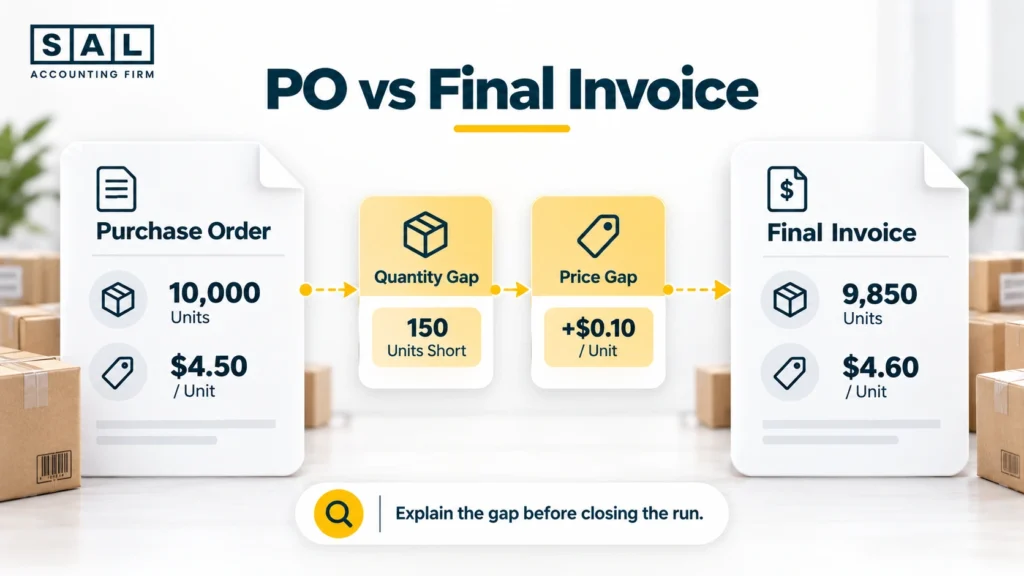
Here’s why this matters. If the final invoice says 9,850 units at $4.60 and your PO said 10,000 units at $4.50, you now have two differences to explain: quantity and price. Without the PO, you’d just pay the invoice and move on.
Pro Tip: Save a PDF of the final agreed PO in the same folder as every invoice and report for that run. One folder per run makes the whole reconciliation faster.
How Do You Connect Manufacturing Deposits to a Co-Packer Production Run?
Keep each deposit linked to the specific run it paid for. When the final invoice arrives, you should be able to answer four questions:
- What did we deposit for this run?
- Did the co-packer deduct it correctly on the final invoice?
- What balance is still payable?
- Is any part of the deposit tied to production that isn’t finished yet?
A common problem: a brand pays a $15,000 deposit in March, and the final invoice in May shows the full $30,000 with no deduction. If nobody checks, the brand either pays twice or leaves an old deposit sitting open in the books for months.
How deposits are set up in the books is covered in our guide to the chart of accounts for supplement ecommerce brands. When deposits leave the bank and how that affects cash is covered in our guide to working capital for online supplement businesses. Here, the only job is making sure each deposit is tied to the right run and cleared.
How Do You Reconcile Brand-Owned Ingredients and Packaging Held by a Co-Packer?
Track what you supplied, what was used, and what’s left. Many online supplement brands buy some materials themselves and send them to the co-packer, such as:
- Active ingredients
- Capsules
- Bottles
- Labels
- Lids
- Cartons
- Scoops
These materials may sit at the co-packer’s site, but that doesn’t mean they stop being yours. Where something is stored doesn’t decide who owns it. For each run, identify:
- Materials the brand supplied
- Materials the co-packer supplied
- Materials used in this run
- Unused materials still held at the co-packer
If you import ingredients yourself, the cost doesn’t stop at the supplier invoice. CBSA notes that duties and GST can apply at the time of importation, so those payments belong in the run’s records too. How those costs are spread across units is covered in our guide to landed cost accounting.
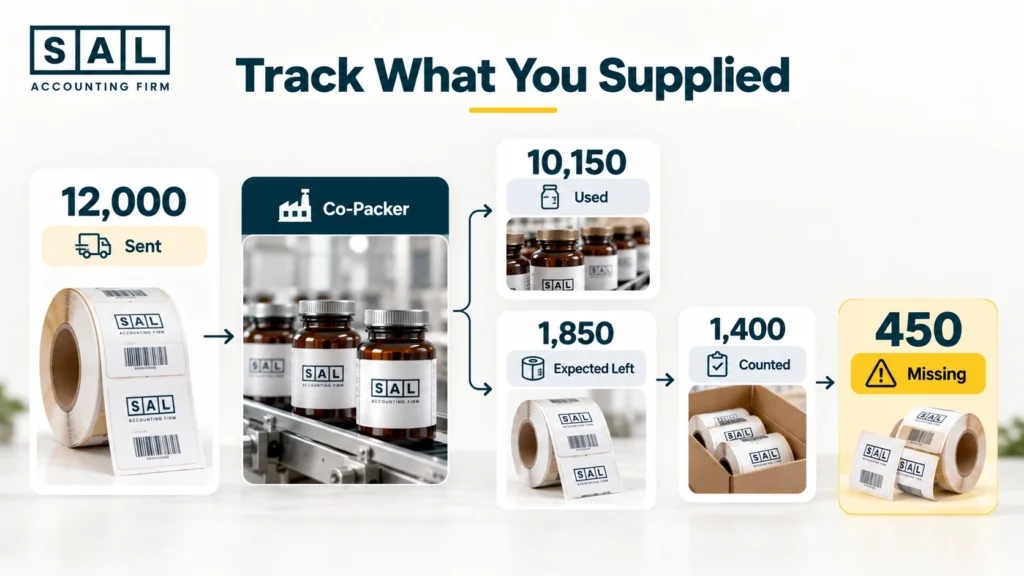
Here’s a simple example. You sent 12,000 labels for a 10,000-unit run. The run used 10,150 labels, including some spoiled during setup. The co-packer should still hold 1,850. If their count says 1,400, you need to know where the other 450 went.
The core question: can you explain what happened to the materials you paid for?
How Do You Reconcile the Final Co-Packer Invoice?
Compare the final invoice line by line with the PO and your original expectations. Look for differences in:
- Production fees
- Setup or run charges
- Testing and quality-control fees
- Packaging charges
- Storage fees
- Rework charges
- Extra production charges
The goal here isn’t to decide how each charge is treated in the books. That’s a separate question, and our guide to inventory capitalized vs expensed covers it. The goal is simpler: explain why the final invoice is different from what you ordered.
Some differences have a clear cause. If you agreed on a price in US dollars and budgeted in Canadian dollars, the exchange rate alone can move the total. The Bank of Canada’s daily exchange rates help you check how much of the gap came from currency.
Keep the final invoice complete, too. The Input Tax Credit Information Regulations set out what information you need before claiming GST/HST back on a purchase, including the invoice date and the tax charged.
Flag any charge you can’t explain before you close the run. Once a run is closed, questions get much harder to raise.
How Do You Reconcile Units Ordered, Produced, and Received in a Co-Packer Run?
This is the heart of the reconciliation. Every unit between the order and the 3PL shelf needs a reason. Here’s a simple example:
- 10,000 units ordered
- 9,850 units produced
- 9,800 saleable units received by the 3PL
That leaves 200 units to explain. The table below shows how they might break down.
| Line | Units | Explanation |
|---|---|---|
| Ordered | 10,000 | Purchase order quantity |
| Production shortfall | −150 | Yield loss during the run, per the co-packer’s report |
| Produced | 9,850 | Co-packer’s finished-goods count |
| Retained samples | −20 | Kept by the co-packer for testing |
| Quality hold | −25 | Still at the co-packer awaiting release |
| Damaged in transit | −5 | Noted on the 3PL receiving report |
| Saleable units received | 9,800 | 3PL receiving report |
Common reasons for a gap:
- Production loss
- Quality-control samples
- Retained samples
- Rejected units
- Damaged units
- Units still held by the co-packer
- Receiving timing differences
Here’s the rule: don’t just adjust the books until they agree. A $1,000 inventory adjustment with no reason behind it hides whatever caused the gap, and it will happen again next run.
Unexplained unit gaps are often one reason a supplement brand’s profit looks wrong.
Case Study: How Ryan’s Collagen Brand in Mimico, Toronto Finds Its Missing Units1
Ryan runs an online collagen powder brand from a small warehouse in Mimico, in Toronto’s west end. He sells on Shopify and Amazon. For his last run, he ordered 8,000 tubs and supplied his own tubs, lids, and labels to the co-packer. His books show 8,000 tubs added to inventory, the full PO quantity. His 3PL’s system shows 7,760 on the shelf.
The Problem
Ryan’s bookkeeper recorded the PO quantity as soon as the final invoice was paid. Nobody compared it with the co-packer’s production report or the 3PL receipt. The co-packer’s final invoice also showed the full balance, with no deduction for his $12,000 deposit. And Ryan doesn’t know how many of his own labels and tubs are still at the co-packer.
What We Do
We gather the PO, the deposit receipt, the material shipments he sent, the co-packer’s production report, the final invoice, and the 3PL receiving report. Then we walk the run from ordered to received. We find 180 units lost in production, 40 retained samples, and 20 units damaged in one carton. We also confirm how many unused tubs and labels are still sitting at the co-packer. Getting the books to reflect the real count is part of the work our ecommerce bookkeeping team in Toronto does for supplement brands.
The Result
Ryan’s inventory now matches the 7,760 saleable tubs actually on the shelf. The co-packer corrects the final invoice, and the $12,000 deposit is applied. Ryan now asks for a production report with every final invoice, so the next run can be closed properly.
How Should Quality Holds, Rejected Units, and Testing Samples Be Handled?
Split every unit produced into a status. Produced units are not automatically saleable inventory. Statuses usually include:
- Saleable
- Quality hold
- Rejected
- Retained for testing
- Damaged
- Still at the co-packer
Retained samples are normal in supplement production. Under Health Canada’s GMP guidance for natural health products, manufacturers and importers keep samples from each lot. So some units from every run will never reach your 3PL, and your records should expect that.
The table below shows how each status fits into the reconciliation.
| Status | Counts as Saleable? | Where It Sits | Question to Ask |
|---|---|---|---|
| Saleable | Yes | 3PL or warehouse | Does the count match the receipt? |
| Quality hold | Not yet | Co-packer | When will it be released or rejected? |
| Rejected | No | Co-packer or destroyed | Who bears the cost? |
| Retained samples | No | Co-packer | How many per lot? |
| Damaged | No | 3PL or in transit | Is there a claim to make? |
Quality holds need the most follow-up. A unit on hold today may become saleable next month, or it may be rejected. Either way, it shouldn’t sit in “saleable inventory” in the meantime.
How damaged or expired stock is valued over time is covered in our guide to supplement inventory accounting.
What If the 3PL Receives a Different Quantity Than the Co-Packer Shipped?
Compare the co-packer’s shipment report with your 3PL’s receiving report. For online supplement brands, this is where many unit gaps start. Look for differences caused by:
- Short shipments
- Damaged cartons
- Partial receipts
- Units still in transit
- Receiving errors at the 3PL

Lot numbers make this check much easier. Cases labelled with a GS1-128 barcode can carry the lot number, so the 3PL can confirm exactly which lot arrived.
If some stock goes straight to Amazon, the same check applies to what Amazon reports as received. Our guide to Amazon FBA bookkeeping covers how those receipts show up.
Selling on more than one channel makes this harder, because one run may be split between your 3PL and Amazon. That’s where multichannel accounting for supplement brands comes in.
The end goal: your accounting inventory should match where the stock actually is and what condition it’s in.
Case Study: How Hailey’s Gummy Brand in Cooksville, Mississauga Closes a Split Shipment2
Hailey sells vitamin gummies online from a unit in Cooksville, Mississauga. Her co-packer finishes a 5,000-unit run and ships it in two pallets: one to her 3PL and one directly to Amazon. The co-packer’s shipment report shows 4,900 units shipped. Her books show 4,900 units received.
The Problem
Her 3PL accepts 2,380 of the 2,450 units on its pallet. Two cartons, 70 units, arrived crushed. Amazon has only logged 2,300 of its 2,450 units so far, because the rest are still being processed. The final invoice also includes a $1,200 rework charge that wasn’t on the PO. Her books say everything arrived, but it hasn’t.
What We Do
We line up the co-packer’s shipment report against both receiving reports, pallet by pallet. We separate the 70 damaged units, which go to a carrier claim, from the 150 Amazon units still in process, which are a timing difference. We also send the rework charge back to the co-packer for an explanation before the run is closed.
The Result
Hailey’s books now show 4,680 units received and 150 in transit, with the 70 damaged units tracked separately. The co-packer confirms the rework charge came from a labelling error on its side and removes it. Hailey now waits for both receiving reports before marking a run as received.
How Do You Know a Co-Packer Production Run Is Ready to Close in the Books?
A run is ready to close when you can explain every step, with documents to back it up. Before closing, you should be able to answer:
- What was ordered?
- What deposits were paid?
- Which materials belonged to the brand?
- What did the co-packer invoice?
- How many units were produced?
- What caused any production differences?
- How many saleable units were received?
- What balance is still payable?
- What finished inventory was recorded?
Again, the goal isn’t perfect matching. The goal is a written reason for every difference.
Closing a run fits naturally into your monthly routine. Our guide to the month-end close for supplement ecommerce brands shows where it belongs. Clean run-by-run records also make your financial reports far more reliable.
Pro Tip: Keep a one-page “run close” summary for each production run. List the ordered, produced, and received counts, the deposit, the final balance, and a one-line reason for each difference.
- Also read: “Ecommerce Reconciliation Best Practices”
What Are the Warning Signs of an Unreconciled Co-Packer Production Run?
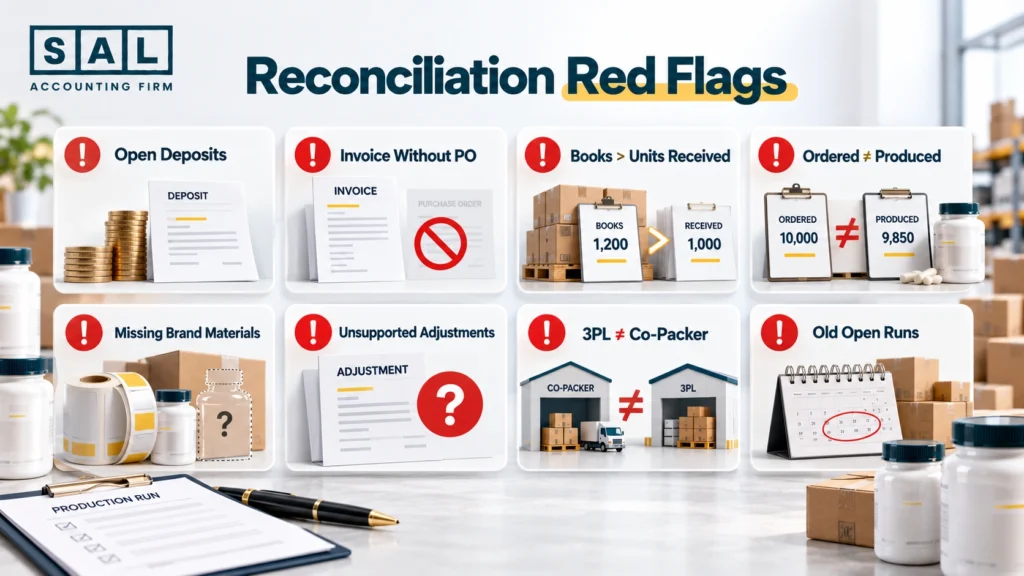
Watch for these:
- Deposits still open long after production finishes
- Final invoices you can’t tie to a production order
- More inventory in the books than units received
- Unexplained gaps between ordered and produced units
- Brand-owned materials disappearing from your records
- Large inventory adjustments with no support
- 3PL receipts that don’t match co-packer shipments
- Old open production runs nobody can explain
Any one of these can throw off your COGS. What belongs in COGS is covered in our guide to COGS for supplement ecommerce brands. The point here is that if the units and dollars from a run don’t reconcile, COGS can’t be right either.
Poorly supported adjustments also draw attention if CRA ever reviews your books, which our guide to CRA audits for ecommerce sellers covers.
Can Your Online Supplement Brand Explain Every Unit in Its Last Production Run?
A co-packer production run isn’t finished just because the invoice is paid. It’s finished when the order, deposits, materials, invoices, production counts, and received stock all tie together, or every difference has a reason.
Pick your most recent run. Walk it from ordered to received. If you can explain every gap, your books are in good shape. If you can’t, that’s where to start.
Clean production runs are just the start. Map out what comes next with our financial roadmap for online supplement brands.