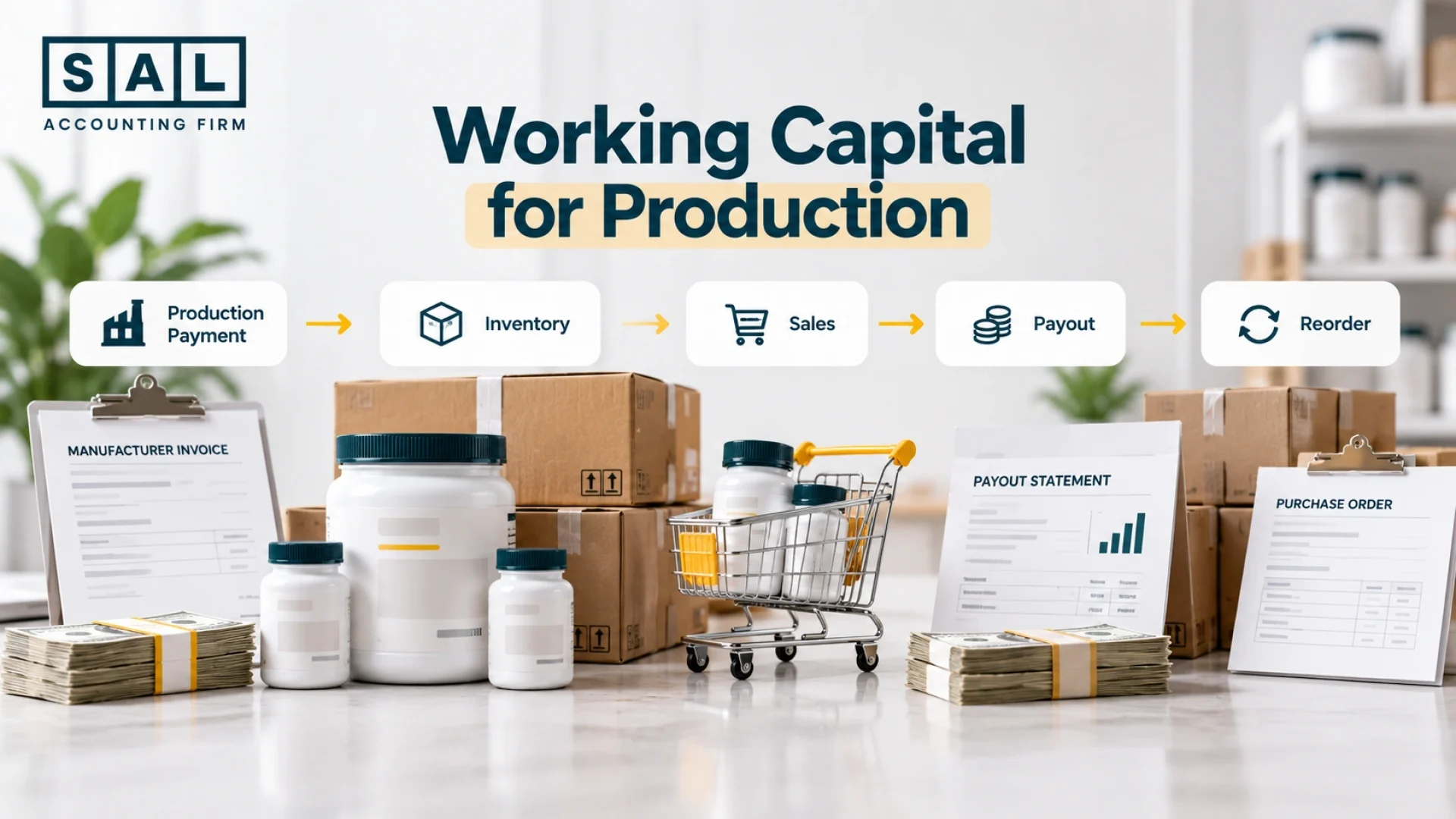
The cash your supplement brand needs for production is usually more than one run costs. You pay your manufacturer weeks before Shopify or Amazon pays you, and you often order the next batch before this one sells out.
Mapping that gap is where SAL Accounting starts with supplement founders who are profitable but short on cash. Before you sign your next purchase order, spend five minutes here.
Profit on paper and cash in the bank are two different scores. Check the first one with the Ecommerce EBITDA Calculator, then use this guide for the second.
Quick Takeaways
- Working capital for production runs is the cash tied up between paying for inventory and getting it back through online sales.
- MOQs set how much you commit. Deposits and payment terms set when that cash leaves.
- Longer lead times force you to reorder earlier, often while the last batch is still selling.
- The biggest pressure usually comes from overlap: paying for Batch 2 while Batch 1 is still on the shelf.
- Peak cash tied up can be much higher than the cost of one production run.
- There’s no fixed percentage that fits every brand. Your production cycle decides the number.
Why Can a Profitable Online Supplement Business Still Run Short of Cash?
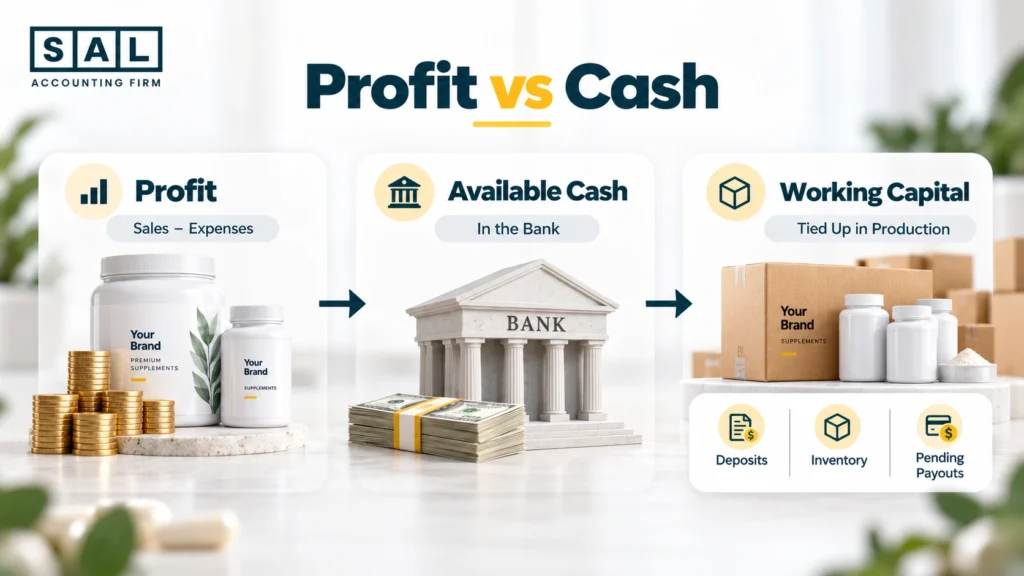
Picture this. Your magnesium formula sells well on Shopify. Last quarter showed a healthy profit. Then your manufacturer emails: the deposit for your next batch is due Friday. You check the bank, and the money isn’t there. Nothing went wrong. Here’s what’s actually happening. Three ideas get mixed up:
- Profit: did sales beat expenses over a period?
- Available cash: what’s in the bank right now to pay the next bill?
- Working capital requirement: how much cash is stuck inside the production cycle, not yet back in your account
In accounting terms, working capital is current assets minus current liabilities. For a supplement brand, the practical version is simpler: how much money is sitting in deposits, stock, and payouts that haven’t landed yet.
That’s why growth can feel tight. Selling more usually means ordering more, and bigger orders tie up more cash before any of it comes back. The wider gap between profit and cash flow is its own topic. This article focuses on one piece of it: the production run.
The point is, ecommerce growth often raises the cash tied up in inventory before it raises the cash in your bank.
Where Does Cash Get Tied Up During a Supplement Production Run?
Every production run follows the same path. Cash leaves at several points and only comes back at the end:
MOQ → Deposit → Production → Final Payment → Freight → Inventory → Online Sale → Payout → Reorder
Here’s how the running example in this article moves through that chain. The numbers are illustrative.
| Step | What Happens | Example Cash Out | When It Leaves |
|---|---|---|---|
| MOQ | Commit to 5,000 units at $10 | $50,000 total commitment | Order placed |
| Deposit | Manufacturer takes 50% upfront | $25,000 | Week 0 |
| Production | Batch is made and packed | No payment | Weeks 0 to 8 |
| Final payment | Remaining 50% before shipment | $25,000 | Week 8 |
| Freight, duties, import GST | Goods move and clear customs | About $6,500 | Weeks 9 to 11 |
| Inventory | Stock reaches your 3PL | No payment | Week 12 |
| Online sale | Customers buy on Shopify or Amazon | Cash starts to return | Week 12 onward |
| Payout | Platform sends your money | Delayed by days or weeks | After each sale |
Look at the gap. The first dollar leaves at week 0. The first dollar comes back after week 12, and only once payouts clear.
Freight, Duties, and Import GST
Many Canadian supplement brands buy from US or overseas manufacturers. That adds three cash items:
- Freight: paid before or on arrival
- Duties: depending on the product and where it’s from
- Import GST: CBSA explains that GST is payable on most goods at the time of importation. Since most supplements aren’t basic groceries, this usually applies.
Import GST is a cash timing issue, not usually a final cost. CRA explains that a registered importer can claim an input tax credit for the tax paid on imported goods, and that the provincial part of HST on commercial imports is self-assessed on your return. That credit comes through your GST/HST return.
Paying in US dollars adds one more wrinkle. If the Canadian dollar drops between your deposit and final payment, the second half costs more than you planned. The Bank of Canada’s daily exchange rates are a simple way to track the swing between payment dates. It’s one of several cross-border cash flow traps for Canadian sellers.
The longer the gap between the first payment and the first payout, the more working capital you need.
- Read More: “GST/HST Refund Calculator”
How Do MOQs Affect Working Capital?
Your manufacturer’s minimum order quantity (MOQ) sets the size of your commitment. You can’t order just what you need. You order what they’ll make.
The basic math:
MOQ × Cost per Unit = Initial Production Commitment
In our example:
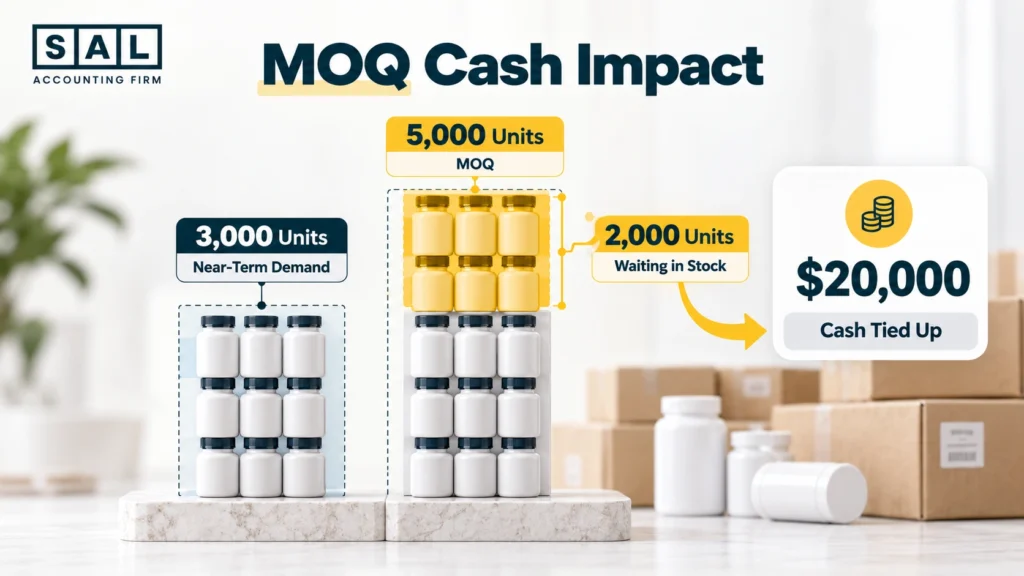
- MOQ: 5,000 units
- Cost per unit: $10
- Commitment: $50,000
Now, say you only expect to sell 3,000 units over the next few months. You still fund all 5,000. The other 2,000 units, worth $20,000 at cost, sit in inventory waiting their turn.
Larger MOQs can:
- Increase the amount of stock you hold
- Stretch out how long it takes to get your cash back
- Tie up more money in slower-moving SKUs
That last one is easy to miss. A flavour that sells half as fast holds your cash twice as long. If you’re not sure which SKUs are slow, SKU-level profitability for supplement brands is the place to start.
The point is, the MOQ decides how much cash you commit, whether or not demand is ready for it.
How Do Manufacturing Deposits Change the Timing of Cash Needs?
Two questions often get treated as one:
- How much does this production run cost?
- When do I actually have to pay?
A $50,000 run doesn’t mean $50,000 leaves on day one. In our example:
- 50% deposit ($25,000) when you place the order
- 50% balance ($25,000) before the goods ship
Other payments can land at different times:
- Packaging deposits: tubs, labels, and scoops are sometimes ordered and paid for separately
- Freight: often paid before or on shipping
- Duties and import GST: paid when goods clear customs
- Final manufacturer payment: sometimes tied to a quality check
Each one is a date on your calendar. Missing one can hold up the whole batch.
Technically, a deposit is money you’ve paid for goods you don’t have yet. How to record it in your books is covered in our guide to the chart of accounts for supplement brands. For working capital, the only question is the date it leaves the bank.
Pro Tip: List every production payment with its due date, not just its amount. A single page with dates on it will tell you more than the total ever will.
Why Does Production Lead Time Affect Working Capital?
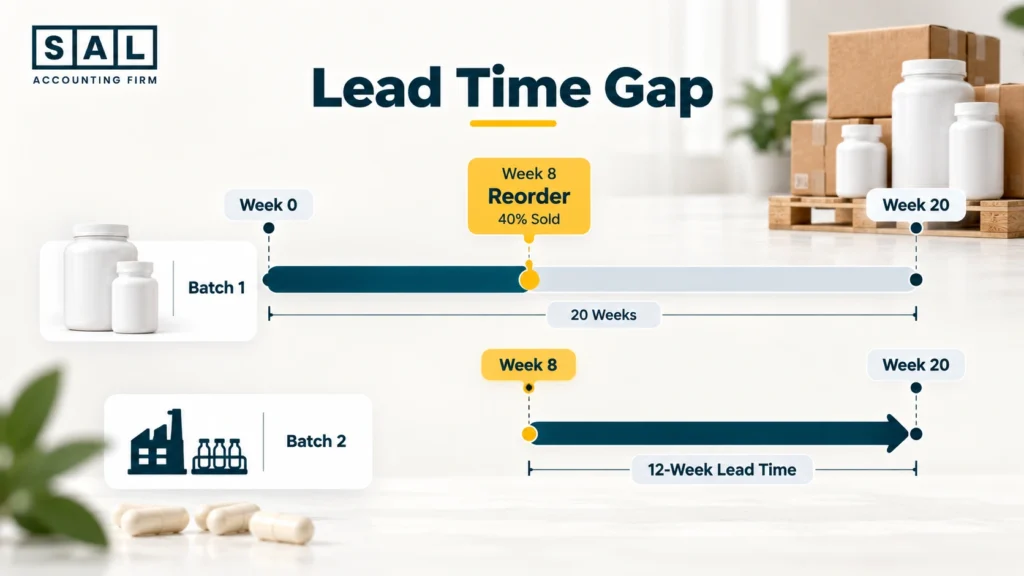
Lead time is how long it takes from placing the order to having stock ready to sell. A longer lead time means you reorder earlier, which means cash leaves sooner. Lead time usually has four parts:
- Manufacturing time
- Packaging time (if it’s sourced separately)
- Freight and transit
- 3PL receiving time
In our example, that adds up to 12 weeks: 8 weeks of production, 3 weeks of freight, and 1 week for your 3PL to receive and shelve it.
Now, say you sell 250 units a week. A 5,000-unit batch lasts 20 weeks. To avoid running out, you have to order the next batch 12 weeks before this one sells out. That means ordering at week 8 of selling Batch 1.
At that point, Batch 1 is only 40% sold. You’re paying for Batch 2 while most of Batch 1 is still on the shelf.
Pro Tip: Set your reorder point in weeks, not units. “Order when 12 weeks of stock is left” is easier to plan cash around than “order at 3,000 units.” Good inventory software for supplement brands can flag this automatically.
Longer lead time means you commit cash earlier.
How Does Ecommerce Sell-Through Affect How Quickly Cash Comes Back?
Sell-through is how fast your inventory turns back into sales. For online supplement brands, there’s a second step: the sale has to turn into a payout. Things that affect how fast cash returns:
- Units sold per week
- How much stock you convert into sales at full price
- Discounts needed to move slow products
- Shopify or payment processor payout timing
- Amazon payout timing, where it applies
Payouts are where online sellers differ from stores. In Canada, Shopify Payments has a 3-day pay period, and your bank can add a few more days. Amazon usually takes longer. It generally holds funds until after delivery and pays out on a roughly two-week cycle, so the gap from sale to bank can stretch to several weeks. Check your own schedule in Seller Central, since reserves vary by account. Here’s the simple rule:
- Fast sell-through and quick payouts release cash sooner
- Slow sell-through or long payout delays keep cash tied up longer
The difference between what you sell and what reaches the bank is worth tracking. Our guide to revenue vs payout reconciliation for supplement stores shows how. The point is, a sale isn’t cash until the payout clears.
Why Is Reorder Overlap Often the Biggest Working-Capital Pressure?
This is the part most founders miss. Your working capital need isn’t just the cost of one production run. It also depends on how much of the last run is still unsold when the next one needs paying for. Let’s follow the running example:
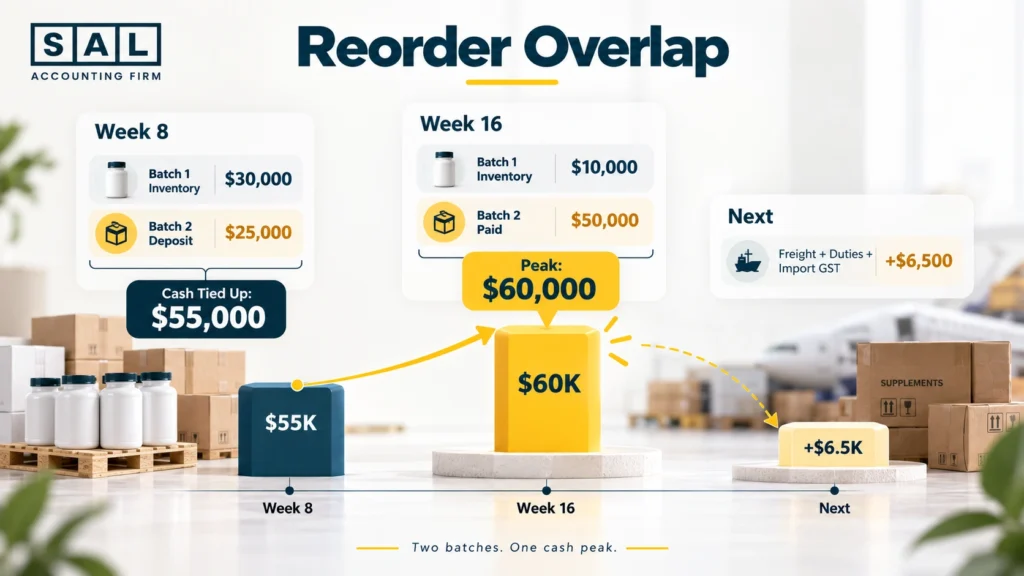
- Week 8 of selling Batch 1: you place the Batch 2 order
- Batch 1 still has 3,000 units left, worth $30,000 at cost
- Batch 2’s $25,000 deposit leaves the bank
- Cash tied up: $55,000
- Week 16: Batch 2’s final payment is due
- Batch 1 has 1,000 units left, worth $10,000
- You’ve now paid $50,000 for Batch 2
- Cash tied up: $60,000
- Weeks 17 to 20: freight, duties, and import GST on Batch 2
- Batch 1 is almost gone
- About $6,500 more leaves before Batch 2 can be sold
So a brand whose production run “costs” $50,000 has up to $60,000 tied up at the peak, plus whatever is still waiting in payouts. That’s before ads, payroll, or rent.
This is the heart of it. You’re funding two production cycles at the same time. The faster you grow, the bigger each batch gets, and the bigger the overlap becomes.
- Also read: “Shopify Cash Flow Warning Signs”
Case Study: How Owen’s Magnesium Brand in Liberty Village, Toronto Maps Its Reorder Overlap1
Owen runs a magnesium gummy brand from a small office in Liberty Village, Toronto. He sells about 60% on Shopify and 40% on Amazon. His profit last quarter was solid, and he’s ready to reorder. His manufacturer asks for a $30,000 deposit on the next 6,000-unit batch, with the balance due before shipping. Owen assumes it’s fine, since the business is profitable. Then he checks the bank.
The Problem
Owen still has about $45,000 of gummies sitting at his 3PL. A large chunk of his Amazon sales is waiting in payouts that won’t arrive for a few weeks. The deposit and the final payment both land before Batch 1 sells through. The business is profitable, but most of the cash is stuck in stock and pending payouts.
What We Do
We lay out every payment on both batches by week: deposit, final payment, freight, duties, and import GST. Next to it, we map expected Shopify and Amazon payouts based on his sell-through. That shows the exact week his cash tied up peaks and how short he’d be. This is part of the monthly picture our ecommerce bookkeeping in Toronto builds for product brands.
The Result
Owen sees that the pinch comes in one six-week window, not all year. He asks his manufacturer to split the batch into two shipments, with the second half’s balance due a month later. His peak cash need drops, and he places the order without borrowing in a rush.
How Much Working Capital Does a New Supplement Product Line Need?
There’s no universal number. Anyone who says “keep X% of revenue” is guessing. The real answer comes from adding up the pieces of your production cycle. For a new line, list:
- Manufacturing deposit
- Remaining production payment
- Packaging commitments
- Freight and duties
- Import GST (recovered later, but paid upfront)
- Inventory held before it sells
- Reorder deposit before the first batch is fully recovered
- A cash buffer
Then use this simple estimate:
Cash tied up at peak ≈ Unsold inventory from the current batch + Next-batch payments due before current payouts arrive + A cash buffer
This is a planning estimate, not a forecast. Your cash flow forecast covers everything else, like ads, payroll, and tax. Here’s an illustrative budget using the running example for a new line.
| Item | Amount | When It Leaves | Comes Back When |
|---|---|---|---|
| Deposit (50%) | $25,000 | Order placed | As Batch 1 sells |
| Final payment (50%) | $25,000 | Before shipment | As Batch 1 sells |
| Packaging | $3,000 | Before production | As Batch 1 sells |
| Freight and duties | $4,000 | In transit | As Batch 1 sells |
| Import GST | $2,500 | At the border | After your GST/HST return |
| Batch 2 deposit | $25,000 | While Batch 1 is selling | As Batch 2 sells |
| Cash recovered from early sales | −$20,000 | Payouts received | Already back |
| Cash buffer | $10,000 | Held aside | Stays in the bank |
| Estimated cash to have on hand | $74,500 |
Notice the gap. The first production run “costs” $50,000, but the new line needs close to $75,000 of cash access to keep moving. New products also tend to sell slower at first, which makes the gap bigger.
Case Study: How Mackenzie’s Collagen Launch in Meadowvale, Mississauga Budgets Beyond the First Run2
Mackenzie sells hair and skin supplements from a small warehouse unit in Meadowvale, Mississauga. Her existing line does well on Shopify. Now she wants to launch a collagen powder. Her manufacturer quotes an MOQ of 6,000 units at $9, so she sets aside $54,000 and plans to launch next quarter.
The Problem
The $54,000 covers the production run and nothing else. It leaves out packaging, freight, duties, and import GST. It also leaves out the reorder deposit she’ll owe if the launch goes well. New products usually start slowly, so her first batch could take months to sell. The launch budget could run out right when the product starts working.
What We Do
We build a line budget like the table above. We add every payment with its date, estimate a slower first-batch sell-through, and include the Batch 2 deposit and a buffer. The full cash need comes out close to $85,000, well above her $54,000 plan. Then we compare that with a smaller first run.
The Result
Mackenzie negotiates a 3,000-unit first run at $10.50 a unit. The unit cost is higher, but the first run drops to $31,500. She launches with her buffer intact and orders the full MOQ once she has real sell-through data.
Why Do Two Similar Supplement Brands Need Different Amounts of Working Capital?
Two brands can have the same monthly sales and very different cash needs. The table below compares two illustrative brands, each selling about $60,000 a month.
| Factor | Brand A | Brand B | Effect on Working Capital |
|---|---|---|---|
| MOQ | 2,000 units | 10,000 units | B commits far more at once |
| Deposit | 30% | 50% | More of B’s cash leaves before stock arrives |
| Lead time | 6 weeks | 14 weeks | B reorders much earlier |
| Sell-through | Fast, 1 SKU | Slower, 6 SKUs | B’s cash is spread and stuck longer |
| Main channel | Shopify | Mostly Amazon | B waits longer for payouts |
| Growth | Steady | Fast | B’s next batches keep getting bigger |
| Peak cash tied up | Lower | Much higher | Same sales, very different need |
Here’s what changes the requirement:
- Higher MOQs: more cash committed at once
- Longer lead times: earlier reorders
- Slower sell-through: cash stays in stock longer
- Larger deposits: more cash leaves before inventory arrives
- Faster growth: the next order comes sooner and is bigger
- Longer payout timing: sales happen before cash reaches the bank
- More SKUs: cash spreads across more inventory
This is why comparing your cash needs with another brand’s rarely helps. Your production cycle is the only one that counts.
How Can an Online Supplement Brand Reduce the Cash Tied Up in Production?
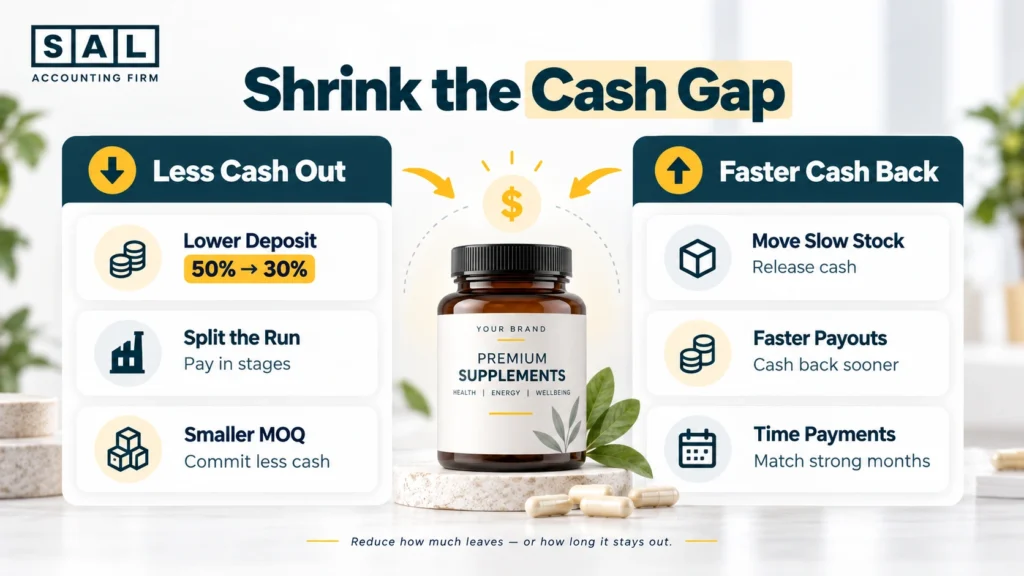
You can’t remove the gap, but you can often make it smaller. A few common levers:
- Negotiate the deposit: moving from 50% to 30% upfront shifts cash to later in the cycle.
- Split the run: ask for staggered releases, with part of the batch shipped and paid for later.
- Trade unit cost for MOQ: a smaller run at a higher price can free up cash, especially for new products.
- Move slow SKUs before reordering: clearing slow stock releases cash already tied up.
- Shorten payout timing: faster payout schedules or a better channel mix can bring cash back sooner.
- Line up big payments with strong sales months: avoid final payments landing in your slowest season.
Each option has a trade-off. A lower deposit may come with a higher unit price. A smaller run may mean more frequent orders. The goal is to pick the trade-off your cash can handle.
- Read more: “How to Scale an Ecommerce Brand”
What Should an Online Supplement Brand Know Before Approving the Next Production Run?
Before you sign the purchase order, make sure you can answer these:
- How much cash is available right now?
- What deposit does this run need, and when?
- What payments are still due on the current batch?
- How many units are on hand, and how long will they last?
- How much will sell before the next payment is due?
- What Shopify and Amazon payouts are expected, and when?
- When does this batch need to be ordered to avoid a stockout?
- What other cash is already committed, like ads, payroll, or tax?
The decision shouldn’t rest on “we sold this many units last month.” It should rest on how much cash stays available through the whole cycle.
This is also where the bigger picture comes in. A supplement cash flow forecast adds every other inflow and outflow to your production timeline. As production runs get bigger, having someone review these numbers with you before each order is what a virtual CFO for ecommerce does.
At the end of the day, the right question isn’t “can we afford this batch?” It’s “can we afford this batch while the last one is still selling?”
Final Thought: Is Your Next Production Run Funded Until the Payouts Arrive?
A profitable supplement brand can still run short of cash, because production is paid for months before it’s paid back. MOQs set how much you commit. Deposits, lead times, sell-through, and payouts decide how long that cash stays away. Reorder overlap is usually where it hurts most.
Map your production cycle once, with every payment and payout on a timeline. Then check it before every reorder.
Want a clearer view of the numbers behind your growth? Start with our growth blueprint for Canadian Shopify brands.