Helping your e-commerce business navigate cross-border challenges and boost profits when selling into the US market
Most Canadian e-commerce brands expanding into the US leak profits through financial inefficiencies they didn’t realise existed. Our blueprint for success helps you address these leaks and build the foundations for cross-border e-commerce growth.
We’ve developed a 3-step financial framework for Shopify brands. Backed by over a decade of US-Canadian e-commerce experience, this will help you take a strategic approach to accounting to expand your business.
What Our Framework Covers
- Key cross-border challenges and how to address them
- How to avoid hidden profit leaks and tax missteps that cost brands money
- Ways to overcome financial data issues and improve your decision-making
- Top integrations that will improve your financial infrastructure
This 3-Step Profit Boost Framework for Canadian Shopify Brands is a resource e-commerce business owners will wish they had sooner!
SAL Accounting’s Proven Framework for Cross-Border E-Commerce Growth on Shopify
Step 1: Improve Your Financial Data
In e-commerce accounting, unreliable data leads to issues with compliance, reporting, and decision-making, which affects your profits. This is often overlooked, as many e-commerce founders focus heavily on sales, ads, ROAS (return on ad spend), conversion rate, and fast growth.
When your numbers are unreliable, it affects every growth decision, such as:
- Pricing setting
- Ad spend
- Inventory planning
- Hiring and expansion
- Cash flow management
What Does Good Financial Data Look Like?
Good financial data foundations require modern, integrated accounting systems and processes that provide a single source of truth. For Shopify brands, this means striving for:
- Efficient reconciliation
- Clean bookkeeping
- Platform-specific reporting
- A separation between personal and business finances
- Forecasting capabilities and proactive accounting
Solutions to Common Financial Data Challenges at Each Growth Stage
At the end of the day, traditional accounting systems are rarely built around how e-commerce businesses actually operate. So, as your business grows, you need a system that works for you, not around or against you.
Here are the main e-commerce growth stages, key challenges founders face, and the steps to establishing good financial data foundations:
Early Stage (Up to $25k/month in sales)
Many Shopify brands start with largely manual accounting processes. We’re talking spreadsheets and basic transaction tracking. As sales grow, you can’t run proper e-commerce accounting like this. It’s time-consuming, error-prone, and lacking clarity
It’s time to treat your Shopify store as a serious business, rather than a side hustle. This means proper business banking, expense and tax management, and choosing the right Shopify plan.
| Financial Priority | What It Means |
|---|---|
| Main focus | Building proper accounting foundations |
| Key founder challenges | Managing finances manuallyMixing personal and business expensesRelying on spreadsheetsMaking decisions based on bank balances instead of genuine reporting |
| Biggest risks | Inadequate processes, unreliable data, and paying too much tax |
| Financial foundations to establish | Register for HST once sales thresholds ($30k) are reached Open separate business bank accounts and cards Start proper expense tracking – showing Shopify sales as revenue and other fees as expenses Get a clear view over ad spend and profits (using tools like Triple Whale) Move onto the right Shopify plan as sales increase |
Growth Stage ($25k–$100k/month in sales)
As Shopify stores grow, financial systems begin breaking down due to the complex data involved. You need to shift from simply tracking transactions to understanding the business financially and investing in the right systems and processes.
By connecting your data sources and bringing in specialist accounting support, you can reconcile transactions and expenses properly and get a better view of your finances.
| Financial Priority | What It Means |
|---|---|
| Main focus | Moving beyond DIY financial management |
| Key founder challenges | Delayed bookkeepingUnclear marginsInconsistent reportingDisconnected financial systems, for example, if A2X isn’t connected to link between your Shopify portal and QuickBooks accountUncertainty around true profit levels |
| Biggest risks | Inaccurate reporting due to data and processes not being aligned |
| Financial foundations to establish | Implement accounting software properly Hire e-commerce-focused accounting support Improve Shopify reconciliation Build reliable monthly reporting Gain visibility into contribution margins and cash flow |
Scaling Stage ($100k–$500k/month in sales)
As you scale further, addressing cross-border challenges and improving your processes are crucial. Any small inefficiencies can now have a big impact. Those that scale most effectively develop clear financial systems before problems become expensive.
It’s time to invest in forecasting and planning tools, review your business entity structures, and ensure you’re paying the right amount for Shopify.
| Financial Priority | What It Means |
|---|---|
| Main focus | Achieving clear data for activities across borders and channels |
| Key founder challenges | Reporting is misaligned across:ShopifyPayment processorsInventory systemsCurrenciesTax jurisdictionsInefficiencies and inaccurate data start to impact:Profit marginsCash flowOperational decisionsTax exposure |
| Biggest risks | Processes and systems that don’t talk to each other, leading to data errors, delays, and poor decision-making |
| Financial foundations to establish | Review your US entity structures Coordinate your cross-border tax needs and monitor sales tax exposure Reduce your Shopify fees Review/choose suitable inventory management systems Sync up systems to establish a clear and efficient reporting infrastructure |
Established Brand ($500k+/month in sales)
At higher revenue levels, accounting becomes far more than bookkeeping and compliance. It becomes a competitive advantage. The best e-commerce brands are not just strong marketers; they also operate with reliable data, clear insights and systems that accommodate growth.
This requires proper investment in the right people, processes, and systems to make decisions that move the needle, respond to change, and stand up to regulatory scrutiny.
| Financial Priority | What It Means |
|---|---|
| Focus | Building better decision-making infrastructure |
| Key founder challenges | The quality of your financial setup now directly impacts:OperationsForecastingExpansion planningFinancing opportunitiesRisk managementLong-term profits |
| Biggest risks | Not upgrading systems or keeping up with the cross-border compliance needs |
| Financial foundations to establish | Operate with advanced financial reporting and proactive accounting Get a clearer view of your inventory Ensure your systems are audit-ready Introduce repeatable processes and better controls Get specialized e-commerce financial support |
Step 2: Reduce Common Profit Leaks
Ensuring you have reliable, accurate financial data is a good foundation for e-commerce growth. However, there are still various pitfalls to avoid when selling into the US.
We outline the ways to avoid these pitfalls and plug costly profit leaks:
1) Choose the Right Shopify Pricing Plan for Your Growth Stage
Many businesses pay for Shopify features they don’t need or make do with an inadequate plan. This leads to missed opportunities and unnecessary costs. It’s important to properly assess your needs and choose a Shopify subscription that’s right for you.
Here’s an overview of the main Shopify plans and their pricing:
| Shopify Plan | Current Annual Billing From | Best Fit | Main Cost Note |
|---|---|---|---|
| Starter | Check current pricing | Link and social selling | Not a full online store |
| Basic | $37 CAD/month | First full Shopify store | Higher payment rates |
| Grow | $99 CAD/month | Stores with steady sales | More features, lower rates |
| Advanced | $389 CAD/month | Scaling stores | Big jump for beginners |
| Plus | From $3,400 CAD/month | Large brands | Enterprise-level cost |
Most new Canadian e-commerce founders start with the Basic Plan and scale from there. But as you grow, review the features, fees, and thresholds in each plan to determine the most suitable tier. For example, the Advanced Plan unlocks premium tools and offers lower transaction fees, which can make a big difference as your sales volumes increase.
While some businesses are reluctant to pay a large amount upfront, it’s often a good idea to use annual billing, which can save you around 25%.
Further reading: Check out our extensive guide to Shopify pricing and costs, which compares the different plans, what you’ll pay, and the main suitability factors.
2) Differentiate Your Revenue from Your Payout
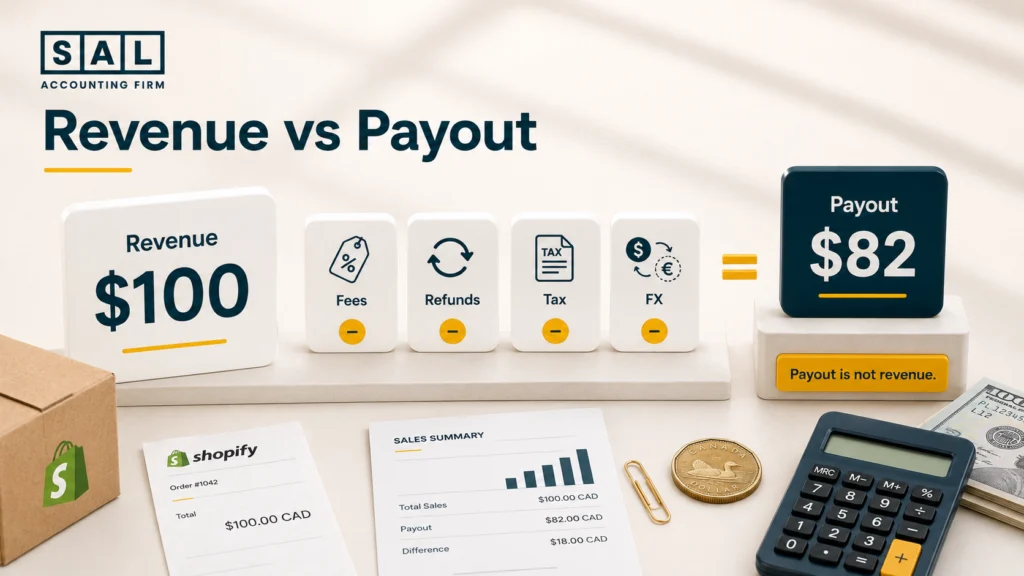
Many growing e-commerce businesses confuse what hits their account with their revenue. What you receive from your sales is your payout, not your revenue. Essentially, it’s what’s left from the transaction after fees, taxes, refunds, adjustments, and currency conversion.
So, from a transaction of, say, $100, you may ultimately only receive $82. This is your payout. And your books should reflect this, so there’s a clear distinction between what you sold and what you received.
Here’s a graphic to demonstrate:
Also, don’t forget your landed cost (which includes supplier costs, duty, freight, brokerages, and import fees), and platform fees. These will give you a true picture of your profits.
As you move up the Shopify tiers, you’ll get the benefit of lower transaction and payout fees.
Further reading: For more about payouts, transaction fees and pricing, and cross-border activities that add costs, read our Global E-Commerce Accounting Guide.
3) Set Up Your Books for US and Canadian Activities
It’s important to get the basics set up early. Things like picking your base currency (most Canadians choose CAD), using a multi-currency account, establishing clear categorization, and tracking FX gains and losses.
When selling into the US, your books should separate the following:
- Canada vs US sales
- Revenues from different channels
- Refunds
- Platform fees
- GST/HST
- US sales tax
- Landed cost
- FX gains and losses
- Activities between your Canadian and US companies
Further reading: Read more about payouts, transaction costs, and cross-border e-commerce best practices in our guide to global e-commerce accounting.
4) Learn About Your Cross-Border Tax Obligations
A common issue sellers run into when shipping across the US is not knowing about different sales tax rules. You need to understand your tax obligations, as this will help you stay compliant and avoid risks of penalties.
Find Out What Sales Tax You’ll Pay in Your Chosen US States
US states have different base tax rates and thresholds, based on sales and transaction volumes. If you don’t know what (and when) you need to pay, you can end up backpaying tax owed, incurring penalties and unnecessary interest, and running into cash flow issues.
So, register for sales tax in US states that you’re operating in via the state’s online tax portal, following the necessary steps to get your sales tax permit to collect it legally. You’ll need to submit your sales tax returns monthly, quarterly, or yearly, depending on each state’s rules.
Here’s a snapshot of the sales tax rates and thresholds in the largest US states:
| State | Base Tax Rate | Economic Nexus Threshold | Important Note |
|---|---|---|---|
| California | 7.25% | Over $500,000 in sales | Local taxes may apply |
| New York | 4% | Over $500,000 and 100 sales | Both tests apply |
| Texas | 6.25% | Over $500,000 in revenue | Total rate up to 8.25% |
| Florida | 6% | Over $100,000 in taxable sales | No transaction test |
| Illinois | 6.25% | $100,000 in sales | Transaction test removed |
Rates and thresholds verified July 15, 2026. Confirm current requirements with the relevant state tax authority.
Monitor Your Sales Tax Nexus
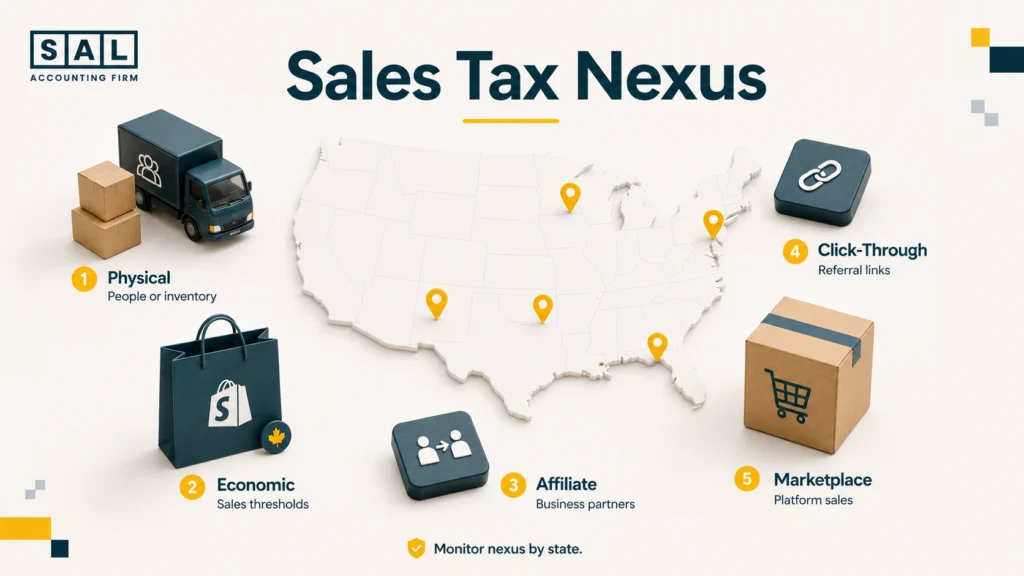
Sales tax nexus is applied when business activities reach certain thresholds. Here are the main nexus categories and triggers:
- Physical nexus – related to physical locations or employees, where you may have workers, offices, goods stored in warehouses or events based in a particular state.
- Economic nexus – based on sales or transaction levels for goods sold in a US state.
- Affiliate nexus – for collaborative activities and partnerships with in-state businesses, where referrals trigger a sales tax liability.
- Click-through nexus – sales from in-state links, such as affiliate ads.
- Marketplace nexus – sales tax requirements for selling on platforms like Amazon, with some platforms handling these obligations for you, according to marketplace laws.
Keeping on top of your sales tax requirements and nexus triggers helps you avoid accounting issues that drain your profits. We recommend reviewing them every few months and using our U.S. Economic Nexus Threshold Checker to identify whether your sales may have created new state sales tax obligations.
Further reading: Learn more about sales nexus thresholds in our article, Sales Tax Nexus Explained: What Every E-Commerce Seller Needs to Know.
Manage Your Sales Tax Reporting Effectively
Shopify has a built-in tool for sales tax reporting. It shows how much sales tax you collected and, when configured correctly, breaks it down by region. This helps you prepare for filing your returns. When setting it up for the US, it automatically calculates sales tax rates for each state. You can then analyze data, apply filters, and export tax reports.
You’ll still need to review your reports and file returns. However, you can integrate third-party tools, such as Avalara, TaxJar and Taxify, to automate tax calculation, filing, and nexus tracking.
Our video on how to review sales tax reports in Shopify walks you through the process step by step:
5) Decide If and When You Should Set Up a US LLC
When selling products in the US, it might seem the natural step to set up a US LLC, right? Especially as foreign Shopify sellers must pay an 1.5% international payout fee on each US sale. However, it’s not a legal requirement. And by setting up an LLC in the US, there’s cross-border tax compliance to consider.
Cross-border tax filing costs start at around $3,500 per year. Also, it opens you to potential double taxation and penalty risks if you file incorrectly (up to $25k). More on that shortly…
So, consider your US vs Canadian sales percentage, as this dictates the difference between the amount of money you’ll end up paying in foreign seller fees vs the amount you’ll pay for cross-border tax compliance costs.
Use Our Handy Shopify Fees Calculator
Our Shopify LLC fee savings calculator is a good indicator of whether setting up a US LLC will make sense for you, based on your cross-border e-commerce activities/sales levels.
Simply add in the Shopify plan you’re on and your current (or projected) monthly sales in the US and at home. It automatically calculates cost savings alongside a quick explainer.
6) Avoid Double Taxation and Costly Filing Penalties
You may also think you’re saving on tax with a US LLC, due to the lower corporate tax rate compared to Canada. Well, when you own a US LLC for this purpose, the CRA can treat this LLC as foreign dividends, meaning you pay tax twice! And if you don’t file things correctly, you may be hit with financial penalties.
Double-tax risks
Essentially, when you submit your taxes, the IRS in the US deems your LLC as a “pass-through” entity. This means profits pass directly to the owner and may be taxed personally. Meanwhile, in Canada, the CRA will view your US-based LLC as a separate corporation.
So, you may be asked to pay tax for income in Canada and again in the US, without foreign tax credits offsetting the duplicate liability. Hence, double taxation. Our Founder, Salman, explains more in this great video:
If you want to set up a US LLC (or already have one) but avoid double tax, your Canadian-based corporation must take ownership of this US LLC. The US LLC should manage your transactions in America, reporting income back to your Canadian corporation. Let the IRS know you’re submitting all income reporting to the CRA and paying it through your Canadian organisation, which is made possible by the US & Canada tax treaty.
Sounds complicated? Don’t worry, let Salman walk you through the process:
Filing penalty risks
Missed or incorrect tax filing in the US can lead to a $25K penalty, while misfiling in Canada incurs a smaller penalty of $2,500.
You must file a completed 1120-F by April 15 in the US to prevent nasty fines, alongside your T1134 in Canada, within your particular deadline. The forms need to show that all income is being submitted under your Canadian corporation, which has a foreign company under it that manages transactions accepted in the US and organizes accounts for these activities.
If you’ve missed filing deadlines in Canada, there’s a Voluntary Disclosures Program to help you catch up, which often sees penalties being waived.
Further reading: Learn more about avoiding IRS penalties and correct form filing.
How We Saved a Leading Toy Seller $30k Each Month
We use our e-commerce accounting expertise and strategic insights to help Shopify brand owners save money. One of those is David, who sells toys online (TeddyBlock.com), and was doing $2 million p/m in sales.
We advised him to open a US LLC to avoid costly Shopify fees racking up and ensure the LLC wasn’t owned by him directly but rather by his Canadian corporation. This helped him:
- Save 30k every month in fees
- Avoid a 53% tax rate on personal income and the double tax issue with the CRA
- Prevent penalties of $25k for potential missed filings with the IRS
- Get peace of mind and focus on growing his store
Further reading: Learn more about how we can handle your US and Canada tax filing and obligations to save you unwanted costs.
Step 3: Make Your Financial Systems More Efficient
If you’re getting serious about e-commerce growth, you need to get serious about financial infrastructure, as Shopify stores often outgrow their existing systems.
Here’s how to create a financial infrastructure that scales and stands up to scrutiny:
1) Get Your Systems Audit-Ready
- Connect your payment tools with accounting software and other platforms for a proper flow of data.
- Ensure you have clear, timestamped audit trails for your financial activities.
- Automate key processes, where possible, using third-party tools (including accounting software) and built-in Shopify automation features.
- Correctly log US-based sales as zero-rated for Canadian GST/HST.
- Set up approval controls for important financial decisions.
- Retain records responsibly and for the appropriate length*, and show proof of sales tax registration, invoices, import/export, CBSA/CBP customs declarations, etc.
Check out our recordkeeping recommendations below.
2) Use Digital Tools That Help You Meet Compliance Requirements
Consider using various tools and integrations for different compliance areas, such as:
- Tax compliance: Tools like Avalara and Lappa help Shopify brands to meet tax rules in different countries and jurisdictions.
- Data protection/consent compliance: OneTrust and Termly are a couple of options to help you comply with privacy regulations, such as PIPEDA in Canada and various US privacy requirements.
- IT/cybersecurity compliance: Boost your security with solutions like CloudFlare, CrowdStrike, and other Shopify integrations to improve resilience.
- Anti-fraud compliance: Shopify has built-in fraud analysis features, as do payment processors, but it’s worth exploring integrations like Chargeflow, Blockify, and Signifyd.
3) Follow E-Commerce Operating Laws and Understand Your Recordkeeping Responsibilities
Familiarize yourself with e-commerce operating laws in Canada and those across the border, including registering your business entities, submitting key forms to relevant authorities, and meeting your sales tax liabilities.
Good recordkeeping is also paramount. Ensure you have a secure, central place for important documents, including:
- Invoices
- Tax submission
- Customs documentation
- Resale certificates
- Key contracts and agreements
- Transfer pricing documentation
The CRA has strict rules on keeping records in your place of business in Canada and retention periods. You must keep records for up to 6 years after the related tax year. However, the CRA may request you retain records for longer than 6 years for auditing purposes.
It’s worth seeking out legal counsel and working with e-commerce tax specialists. They can help you fulfil your initial obligations and understand what you need to do as your business grows.
4) Increase Your Inventory Management Capabilities
Good inventory management comes from strong forecasting and clear views of your stock levels. Overstocking can cost money in storage and waste, while understocking leads to missed sales.
Consider investing in top inventory management systems, such as Microsoft Dynamics 365, Cin7, NetSuite, QuickBooks Commerce, and Inventory Planner (powered by Sage).
Features and capabilities to look for include:
- Real-time and in-transit inventory tracking
- SKU-level and warehouse-level data and insights
- Integrated operations (syncing up finance, sales, and procurement processes)
- Customizable options and scalable solutions
Sophisticated inventory management platforms help you forecast effectively based on seasonality, cash flow, lead times, freight timelines, and marketing activities. They also highlight potential issues, such as slow-moving SKUs, aging stock, and markdown risks.
5) Improve Your Operations with Key Shopify Integrations
If you have ambitious growth plans, slick operations are critical. And tech solutions that work well together (backed by integrations) help you to scale your business effectively.
Here are some of our Shopify integration recommendations for different workflows:
- CRM (customer relationship management) for segmentation, email automation, and remarketing, plus data insights: HubSpot, Salesforce, or Klaviyo
- Smooth order processing and shipping solutions: ShipStation
- Ads and email performance analytics: Triple Whale
- Multichannel reconciliation and payout matching: A2X or Synder
These are just a handful of solutions. Whatever your workflow, there are Shopify integrations to improve it.
We found that 68% of merchants overlook these kinds of integrations, resulting in 22% in lost revenue due to inefficient systems and processes. For example, CRM platforms help improve customer engagement, encourage repeat purchases, and increase profits (often by between 25-95%).
Further reading: Explore our guide to the Best CRM platforms for E-Commerce and the 12 Must-Have Apps to Scale Your Shopify Store.
6) Take a Proactive Accounting Approach
A fully integrated financial infrastructure helps you operate smoothly and stay ahead of potential issues. Here is what proactive accounting looks like:
- Tracking and monitoring ongoing performance, and analyzing data in real time
- Regular process reviews, risk management, and compliance and tax liability checks
- Stepping up your reconciliation frequency as your sales increase
- Establishing standard operating procedures (SOPs) to make financial processes repeatable and easier to manage
- Upgrading security tools and training regularly
- Improving cash flow management and seeking potential lending opportunities, such as invoice finance or Shopify’s own lending solutions
- Staying on top of key financial dates, such as tax filing dates, payroll deadlines, and upcoming compliance requirements, and setting reminders and automation triggers
7) Getting CPA Support
The bigger your brand gets, the more complicated your accounting and bookkeeping become. If your in-house cross-border payments and tax expertise is limited, you may need help from a CPA (certified public accountant). E-commerce CPAs are more than just accountants or bookkeepers. They help you address global challenges, maintain compliance, and implement the right systems.
Working with a CPA makes sense when:
- Manual processes are making month-end a recurring headache
- Profit margins are going up and down, but you’re not able to see the influencing factors
- Cash flow is uneven, and inventory management feels chaotic
Further reading: Learn more about when you need a CPA and the typical costs.
Download Our Financial Checklist for Growing Canadian Shopify Brands
Based on our framework for increasing profits and scaling your Canadian Shopify store, we’ve created a practical financial roadmap that shows which actions to consider at each stage of growth.
Download the Canadian Shopify Financial Growth Roadmap to see what to focus on as your sales increase, your store enters new US states, and your financial responsibilities become more complex.

Four growth stages tied to real monthly sales figures
- Four growth stages tied to real monthly sales figures
- The bookkeeping mistake that quietly invites CRA audits
- When a US LLC makes sense, and when it does not
How SAL Accounting Can Help
SAL Accounting is a leading CPA accounting and bookkeeping firm that’s passionate about helping Canadian e-commerce brands grow their Shopify stores and enter the US market.
We understand the challenges of expanding into the US, and we know how to get businesses moving and keep them compliant. Our role is to simplify cross-border finances and take the stress out of accounting, so you can focus on growing your brand.
As a leading CPA for Canadian e-commerce businesses, we can support you with tax planning and compliance, inventory, COGS (cost of goods sold), financial reporting, and entity setup.
We have over a decade of e-commerce experience and specialist Canada-US cross-border knowledge. And we take a collaborative approach, explaining why things need to change, what risks you’re exposed to, and their impact on your profits.
Get in touch to learn more about our CPA services or to discuss any challenges you’re experiencing with your current e-commerce accounting.