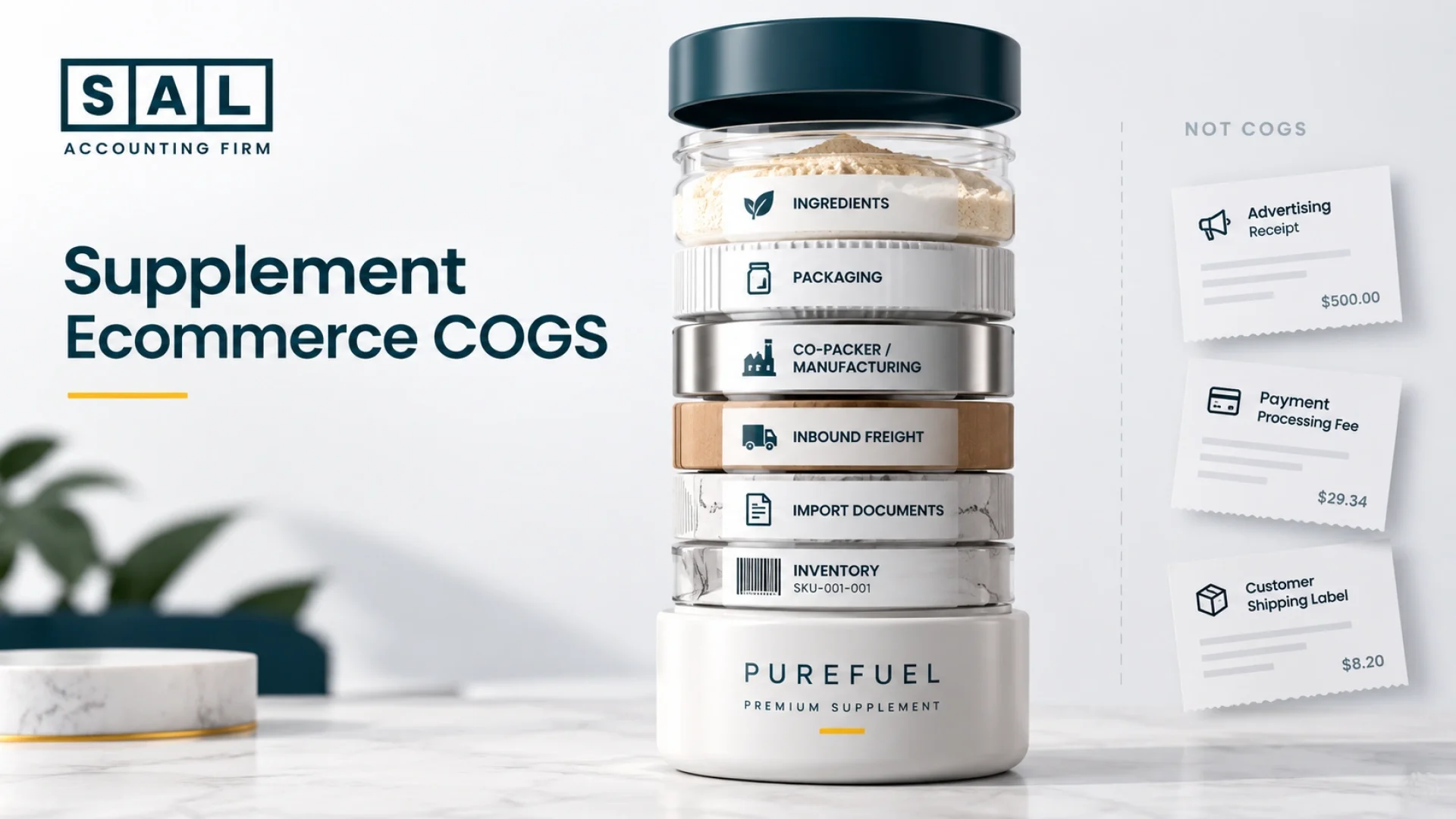
Does your supplement business have solid sales, but you’re not sure which costs should be included in COGS? Putting the wrong costs there can push COGS too high or too low and distort your gross margin.
Ingredients, packaging, manufacturing and inbound freight can form part of inventory cost, while selling costs stay separate. SAL Accounting works with ecommerce brands on these numbers. Read on to see what belongs in COGS and what doesn’t.
See how changes in product cost flow through to operating profit with the Ecommerce EBITDA Calculator.
Quick Takeaways
- COGS tracks inventory sold, not everything the business pays for during the month.
- Product, ingredient, packaging and relevant manufacturing costs can form part of inventory cost.
- Inbound freight and applicable import duties can also form part of inventory cost.
- Advertising, payment fees and outbound customer shipping generally stay outside product COGS.
- Unsold inventory remains on the balance sheet until the related products are sold.
- What you pay a manufacturer in a month does not have to match that month’s COGS.
What Is COGS for a Supplement Ecommerce Business?
COGS, or cost of goods sold, is the cost attached to the supplement products sold during a specific period.
For an ecommerce supplement business, COGS can come from buying finished products or producing them. Unsold inventory stays on the balance sheet until the related products are sold. The CRA’s guidance on inventory and cost of goods sold explains the role inventory plays when calculating business income.
The basic calculation is:
Opening Inventory + Purchases and Production Costs − Ending Inventory = COGS
For example, a business starts the month with $40,000 in inventory. It adds another $100,000 in purchases and production costs during the month and ends with $55,000 in inventory.
That leaves:
$40,000 + $100,000 − $55,000 = $85,000 COGS
That $85,000 depends on having the inventory and related transactions recorded correctly. A good starting point is knowing how to categorise ecommerce transactions so inventory, fees and operating expenses do not end up mixed together.
For the bigger picture, accounting for an online supplement business also needs sales, inventory, payouts and expenses to tell the same story.
What Costs Are Included in Supplement Ecommerce COGS?
Supplement COGS starts with the costs of buying or producing the inventory. Costs tied to selling, marketing or fulfilling the final customer order are a different matter.
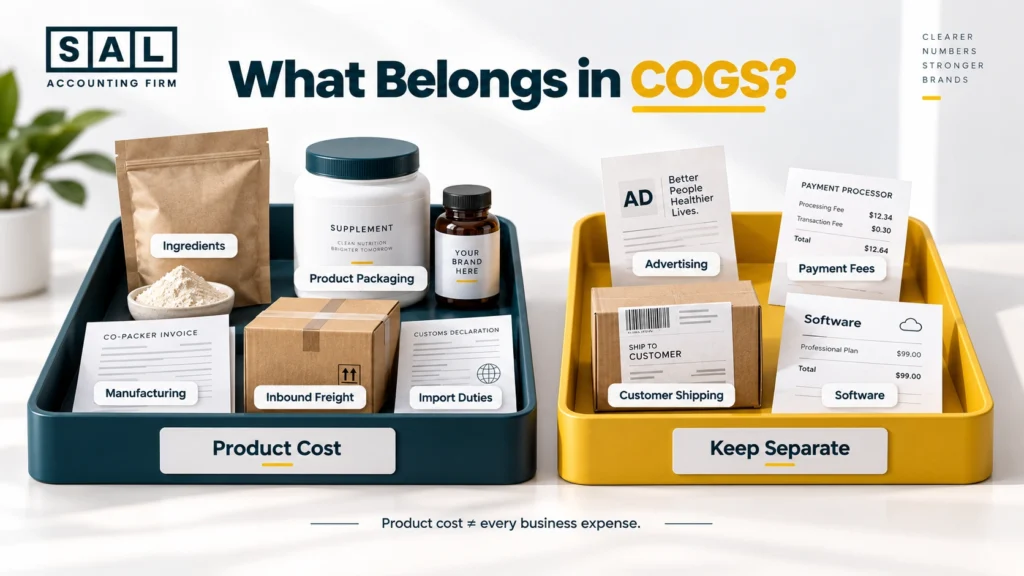
For a Canadian supplement business, product cost can start with the finished goods themselves and build from there. Raw materials, product packaging, production work, freight-in and applicable import costs can all form part of inventory cost depending on what the charge actually covers. Here’s the simplest way to separate the main costs:
| Cost | Usually Part of Product Cost? | Why | Example |
|---|---|---|---|
| Ingredients | Yes | Become part of finished product | Protein powder, vitamins |
| Product packaging | Yes | Part of finished inventory | Bottles, tubs, labels |
| Manufacturing | Yes | Converts materials into product | Co-packer production |
| Inbound freight | Usually | Brings inventory to location | Factory → warehouse |
| Non-recoverable import duties | Usually | Cost of acquiring inventory | Customs duty |
| Payment processing | No | Transaction cost | Shopify Payments fee |
| Outbound shipping | Generally no | Customer fulfilment cost | Warehouse → customer |
| Advertising | No | Marketing cost | Meta Ads |
| Software | No | Operating expense | Accounting software |
The distinction becomes easier once you understand which ecommerce costs should be capitalised or expensed.
Product and Manufacturing Costs
If you buy a finished supplement from a supplier, the product’s purchase price is usually the starting point.
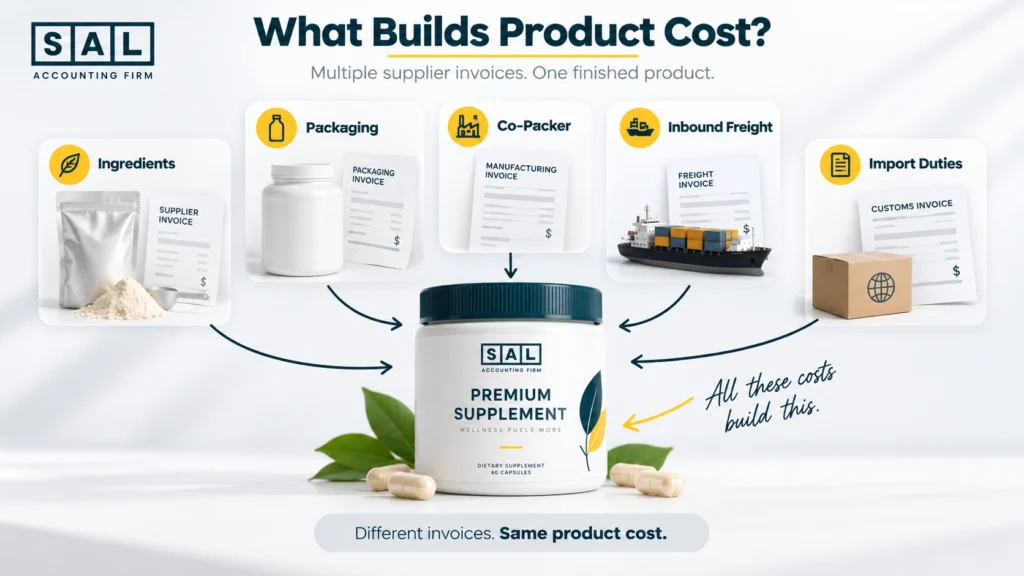
Manufactured supplements are a little different because several costs can go into the same batch. You might pay one supplier for ingredients, another for packaging and a co-packer for production. Those are different invoices, but they can all relate to the same inventory.
Ingredients and Raw Materials
If an ingredient goes into the supplement you sell, its cost is tied directly to producing that inventory.
Say you buy your own powder, vitamins or other ingredients and send them to a co-packer. You have paid for materials that will become part of the finished product.
That is different from paying for software, advertising or other costs of running the business.
Packaging Used to Make the Product
Packaging that becomes part of the supplement belongs with the product cost. That could include:
- bottles;
- tubs;
- pouches;
- product labels; and
- other packaging that becomes part of the finished product.
The key distinction is between packaging the product and packaging used to ship an order.
A bottle or pouch becomes part of the product. A shipping box used to send the finished product to a customer is part of fulfilment.
Manufacturing and Co-Packer Charges
If a co-packer charges you to turn ingredients and packaging into finished supplements, that production work is tied to the inventory.
For example, say a co-packer charges $12,000 to produce 5,000 units. If the fee covers blending, filling, bottling and labelling, it relates directly to producing those units.
The important part is checking what the invoice actually covers. A co-packer invoice may include production alongside storage, handling or other services, so the full invoice should not automatically be pushed into one account.
Pro tip: Don’t book a co-packer invoice from the total alone. Check what each line is actually charging you for first.
Import Duties on Inventory
If you import supplements, certain customs duties paid to acquire those goods can form part of inventory cost.
Under IAS 2, inventory cost includes purchase costs, costs of conversion and other costs required to bring inventory to its present location and condition.
That means you should not automatically add every tax amount shown on an import document to inventory.
Recoverable taxes need to be treated differently from costs the business cannot recover.
Costs to Prepare Inventory for Sale
The basic principle is to look at what it took to acquire or produce the inventory and get it into its present location and condition.
Once the product is ready for sale, the costs of marketing it, processing the customer’s payment or delivering the order generally tell a different story.
A cost does not become COGS simply because it happened before a customer placed an order.
Freight-In and Inbound Transportation
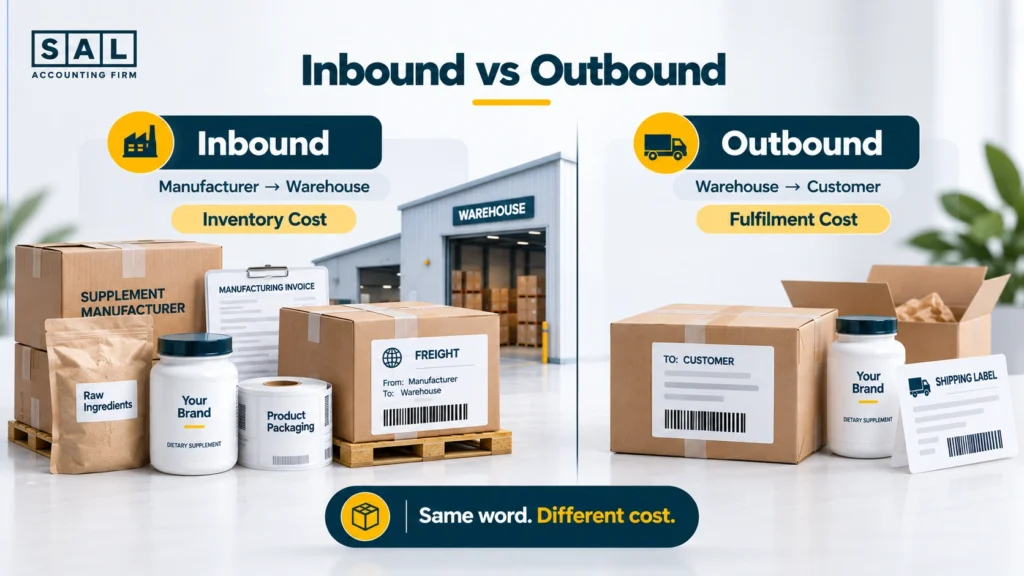
Freight used to bring inventory into the business is different from shipping a completed order to a customer.
Suppose a manufacturer sends 5,000 bottles to your Canadian warehouse and you pay $2,500 for transportation. That freight is connected with acquiring and bringing the inventory to its location.
Now take one of those bottles and ship it from the warehouse to a customer. That is outbound fulfilment.
Both invoices might say “shipping,” but they do not represent the same cost.
Pro tip: Ask where the product is going. Factory → warehouse and warehouse → customer may both be shipping, but they belong to different parts of the P&L.
- Read more: “Inventory Landed Cost Accounting for Ecommerce”
Case Study: How a Supplement Brand in The Junction Finds Its Real Product Cost1
A supplement brand in The Junction, Toronto sells five main products through Shopify. Sales are growing, but the owner notices that the margin on one of the best-selling products looks unusually high.
The Problem
The product is made by a co-packer, while the business buys some ingredients and packaging separately. The manufacturing fee is recorded with inventory costs, but some packaging and inbound freight are sitting in other expense accounts. One illustrative production run includes:
- $18,000 in ingredients;
- $7,500 in packaging;
- $9,000 in co-packer charges; and
- $2,500 in inbound freight.
Some finished units are also still sitting in the warehouse.
What We Do
We bring the supplier and co-packer invoices together and match the relevant costs to the production run. We then separate the cost attached to units already sold from the amount still sitting in inventory.
Result
The business can see what the product actually costs without pushing every supplier payment directly into the current month’s COGS. The P&L becomes easier to read, and the owner has a more consistent product-cost figure for margin and pricing decisions.
For Shopify brands where inventory costs, fees and payouts are becoming harder to separate, Shopify Accounting keeps those pieces from disappearing into one net number.
How Do You Calculate COGS for an Online Supplement Business?
To calculate COGS, start with the inventory on hand at the beginning of the period, add the purchases and production costs added to inventory, then subtract what remains unsold at the end.
Opening Inventory + Purchases and Production Costs − Ending Inventory = COGS
Using the same example:
| COGS Component | What It Represents | Treatment | Amount |
|---|---|---|---|
| Opening inventory | Stock already on hand | Add | $40,000 |
| Purchases/production | Costs added to inventory | Add | $100,000 |
| Ending inventory | Stock still unsold | Subtract | $55,000 |
| COGS | Cost attached to sold inventory | Result | $85,000 |
The $55,000 still sitting in inventory does not become this month’s COGS simply because the business has already paid for it.
A supplement brand can therefore make a large production payment without recording the full payment as COGS in the same month.
- Also read: “How to Calculate COGS for Ecommerce Stores”
Once you know what belongs in inventory, the next decision is how that cost gets assigned across units. The difference between FIFO and weighted-average inventory costing becomes relevant at that stage.
Which Costs Should Stay Outside COGS?
Costs related to selling orders, marketing products or running the business generally sit outside product COGS.
A useful question is: Did this cost go into acquiring or producing the inventory, or did it arise because we were selling and running the business?
The answer usually points you in the right direction.
Selling and Transaction Fees
Payment processing fees and marketplace commissions are tied to the transaction rather than producing the supplement itself.
For example, if a customer pays $100 and the payment processor charges $3, that $3 is a payment-processing cost. The same idea applies to marketplace selling fees.
Selling through several platforms adds another layer because each channel may take different deductions before sending you a payout. That’s where multichannel supplement ecommerce accounting becomes important.
Fulfilment and Outbound Shipping
A 3PL invoice can contain several different charges, including:
- receiving inventory;
- storage;
- picking and packing;
- shipping;
- returns; and
- other handling fees.
Those charges should be reviewed based on what service was actually provided.
A 3PL invoice does not mean every line belongs in product cost.
Shipping is easier to understand when you look at the direction:
Manufacturer → Warehouse: inbound transportation.
Warehouse → Customer: outbound fulfilment.
Routine storage after supplements are already in saleable condition is generally kept outside inventory cost. Under IAS 2, storage costs are generally excluded unless that storage is necessary in the production process before another production stage.
These balances should also be reviewed together at month-end. A proper supplement ecommerce month-end close brings inventory, fulfilment and other balances back into the same review.
Advertising and Marketing
Advertising is a cost of bringing customers to the product.
Example: if one bottle costs $8 to produce and the business spends $2,000 on Meta Ads that month, the $2,000 advertising spend does not become part of the $8 product cost.
The same principle applies to Google Ads, influencer campaigns and other marketing expenses. They still reduce profit. They just do it somewhere other than product COGS.
Software and Operating Expenses
Accounting software, ecommerce platforms, office expenses and other general operating costs normally sit outside inventory cost.
The cleaner way to handle these costs is through a chart of accounts built for supplement ecommerce so product costs, fulfilment, marketing and overhead each have a clear place.
How Do Private Label and White Label Sourcing Affect COGS?
The sourcing model changes how product costs appear on the invoice. The basic COGS principle does not change.
- White-label sourcing: A supplier sells you a finished supplement at one bundled price. Ingredients, production and packaging may already be included in that price.
- Private-label or customised production: Formulation, ingredients, packaging, manufacturing and labelling may appear as separate charges.
The invoice can therefore look very different between two supplement companies even when both are ultimately calculating the cost of finished inventory.
When Does Inventory Cost Become COGS?
Inventory cost becomes COGS when the related inventory is sold. The timing of the supplier payment does not control when the cost becomes COGS.
Under IAS 2, the carrying amount of inventory is recognised as an expense when that inventory is sold.
Say a business produces 1,000 bottles in September but sells only 600 by September 30.
The cost attached to the remaining 400 bottles does not normally belong in September COGS because those units are still inventory. Buying or producing inventory and selling inventory are two different events.
This is also why ecommerce reconciliation needs to go further than simply matching transactions to the bank. Inventory movements have to make sense too.
Why Doesn’t COGS Match What You Paid Your Manufacturer?
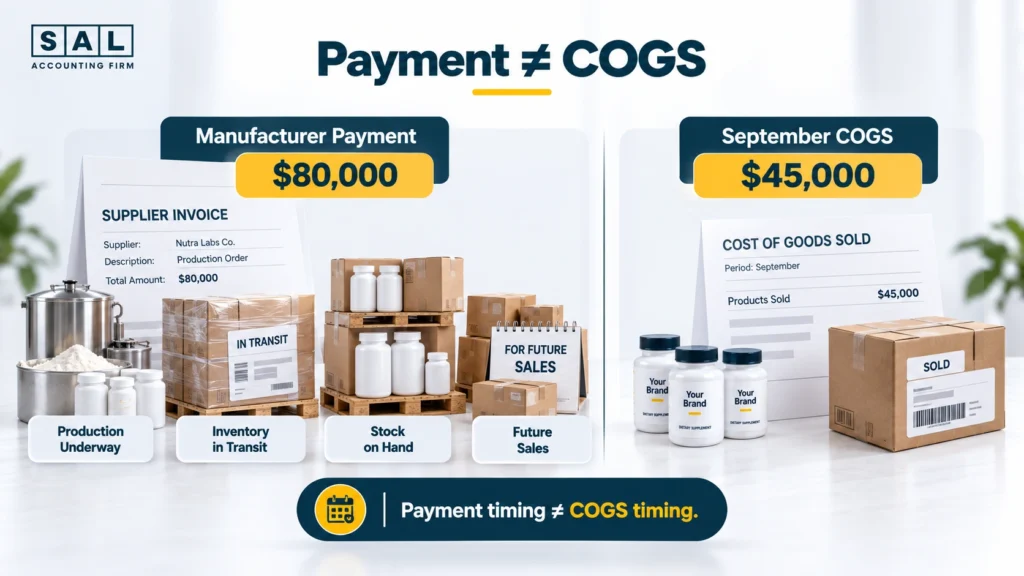
A manufacturer payment records when cash leaves the business. COGS records the cost attached to products sold during the period. A supplement company might pay its manufacturer $80,000 in September, but that payment could relate to:
- production still underway;
- inventory travelling to the warehouse;
- finished stock still on hand at September 30; and
- units that will not sell until October or later.
At the same time, September sales may include products manufactured and paid for months earlier. So the September P&L could show $45,000 of COGS even though the company paid the manufacturer $80,000.
That difference does not automatically mean something is wrong. It reflects timing.
Posting every supplier payment directly to COGS can make one month look less profitable and the next month look better than it really was. It’s one of the common problems that can creep in with DIY ecommerce bookkeeping.
Pro tip: Reconcile units as well as dollars. A supplier payment can be completely correct while the COGS showing on the P&L is still wrong.
Case Study: How a Streetsville Supplement Brand Separates a Manufacturer Payment From COGS2
A growing supplement brand in Streetsville, Mississauga pays $40,000 to a manufacturer in October for a new production run. The owner expects the full $40,000 to appear in October COGS, but it does not.
The Problem
The payment covers products that have not all been sold yet. Some production is still underway, while other finished units will remain in inventory for later orders.
At the same time, the company is selling products in October that were manufactured and paid for earlier. The $40,000 manufacturer payment and October COGS represent two different things.
What We Do
We review the manufacturer payment alongside the inventory records and October sales. The cost attached to inventory still on hand stays separate from the cost of products already sold.
We also review opening and ending inventory so the COGS figure reflects the units that actually moved during the month.
Result
The owner can see why the entire $40,000 payment does not belong in October COGS. The P&L reflects the products sold during October, while unsold inventory remains on the balance sheet.
Once supplier bills, inventory and sales volume become difficult to follow through a bank feed alone, Ecommerce Accounting gives those timing differences somewhere clear to go.
How Does COGS Affect Gross Profit and Gross Margin?
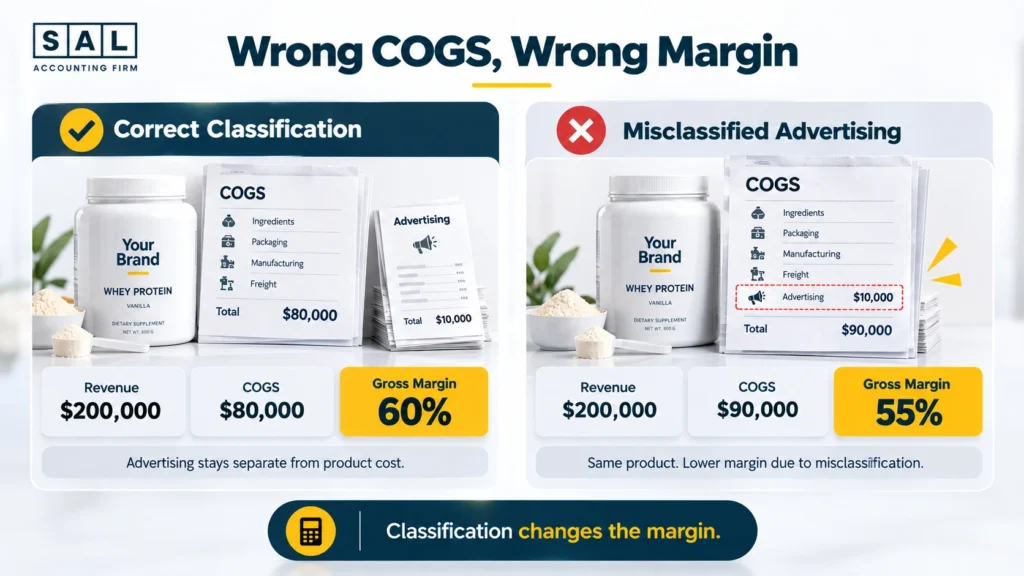
A higher COGS figure leaves less gross profit from the same amount of revenue. A lower COGS figure leaves more. For example, a supplement brand has:
- Revenue: $200,000
- COGS: $80,000
- Gross Profit: $120,000
- Gross Margin: 60%
Now imagine $10,000 of advertising is incorrectly added to COGS. Reported COGS becomes $90,000. Gross margin falls to:
($200,000 − $90,000) ÷ $200,000 = 55%
The business did not suddenly spend another $10,000 producing supplements. The marketing expense was simply sitting in the wrong category. That is why consistent COGS classification matters.
Misclassification is also one reason supplement brand profit can look wrong even when the underlying sales have not changed.
Pro tip: A lower gross margin does not always mean your product becomes more expensive. First check whether marketing, fulfilment or transaction costs accidentally moved into COGS.
What Are the Most Common COGS Mistakes for Online Supplement Sellers?
Most COGS problems come from one of two things:
- putting a cost in the wrong category; or
- recording it in the wrong period.
Here are the mistakes worth checking first:
| COGS Mistake | What It Causes | Better Approach | What to Check |
|---|---|---|---|
| Manufacturer payment → COGS | Timing errors | Track inventory first | Units actually sold |
| All purchases → COGS | COGS overstated | Account for ending inventory | Unsold stock |
| Ending inventory ignored | Margin distorted | Record closing inventory | Period-end count |
| Inbound/outbound freight mixed | Product cost unclear | Separate direction | Where goods are going |
| Every 3PL fee → COGS | Costs get mixed | Review each charge | Service provided |
| Advertising → COGS | Gross margin understated | Keep marketing separate | Ad spend |
| Payment fees → COGS | Selling costs mixed in | Track fees separately | Processor reports |
| Production costs missed | COGS understated | Review manufacturing | Supplier/co-packer invoices |
These are part of the broader ecommerce accounting mistakes that become harder to spot once order volume grows.
A monthly review catches many of them before they roll into another reporting period. This ecommerce bookkeeping checklist gives you a practical set of inventory, COGS, fee and reconciliation checks to work through.
Is Your Supplement Ecommerce COGS Accurate?
At the end of the day, accurate COGS should answer a pretty simple question: what did the products you actually sold cost the business? You should be able to explain:
- what went into the product cost;
- what is still sitting in inventory;
- why inbound and outbound shipping are treated differently;
- why a manufacturer payment does not automatically equal COGS; and
- why marketing, transaction fees and operating costs sit somewhere else.
As your supplement business grows, those answers get harder to see across more suppliers, larger production runs, multiple warehouses and additional sales channels.
Your financial reports for an online supplement business should bring those numbers together clearly enough that you can explain where your gross margin actually came from.
COGS should reflect the cost of the products you sold, not everything you happened to pay for that month.
Growing a Canadian Shopify brand? Get the Financial Growth Blueprint to see what your finance setup should look like as the business scales.