
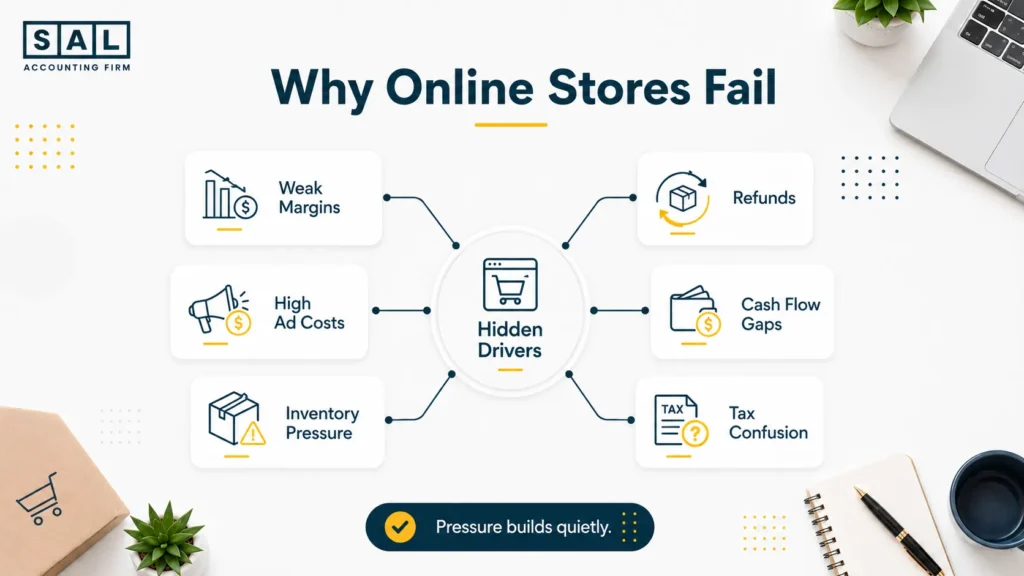
Most ecommerce stores fail because sales grow faster than the numbers behind them. Revenue may look strong, but weak margins, rising ad costs, refunds, inventory pressure, cash flow gaps, and tax issues can quietly drain the business.
For Canadian Shopify, Amazon, Etsy, and WooCommerce sellers, SAL Accounting helps make those numbers clear enough to trust. This guide will help you understand the ecommerce failure rate, spot the warning signs, and build a practical 90-day plan to avoid ecommerce failure.
If Shopify fees are already eating into your sales, the Shopify Fee Calculator gives you a quick place to start.
Quick Takeaways
- The exact ecommerce failure rate varies by source, so treat big percentages as warning signs, not fixed official facts.
- Many online stores fail because sales look strong, but profit and cash flow are weak.
- Paid ads can hide deeper problems with margins, repeat purchases, conversion rate, and AOV.
- Shopify and Amazon sellers need clean tracking for sales, payouts, fees, refunds, inventory, and tax.
- Canadian sellers expanding into the US should check sales tax exposure before US sales become hard to clean up.
- A practical 90-day fix starts with unit economics, then cash flow, CRO, retention, operations, and tax review.
Why Do Ecommerce Stores Fail, and Who Is Most at Risk?
Ecommerce stores usually fail because sales grow faster than the systems behind them. Orders may be coming in, but weak margins, high ad costs, returns, inventory pressure, messy payouts, and unclear tax obligations can quietly drain the business.
When those numbers start getting harder to trust,e-commerce bookkeeping can help separate what came in, what went out, and what the store actually kept. You might be wondering:
- “My store is making sales, but is it actually profitable?”
- “Why do my Shopify payouts not match what I expected?”
- “Why are Amazon deposits so hard to understand?”
- “Why does inventory keep eating my cash?”
- “Are my US sales creating tax problems I have not checked yet?”
E-commerce failure usually starts when the numbers get harder to trust. This post will help you spot the warning signs, understand what your store actually keeps, and build a practical plan to fix the weak points before they turn into bigger problems.
- Also read: “Why Most Amazon Sellers Fail”
What Is the Ecommerce Failure Rate?
There is no single official ecommerce failure rate. You may see claims that 80% or 90% of ecommerce stores fail, but those numbers are not always measuring the same thing. The percentage can change depending on:
- what counts as failure: closing the store, becoming inactive, losing money, or never reaching profit
- the timeframe: first year, first three years, or longer
- the business type: Shopify store, Amazon seller, marketplace brand, dropshipper, or full DTC brand
- the source: industry article, survey, platform data, or official business survival data
That is why official data tends to be more careful. The U.S. Bureau of Labor Statistics tracks “business survival rates by age, year, industry, and location. ISED Canada’s Key Small Business Statistics also looks at business births, disappearances, and survival over time. So the better question is not “what exact percentage of ecommerce stores fail?” It is this:
What makes an ecommerce store fragile in the first place?
Usually, the answer is unclear numbers. When sales look good but margins, cash flow, inventory, refunds, fees, and tax are hard to track, the business becomes much easier to misread.
| Question | Common Answer | Better Way to Think About It | What to Watch |
| What is the ecommerce failure rate? | “80-90% fail” | The exact number varies | Cash, profit, CAC |
| Why do ecommerce stores fail? | “Bad marketing” | Usually several leaks together | Margins, returns, fees |
| When do stores fail? | “At startup” | Often when scaling exposes weak numbers | Inventory, payouts, tax |
| How do stores survive? | “Get more traffic” | Fix the economics first | COGS, AOV, cash flow |
Why Do Ecommerce Stores Fail Even When Sales Are Growing?
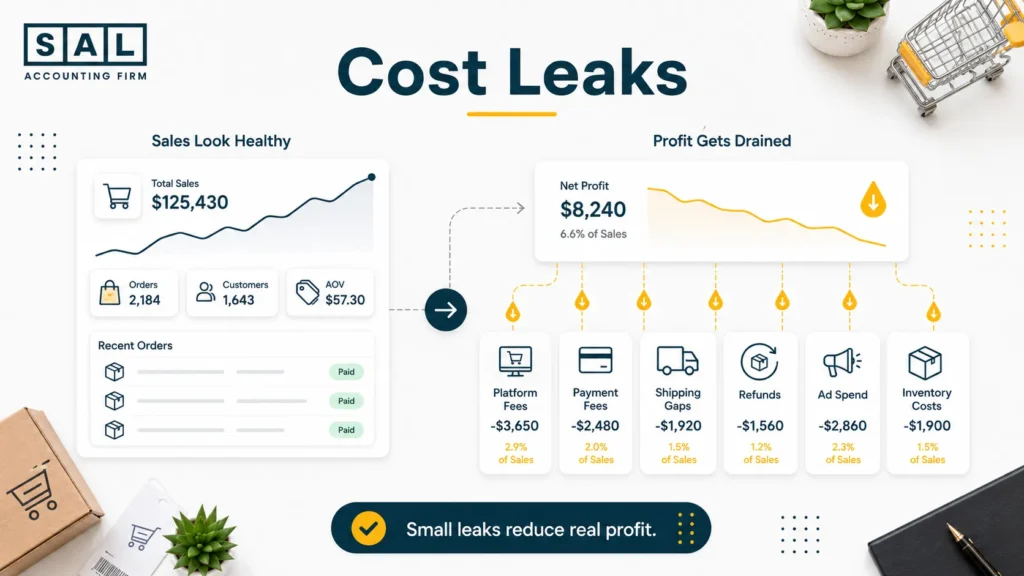
Ecommerce stores can fail even with growing sales because sales are not the same as profit, cash, or stability. Let’s say your Shopify dashboard shows $100,000 in monthly sales. Sounds good, right? Now subtract:
- discounts
- payment fees
- refunds
- chargebacks
- product costs
- shipping
- ad spend
- app costs
- GST/HST or sales tax set-asides
Suddenly, the amount left is much smaller. That often connects to Shopify profit calculation mistakes, especially when owners look at top-line revenue before checking what each order actually leaves behind.
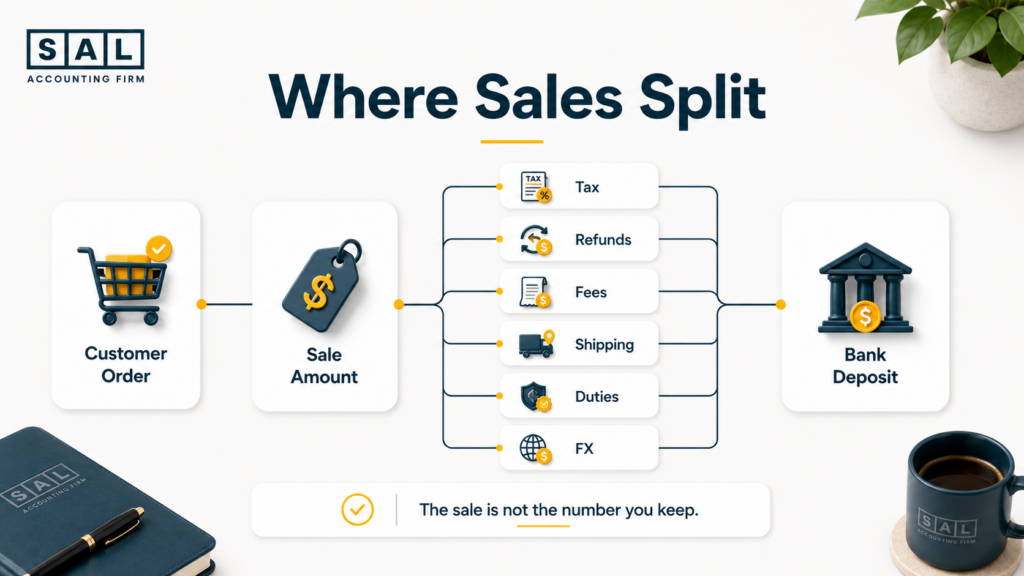
It also connects to e-commerce reconciliation, because your bank deposit is not your revenue. A $10,000 payout might already have fees, refunds, chargebacks, shipping adjustments, or taxes mixed into it.
Pro Tip: Do not judge your store by revenue alone. Judge it by what is left after the sale has been fully processed.
Why Is Your Ecommerce Store Getting Sales but Not Making Profit?
Your ecommerce store may be getting sales but not making profit because the cost of getting, fulfilling, and refunding orders is too high. This is where founders often feel stuck. The store is busy. Orders are coming in. Ads are running. Customers are buying. But the bank balance still feels tight. Usually, the problem is one of these:
- COGS is too high
- shipping is underpriced
- discounts are too aggressive
- ads cost too much
- return rates are too high
- platform fees are not being tracked
- inventory is tying up cash
- tax money is being spent by accident
If your COGS is wrong, every pricing decision becomes shaky. Product cost is only part of the picture, which is why calculating COGS for ecommerce stores needs to include things like freight, duties, packaging, and prep costs too.
Pricing has the same issue. A product can sell well and still hurt the business if the margin is too thin after shipping, discounts, and ads. Before changing prices, it helps to look at ecommerce pricing strategy through the lens of what the store actually keeps, not just what competitors are charging.
What Are the Biggest Reasons Online Stores Fail?
Online stores usually fail because the founder cannot clearly see which part of the business is leaking money, time, or trust. Here are the biggest reasons why online stores fail.
| Failure Reason | Warning Sign | KPI to Watch | Practical Fix |
| Weak margins | Sales grow but cash stays tight | Contribution margin | Reprice, review COGS |
| High ad costs | Sales depend on paid traffic | CAC, MER, ROAS | Build repeat revenue |
| Poor conversion | Traffic does not become orders | CVR, cart abandonment | Fix product pages |
| Low AOV | Shipping eats profit | Average order value | Use bundles or thresholds |
| High returns | Refunds wipe out revenue | Return rate | Fix sizing, photos, policies |
| Cash flow gaps | Inventory creates stress | Cash runway | Forecast weekly |
| Ops mistakes | Stockouts or late orders | Fulfilment time | Improve reorder planning |
| Tax confusion | Sales grow across regions | GST/HST, nexus | Review obligations early |
If you want a quick profit check, the Ecommerce EBITDA Calculator can help you see whether the business is producing operating profit after COGS, marketing, and overhead.
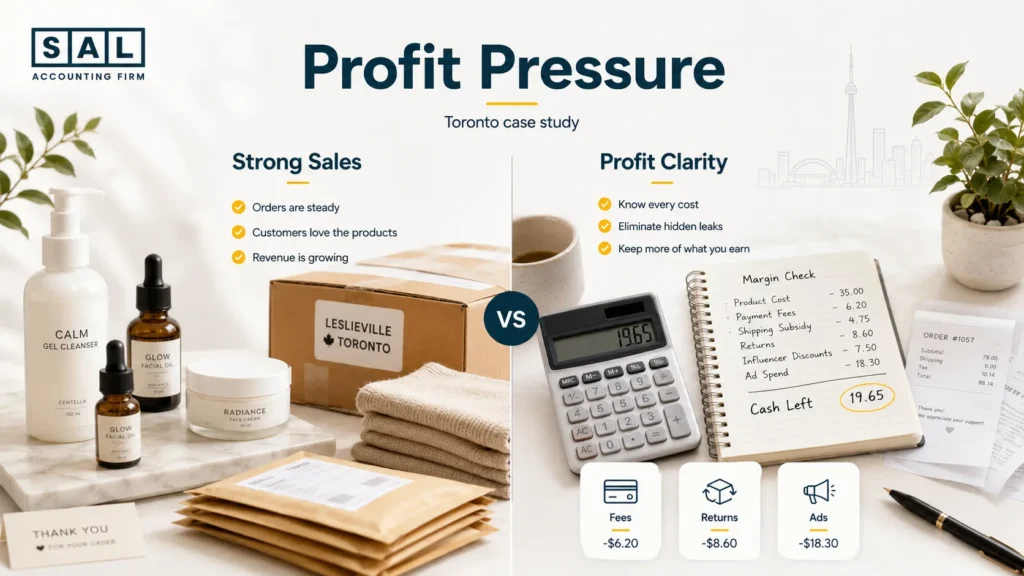
Case Study: How Priya in Leslieville Found the Real Reason Her Shopify Store Felt Broke1
Priya runs a skincare store from Leslieville in Toronto. Her Shopify dashboard shows steady sales, her Meta ads bring in orders, and her best-selling bundle gets strong reviews. But every month feels tight. She sees $70,000 in sales and still wonders why there is barely enough cash left for inventory, ads, and the next product launch.
The Problem
The problem is not demand. The problem is that Priya is looking at sales before looking at what those sales actually cost. Product costs, payment fees, shipping subsidies, returns, influencer discounts, and ad spend are all being reviewed separately. Basically, the sales are there, but the profit story is blurry.
What We Do
The first step is to rebuild the numbers around contribution margin, not just revenue. That means separating gross sales, discounts, refunds, product costs, platform fees, shipping, and paid ads so Priya can see what each order actually leaves behind.
The Result
Priya can now see which products support cash flow and which ones only look good on the dashboard. Instead of chasing every sale, she can focus on offers that actually leave enough margin behind.
Why Do Ecommerce Stores Have Cash Flow Problems?
Ecommerce cash flow problems happen when money leaves the business faster than it comes back. That can happen even when sales are growing. Common pressure points include:
- inventory paid before it sells
- ads paid before profit is confirmed
- refunds issued after revenue is counted
- payment processor delays
- Shopify or Amazon payouts arriving net of fees
- tax money getting mixed with operating cash
- supplier deposits due before customer cash arrives
For Shopify sellers, the issue often shows up when the store looks profitable but the bank balance says something different. A clean Shopify cash flow statement helps explain that gap.
For any growing online store, a cash flow forecast gives you a way to plan inventory, tax, payroll, and ad spend before the bank balance gets uncomfortable.
| Cash Pressure | Example | Why It Hurts | Fix |
| Inventory order | $25,000 | Cash leaves before sales return | Plan reorder timing |
| Ad spend | $400/day | Money leaves daily | Track CAC and margin |
| Refunds | $6,000/month | Sales get reversed | Review return reasons |
| Payout delays | 3-14 days | Bank cash trails sales | Reconcile payouts |
| Tax set-aside | Not separated | Future bill surprises you | Move tax weekly |
Payment timing is a common part of the issue, especially when platforms, processors, and marketplaces all report money differently. That is why ecommerce payment reconciliation is not just a bookkeeping task. It helps explain what actually happened between the sale and the bank.
How Can Conversion Rate Optimization Help Avoid Ecommerce Failure?
Conversion rate optimization helps more visitors buy without forcing the store to spend more on traffic. That matters because paid clicks get expensive fast when product pages, shipping details, or checkout steps create friction.
Baymard’s cart abandonment research shows why checkout is one of the first places to review. NRF’s 2025 retail returns data also shows why returns need attention after the sale, not just traffic before it. Start with the basics:
- clearer product pages
- better product photos
- visible shipping costs
- simple return policy
- faster mobile experience
- reviews and trust signals
- easier checkout
- bundles that make sense
Now, keep in mind: CRO is not just a design project. It is a profit project.
How Do LTV and CAC Show Whether Ecommerce Growth Is Working?
LTV CAC ecommerce metrics show whether each new customer is worth more than it costs to acquire them. CAC means customer acquisition cost. LTV means lifetime value.
Example: If you spend $45 to get a customer and the first order only leaves $18 in contribution profit, you need repeat purchases to make that customer worth it.
This is why ROAS alone can be misleading. ROAS does not always show refunds, product cost, shipping, chargebacks, or cash timing. Your weekly review should include:
- CAC
- AOV
- contribution margin
- repeat purchase rate
- refund rate
- email/SMS revenue
- cash available for inventory
Once those numbers are being reviewed weekly, ecommerce financial statements become much more useful. The income statement, balance sheet, and cash flow statement each show a different part of the same story.
What Sales Tax Compliance Mistakes Can Cause Problems for Ecommerce Sellers?
Sales tax compliance ecommerce mistakes usually happen when Canadian sellers grow across provinces, platforms, or US states without checking what needs to be registered, collected, filed, or tracked.
GST/HST Mistakes for Canadian Ecommerce Sellers
For Canadian ecommerce sellers, GST/HST is usually the first sales tax issue to review. Key mistakes include:
- treating all Canadian sales the same, even when customers are in different provinces
- assuming Shopify or another platform has set up every tax rate correctly
- mixing tax collected with operating cash
- not checking whether sales tax collected, payouts, and reports actually match
- waiting until filing time to figure out whether GST/HST was handled properly
The CRA’s guidance on GST/HST and e-commerce explains how online sales can be treated, while it place-of-supply rules help show why the customer’s location can affect the rate.
If GST/HST is the confusing part, the GST/HST Refund Calculator for Ecommerce Stores can help you estimate whether you may owe money or be due a refund based on what you collected and paid.
US Sales Tax Mistakes for Canadian Ecommerce Sellers
For Canadian ecommerce sellers expanding into the US, sales tax can become harder to track because each state has its own rules.
Key mistakes include:
- assuming one or two US sales never matter
- assuming Shopify, Amazon, or another platform handles everything automatically
- not separating marketplace sales from direct website sales
- ignoring customer location when US orders start growing
- waiting until US sales are already high before checking nexus exposure
This is where US sales tax requirements for Canadian sellers fits naturally, especially if your store is getting more US orders through Shopify, Amazon, or another marketplace.
- Read more: “Shopify GST/HST Tax Guide”
Case Study: How Daniel in Port Credit Caught a Cross-Border Sales Problem Early2
Daniel sells home office accessories from Port Credit in Mississauga. Most of his early orders come from Ontario, but after a few TikTok videos take off, US sales start growing quickly. At first, that feels like a win. More orders, more customers, more momentum. But Daniel is not sure whether Shopify, Amazon, and his direct website are all being handled the same way for taxes.
The Problem
The business has grown faster than its finance setup. Canadian GST/HST is being reviewed, but US sales tax exposure is unclear. Marketplace sales, direct Shopify orders, customer locations, and sales thresholds are not being checked in one place. Nothing has gone wrong yet, but Daniel has that “I might be missing something” feeling a lot of ecommerce founders know well.
What We Do
The first move is to map where sales are coming from by channel and location. Then the business reviews which sales go through marketplaces and which are direct-to-consumer orders. From there, Daniel can see where he is close to potential US sales tax thresholds and what needs a deeper review.
The Result
Daniel has a clearer view of which sales channels need attention first. Instead of waiting until filing season, he can deal with the risk while the numbers are still manageable.
What Should Ecommerce Founders Check First When the Store Feels Stuck?
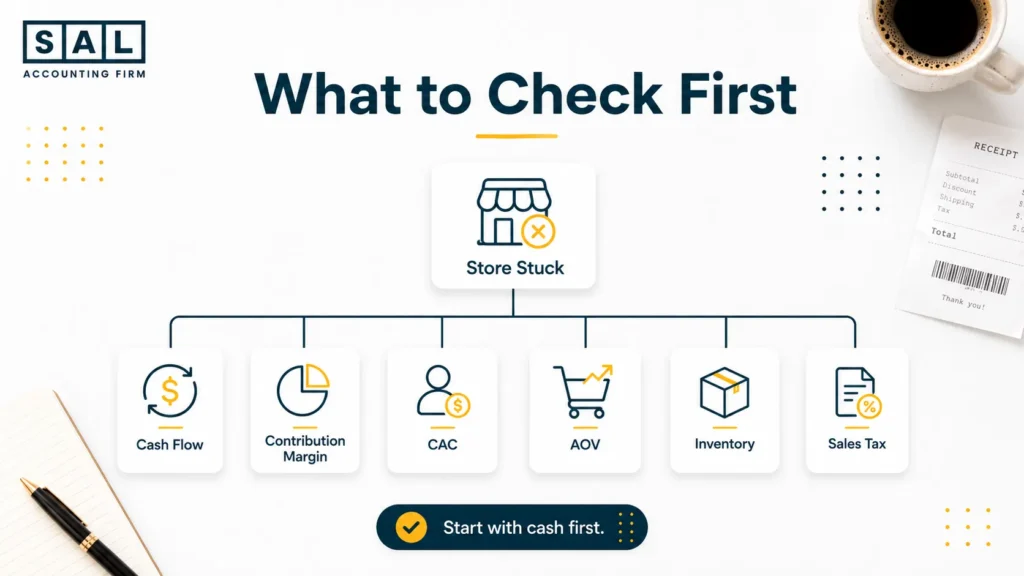
When an ecommerce store feels stuck, check the numbers closest to cash first. Here is a simple starting point.
| If This Is Happening | Check This First | Why It Matters | Next Step |
| Sales are growing but cash is tight | Contribution margin | Revenue may not be profitable | Review COGS and fees |
| Ads are working but profit is weak | CAC and AOV | Paid growth may be too expensive | Improve offers |
| Shopify payouts do not match sales | Fees, refunds, tax | Deposits hide deductions | Reconcile payouts |
| Amazon deposits look confusing | Settlement reports | Fees may be buried | Separate FBA costs |
| US sales are growing | Economic nexus | State rules may apply | Check thresholds |
| Inventory feels stressful | Reorder timing | Cash may be trapped | Build forecast |
Pro Tip: Start with cash, not vanity metrics. A busy store can still be fragile if the bank balance cannot support inventory, taxes, payroll, and ads.
How Can Ecommerce Stores Avoid Failure in 90 Days?
Ecommerce stores can avoid failure by using the first 90 days to fix the numbers before scaling harder. Here is a practical plan.
| Timeline | Focus | What to Check | What to Fix |
| Days 1-15 | Unit economics | Sales, fees, COGS, shipping | Contribution margin |
| Days 16-30 | Cash flow | Payouts, tax, inventory | Weekly forecast |
| Days 31-45 | CRO | Product pages, checkout | Buying friction |
| Days 46-60 | AOV and margin | Bundles, discounts | Better offers |
| Days 61-75 | Retention | Email/SMS, repeat rate | Ad dependence |
| Days 76-90 | Operating rhythm | KPI review, month-end | Consistency |
A good 90-day plan only works if the monthly rhythm holds. For Shopify stores, a simple Shopify month-end close checklist can help make sure sales, refunds, fees, payouts, tax, inventory, and bank deposits are reviewed before the next month starts.
What Metrics Should Ecommerce Founders Track Every Week?
Ecommerce founders should track the metrics that show whether the business is actually healthy, not just busy. Every week, review:
- net sales
- contribution margin
- CAC
- AOV
- return rate
- inventory position
- cash balance
- tax set-aside
- payout issues
If you use Shopify, Amazon, QuickBooks, Xero, A2X, or multiple apps, the tools need to connect properly. A weak setup can make reports look cleaner than they really are.
For Shopify sellers, automated Shopify accounting are worth thinking about as part of the same question: can your tools show what actually happened in the store?
For tool selection more broadly, ecommerce accounting software should be chosen around your sales channels, order volume, tax setup, and inventory needs, not just the cheapest monthly fee.
- Read more: “Shopify Accounting Best Practices”
When Should Ecommerce Founders Get Accounting Help?
Ecommerce founders should get accounting help when sales, fees, payouts, taxes, inventory, and cash flow become too messy to review confidently.That usually happens when:
- Shopify or Amazon payouts do not match your books
- you are unsure what your real profit is
- refunds and discounts are hard to separate
- inventory purchases are creating cash stress
- you sell across Canada and the US
- you are not sure whether tax rules apply
- you are making decisions from dashboards instead of clean numbers
This does not mean you did anything wrong. It usually means the business has outgrown a basic setup.
If Shopify is where most of your sales happen, Shopify accounting can help you understand what the store actually keeps after fees, refunds, tax, inventory costs, and payouts. If Amazon is part of the mix too, Amazon seller bookkeeping can make settlement reports easier to read before fees, returns, reimbursements, and storage costs blur the picture.
At that point, knowing when your ecommerce business needs a CPA can make the next step clearer, especially if your store now has multiple sales channels, cross-border tax questions, inventory pressure, or reports you no longer trust.
Conclusion: How to Avoid Ecommerce Failure Before It Gets Expensive
Ecommerce failure is rarely one big dramatic event. Most of the time, it starts quietly. Margins get thinner. Ads get more expensive. Refunds grow. Inventory ties up cash. Payouts stop matching the numbers. Tax questions get pushed aside. The good news is that these problems usually leave clues.
At the end of the day, learning how to avoid ecommerce failure is not about chasing more sales at any cost. It is about building a store where the numbers are clear enough to trust. If your ecommerce numbers are starting to feel harder to understand, contact us at SAL Accounting and get a clearer sense of what needs to be fixed, tracked, or set up next.