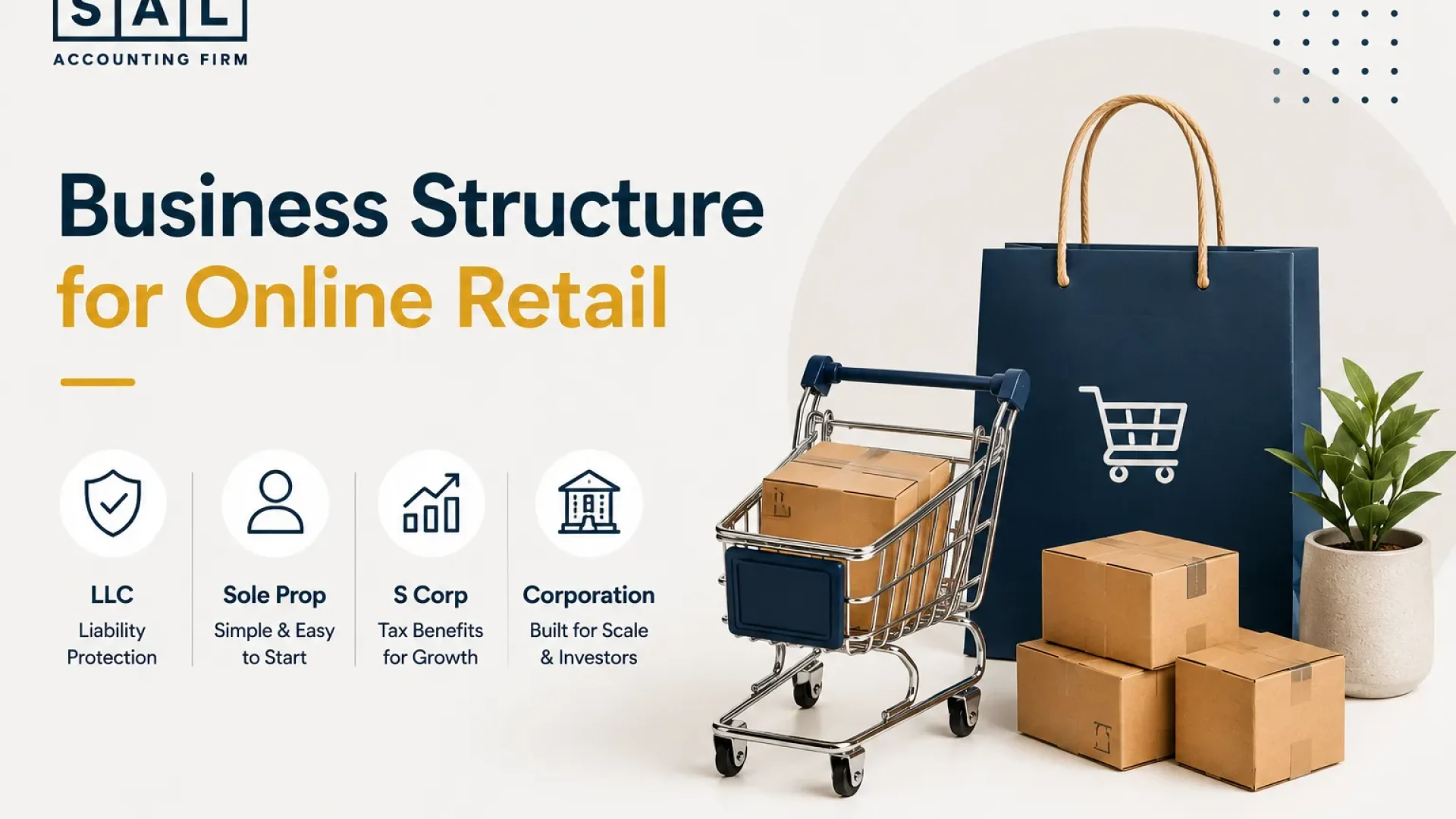
For most growing Shopify, Amazon, and Etsy sellers, an LLC is usually the best business structure for online retail. It protects personal assets, keeps taxes flexible, and leaves room to grow. A sole proprietorship can work while you’re testing, while an S Corp or corporation may fit later.
At SAL Accounting, this guide is here to make the structure question less foggy: what works when you’re testing, what changes when sales grow, and when taxes start needing more planning.
Know what your Shopify store actually keeps after fees first. The Shopify Fee Calculator gives you a cleaner number to work from before tax and structure decisions get involved.
Quick Takeaways
- A sole proprietorship is simple, but it does not separate you from the business.
- An LLC is often the best fit for growing Shopify, Amazon, and Etsy sellers.
- An S Corp is usually a tax election, not a separate legal structure.
- A corporation can make sense for larger brands, investors, or more formal growth plans.
- The best choice depends on profit, product risk, ownership, location, and future plans.
If your store is already getting harder to track, SAL can help with e-commerce bookkeeping services so your reports show what actually happened across sales, fees, payouts, refunds, and inventory.
What Is the Best Business Structure for Online Retail?
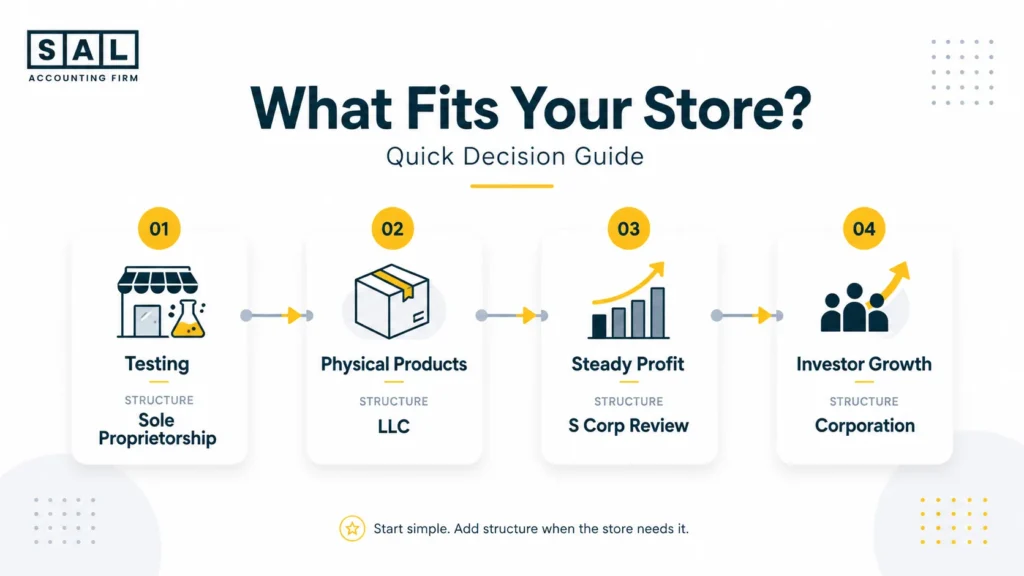
For online sellers, the best structure usually changes as the store grows. A small Etsy shop may not need the same setup as an Amazon FBA seller with inventory or a Shopify store expanding into the U.S. The IRS and SBA point to the same idea: structure affects taxes, paperwork, liability, and growth. Basically:
- Testing a small idea? Sole proprietorship may be enough.
- Selling physical products? An LLC is usually worth considering.
- Consistently profitable? An S Corp election may be worth reviewing.
- Raising investors? A corporation may fit better.
The point is not to pick the most complicated structure. It is to pick the one that matches the store you are actually running.
Online Retail Business Structure Comparison Chart
Here’s the quick side-by-side view before we break each structure down. It shows how each option compares on protection, taxes, complexity, and growth.
| Structure | Best For | Liability Protection | Tax Setup | Complexity | Growth Potential |
| Sole Proprietorship | New sellers testing an idea | No | Personal return | Low | Limited |
| LLC | Growing online sellers | Yes, if maintained properly | Flexible, often pass-through | Medium | Strong |
| S Corp Election | Profitable stores with steady income | Yes, through LLC/corp | Salary + distributions | Higher | Strong |
| Corporation | Larger or investor-backed brands | Yes | Corporate tax rules | High | Very strong |
This table is only a starting point. Your final choice should also consider your state, residency, profit, sales channels, and whether you sell physical or digital products.
Sole Proprietorship for Online Retail: Simple, Cheap, but Limited
A sole proprietorship is the simplest business setup. If you start selling online without forming another entity, you may already be operating as a sole proprietor. The SBA explains that you are automatically considered a sole proprietor if you do business activities but do not register as another kind of business.
For example, if you open an Etsy shop selling digital templates and earn a few thousand dollars, this setup may be fine while you test the idea.
Pros of a Sole Proprietorship
- Easy to start
- Low cost
- Simple tax filing
- Full control
- No separate entity setup
Cons of a Sole Proprietorship
The main issue is that you and the business are legally connected. That can create problems as the store grows, especially if you have:
- business debt
- customer disputes
- product issues
- supplier problems
- personal and business money mixed together
- unclear reports once fees, refunds, ads, and product costs start piling up
That last point is why many sellers eventually look at ecommerce financial statements: they need to see what the store actually keeps, not just what the platform shows in sales.
Pro Tip: A sole proprietorship can work for low-risk testing. But once your store has real product risk or steady profit, it may be time to review a stronger setup.
LLC for Online Retail: The Best Fit for Many Growing Sellers
An LLC, or limited liability company, is often the practical middle ground for online sellers. The IRS describes an LLC as a business structure allowed by state statute, and its tax treatment can depend on ownership and elections. You can see that in the IRS explanation of business structures and LLC tax classifications.
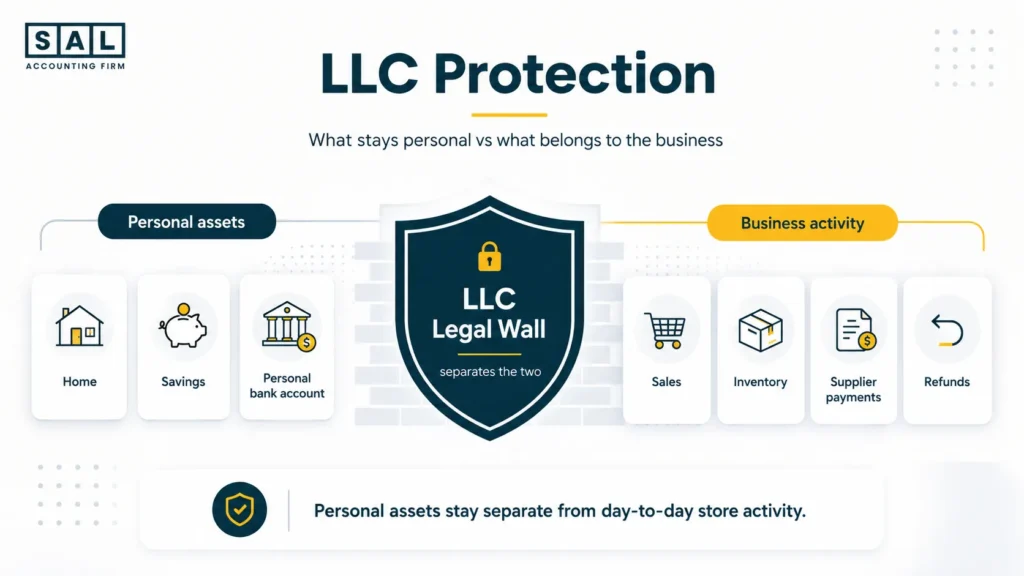
For ecommerce, the biggest benefit is separation. An LLC helps separate the business from you personally. That matters when you sell physical products, carry inventory, work with suppliers, handle returns, or sell through multiple channels.
Pros of an LLC
- Helps protect personal assets
- Looks more professional to suppliers and banks
- Makes business banking cleaner
- Supports growth across Shopify, Amazon, Etsy, or wholesale
- Can later elect S Corp tax treatment if it makes sense
This structure often connects to practical setup decisions too. For example, once the LLC has its own bank account, e-commerce payment reconciliation becomes much easier because the store’s money is not mixed with personal spending.
Cons of an LLC
- State filing fees
- Annual state requirements in some places
- More recordkeeping
- Liability protection can weaken if you mix personal and business money
An LLC does not magically clean up messy books. You still need separate accounts, proper records, and clean platform reporting.
Pro Tip: For Shopify sellers, this can show up quickly in Shopify payment reconciliation, where the sale shown in Shopify may not match the deposit that lands in the bank.
Case Study: Toronto Shopify Seller Moves from Side Hustle to Cleaner Structure1
A Shopify seller based near Liberty Village in Toronto starts with a small home décor store. At first, the store is simple. She orders small batches, tests products, and uses one personal bank account because the business still feels like a side project. Then a few products take off. She starts selling into the U.S., carrying more inventory, paying for ads, and dealing with refunds. The store is no longer just a test. It has real cash flow, product risk, and cross-border questions.
The Problem
Her Shopify payouts, supplier payments, ad spend, and personal spending are mixed together. She is also unsure whether she needs a Canadian corporation, a U.S. LLC, or a cleaner local setup before growing further into U.S. sales.
What We Do
We review her sales channels, profit, supplier risk, and U.S. customer exposure. The first step is not rushing into a structure because it sounds popular online. It is cleaning up the books, separating business money, and understanding whether Canadian or U.S. setup questions need to come first.
The Result
She gets a clearer structure plan and cleaner records. She can see what the store is earning, what risks are growing, and what needs to be fixed before expanding further. The biggest win is that she stops guessing from Shopify sales numbers and starts making decisions from cleaner business data.
For Canadian owners thinking about U.S. expansion, this often connects to whether a Canadian corporation can own a U.S. LLC and what that could mean before forming anything.
S Corp for Ecommerce: When Tax Savings May Be Worth It
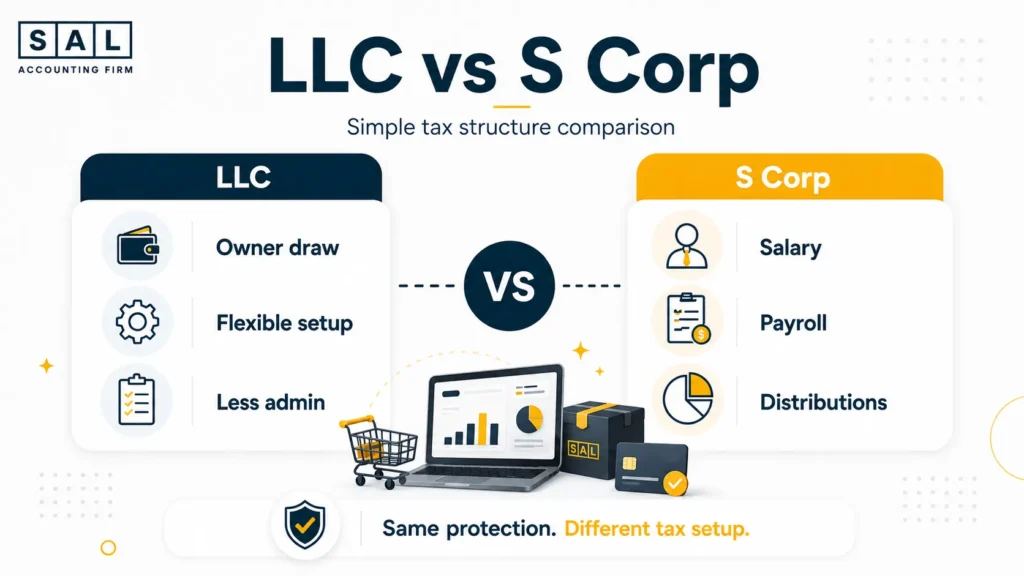
An S Corp is where many online sellers get confused. It is usually a tax election, not the first legal entity you form. Many sellers start with an LLC, then file Form 2553 to ask the IRS to treat the business as an S corporation.
Why does this matter? In the right situation, an S Corp may reduce self-employment tax. The IRS says the self-employment tax rate is 15.3%, covering Social Security and Medicare. But it is not a shortcut. If you work in the business, you usually need to pay yourself a reasonable salary through payroll before taking extra profit as distributions.
When an S Corp May Make Sense
It may be worth reviewing if:
- Your store has steady profit
- You already have clean books
- You pay yourself regularly
- The tax savings are bigger than payroll and filing costs
- You are ready for more structure
This is also where e-commerce tax deductions matter. If your expenses, cost of goods sold, platform fees, and ad spend are not tracked clearly, you may not know your real profit in the first place.
When It May Be Too Early
It may not make sense if:
- Profit is still low
- Cash flow changes a lot month to month
- You are still testing products
- You do not want payroll yet
- The admin cost would cancel out the savings
Read more: “LLC vs LLP vs S Corp: How to Choose the Right Structure”
LLC vs S Corp for Ecommerce: Which One Saves More Tax?
The better question is usually not “LLC or S Corp?” It is:
Should my LLC stay taxed the default way, or should it elect S Corp tax treatment?
Here’s the simple difference.
| Question | LLC | LLC with S Corp Election |
| Easier to manage? | Yes | No |
| Payroll required? | Usually no | Yes |
| May reduce self-employment tax? | Usually no | Possibly |
| Better for early-stage stores? | Often | Usually not |
| Better for steady profit? | Maybe | Worth reviewing |
Example: a Shopify store making $35,000 in annual profit may not benefit much from S Corp status. The payroll and tax filing costs could eat up the savings.
A store making consistent six-figure profit may be different. At that point, the salary and distribution split may be worth reviewing with a CPA.
The IRS also explains that eligible pass-through businesses may qualify for the QBI deduction, which can allow a deduction of up to 20% of qualified business income. That “up to” matters. It is not automatic for every seller.
Good structure decisions start with real profit, not platform revenue. That is why calculating COGS for ecommerce stores matters before you compare tax options.
Case Study: Mississauga Amazon Seller Reviews S Corp Advice Before Expanding2
An Amazon FBA seller based in Port Credit, Mississauga sells kitchen accessories to customers in Canada and the U.S. The store grows quickly, and the owner keeps hearing that profitable sellers should “just become an S Corp.” The advice sounds simple, but his situation has a cross-border layer. He is based in Canada, sells through Amazon, and receives payouts from marketplaces that do not always line up neatly with his bank deposits.
The Problem
He is comparing LLC and S Corp advice written mostly for U.S. residents. But his business is Canadian-owned, selling into the U.S., and using Amazon’s fulfillment network. Choosing the wrong setup could create confusion around tax filing, owner eligibility, payroll, and where income needs to be reported.
What We Do
We review the business from both sides: ecommerce operations and cross-border tax exposure. We look at where the owner lives, where the business operates, where customers are located, how Amazon payouts are recorded, and whether a U.S. entity actually makes sense.
The Result
He avoids making a structure decision based on generic U.S. advice. Instead, he gets a clearer plan for bookkeeping, U.S. sales review, and future structure options. He also understands that S Corp planning is not automatically available or suitable for every non-U.S. seller.
This is common for Amazon sellers because Amazon FBA bookkeeping has its own layers: settlement reports, storage fees, returns, reimbursements, inventory, and marketplace tax handling.
C Corporation for Online Retail: Best for Bigger Growth Plans
A C corporation is a more formal structure. It can make sense if you plan to raise outside investment, issue shares, offer equity, or build a larger company that may eventually be sold.
For most small Shopify, Amazon, or Etsy sellers, it is usually more structure than needed at the beginning.
Pros of a C Corporation
- Strong legal separation
- Easier to issue shares
- Better fit for outside investors
- More formal ownership structure
Cons of a C Corporation
- More paperwork
- Higher setup and filing costs
- More formal rules
- Possible double taxation
If you are still owner-operated and mainly trying to understand profit, taxes, and product risk, an LLC may be simpler. But if the goal is to raise capital, build a team, and issue shares, a corporation may be worth discussing.
For sellers still working through early costs, starting an ecommerce business is usually the better planning topic before jumping into a corporate structure.
How Taxes, Liability, and Growth Compare by Business Structure
Your structure affects more than tax forms. It changes how the business handles risk and growth.
Tax Differences for Online Sellers
Taxes can look very different depending on how your store is set up. The goal is not just to pick a label, but to understand how income is reported and when better planning options may open up.
| Structure | Tax Style | Main Benefit | Watch-Out |
| Sole Proprietorship | Personal return | Simple filing | Limited planning |
| LLC | Flexible pass-through | More options | Records must stay clean |
| S Corp Election | Salary + distributions | Possible tax savings | Payroll required |
| C Corp | Corporate tax | Investor-friendly | More complexity |
This is why tax planning should connect to preparing your ecommerce business for tax season, not just choosing a label.
Liability Protection for Ecommerce Stores
Liability protection matters more when you sell physical products.
Think about:
- Product defects
- Customer injury claims
- Supplier disputes
- Copyright or trademark issues
- Unpaid business debts
- Contractor or employee disputes
An LLC or corporation can help create separation, but only if you treat the business as separate.
Growth Potential for Shopify, Amazon, and Etsy Sellers
Growth usually needs cleaner structure.
That can mean:
- Business bank accounts
- Business credit cards
- Inventory financing
- Supplier contracts
- Cleaner reports
- Better records for a future sale
A business bank account is not just admin. It helps keep your store’s money clearer, especially when you are comparing business bank accounts for ecommerce or opening accounts for an LLC.
Best Business Structure by Online Seller Type
Different platforms create different structure questions.
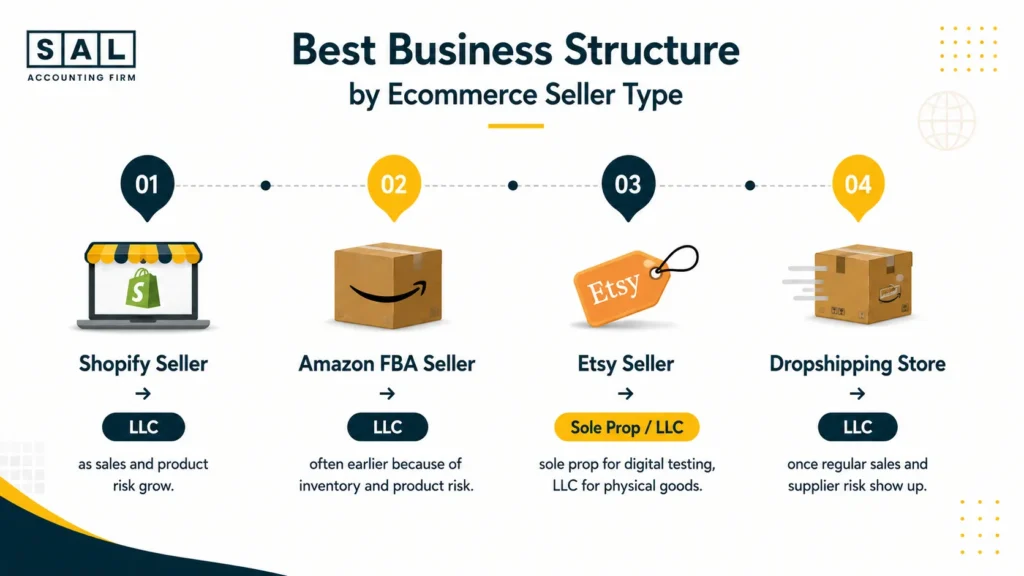
Best Business Structure for Shopify Sellers
A new Shopify seller may start simple. But once the store has regular payouts, refunds, ad spend, and physical products, an LLC is often worth considering. This usually becomes more important when you have:
- product or customer risk
- Shopify payouts hitting the bank regularly
- refunds, chargebacks, or sales tax to track
- ad spend and product costs affecting profit
- reports that no longer feel easy to trust
This also connects to Shopify accounting best practices, because clean structure does not help much if the numbers are still messy.
If Shopify is your main channel and the setup is starting to feel harder to follow, SAL’s Shopify accounting support can help you see what the store keeps after fees, refunds, sales tax, and product costs.
Best Business Structure for Amazon FBA Sellers
Amazon FBA sellers often face product risk earlier. An LLC may make sense sooner if you are dealing with:
- inventory
- supplier contracts
- returns
- FBA fees
- customer claims
- marketplace tax collection
- settlement reports
The tax side can also get more involved, especially when Amazon seller taxes start overlapping with sales tax, marketplace collection, and inventory reporting.
- Also read: “Amazon FBA Accounting Best Practices”
Best Business Structure for Etsy Sellers
Etsy sellers are not all the same.
A sole proprietorship may be enough at the start if you sell:
- digital printables
- templates
- downloads
- low-risk handmade items in small volume
An LLC may be worth reviewing once you sell physical products like:
- candles
- jewelry
- skincare
- baby products
- home goods
Etsy sellers also need to think about tax reporting, deductions, and platform fees. That is where an Etsy seller tax guide can help connect the structure decision to real reporting.
Best Business Structure for Dropshipping Stores
Dropshipping can feel low-risk because you do not hold inventory. But the customer still buys from your store. If the product is defective, late, or not as described, the complaint comes back to your brand. That is why dropshipping sellers often review LLCs once the store has:
- regular sales
- supplier issues
- customer complaints
- refund requests
- cross-border orders
- ad spend tied to thin margins
For Canadian sellers, dropshipping taxes in Canada can also affect how the setup should be tracked.
U.S. vs Canada Business Structures for Online Sellers
This guide focuses mainly on U.S. business structures, but Canadian sellers should be careful with U.S. advice. The names may sound familiar, but the tax treatment can be very different.
If Your Ecommerce Business Is Based in the U.S.
Your main options are usually sole proprietorship, LLC, S Corp election, or C corporation. For many growing Shopify, Amazon, and Etsy sellers, an LLC is often the practical middle ground. An S Corp may come later as a tax election if profit is steady enough to justify payroll and extra filings.
If Your Ecommerce Business Is Based in Canada
Your options usually look more like sole proprietorship, partnership, or corporation. Canada does not use S Corp elections the same way the U.S. does. The CRA’s business setup guidance explains how structure affects income reporting and tax filing in Canada.
If You’re a Canadian Seller Expanding into the U.S.
Do not form a U.S. LLC just because another online seller did. Your residency, ownership, sales channels, and U.S. activity all matter. Before setting anything up, it helps to understand what registering a business in the U.S. from Canada actually involves.
Sales tax can come up even earlier. If your U.S. sales are growing, U.S. sales tax requirements for Canadian sellers may matter before you change your business structure.
Final Thoughts: How to choose the Structure That Fits Your Store Now
The best business structure for online retail depends on your stage, risk, and profit. A sole proprietorship can work when you are testing. An LLC often fits growing ecommerce sellers. An S Corp election may help once profit is steady. A corporation may make sense for bigger growth plans.
The point is not to make the setup more complicated than it needs to be. It is to choose a structure that fits the store you are actually running now. If your store has grown and you are not sure whether your setup still fits, contact us at SAL Accounting and get a clearer sense of what needs to be fixed, tracked, or reviewed next.