Selling on Amazon can feel simple until tax time. You make sales, Amazon takes fees, refunds happen, sales tax may be collected, and then a payout lands in your bank account. The tricky part is knowing what all of that means for your taxes.
At SAL Accounting, we see this all the time with Amazon sellers: the store looks busy, sales are coming in, but the tax side is hard to follow because Amazon payouts don’t show the full picture. This guide breaks down what you need to understand, from income tax and GST/HST to U.S. sales tax, deductions, and cross-border selling.
Before filing season, it also helps to pull together the tax documents your e-commerce store needs so you’re not trying to rebuild the year from Amazon reports at the last minute.
Quick Takeaways
- Amazon sellers usually pay income tax on profit, not total sales.
- Your Amazon payout is not the same thing as your profit. It may already include fees, refunds, sales tax, ad costs, storage fees, and other adjustments.
- In Canada, GST/HST registration usually becomes required once taxable sales pass the $30,000 small supplier threshold over the relevant period.
- In the U.S., Amazon often collects and remits sales tax through marketplace facilitator rules, but sellers still need to understand their own filing and recordkeeping responsibilities.
- Cross-border sellers need to pay close attention to inventory location, currency conversion, marketplace reports, and whether they need registrations in the other country.
Do Amazon Sellers Pay Taxes in Canada and the U.S.?
Yes. Amazon sellers in Canada and the U.S. generally pay tax when their store earns profit. The key is understanding what profit actually means. The payout may already have Amazon fees, FBA charges, refunds, advertising costs, storage fees, and sales tax adjustments taken out. This is why Amazon FBA bookkeeping needs to separate sales, fees, refunds, taxes, and deposits instead of treating every payout as simple income. Basically, your tax return needs to reflect the full picture:
- what you sold
- what Amazon collected
- what fees were taken
- what refunds were issued
- what costs you paid
- what profit was left
That is where many Amazon sellers get stuck. Seller Central, bank deposits, and bookkeeping software do not always line up unless the setup is done properly.
If your Amazon payouts already feel hard to follow, SAL can help you get Amazon payouts, fees, refunds, and sales tax organized properly so your tax numbers are based on what actually happened in the store, not just what landed in the bank.
Example: Let’s say Amazon shows $10,000 in monthly sales, but only $8,200 lands in your bank account. That does not mean your revenue was only $8,200.
This helps sellers understand why their Amazon payout does not always match their real revenue or profit.
| Amazon Item | What It Shows | Tax Use | Common Mistake | What to Do |
| Gross sales | Total sales | Revenue starting point | Using payout as revenue | Start with full sales |
| Refunds | Returned sales | Reduces revenue | Ignoring returns | Track separately |
| Amazon fees | Platform costs | Deductible expense | Missing fees | Pull fee reports |
| FBA fees | Fulfillment costs | Deductible expense | Blending all fees | Separate by type |
| Ads | Marketing spend | Deductible expense | Leaving ads out | Match to ad reports |
| Sales tax | Tax collected | Liability/reporting | Treating as income | Keep separate |
| Payouts | Bank deposits | Reconciliation | Recording as income | Break down deposits |
E-Commerce Taxes Amazon Sellers Need to Know
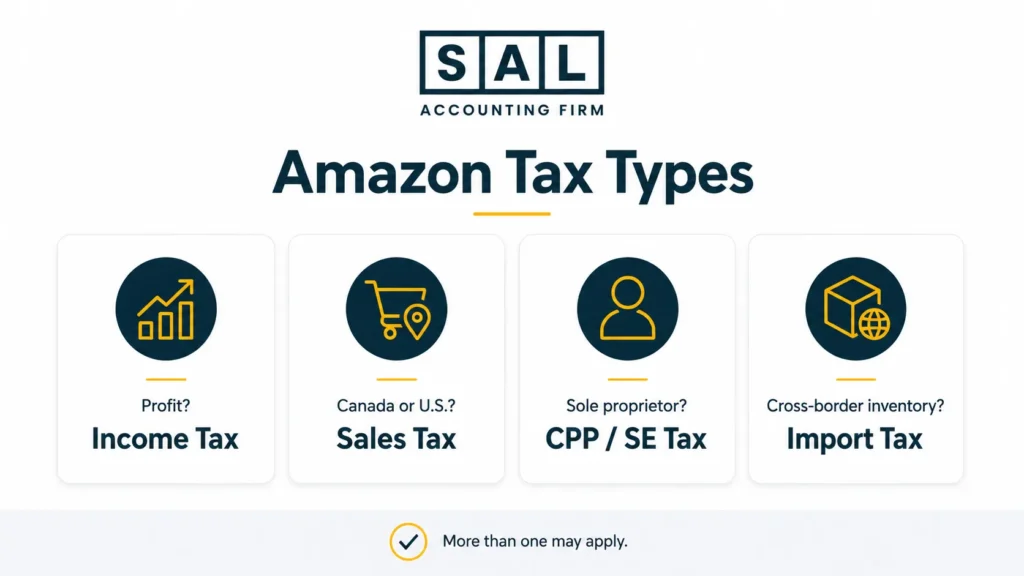
Amazon sellers usually deal with a few different types of tax.
- Income tax is tax on your business profit. This applies whether you sell through FBA, FBM, Amazon.ca, Amazon.com, or both.
- Sales tax is tax charged to the buyer. In Canada, this usually means GST/HST, and sometimes PST or QST. In the U.S., sales tax depends on state and local rules.
- CPP or self-employment tax may apply if you operate as a sole proprietor or self-employed seller.
- Customs duties and import taxes may apply when inventory moves across the border.
The point is, Amazon tax is not just one thing. It is a mix of sales, payouts, fees, tax collected from customers, inventory movement, and business profit. That bigger picture is part of why e-commerce taxes can feel different from regular business taxes.
Income Tax for Canadian Amazon Sellers
If you live in Canada and sell on Amazon, you generally report your Amazon profit to the CRA. That includes sales from Amazon.ca, Amazon.com, and other marketplaces.
If you’re a sole proprietor, your Amazon profit is usually reported on your personal tax return. Your income is taxed using federal and provincial tax rates. For most Canadian Amazon sellers, the key number is not total sales. It’s profit after business costs. That means your books should clearly show:
- Amazon sales
- refunds and returns
- Amazon fees and FBA charges
- shipping and packaging costs
- advertising costs
- inventory costs
- final profit
Example: Sara sells phone cases on Amazon.ca. Her store brings in $80,000 in sales during the year. After inventory, Amazon fees, shipping, ads, refunds, and other costs, her profit is $32,000. Sara does not pay income tax on the full $80,000. She pays tax on the $32,000 profit.
That is why clean bookkeeping matters. If Amazon fees or product costs are missing, your profit may look higher than it really is.
What if the Amazon business is incorporated?
If your Amazon business is incorporated in Canada, the corporation files its own corporate tax return.
Canadian-controlled private corporations that qualify for the small business deduction may benefit from a lower federal small business tax rate. The CRA lists the federal small business net tax rate at 9%, with provincial tax added separately (CRA corporate tax rates). Incorporation can help in the right situation, but it is not automatically the best answer for every seller. Before choosing, it helps to look at:
- how much profit the store is making
- how much cash you need personally
- whether money will stay inside the business
- the extra bookkeeping and filing costs
- where you plan to grow next
This is where the main Canadian business structures matter, because each setup affects tax filing, bookkeeping, and cash flow differently. Incorporation is not just about getting a lower tax rate. It has to fit how your Amazon business actually works.
Income Tax for U.S. Amazon Sellers
If you live in the U.S. and sell on Amazon, you generally report your Amazon profit to the IRS. If you operate as a sole proprietor or single-member LLC, your Amazon profit is usually reported on your personal tax return.
Example: Let’s say Jack sells mugs on Amazon.com.
His Amazon reports show $90,000 in sales. After product costs, Amazon referral fees, FBA fees, advertising, refunds, software, and shipping costs, his profit is $38,000. Jack’s taxable business income is based on the $38,000 profit, not the full $90,000 in sales.
If Jack also sells through Shopify, Etsy, Walmart, or his own website, those sales need to be included too. Amazon is only one part of the full business picture.
For Canadian sellers expanding into Amazon.com, U.S. filings can become more complicated if the business has U.S. activity, U.S. entities, or U.S. tax forms involved. This often connects to U.S. tax filing from Canada when the seller’s setup goes beyond simple marketplace sales.
GST/HST for Amazon Sellers in Canada
In Canada, sales tax depends on where the customer is located and what kind of product is sold. Most sellers hear “GST/HST,” but some provinces also have PST or QST rules. The exact rate depends on the customer’s province or territory, and the CRA keeps current rates in its GST/HST rates guide.
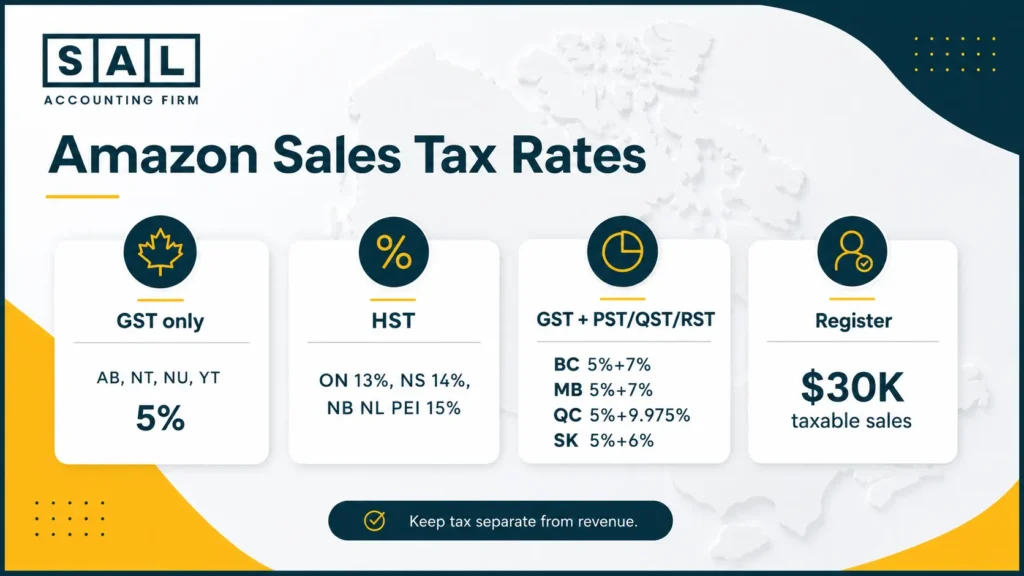
The big threshold to know is the $30,000 small supplier threshold. If your taxable sales pass $30,000 over the relevant period, you may need to register for GST/HST. The CRA explains how this works under its small supplier rules. For Amazon sellers, GST/HST usually comes down to a few practical questions:
- Have your taxable sales passed the $30,000 threshold?
- Is Amazon collecting tax from customers?
- Are your reports separating sales tax from revenue?
- Do your GST/HST filings match what actually happened in Seller Central?
Example: Emma sells hats on Amazon.ca. If she sells $20,000 during the year, she may still be under the small supplier threshold. If sales grow to $45,000, she should review whether GST/HST registration is required.
Once registered, she needs to understand what Amazon collected, what still needs to be reported, and whether the reports are showing the right numbers. This is where GST/HST return filing in Canada matters, because the return should match what actually happened in the business.
If the GST/HST side is starting to feel unclear, SAL can help you file HST returns using the right Amazon numbers so sales tax is not mixed into revenue or left out of the reports.
| Tax Type | Provinces/Territories | Tax Rate | What Amazon Sellers Should Know |
| GST only | Alberta, Nunavut, Northwest Territories, Yukon | 5% | GST applies, but there is no HST. |
| GST + PST | British Columbia | 5% GST + 7% PST | GST and PST are separate. |
| GST + RST | Manitoba | 5% GST + 7% RST | RST is separate from GST. |
| GST + QST | Quebec | 5% GST + 9.975% QST | QST may need separate attention. |
| GST + PST | Saskatchewan | 5% GST + 6% PST | PST is separate from GST. |
| HST | Ontario | 13% HST | One combined HST rate applies. |
| HST | New Brunswick, Newfoundland and Labrador, Prince Edward Island | 15% HST | One combined HST rate applies. |
| HST | Nova Scotia | 14% HST | Reduced from 15% on April 1, 2025. |
Case Study: How Sarah in Liberty Village, Toronto Gets Her Amazon Taxes Under Control1
Sarah runs a small Amazon FBA store from Liberty Village in Toronto. Her store sells home organization products across Canada, and recently she started getting more U.S. orders through Amazon.com. Sales looked healthy, but every month felt confusing because Amazon payouts never matched the sales she saw in Seller Central. Some deposits included refunds, FBA fees, storage fees, advertising costs, and sales tax adjustments, so she could not tell what her real profit was.
The Problem
Sarah was treating Amazon deposits like revenue. That made her income look unclear and sometimes higher than it really was. She also was not fully sure whether her GST/HST numbers matched what Amazon collected from customers.
What We Do
SAL helps organize her Amazon reports so sales, refunds, FBA fees, ad costs, sales tax, and payouts are separated properly. We also review whether her GST/HST filing is based on the right numbers and help her understand how her U.S. sales should be tracked in Canadian dollars.
The Result
Sarah now has a cleaner view of her Amazon profit, not just her bank deposits. She knows what Amazon fees are costing her, what sales tax needs attention, and what numbers should be used for filing. Tax time feels less like cleanup and more like checking work that is already organized.
U.S. Sales Tax for Amazon Sellers
U.S. sales tax works differently from Canadian GST/HST. There is no single national sales tax system. Each state has its own rules, rates, thresholds, and filing requirements.
Amazon often collects and remits sales tax under marketplace facilitator rules. Amazon describes this as Marketplace Tax Collection, where Amazon may collect and remit taxes in jurisdictions with marketplace facilitator laws (Amazon MTC rules). That helps sellers, but it does not mean sales tax can be ignored. You still need to know:
- where your inventory is stored
- whether you sell outside Amazon
- whether you have state filing requirements
- whether Amazon collected tax on the sale
- whether your books separate sales tax from revenue
For FBA sellers, inventory location matters because Amazon may store products in different warehouses. That can create sales tax questions in states where the seller did not expect to have a connection. For Canadian sellers with U.S. customers, U.S. sales tax requirements for Canadian sellers can matter even when Amazon handles part of the collection. Amazon may handle a lot of the collection, but your records still need to make sense.
Customs and Import Taxes for Amazon Sellers
If you move products between Canada and the U.S., customs and import rules can come into play. This usually matters when you:
- ship inventory to Amazon FBA warehouses
- import products from suppliers
- sell across the Canada-U.S. border
- move goods between marketplaces
The duty or import tax depends on the product, value, country of origin, and shipping method. This is one area where it is easy to oversimplify. A product made in China and shipped from the U.S. to Canada is not treated the same as a product made in the U.S. and shipped to Canada.
So the takeaway is simple: do not guess based only on where the package ships from. Check the product, origin, value, tariff code, and paperwork. These same issues often show up in cross-border e-commerce shipping because inventory movement and tax paperwork usually need to line up.
CPP and Self-Employment Tax for Amazon Sellers in Canada and the U.S.
If you are a sole proprietor, income tax may not be the only tax on your Amazon profit.
In Canada, self-employed individuals generally pay both the employee and employer portions of CPP through their personal tax return. The CRA explains this under CPP contribution rules.
In the U.S., self-employed sellers generally pay self-employment tax for Social Security and Medicare. The IRS explains this under its self-employment tax rules. Here is what this means in plain English:
- Canadian sole proprietors may pay income tax plus CPP.
- U.S. sole proprietors may pay income tax plus self-employment tax.
- These amounts are based on business profit, not total Amazon sales.
- If nothing is set aside during the year, the final tax bill can feel bigger than expected.
That is why Amazon sellers can be surprised at tax time. It is not always because sales were higher than expected. Sometimes, it is because CPP or self-employment tax was not planned for early enough.
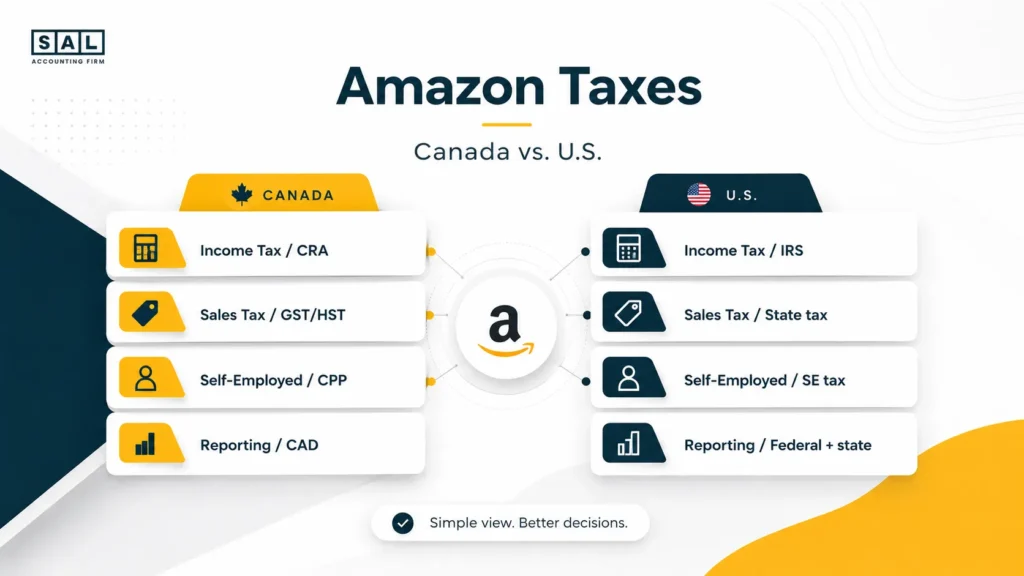
This gives sellers a quick side-by-side view of what usually changes between Canada and the U.S.
| Tax Area | Canada | U.S. | What to Check | Why It Matters |
| Income tax | CRA | IRS | Profit after costs | Tax is based on profit |
| Sales tax | GST/HST, PST/QST | State sales tax | Who collected tax | Avoid mixing tax with revenue |
| Self-employed tax | CPP | Self-employment tax | Sole proprietor status | Extra tax may apply |
| Inventory movement | Import duties/GST/HST | Import duties | Product origin and value | Cross-border costs can change |
| Tax records | CRA filings | IRS/state filings | Reports and deadlines | Missing records creates cleanup work |
Tax Return and Filing Basics for Amazon Sellers
Tax filing depends on your country and business structure.
In Canada, most individuals file by April 30. Self-employed individuals usually have until June 15 to file, but any balance owing is still due by April 30. The CRA lists these dates in its personal tax deadlines.
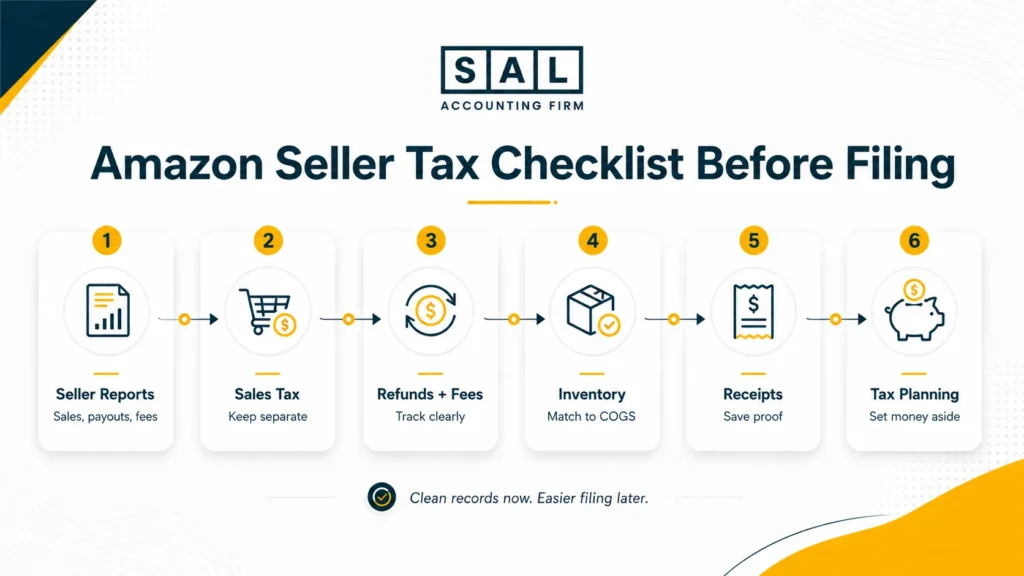
In the U.S., self-employed sellers may need to make estimated tax payments during the year. These payments help cover tax when nothing is automatically withheld from your income. The IRS explains this under estimated tax payments. For Amazon sellers, filing is much easier when these records are organized early:
- Amazon sales reports
- settlement reports
- fee reports
- refund reports
- advertising reports
- inventory purchase records
- shipping and storage costs
- bank statements
- bookkeeping reports
U.S. sellers may also receive Form 1099-K from Amazon if they meet the federal reporting threshold. For e-commerce sellers, Form 1099-K reporting can be confusing because the form may show gross payments, not your final taxable profit.
The IRS says an online marketplace is generally required to send Form 1099-K if payments for goods or services total over $20,000 and more than 200 transactions, though platforms may still send one below that amount (IRS 1099-K threshold). Keep in mind, not receiving a tax form does not automatically mean the income is tax-free.
Common Tax Deductions for Amazon Sellers
Amazon sellers can usually deduct ordinary business expenses that help them earn income. Common deductions include:
- Inventory costs: Products you buy to resell.
- Amazon fees: Referral fees, FBA fees, storage fees, subscription fees, and seller fees.
- Shipping and packaging: Boxes, labels, postage, freight, and delivery costs.
- Advertising: Amazon ads, Google ads, social ads, influencer costs, and other marketing expenses.
- Software and tools: Bookkeeping software, inventory tools, repricing tools, analytics platforms, and apps.
- Home office costs: A portion of rent, utilities, internet, or related costs may apply if part of your home is used for business.
- Professional fees: Accounting, bookkeeping, tax filing, and legal costs connected to the business.
The goal is not to “write off everything.” The goal is to track real business costs properly so your profit is not overstated. For more detailed categories, e-commerce business expenses are usually easier to understand when they are tied back to sales, inventory, shipping, software, and platform costs. This turns the deductions section into a practical checklist sellers can actually use at tax time.
| Deduction | Examples | Canada/U.S. Use | Records to Keep | Watch For |
| Inventory | Products for resale | Both | Supplier invoices | Track what was sold |
| Amazon fees | Referral, FBA, storage | Both | Fee reports | Don’t miss hidden fees |
| Shipping | Freight, postage | Both | Carrier receipts | Separate inbound/outbound |
| Ads | Amazon, Google, social | Both | Ad invoices | Match spend to business |
| Software | Apps, tools, bookkeeping | Both | Subscriptions | Keep monthly receipts |
| Home office | Rent, internet, utilities | Both | Bills, workspace calc | Use reasonable portion |
| Professional help | Accountant, bookkeeper | Both | Invoices | Keep tax-related support |
Cross-Border Tax Compliance for Amazon Sellers
Cross-border selling is where Amazon tax can get more complicated.
A Canadian seller using Amazon.com may need to think about U.S. marketplace sales tax, exchange rates, inventory location, and how U.S. sales are reported in Canadian dollars.
A U.S. seller using Amazon.ca may need to think about Canadian sales tax registration, Canadian inventory storage, and whether Canadian filings are required. Here are the main things to check:
- Where is your business based? Your home country usually wants to know about your business income.
- Where is your inventory stored? FBA inventory can create tax questions because products may sit in warehouses outside your home province, state, or country.
- Who is collecting sales tax? Amazon may collect some tax, but your records should still show what happened.
- Which currency are you reporting in? Canadian sellers generally need Canadian-dollar reporting for Canadian tax filings.
- Do your Amazon reports match your bookkeeping? Sales, fees, refunds, tax collected, and payouts need to be separated clearly.
If your Amazon business is selling across Canada and the U.S., SAL can help you get clear cross-border tax guidance for your setup so you understand what needs to be reported, where tax may apply, and what to fix before filings get messy.
For sellers planning to use Amazon outside their home country, international selling through Amazon FBA can bring together inventory, taxes, shipping, and marketplace reporting in one setup.
Case Study: How Daniel in Port Credit, Mississauga Handles Cross-Border Amazon Sales More Clearly2
Daniel runs an Amazon FBM and FBA business from Port Credit in Mississauga. He sells specialty kitchen products to customers in Canada and the U.S. His business grew quickly, but the tax side became harder to follow once he started shipping inventory across the border and selling through both Amazon.ca and Amazon.com. He had invoices, customs documents, Amazon reports, supplier bills, and sales tax details in different places.
The Problem
Daniel could see that sales were growing, but he did not know whether his books showed the full picture. Inventory costs, shipping costs, U.S. sales, GST/HST, and Amazon fees were not connected clearly, which made profit and tax planning difficult.
What We Do
SAL helps Daniel bring the key pieces together: Amazon settlement reports, inventory purchases, shipping costs, customs paperwork, and sales tax records. We also help him understand which Canada-U.S. tax issues need attention so he is not guessing based only on payouts or sales totals.
The Result
Daniel gets a clearer view of what his Amazon business is actually earning after costs. He can see where money is going, what needs to be tracked for tax, and which cross-border details should be reviewed before filings become messy. This gives him better numbers for tax time and better information for business decisions.
Tax Planning Strategies for Amazon Sellers
Good tax planning is not about shortcuts. It is about avoiding surprises. Here are a few practical ways Amazon sellers can stay ahead.
1. Separate business and personal finances
Use a separate bank account and credit card for the Amazon business. This makes it easier to track inventory, fees, software, ads, refunds, and payouts.
2. Reconcile Amazon payouts properly
Do not record every Amazon deposit as revenue. A payout may include sales, refunds, fees, reimbursements, advertising charges, and tax movements. Your books should break those pieces apart.
This often connects to e-commerce payment reconciliation, because the real issue is not just the sale. It is what happened between Amazon, your customer, your fees, and your bank account.
3. Track inventory carefully
Inventory is one of the biggest areas where Amazon sellers get confused.
Buying inventory is not always the same thing as immediately deducting it. The timing depends on how inventory is tracked and when products are sold. For sellers trying to understand profit more clearly, calculating cost of goods sold for e-commerce stores helps connect inventory costs to the products actually sold.
4. Review your business structure
A sole proprietorship may be simple when you are starting. As profit grows, incorporation or a different U.S. entity structure may be worth reviewing. The right setup depends on profit, risk, cash needs, filing costs, and long-term plans.
Before choosing, it helps to compare the best business structure for online retail based on how the store actually operates.
5. Set money aside for tax
If tax is not withheld from your Amazon income, you may need to make installments or estimated payments.
This is much easier when you plan for it during the year instead of waiting until filing season. A simple financial calendar for key tax deadlines can help sellers avoid leaving payments and filings until the last minute.
6. Work with an e-commerce accountant
Amazon accounting is different from regular small business accounting. You need someone who understands Seller Central reports, marketplace tax collection, FBA fees, refunds, inventory, cross-border sales, and the gap between platform sales and bank deposits.
If your store is growing and the books are starting to feel harder to trust, SAL can help you keep your e-commerce books clear before tax season.
Final Thoughts: Getting Amazon Seller Taxes Right in Canada and the U.S.
Amazon taxes can feel confusing because there are so many moving parts: sales, fees, refunds, inventory, sales tax, payouts, and cross-border rules. Once your numbers are set up properly, the picture gets much clearer.
If your Amazon numbers are getting harder to trust, you can get help reviewing your tax setup for Amazon with SAL Accounting so you understand what is happening, what needs to be filed, and what to fix next.
Amazon Seller Tax FAQs for Canada and the U.S.
Yes. Canadian Amazon sellers generally report business profit to the CRA. They may also need GST/HST registration once sales pass the small supplier threshold.
They can. FBA inventory stored in a state or country may create tax questions. If your U.S. sales are growing, the US economic nexus threshold checker can help you check whether state sales tax obligations may be coming up.
Yes. U.S. Amazon sellers generally report business profit to the IRS. Depending on the setup, state income tax and self-employment tax may also apply.
Often, yes. Amazon collects sales tax in many places under marketplace facilitator rules. Sellers still need clean records and may still have filing duties.
No. Your payout is what Amazon sends after fees, refunds, adjustments, and other items. Revenue, sales tax, fees, and refunds should be tracked separately.
Common deductions include inventory, Amazon fees, shipping, packaging, advertising, software, home office costs, and professional fees.
Usually, yes. Canadian sellers generally report worldwide business income, including U.S. Amazon sales, in Canadian dollars.
It depends. If a U.S. seller stores inventory in Canada or sells through certain Canadian setups, GST/HST rules may apply.
Form 1099-K reports certain payment transactions. For Amazon sellers, it can show gross payments, so it should be compared against fees, refunds, and other business costs.
Income tax is generally based on profit, not total sales. Profit is what remains after eligible business costs are deducted.
Not always, but it helps when sales grow, inventory gets complicated, payouts do not match your books, or you sell across Canada and the U.S.
As soon as sales become consistent. It is easier to track fees, inventory, sales tax, and profit during the year than to clean everything up at tax time.