Selling online from Vancouver and not sure if PST applies to you yet? If you regularly sell taxable goods in the province, you generally have to register for PST. The main exception is the small seller rule: no shop or other business premises, and $10,000 or less in sales over the past 12 months and the next 12.
Below, SAL Accounting walks through the test, the registration steps, and what changes after.
Quick Takeaways
- Vancouver online stores that regularly sell taxable goods generally have to register for PST.
- Some products are exempt, including vitamins, books, bicycles, and children’s clothing.
- Small sellers can wait: no established business premises, and $10,000 or less in retail sales over the past 12 months and expected over the next 12.
- If you collect PST without being registered, you still have to send it to the government.
- Small sellers can register voluntarily and use a PST number for inventory bought for resale.
- PST returns are due by the last day of the month after each reporting period, and filing on time can earn a commission.
- You must keep PST records for 5 years.
PST is one of the first registrations a growing online store runs into. Seeing how ecommerce bookkeeping tracks it alongside your other taxes shows which records to keep from day one.
Does Your Vancouver Online Store Need to Register for PST?
Yes, if you regularly sell taxable goods in BC, unless you qualify as a small seller.
The rule is set out in the government’s bulletin on registering to collect PST. If your business is in BC and sells taxable goods in the ordinary course of business, you must register. Once you meet those criteria, you can’t make retail sales in BC without a valid PST number.
The online part doesn’t change anything. Selling through your own website is still selling in BC when your business and your customers are here.
What Do Vancouver Online Stores Charge PST On?
Most physical products are taxable, but several common categories are exempt.
General merchandise like clothing and cosmetics counts as taxable goods. Here’s how some common online store products are treated:
| Product | PST? | Notes |
|---|---|---|
| Adult clothing | Yes | Taxable as general merchandise |
| Cosmetics | Yes | Taxable as general merchandise |
| Clothing patterns and related materials | Yes | Taxable since October 1, 2026 |
| Vitamins and dietary supplements | No | Exempt |
| Books, e-books, newspapers, magazines | No | Exempt |
| Bicycles and qualifying e-bikes | No | Exempt |
| Children-sized clothing and footwear | No | Exempt |
| Adult-sized clothing for children under 15 | No | Exempt |
| Goods shipped outside BC | No | Exempt |
This matters for registration, not just checkout. The registration rules in Part 8 of the Provincial Sales Tax Act don’t require a business to register if it sells only exempt goods. So a store selling only vitamins or books is in a very different position from a store selling taxable products.
Mixed catalogues need the most care. A store selling both adult and children’s clothing, for example, charges PST on some items and not others. Tracking which sales are taxable is part of understanding the types of taxes an ecommerce business deals with.
What Is the Small Seller Rule for Vancouver Online Stores?
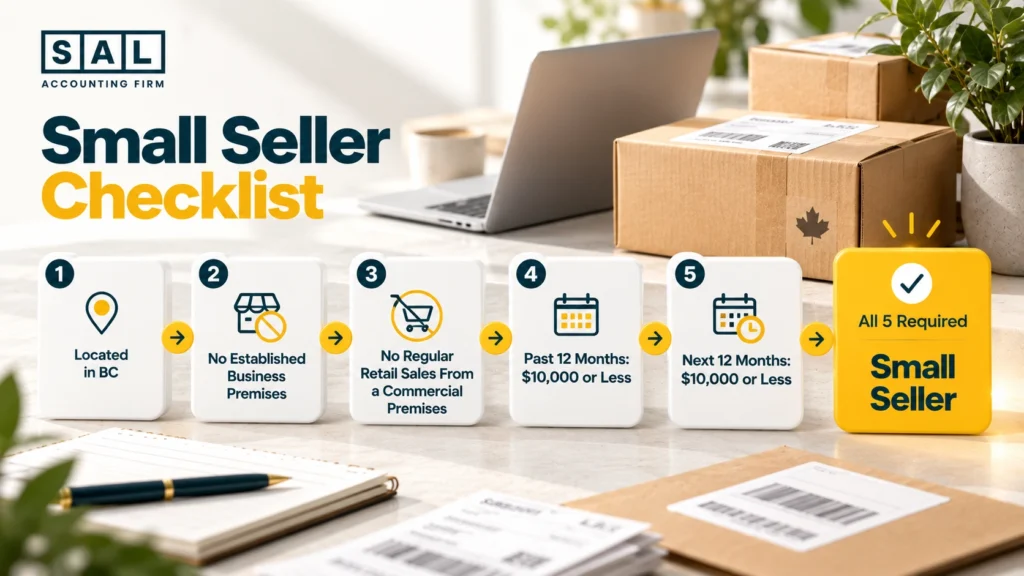
You can skip registration if you have no business premises and $10,000 or less in retail sales, in both the past 12 months and the next 12. You may be a small seller if all of these are true:
- You’re located in BC
- You don’t maintain an established business premises
- You don’t regularly make retail sales from an established commercial premises, such as a store
- You had $10,000 or less in gross revenue from retail sales of eligible goods in the past 12 months
- You expect $10,000 or less in the next 12 months
Notice that the test looks both ways. It isn’t enough to have been small last year. If you expect to pass $10,000 over the next 12 months, you’re no longer a small seller.
Small sellers don’t charge PST on their sales. Instead, they pay PST when they buy products for resale.
Pro Tip: If customers visit you to shop, even in a space in your home, read the government’s small seller bulletin before assuming you qualify. The premises test matters just as much as the $10,000 test.
Case Study: How a Vancouver Stationery Brand Outgrows the Small Seller Rule1
Nora sells hand-printed notebooks and cards online from her apartment near Commercial Drive in Vancouver. Over the past 12 months, her sales come to about $7,500. She has no shop, so she’s a small seller and doesn’t charge PST.
The problem: In October, Nora launches a holiday gift-box pre-order on her site. Within two weeks, she has pre-orders worth over $6,000, and she expects more before year-end. Her sales for the past 12 months are still under $10,000. But her expected sales for the next 12 months are now well over it, so she no longer passes the small seller test.
What she does: Nora registers for PST before the gift boxes ship, and she updates her store to charge PST on her taxable sales.
The result: Every gift box goes out with the right tax. Nora now checks her expected sales, not just past sales, each time she plans a big launch.
What Happens If You Charge PST Without Registering?
You still have to send that money to the government. Some sellers add PST “just in case,” or charge the wrong rate. Either way, the money doesn’t become yours. If you’re not registered and you collect PST, or an amount as if it were PST, you have to remit it. The same goes for charging the wrong rate, like 10% instead of 7%.
That creates two problems. Your customers pay more than they should, and you owe the government money you may have already spent.
The fix is simple: either register and charge PST correctly, or, if you’re a small seller, don’t charge it at all.
Should Your Vancouver Online Store Register Voluntarily?
Sometimes, especially if you buy a lot of inventory for resale.
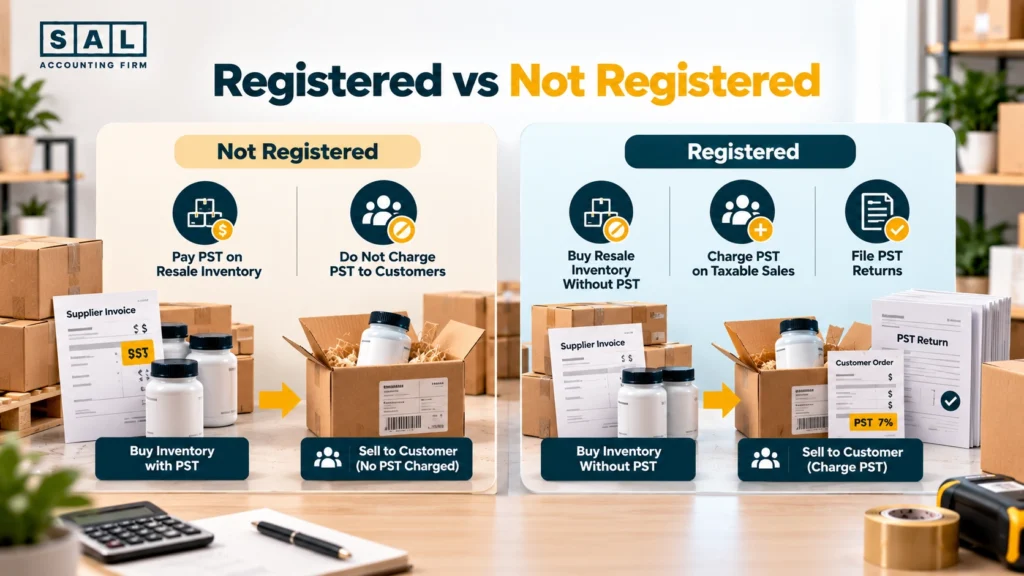
If you don’t have to register, you still can. One common reason is to use a PST number to claim an exemption on inventory bought for resale. As a small seller, you pay PST on those purchases. With a PST number, you can generally buy goods for resale without paying PST, but you then charge and collect PST on your taxable sales. It’s a trade-off:
- Not registered: you pay PST on inventory, and don’t charge it to customers
- Registered: you buy inventory for resale without paying PST, but charge PST on your taxable sales and file returns
Which works better depends on how much you buy, how fast you’re growing, and whether charging PST affects your prices.
Case Study: How a Vancouver Home Décor Store Weighs Voluntary Registration2
Theo runs an online home décor store from his home in Kerrisdale, Vancouver. His sales are under $10,000 a year, so he’s a small seller. He buys about $6,000 of candles, vases, and throws from wholesalers each year and pays PST on every order.
The problem: Theo is paying about $420 a year in PST on inventory he plans to resell. He also expects to pass $10,000 within the next year as his store grows, which would require registration anyway.
What he does: Theo registers voluntarily. He gives his PST number to his wholesalers when buying inventory for resale, and he sets up his store to charge PST on his taxable sales.
The result: Theo stops paying PST on his resale inventory. When his sales pass $10,000, nothing changes, because he’s already registered and set up.
How Do You Register for PST in Vancouver?
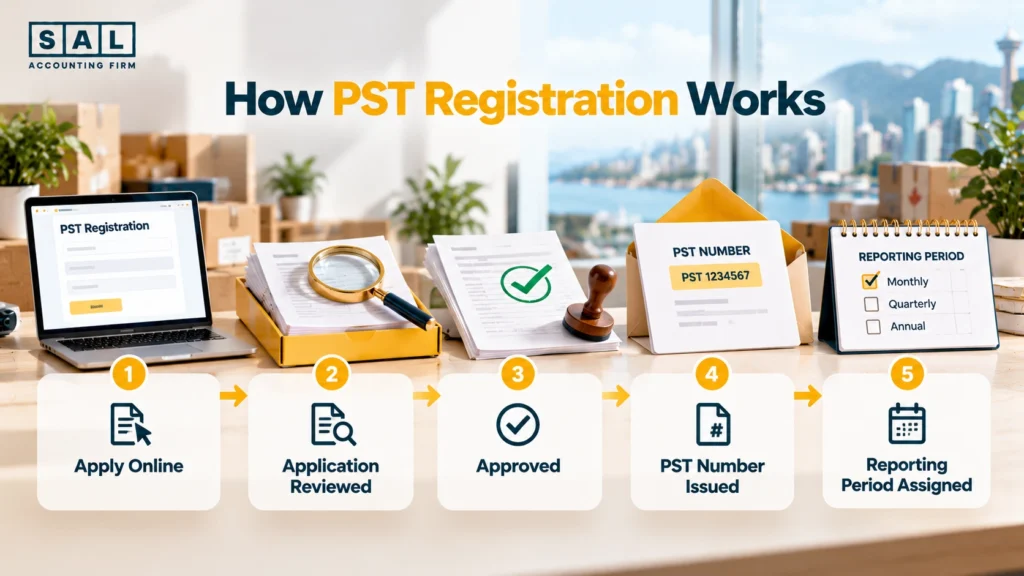
You register online, and you receive your PST number and reporting periods by letter. Once your application is approved, the letter tells you two things:
- Your PST number
- The reporting period you’ll file on
Your ongoing reporting period starts on the first day of the month you apply to register. Keep the letter with your business records.
A PST number doesn’t replace a business licence. Your licence comes from the City, and the City’s home-based business rules apply separately from PST. The full requirements for a Vancouver business licence for online stores, including space limits and costs, are a separate step.
What Changes Once Your Vancouver Online Store Has a PST Number?
You charge, collect, and report PST on your taxable sales. In practice, that means:
- Checkout: set your store to charge 7% PST on taxable goods delivered in BC
- Invoices and receipts: show the PST you charged
- Filing: report and remit PST on your assigned reporting period
- Changes: report changes like a new address, business name or type, a new legal structure, or closing the business
PST is separate from GST, which has its own registration with the CRA. You generally have to register for GST once your taxable sales pass $30,000 in a single calendar quarter or over four quarters in a row. Getting both taxes right at checkout is easier when your store’s tax settings follow the customer’s delivery address, which is the same principle behind the Shopify GST/HST settings.
Pro Tip: Place a test order to a BC address and one to an address outside BC after setup. Check that PST only appears on the BC order.
How Often Does a Vancouver Online Store File PST Returns?
Your filing schedule depends on how much PST you collect, and every return is due by the last day of the month after its reporting period. The government assigns your reporting period based on your PST collectable each year:
| PST Collectable per Year | Reporting Period |
|---|---|
| More than $12,000 | Monthly only |
| More than $6,000 up to $12,000 | Monthly or quarterly |
| $3,000 or less | Quarterly, semi-annual, or annual |
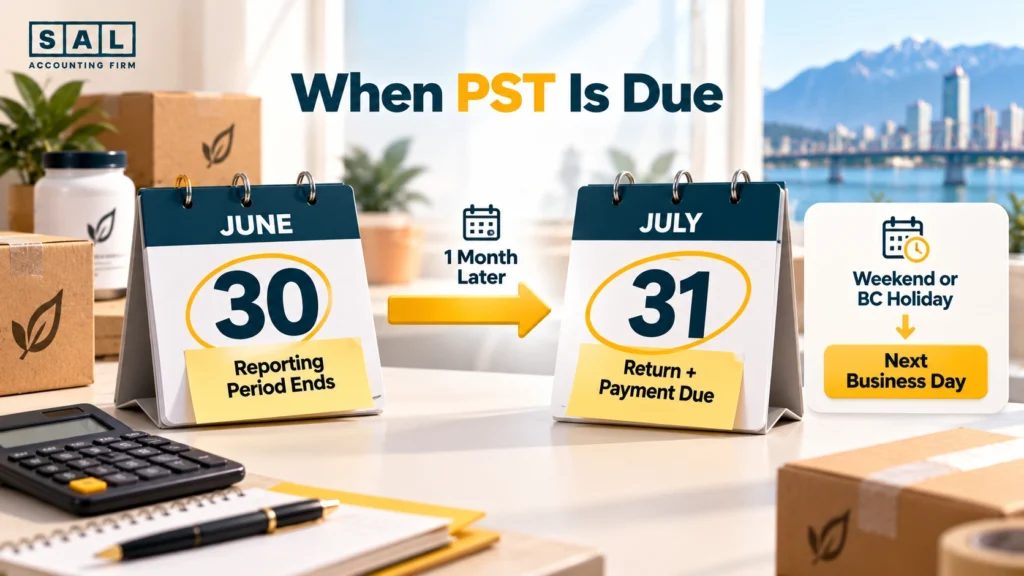
Whatever your period, the due date rule is the same. If your period ends June 30, your return and payment are due by July 31. If the due date falls on a weekend or a BC statutory holiday, it moves to the next business day. Three more rules worth knowing:
- Commission: if you report and pay on time, you can receive a commission of up to $198 per reporting period
- Electronic filing: businesses with at least $1.5 million in total Canadian sales a year must file and pay electronically
- Penalties: filing late can cost you penalties, interest, and the commission
Putting your PST due dates alongside your other deadlines in a financial calendar of key deadlines keeps the commission in your pocket.
When Does a Vancouver Online Store Self-Assess PST?
When you buy taxable items for your business without paying PST, you report and pay that PST yourself on your next return.
This usually happens when a seller doesn’t charge PST on something that’s taxable. For a Vancouver online store, that can mean equipment, supplies, or software bought from a supplier that didn’t charge PST.
It also covers items you take out of your resale inventory for your own use. If you bought goods exempt for resale and then use them in the business instead of selling them, the PST becomes due.
On your PST return, self-assessed PST is added to the PST you collected on sales. Both are paid together.
How Long Should a Vancouver Online Store Keep PST Records?
You must keep your books, records, and business documents for 5 years. For PST, that includes:
- Sales records showing taxable and exempt sales
- Copies of invoices and receipts
- Records of PST collected and remitted
- Records of goods shipped outside BC
- Purchase records for inventory bought exempt for resale
- Your PST returns
You can destroy records older than 5 years at your discretion, unless there’s an outstanding appeal. Keeping these organized month by month makes filing faster, and a solid ecommerce bookkeeping checklist helps make sure nothing slips.
What Changed for BC PST in October 2026?
As of October 1, 2026, clothing patterns and related materials became taxable goods, and services to clothing and footwear became taxable services. That includes:
- Clothing patterns and related materials, such as yarn and natural fibres commonly used to make or repair clothing
- Alterations and repairs to clothing or footwear, except services to exempt protective clothing or footwear
This mainly affects Vancouver online stores that sell sewing patterns, knitting supplies, or fabric, or that offer alterations or repairs. If your store sells any of these and you were a small seller only because your products were exempt, check whether you now pass the registration test.
A separate expansion of PST to certain professional services, also planned for October 1, 2026, has been paused.
Final Thought: Is Your Vancouver Online Store Ready for PST?
If you sell taxable goods online from Vancouver, you generally need to register for PST. Small sellers can wait, as long as they have no business premises and stay at $10,000 or less in sales, both looking back and looking ahead. Once you’re registered, charge PST only on taxable goods delivered in BC, file on time to earn your commission, and keep your records for 5 years.
Check the small seller test every few months, and register before you cross it, not after. Crossing $10,000 is a sign your store is growing, and our free growth roadmap helps you plan the next stage.