
Not sure if this guide applies to you? If your store is doing under $3K a month, a general accountant will get you through tax season. This guide is for Shopify and Amazon sellers past $10K monthly revenue who are either outgrowing their current setup or evaluating a specialist for the first time.
Most ecommerce sellers pick an accountant the same way they pick a dentist.
A trusted friend recommends one, there’s a quick call, a handshake, and that’s that. Then six months later, the books don’t match what Shopify says, US sales tax is anyone’s guess, and asking “what’s my actual margin on this product?” gets a four-day delay.
We see this all the time.
The vet matters more than the hire.
A focused 30-minute interview with the right questions tells you more than a year of working together. Before shortlisting anyone, our tax document checklist for ecommerce stores shows you what to bring so you’re comparing firms on the same baseline.
The short version
- Platform experience matters most. “We work with all kinds of businesses” usually means generalist.
- Fixed monthly pricing beats hourly. Hourly makes every quick question feel expensive, so you stop asking them.
- A real ecommerce specialist names their settlement tools (A2X, QuickBooks, Xero) without hesitation.
- Sales tax should be discussed by jurisdiction: state by state, province by province. Not in generalities.
- Security is non-negotiable. Your books contain sensitive financial and customer data.
If you’d rather skip the vetting and talk to a specialist directly, book a free 30-minute call and we’ll answer every one of these ourselves.

E-commerce Accountant: 3 Questions to Filter Platform Experience
Start here. These three questions tell you within the first five minutes whether you’re talking to a specialist or a generalist.
1. Do you work specifically with Shopify or Amazon sellers?
This is the primary filter. Anyone can say yes. What you’re listening for is what comes next.
A good follow-up: “Walk me through how you handle a Shopify payout.” Not the concept of it. The actual mechanics. What tool do they use? How does the payout get recorded? Where do fees, refunds, and taxes go?
Red flag answer:
“We record the deposit when it hits your bank.”
That means they’re recording net revenue and missing the full picture: fees, refunds, and platform deductions that your margin depends on.
Strong answer:
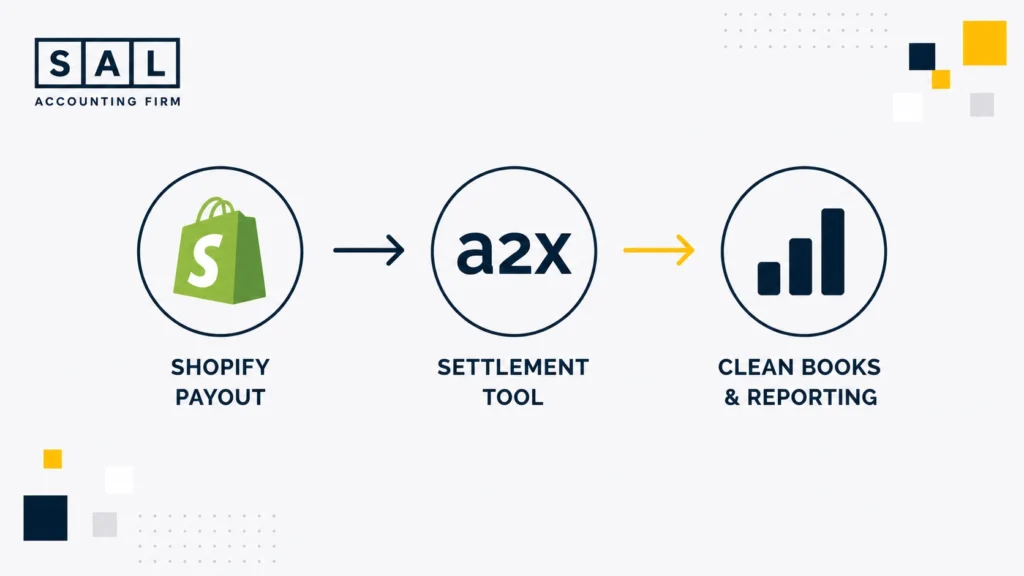
“We use A2X to pull the payout breakdown and map it into a settlement journal. Sales go to revenue, fees go to their own expense line, refunds get netted separately.” Specific, without prompting.
If they can’t answer the follow-up in plain language, they haven’t done it. Our guide on what to look for in an ecommerce bookkeeper covers what a full answer looks like.
2. Which settlement-mapping tools do you use: A2X, Link My Books, or something else?
QuickBooks and Xero are the two standard ledger platforms. But they are only half the picture.
The tool that sits on top is what matters: it takes your Shopify or Amazon payout, which is one number bundling sales, fees, refunds, and taxes together, and maps it into the right accounts. Without it, your books are built on a number that doesn’t mean anything.
A specialist names their tool immediately. A2X is the most common for Shopify and Amazon. Link My Books is another. No answer, or “we handle that manually,” means they haven’t done this at any real volume. See how these tools compare in our accounting software guide for Shopify sellers.
3. How do you handle Shopify and Amazon settlements: settlement journals or transaction-by-transaction?
This is one of the most revealing small business accountant interview questions. But most sellers don’t ask for it. Basically, there are two ways to record a payout:
| Method | What it means | Main issue | Better for ecommerce? |
|---|---|---|---|
| Transaction-by-transaction | Every order is recorded one by one | Gets messy as order volume grows | Usually no |
| Settlement journals | Each payout is recorded as one structured entry | Needs proper setup | Yes |
Transaction-by-transaction may work at 50 orders a month, but at 500, the numbers become harder to trust. Settlement journals are how serious ecommerce accountants usually work.
A real answer sounds like: “We use A2X to map each payout into one journal entry that separates gross sales, platform fees, refunds, and taxes. Everything ties back to the settlement report.”
If they pause, or describe recording individual orders, that tells you a lot.
Also Read: Top Accounting Firms Comparison: What Ecommerce Sellers Should Know
Hiring a CPA: 4 Questions About Money, Margin, and Tax
Once you confirm platform experience, these four questions show whether they understand the areas that cost you money when they go wrong.
4. Fixed monthly fee or hourly billing?
This tells you more about the working relationship than the price itself. Fixed monthly is usually better for ongoing ecommerce accounting because it keeps costs predictable and makes it easier to ask questions.
Hourly can work for one-off projects, but it discourages you from picking up the phone. When every question feels like it costs money, you stop asking them. You end up making decisions on gut feel instead of clean numbers.
| Model | How It Works | Pros | Cons |
|---|---|---|---|
| Fixed monthly | Flat fee for defined scope | Predictable, easier to ask questions | Scope needs to be clear |
| Hourly | Billed per hour | Pay only for what you use | Surprise invoices; discourages calls |
| Hybrid | Monthly base + hourly projects | Flexible | Hardest to budget |
The goal is not just a cheaper invoice. It is a setup where you feel comfortable asking questions before decisions get expensive.
Not sure what ecommerce accounting realistically costs? Our Shopify fee calculator gives you a picture of your platform costs before any pricing conversation.
5. How do you track COGS: monthly, by SKU, with landed cost included?
Monthly by SKU with landed cost is the right answer. Once-a-year COGS means 11 months of P&Ls that tell you almost nothing about actual margin. You’re blind to your most important number.
Our Amazon FBA bookkeeping guide shows what proper COGS tracking looks like in practice.
6. How do you handle US state sales tax nexus and Canadian GST/HST/QST?
Sales tax is where quiet mistakes become expensive.
A strong answer sounds like: “You crossed the economic nexus in California based on your last 12 months of US sales, so we registered you there in March. You’re approaching the Texas threshold, so we should decide on registration before Q3.”
That level of detail means they are watching the risk before it becomes a notice.
A vague answer like “we handle taxes” or “we’ll look at that at year-end” means you should keep asking questions.
Before the interview, run your numbers through our US economic nexus threshold checker. Put the results in front of them and see how specific their answer gets.
7. Do you use TaxJar, Avalara, or another sales tax automation tool?
TaxJar and Avalara are common tools for multi-state US filings. Manual filing can work in a low number of states. Automation also helps reduce missed filings, manual errors, and last-minute cleanup.
Tool names to listen for: A2X Shopify/Amazon, TaxJar/Avalara, Link My Books, QuickBooks, and Xero.
Also Read: Top E-commerce Automation Tools for 2026
The 3 Questions About the Ongoing Relationship
These questions show what working with the firm actually looks like month to month.
8. What does your month-end close package include, and when do you deliver it?
Most sellers ask this too late. By then, they have already received months of reports with little context, no channel breakdown, and numbers that do not match Shopify or Amazon.
A real close package should include:
- P&L by sales channel
- Balance sheet
- Cash flow statement
- Sales tax liability summary
- Short notes on anything unusual
- Delivery within 10 business days of month-end
Also the month-end close cadence should be clear. “By the end of the following month” is too vague for a growing ecommerce business. Ten business days gives you numbers while they are still useful.
If they say “your financials,” ask: “What’s actually included?” The detail in their answer is a preview of the detail you will get every month.

9. How do you protect my store and financial data?
Your accountant will have access to sensitive information, so security matters.
You do not need a technical explanation. You just need a clear answer. If they cannot explain how they protect your data in plain language, treat that as a red flag.
10. What does a clean handover from my current accountant look like?
A clean handover usually takes about 30 days. It should not feel chaotic, awkward, or like you are managing the entire process yourself. A normal handover looks like this:
Days 1–7:
Professional clearance letter from the previous firm and access review.
Days 8–15:
Review of prior books, restated numbers, and open issues.
Days 16–25:
Sales tax compliance check and setup of CRA/IRS authorization. For Canadian accounts, that usually means setting up CRA representative access. For US tax matters, it may include IRS Form 8821.
Days 26–30:
Formal authorization as your tax agent and first reporting plan.
Before signing, ask for two references from ecommerce businesses if possible. Ask each reference:
- How quickly do they respond to simple questions?
- Did pricing stay clear over time?
- Was there ever a surprise, and how did they handle it?
Also Read: 8 Signs It’s Time to Upgrade your eCommerce Accountant
Score the Answers as You Go
Do not rely on gut feel alone. Score each answer during the call.
- 0 = vague, wrong, or avoids the question
- 1 = acceptable, but not specific
- 2 = clear, sharp, and ecommerce-specific
| Score | What it usually means |
|---|---|
| 18–20 | Strong ecommerce specialist |
| 12–17 | Ask more follow-up questions |
| Under 12 | Move on, regardless of price |
The score matters because the cheapest accountant is not always the cheapest outcome.
A weak setup can lead to sales tax exposure, unclear margins, cash flow surprises, and books that are not ready when a lender, buyer, or tax authority asks for them.
Basically, a generalist accountant is not expensive. Until they are.
What Happened When One Seller Used These Questions
Nadia runs a Canadian skincare brand on Shopify, doing about $60K a month in sales, with more US orders starting to come in. She had been with a generalist accountant for two years, and at first, everything looked fine.
But when she used these questions to compare three new firms, the gaps showed up quickly. None of them could clearly explain how they would handle her Shopify payouts. Two had never heard of A2X. One would not share references.
Then SAL looked at her current setup, and a few things became clear. Some US sales tax had been counted as income, even though it was money she might need to send to the tax authority. Shopify fees were hidden inside the numbers, so her profit looked better than it really was. Her platform access also was not as protected as it should have been.
The handover took 26 days. By day 55, her books were cleaned up. By day 70, she had a monthly P&L by channel, so she could finally see which parts of the business were actually making money.
Now, she uses these questions before hiring any key vendor.

Composite of real client situations. Numbers are illustrative.
Work With SAL, or Run These Questions on Us First
Vetting an accountant well is a one-time cost. Vetting them poorly is a recurring one.
We work specifically with Shopify and Amazon sellers: Canadian DTC brands, cross-border sellers, multi-channel stores. These questions are the same ones we go through when onboarding a new client. We’re built around the tools and workflows this kind of business actually needs.
Our ecommerce bookkeeping services cover everything from monthly close to cross-border tax, built specifically for sellers on Shopify, Amazon, and other platforms.
If you want to put these questions to us directly, book a free 30-minute call. We’ll walk through your current setup and tell you honestly whether we’re the right fit.