
Not sure what you should actually pay for accounting when you run an online store? You’re not the only one. At SAL Accounting, we see this all the time with Shopify, Amazon, Etsy, and WooCommerce sellers. The store looks busy, sales are coming in, but the numbers feel harder to trust once fees, refunds, payouts, inventory, and tax all start mixing together.
Canadian online sales are not a small side issue anymore. Statistics Canada reported that retail e-commerce sales reached $4.3 billion in December 2025 and made up 6.1% of total retail trade. This post breaks down what online store accounting usually costs, why prices vary, and how to choose the right setup for your stage.
Quick Takeaways
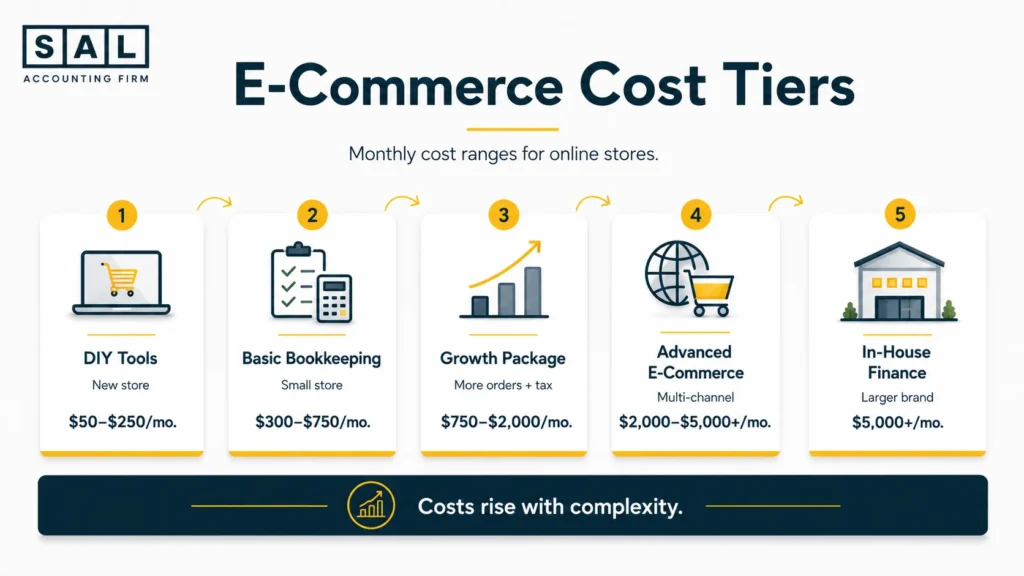
- A simple DIY setup may cost around $50 to $250 per month for software and basic apps.
- Basic online store bookkeeping pricing often starts around $300 to $750 per month if your store is small and clean.
- Growing e-commerce stores usually pay $750 to $2,000 per month when payouts, inventory, COGS, and sales tax need proper tracking.
- More involved ecommerce accounting packages can run $2,000 to $5,000+ per month, especially with multiple channels, US sales, or detailed reporting.
- One-time setup or cleanup work is usually separate. Budget $500 to $5,000+, depending on how messy the books are.
- The cheapest option is not always the best option if it leaves you unsure about profit, tax, or what your store actually kept.
If Shopify is your main platform, start by checking what fees may be eating into your sales with our Shopify Fee Calculator. It gives you a clearer starting point before you compare accounting quotes.
How Much Does Accounting for an Online Store Cost Per Month?
Accounting for an online store can cost about $50 to $250 per month for DIY tools, $300 to $1,000 per month for basic bookkeeping, and $1,500 to $5,000+ per month for more involved e-commerce accounting. The real answer depends on your setup. A Shopify store with 40 orders a month is not the same as an Amazon FBA seller with 4,000 orders, inventory, returns, GST/HST, and US sales tax.
If your numbers are already getting harder to trust, SAL can help with e-commerce bookkeeping so your reports reflect what actually happened in the store. Here’s a simple planning table.
| Store Type | Approx. Monthly Revenue | Monthly Accounting Budget | Usually Fits | Main Accounting Need |
| New store | $0 to $10K | $50 to $250 | One platform, low orders | Software and basic tracking |
| Small store | $10K to $50K | $300 to $750 | Simple activity | Monthly bookkeeping |
| Growing store | $50K to $500K | $750 to $2,000 | More orders, inventory, tax | Payout and COGS tracking |
| Multi-channel store | $500K to $2M | $2,000 to $5,000+ | Shopify, Amazon, Etsy, US sales | Full ecommerce accounting |
| Larger brand | $2M+ | $5,000+ | Bigger team, planning needs | Controller or CFO support |
Basically, e-commerce accounting costs go up when the work behind the numbers goes up.
A low-order Shopify store may only need basic software and a clean monthly review. A store selling on Shopify, Amazon, and Etsy may need payout reconciliation, inventory tracking, tax filing support, and better monthly reporting.
That is the big difference. You’re not just paying someone to sort expenses. You’re paying for clean numbers you can actually use.
Case Study: How Maya in Liberty Village Budgets for Shopify Accounting1
Maya runs a skincare Shopify store from Liberty Village in Toronto. Most months, she brings in around $28,000 to $35,000 in sales. The store looks healthy, but the numbers feel unclear. Shopify shows one amount, the bank shows another, and she is not sure how much is going to fees, refunds, sales tax, shipping adjustments, and app costs.
The Problem
Maya’s books are being handled like regular bookkeeping. Bank deposits are recorded as sales, but Shopify payouts are not broken down properly. Her reports do not clearly show gross sales, refunds, Shopify fees, sales tax collected, or what the store actually keeps.
What We Do
We review how Shopify, Shopify Payments, PayPal, and the bank feed are connected. Then we separate the payout activity into sales, refunds, fees, tax, and final deposits. We also help Maya choose the accounting setup that fits her order volume and reporting needs.
The Result
Maya now has a realistic accounting budget of about $750 to $1,200 per month. She knows what that cost covers, why Shopify sales do not match bank deposits, and whether the store is profitable after refunds, fees, and product costs.
What Does E-commerce Bookkeeping Include?
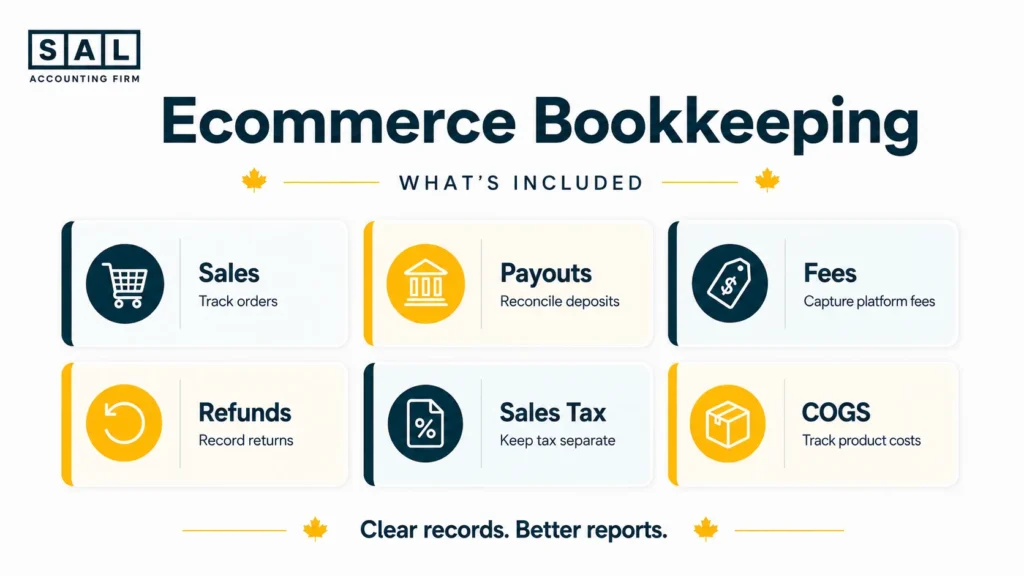
E-commerce bookkeeping is not just sorting bank transactions. It explains why your platform sales, payouts, fees, refunds, taxes, and bank deposits do not line up neatly.
This often connects to e-commerce payment reconciliation, because the issue is not just the sale. It is what happened between Shopify, Amazon, Stripe, PayPal, and the bank. A monthly e-commerce bookkeeping package may include:
- bank and credit card reconciliation
- Shopify, Amazon, Etsy, or WooCommerce payout review
- payment processor fees
- refunds and chargebacks
- discounts and gift cards
- sales tax collected
- inventory adjustments
- COGS, which means cost of goods sold
- monthly profit and loss reports
- questions or review calls
Here’s what that can look like in practice.
| Bookkeeping Item | What It Shows | Why It Matters | Common Issue |
| Gross sales | Platform sales | Starting revenue number | Recorded as bank deposit |
| Fees | Shopify, Amazon, Stripe | Real selling cost | Hidden inside payouts |
| Refunds | Returned orders | Net sales impact | Missed or duplicated |
| COGS | Product cost | Real gross profit | Tracked too late |
| Sales tax | Tax collected | Filing amount | Mixed into revenue |
The point is simple: clean e-commerce books should help you understand what your store actually kept, not just what landed in the bank.
If your reports only show deposits and expenses, you may miss the real story. That is wheree-commerce financial statements can become more useful than a basic profit and loss report.
Why Is E-commerce Accounting More Expensive Than Regular Bookkeeping?
Regular bookkeeping often starts with the bank feed. E-commerce bookkeeping can’t stop there.
Online stores create extra layers that need to be separated clearly, such as:
- platform fees
- payment processing fees
- refunds and chargebacks
- shipping adjustments
- sales tax collected
- inventory costs
- COGS, which means cost of goods sold
- bundled products, discounts, and app data
Example: Shopify may show $20,000 in sales, but only $17,400 hits your bank. That does not mean your revenue is $17,400. It usually means Shopify already took out fees, refunds, chargebacks, shipping adjustments, or sales tax.
If your bookkeeper records the bank deposit as sales, the reports may look tidy, but they will not show what actually happened. Now add inventory. If you sell a product for $100 and it costs $42 to buy, ship, and prepare it, that $42 needs to show up properly. This is where calculating COGS for e-commerce stores becomes part of the monthly work.
- Read More: “Shopify Inventory Accounting Guide”
What Affects Online Store Bookkeeping Pricing?
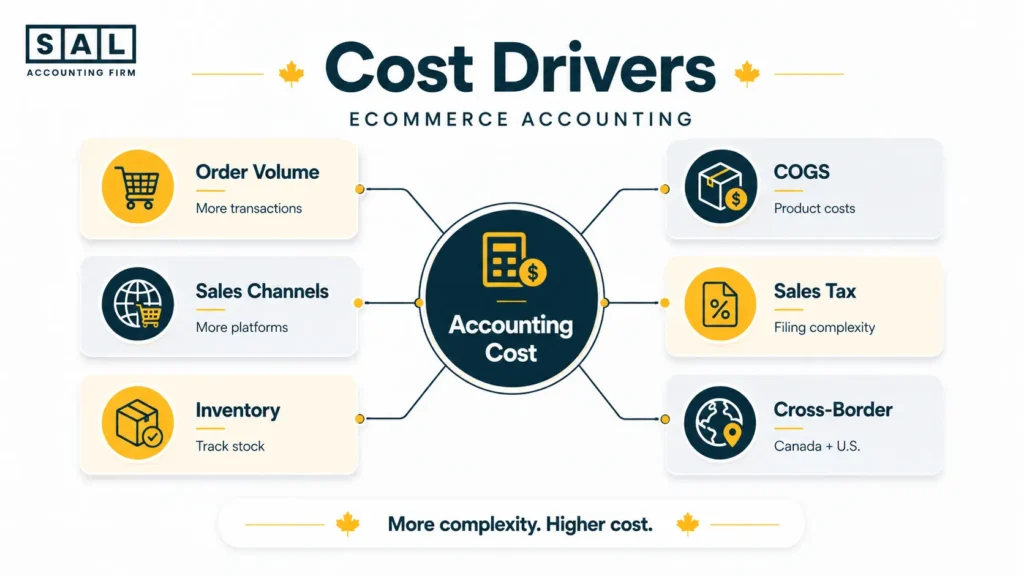
Online store bookkeeping pricing is usually based on complexity, not just revenue. A store making $40,000 per month with one clean Shopify setup may be easier to manage than a store making $25,000 per month across Shopify, Amazon, Etsy, PayPal, Stripe, and Klarna. Here are the main cost drivers.
1. Order Volume
More orders mean more refunds, fees, chargebacks, and payout lines to check. A store with 50 orders a month is usually simple. A store with 5,000 orders a month needs a better system.
2. Number of Sales Channels
One Shopify store is easier than Shopify plus Amazon plus Etsy plus WooCommerce. Each platform reports sales, fees, tax, and refunds differently. If you sell on more than one platform, you may also need to compare which channel is actually making money.
This can matter when you are weighing Shopify vs Amazon FBA, because each platform has a different fee structure, payout timing, and reporting setup.
3. Shopify, Amazon, Etsy, and WooCommerce Payouts
Marketplace payouts are not always clean. Amazon settlements can include sales, referral fees, FBA fees, refunds, reimbursements, storage fees, ad costs, and other adjustments. If those numbers feel hard to follow, SAL can help you get Amazon payouts and seller reports organized properly.
Amazon’s Marketplace Tax Collection rules may also affect how sales tax appears in seller reports. Etsy sellers can run into a similar issue, where Etsy seller tax tracking comes down to separating what customers paid from what actually reached the bank.
4. Inventory and COGS
Inventory adds another layer. You need to know what products cost, when they were sold, and how those costs should show up in the books. This matters even more if you have bundles, freight, duties, packaging, FBA inventory, or multiple warehouses.
For Amazon sellers, Amazon FBA bookkeeping can be more involved because storage fees, fulfillment fees, refunds, reimbursements, and inventory movement all affect the numbers.
5. Sales Tax and Cross-Border Sales
Sales tax can change the price because someone has to track what was collected, what needs to be filed, and where it needs to go. For Canadian sellers expanding into the US, cross-border activity can also affect how the business should track income, currency, filings, and sales tax exposure.
This is also where cross-border e-commerce shipping can affect the accounting side, because duties, freight, customs costs, and landed costs may need to be tracked properly.
How Much Do DIY Accounting Tools Cost for an Online Store?
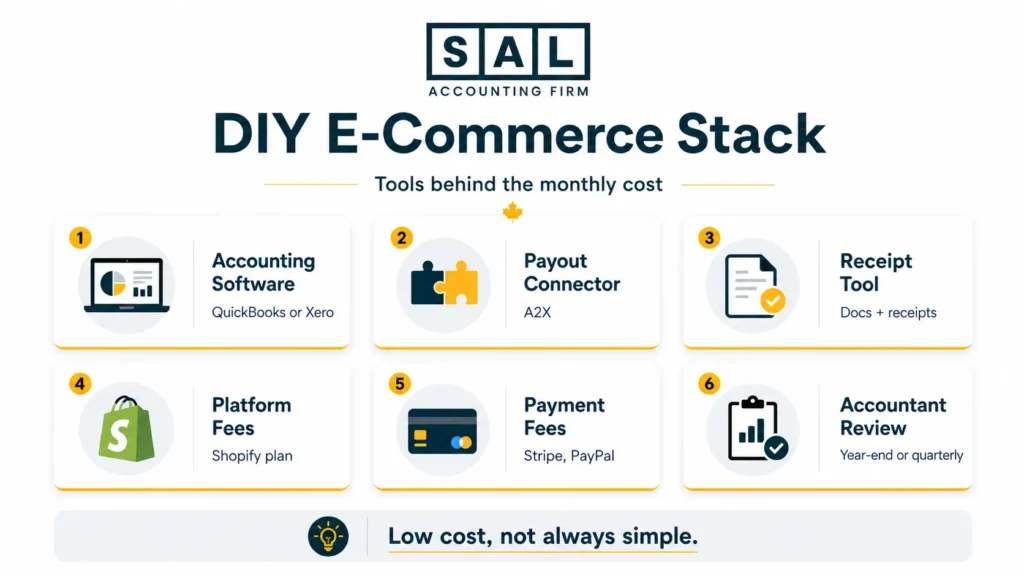
DIY can work well when your store is still simple. A basic setup might include:
- QuickBooks or Xero for your main books
- A2X to summarize Shopify or Amazon payouts
- Shopify’s plan fees as part of your monthly platform cost
- payment processing fees from Shopify Payments, Stripe, PayPal, or Amazon
- app costs for tools connected to your store
QuickBooks Canada lists different online accounting plans on its QuickBooks pricing page. Xero Canada lists its current plans on its Xero pricing page. A2X says its Shopify plans start from $29 per month on its A2X Shopify pricing page.
Shopify also lists current subscription details on its Shopify pricing page. That matters because your real monthly cost is not just accounting software. It is the full stack you use to sell, get paid, and keep the books clean. A simple DIY stack might look like this:
| Tool Type | Example | Why You Might Need It | Watch For |
| Accounting software | QuickBooks or Xero | Main books | Plan limits |
| Payout connector | A2X | Shopify/Amazon summaries | Order volume pricing |
| Receipt tool | Varies | Documents and receipts | Extra monthly cost |
| Accountant review | Year-end or quarterly | Catch mistakes | Separate fee |
DIY is usually fine if:
- you have one store
- your order volume is low
- you do not carry complicated inventory
- you are not filing in several tax locations
- you understand the reports well enough to spot problems
The problem starts when DIY turns into hours of guessing every month. If you’re spending your evenings trying to figure out why Shopify sales, PayPal deposits, and your bank balance do not match, the “cheap” setup may already be costing you time.
For Shopify-heavy stores, e-commerce accounting software for Shopify sellers can help you compare what belongs in your software stack before you add more apps. If you are comparing broader platforms, best e-commerce accounting software is another useful decision point.
How Much Do Ecommerce Accounting Packages Cost?
Ecommerce accounting packages usually fall into three broad levels.
1. Basic Ecommerce Bookkeeping Package
A basic package may cost around $300 to $750 per month. This usually fits a small store with simple activity. It may include:
- bank reconciliation
- credit card reconciliation
- expense categorizing
- basic monthly reports
- light Shopify or Amazon review
- simple GST/HST tracking
This is not usually enough for complex inventory, multiple sales channels, or detailed margin reporting.
2. Growing Store Accounting Package
A growing store package may cost around $750 to $2,000 per month. This is often where Shopify, Amazon, Etsy, and WooCommerce sellers land once they need more than categorized transactions. It may include:
- payout reconciliation
- sales tax tracking
- COGS review
- inventory support
- monthly reports
- questions by email
- a monthly review call
If Shopify is your main channel and the numbers are starting to feel messy, SAL can help with Shopify accounting so you can see what your store actually keeps after fees, refunds, tax, and product costs.
3. Advanced Ecommerce Accounting Package
An advanced package may cost $2,000 to $5,000+ per month. This fits stores with more moving parts, such as:
- multiple platforms
- multi-currency activity
- inventory across locations
- US sales tax exposure
- product-level margin reporting
- cash flow planning
- controller-style review
Example: If Amazon shows strong sales but cash is tight, you need more than a basic profit and loss report. You need to see fees, refunds, ad spend, inventory, and product cost clearly.
This is also where choosing the right e-commerce bookkeeper matters. A cheap quote may not help much if the person does not understand payouts, inventory, marketplaces, and tax.
If you are comparing firms, e-commerce accountant red flags can help you spot the difference between basic bookkeeping and support that actually fits an online store.
How Much Does Sales Tax Filing Cost for E-commerce Sellers?
Sales tax filing cost depends on:
- where you sell
- where you collect tax
- how often you need to file
For a simple store, filing may only add a small fee. For a store selling across Canada and the US, it can become a bigger part of your accounting budget.
GST/HST Filing in Canada
In Canada, GST/HST usually becomes part of your setup once your store crosses the CRA’s $30,000 small supplier threshold. The CRA explains this under its small supplier rules. Once you register, sales tax needs to be tracked separately from revenue. This connects to GST/HST return filing in Canada, especially when Shopify or Amazon payouts mix sales, refunds, fees, and tax together.
If you are not sure whether registration should have happened already, what happens when an e-commerce seller is not registered for GST/HST is usually the next thing to check.
Shopify Tax and Platform Settings
Shopify can help calculate tax, but it does not replace proper bookkeeping.
Shopify explains that Shopify Tax is free for the first US$100,000 in global sales per calendar year, then charges a percentage fee where tax collection is turned on. The details are listed under Shopify Tax pricing. The key point: your books still need to show what was collected, refunded, and filed.
US Sales Tax Filing
US sales tax can raise accounting costs because each state has its own rules, thresholds, and filing schedule. Sales Tax Institute keeps an economic nexus state chart, and Avalara maintains a state-by-state economic nexus guide.
This can matter once US sales tax requirements for Canadian sellers start showing up through direct sales or marketplace activity. Here’s a simple cost-planning view.
| Sales Tax Work | Possible Cost | Usually Depends On | Common Issue |
| GST/HST filing | $100 to $300 per filing | Clean records | Tax mixed into sales |
| One US state filing | $50 to $250+ per filing | State and frequency | Missed filing dates |
| Multi-state filing | Varies | Number of states | Too many small filings |
| Cleanup before filing | Separate fee | Months behind | Payouts not separated |
Keep in mind: tax software helps calculate tax, but someone still needs to check whether the numbers make sense.
- Read more: “Shopify Accounting Best Practices”
What Are One-Time Setup and Cleanup Costs for Ecommerce Accounting?
Monthly bookkeeping is one thing. Setup and cleanup are different. A clean setup might cost $500 to $2,500+. This can include:
- QuickBooks or Xero setup
- chart of accounts
- Shopify or Amazon connection
- A2X setup
- sales tax mapping
- opening balances
- basic reporting setup
If you’re using Shopify and QuickBooks together, Shopify QuickBooks integration affects how clean your reports are later. Cleanup can cost $1,000 to $5,000+, depending on how far behind the books are. For example, if months of Shopify deposits were recorded as revenue, someone needs to separate sales, fees, refunds, and tax.
A simple Shopify month-end close checklist can reduce cleanup because issues get caught while the details are still fresh.
- Also read: “Shopify Payment Reconciliation Guide”
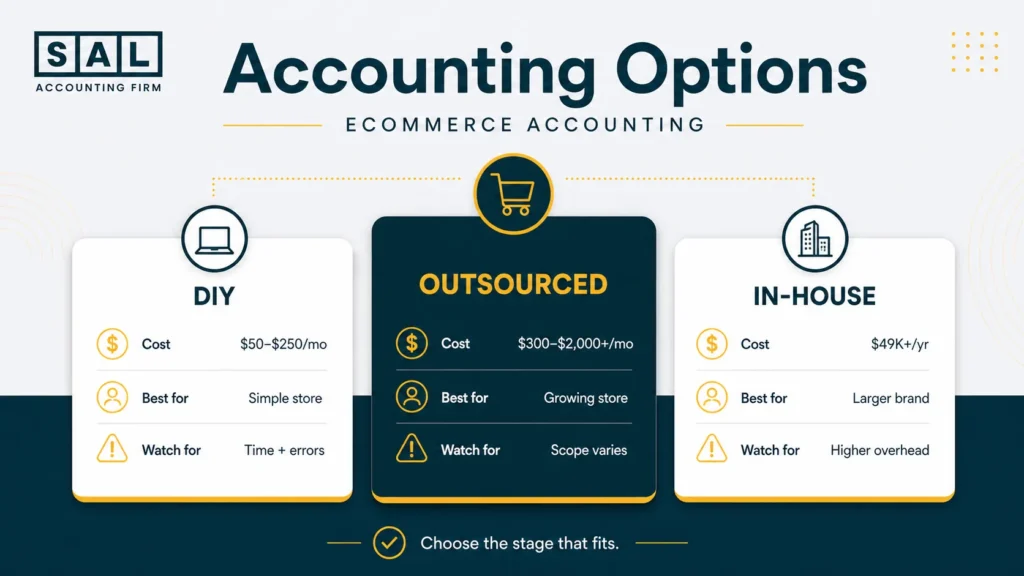
Is Outsourced Bookkeeping Cheaper Than Hiring In-House?
Usually, yes, at least for small and growing stores. In-house support costs more than the salary alone. You also need to factor in:
- payroll costs
- benefits
- software
- training
- management time
- backup when that person is away
In Canada, Job Bank lists national wages under its bookkeeper wage report. For many growing stores, outsourced ecommerce accounting compared with in-house accounting is a useful decision point.
The real question is not just “which option costs less?” It is “which option gives me clean enough numbers for the stage I’m in?”
How Much Should You Budget for Accounting Based on Your Store Size?
The right budget depends on where your store is now and what your numbers need to explain. A new Shopify store does not need the same accounting setup as a multi-channel brand with inventory, sales tax, and US orders:
1. New Store or Side Hustle
Budget around $50 to $300 per month. This may cover software, simple tracking, and occasional review. At this stage, the goal is to keep things clean before the store grows. Focus on:
- separate business bank account
- separate business credit card
- basic expense tracking
- clean sales records
- tax documents saved early
If you are still planning the business setup, starting costs for an e-commerce business can help separate platform costs, inventory, accounting tools, and launch expenses.
2. Growing Shopify or Amazon Store
Budget around $500 to $2,000 per month. At this stage, you probably need monthly bookkeeping, payout reconciliation, sales tax tracking, and COGS review.
The real goal is not just “doing the books.” It is knowing if the store is actually profitable after fees, refunds, product cost, shipping, ads, and tax. This is also where e-commerce business expenses become easier to track if the books are set up properly from the start.
3. Multi-Channel Store
Budget around $2,000 to $5,000+ per month. This usually fits stores selling through Shopify, Amazon, Etsy, WooCommerce, or other channels at the same time.
Now the challenge is not just volume. It is making sure each platform is recorded properly and that you can compare performance without guessing. If Shopify and Amazon are both part of your setup, Amazon Shopify integration can affect how orders, inventory, and payouts flow into the books.
4. Canadian Seller Expanding Into the US
Budgeting can be harder here because the accounting touches more than bookkeeping. You may need help with sales tax, currency, structure, US filings, and how the Canadian side reports the income.
If this is starting to feel unclear, SAL can help with Canada-US ecommerce tax guidance so you know what needs to be tracked, filed, and fixed.
This can also connect to registering a business in the US from Canada if your accounting questions are starting to turn into structure questions.
Case Study: How Daniel in Port Credit Plans Accounting Costs Before US Expansion2
Daniel runs a home goods store from Port Credit in Mississauga. He sells through Shopify and Amazon Canada, and US orders are starting to grow. Monthly sales are moving toward $80,000, but the numbers are getting harder to follow. Amazon has FBA fees, refunds, and reimbursements. Shopify has payment fees, discounts, sales tax settings, and app costs.
The Problem
Daniel’s current bookkeeping works for basic Canadian sales, but it does not give him enough detail for the next stage. He is unsure about product margins, GST/HST, Amazon fees, and whether US sales tax could become a problem as US orders grow.
What We Do
We review Daniel’s Shopify and Amazon reports, then compare them against the bank deposits. We separate platform fees, refunds, inventory costs, sales tax, and payout timing. We also map out what support he needs now and what can wait.
The Result
Daniel moves from basic bookkeeping to a stronger ecommerce accounting package. His monthly cost increases, but now the cost makes sense. He is paying for payout reconciliation, inventory and COGS tracking, GST/HST review, and a clearer view of growing US sales.
- Read more: “Best Business Structure for Online Retail”
How Can You Reduce E-commerce Accounting Costs Without Messy Books?
You can keep costs lower by making the work easier to manage. A few simple habits help:
- keep one business bank account
- keep one business credit card
- avoid mixing personal and business spending
- connect Shopify, Amazon, and payment processors properly
- use a payout tool when order volume grows
- upload receipts monthly
- track product costs before tax time
- close the books every month, not once a year
- ask what your accountant needs before expanding into the US
This often comes back to a basic small business bookkeeping checklist. The cleaner your records are, the less time someone has to spend untangling them later.
If your main issue is deductions and what records to keep, e-commerce tax deductions can help you see what should be tracked before tax season.
Pro Tip: If you’re planning to sell into the US, ask about tax and bookkeeping setup before your first big sales push. It is usually easier to set it up cleanly than fix it later.
Conclusion: What Should an Online Store Owner Pay for Accounting?
For a small store, basic tools or light bookkeeping may be enough. For a growing Shopify, Amazon, Etsy, or WooCommerce store, monthly support often lands around $750 to $2,000. For multi-channel or cross-border stores, costs can move higher.
The right choice depends on how clear your numbers need to be. If fees, refunds, inventory, and tax are getting hard to follow, stronger accounting support can help you stop guessing from messy reports.
If you’re unsure which level of support fits your store, contact SAL Accounting and get a clearer sense of what needs to be fixed, tracked, or set up next.