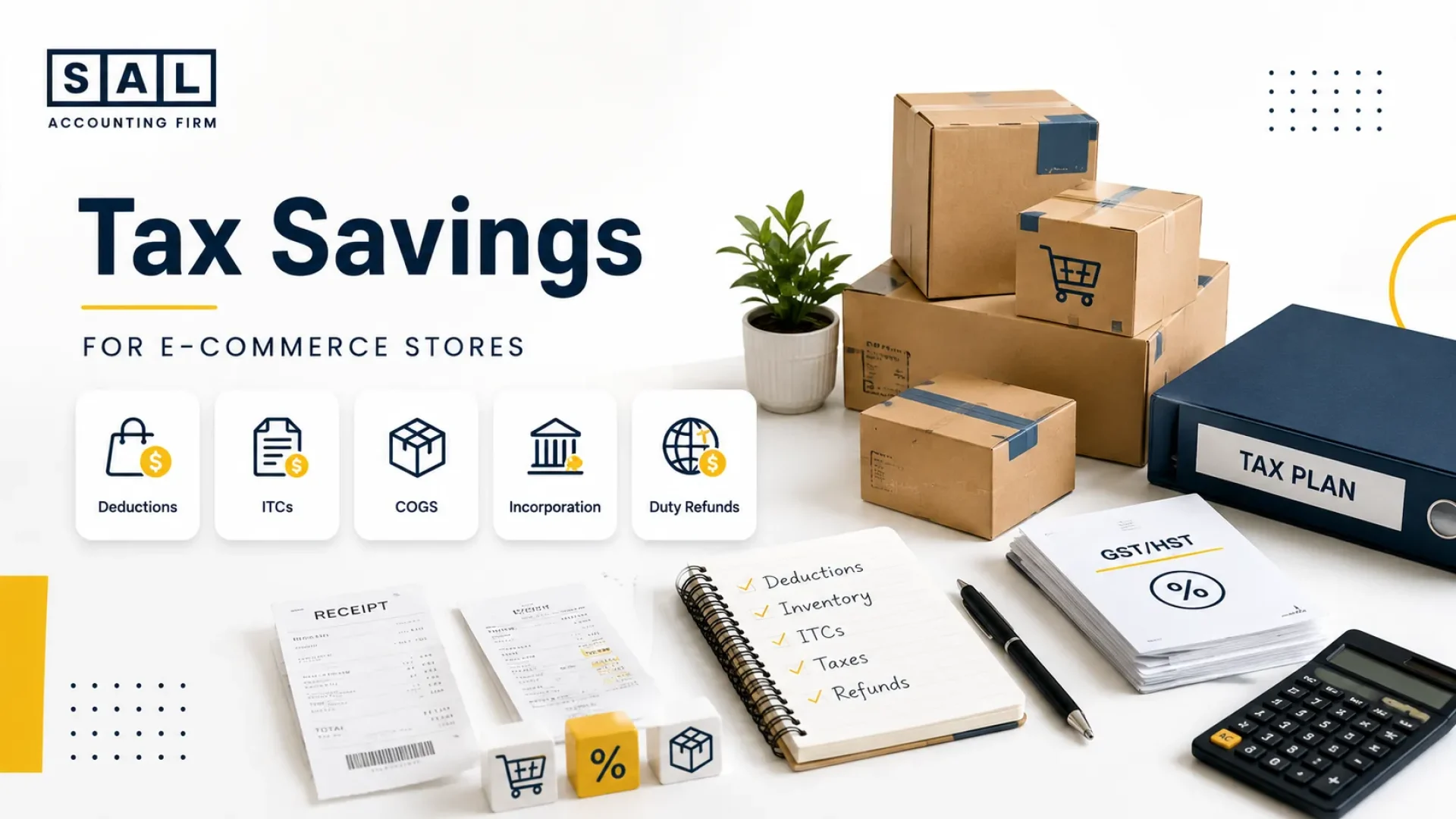
Tax loopholes for e-commerce stores are legal ways to lower your tax bill, not shady tricks. For Shopify, Amazon, and Etsy sellers, they usually include deductions, GST/HST input tax credits, COGS, CCA, SR&ED, incorporation planning, and duty refunds.
SAL Accounting works with ecommerce sellers who need these numbers to make sense. Read to the end to see which strategies may fit your store and what proof to keep.
Use SAL’s ecommerce tax document checklist to see what proof to gather before tax time.
Quick Takeaways
- Tax loopholes for e-commerce stores usually mean legal deductions, GST/HST input tax credits, COGS, CCA, SR&ED credits, duty refunds, and business structure planning.
- The goal is not to hide income. The goal is to use the rules properly and keep proof.
- Shopify, Amazon, Etsy, Stripe, PayPal, ad platforms, suppliers, and 3PLs all create records that affect tax.
- Some tax-saving options are simple, like claiming platform fees. Others, like SR&ED or duty drawback, need closer review.
- The best tax loophole is the one your records can actually support.
What Are Tax Loopholes for E-commerce Stores in Canada?
Tax loopholes for e-commerce stores are legal tax rules that may reduce what you owe when they’re used properly. For online sellers, these usually include business deductions, GST/HST input tax credits, inventory and COGS planning, capital cost allowance, SR&ED credits, incorporation planning, and duty drawback. The real question is:
Are you claiming what your store is allowed to claim, and can you prove it?
Here’s the simple version:
| Tax Loophole | Best For | Main Benefit | Record Needed |
| Platform fee deductions | Shopify, Amazon, Etsy sellers | Captures selling costs | Monthly statements |
| Ad and software deductions | Growth-focused stores | Lowers taxable income | Invoices |
| Inventory and COGS | Product sellers | Shows real gross profit | Inventory reports |
| GST/HST ITCs | Registered sellers | Recovers eligible GST/HST | Tax invoices |
| CCA | Equipment purchases | Claims assets properly | Receipts |
| Incorporation review | Profitable stores | Possible tax deferral | Corporate records |
| SR&ED credits | Technical projects | Possible tax credit | Project records |
| Duty drawback | Import/export sellers | May recover duties | Import/export proof |
Example: If Shopify shows $25,000 in sales, but your bank deposit is $21,250, that difference may include fees, refunds, discounts, apps, shipping adjustments, or sales tax. If your books only record the bank deposit, you may miss deductible costs.
That is why everyday ecommerce tax deductions matter. They are not exciting, but they are often where ecommerce sellers lose the most clarity.
Are Tax Loopholes for E-commerce Stores Legal?
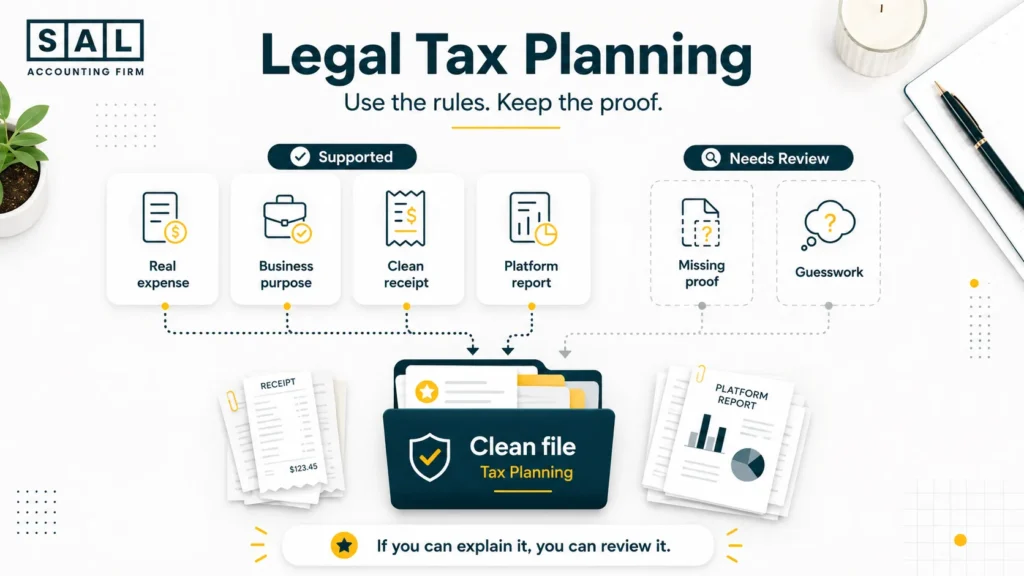
Yes, tax loopholes are legal when they mean proper deductions, credits, refunds, and planning strategies. What matters is that the claim is real, business-related, and supported. Legal tax planning means:
- claiming real business expenses
- tracking inventory properly
- recovering eligible GST/HST through ITCs
- reviewing whether incorporation makes sense
- claiming credits only when the work qualifies
- keeping documents that explain the claim
Tax evasion is different. That means hiding income, faking expenses, or guessing at numbers. Most ecommerce sellers are not trying to do anything wrong. They just have tax data coming from too many places.
Pro tip: If you cannot explain a tax claim in plain English, slow down before claiming it. The issue may be fixable, but guessing is not the answer.
Which Tax Deductions Can Shopify, Amazon, and Etsy Sellers Claim?
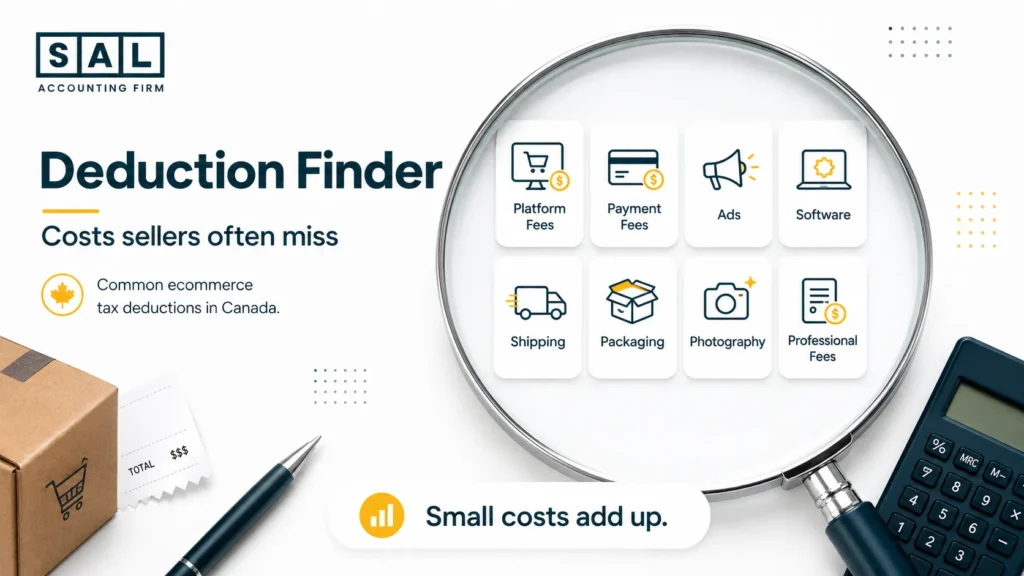
Ecommerce sellers can usually review deductions for platform fees, payment processing fees, ads, software, shipping, packaging, professional fees, product photography, inventory costs, and eligible home office expenses.
Many of these are normal ecommerce business expenses. They just get missed because they’re spread across payout reports, app invoices, ad accounts, and supplier bills. Common deductions may include:
- Shopify, Amazon, Etsy, and marketplace fees
- Stripe, PayPal, and payment processing fees
- Meta, Google, TikTok, and Amazon ads
- Shopify apps and ecommerce software
- shipping, fulfilment, and packaging
- product photography and creative costs
- bookkeeping and accounting fees
- inventory-related costs
- eligible home office costs
For Shopify sellers, this often overlaps with Shopify seller taxes, because sales tax, income tax, refunds, discounts, and platform fees all show up in different reports. Etsy sellers run into a similar issue with Etsy seller taxes, especially when listing fees, transaction fees, and payment fees are easy to miss.
Pro tip: Do not use bank deposits as your only source of tax information. A payout is already reduced by fees, refunds, and other deductions.
- Also read: “Ecommerce Tax Deductions”
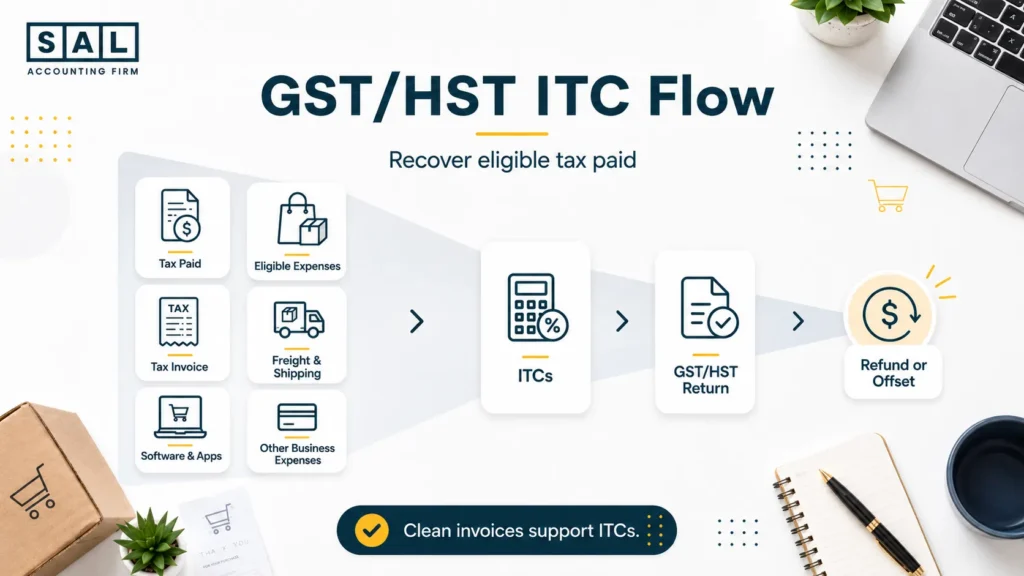
How Can GST/HST Input Tax Credits Lower an Ecommerce Seller’s Tax Bill?
GST/HST input tax credits can help registered ecommerce sellers recover GST/HST paid on eligible business expenses. The CRA explains that registrants can claim input tax credits for GST/HST paid or payable on purchases and expenses used in commercial activities.
For ecommerce sellers, ITCs may apply to eligible GST/HST paid on:
- shipping supplies
- freight and delivery
- software subscriptions
- professional fees
- business-use-of-home expenses
- equipment and operating costs
Example: You run a Shopify store in Ontario and spend $10,000 on eligible business expenses with 13% HST. That means you paid $1,300 in HST. If you are registered and the expenses qualify, that $1,300 may be recoverable as an input tax credit.
That is not a shady loophole. It is just how GST/HST works when records are clean. For Shopify sellers, Shopify GST/HST setup and GST/HST return filing become much easier when tax collected, expenses, and payout reports line up.
Pro tip: Pull your GST/HST records monthly, not just at filing time. It is much easier to catch missing ITCs while the invoices are still fresh.
Can CCA Help Ecommerce Sellers Deduct Equipment and Software?
Yes, capital cost allowance can help ecommerce sellers deduct the cost of certain business assets over time. CRA guidance explains that when depreciable property wears out or becomes obsolete, the cost is usually deducted over several years through capital cost allowance instead of being fully deducted in the year it is purchased. For ecommerce sellers, this may apply to:
- laptops
- label printers
- product photography equipment
- cameras and lighting
- warehouse shelves
- inventory scanners
- packaging machines
- business-use furniture
Monthly software subscriptions may be treated differently from equipment. For example, a Shopify app subscription and a camera used for product photos are not always handled the same way. The key is not to assume every purchase is an instant full write-off.
Can Incorporation Lower Taxes for Ecommerce Sellers?
Incorporation can help some profitable ecommerce sellers with tax planning. A Canadian-controlled private corporation may qualify for the small business deduction, and the CRA lists the net federal tax rate for qualifying CCPCs as 9% under its corporation tax rates.
Still, not every seller needs to incorporate. It depends on profit, cash needs, risk, and growth plans.
- profit is steady
- inventory is growing
- liability risk is higher
- you want to keep cash in the business
- you are hiring contractors or staff
- you are expanding into the US
The right structure depends on where the business is now and where it is going. If you are comparing sole proprietorship, corporation, partnership, or a more complex setup, the best business structure for online retail is usually the one that fits your profit, risk, and growth plans.
- Read more: “Best Business Structure for Online Retail”
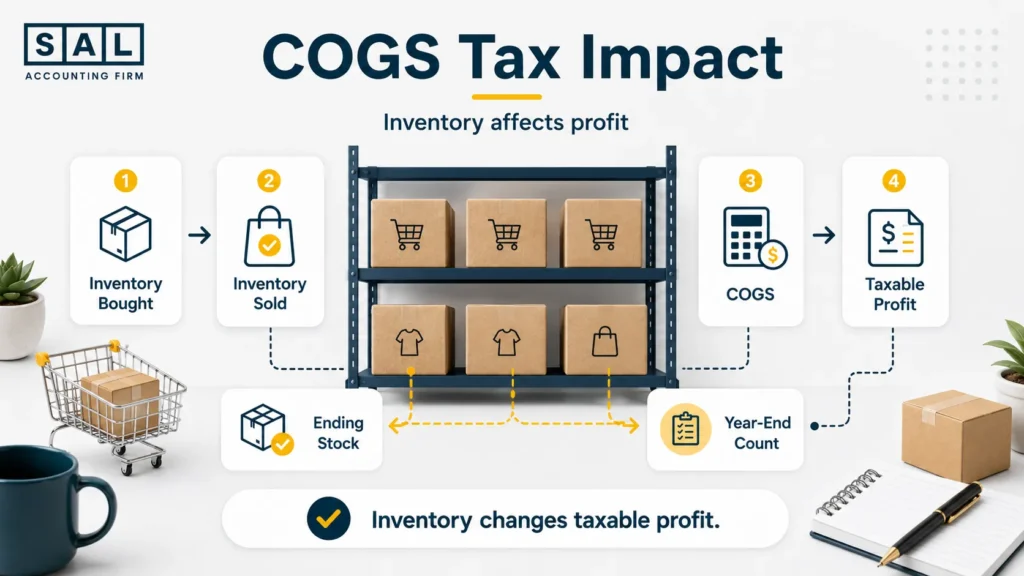
Can Inventory and COGS Reduce Taxable Income for Ecommerce Stores?
Yes. Inventory and cost of goods sold can reduce taxable income when they’re tracked properly. For product-based ecommerce stores, COGS may include:
- product costs
- supplier costs
- freight
- duties
- packaging
- other costs tied to getting products ready for sale
The key point is that inventory is not always deducted the moment you buy it.
Example: Let’s say you bought $60,000 of inventory during the year, but $18,000 is still unsold at year-end. That does not usually mean the full $60,000 becomes the cost of goods sold right away. You need to know what was sold and what is still sitting in stock.
That is where it helps to calculate COGS for ecommerce stores instead of treating inventory like a simple expense.
Pro tip: Do a clean year-end inventory count. Shopify, Amazon FBA, your 3PL, and your own storage space should all be part of the review.
Can Ecommerce Businesses Claim SR&ED Tax Credits?
Some ecommerce businesses can claim SR&ED tax credits, but not every test qualifies. The CRA explains that the SR&ED tax incentive program can help Canadian businesses earn tax incentives that reduce income tax payable.
For ecommerce sellers, normal ad tests or product photo tests usually need careful review. Technical work, like custom software or product development problems, may be worth looking at. Examples may include:
- developing a custom Shopify app to solve a technical problem
- testing materials for a new product
- solving a manufacturing issue
- building a custom system that goes beyond normal ecommerce setup
- documenting failed and successful technical experiments
SR&ED is not for “we tried a new ad angle.” It is more likely to matter when the business is trying to solve a technical problem and keeping records of the work.
Pro tip: If you think a project may qualify for SR&ED, document the problem, the tests, the failed attempts, the time spent, and what changed. Do not wait until year-end and try to recreate the story.
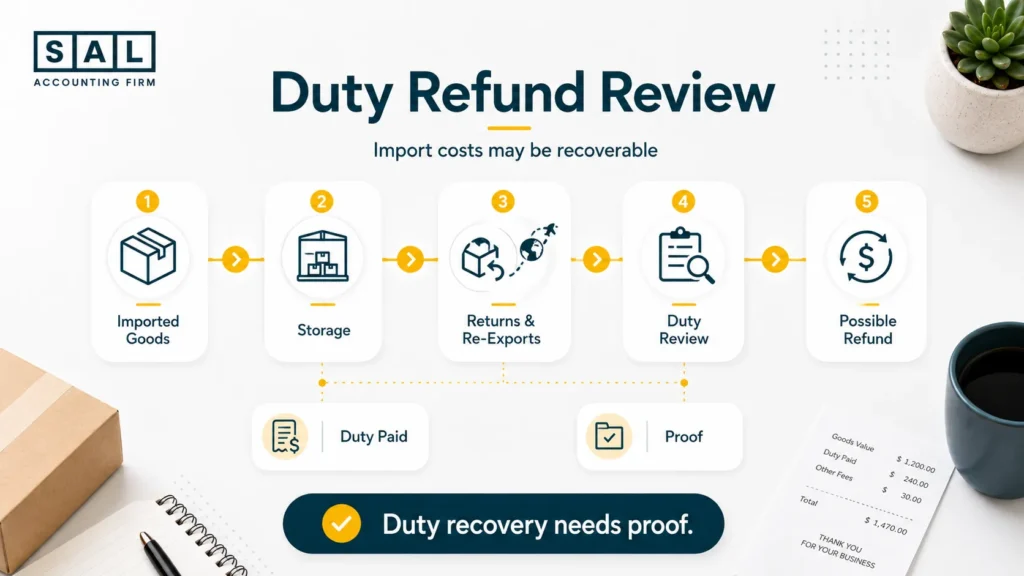
Can Cross-Border Ecommerce Stores Recover Import Duties?
Yes, in some cases. Ecommerce stores that import goods into Canada and later export or re-export them may be able to review duty recovery options. CBSA explains that the Duty Drawback Program may refund duties paid on imported goods if the goods are eventually exported in the same condition, or used in manufacturing and eventually exported. This can matter for stores selling:
- apparel
- accessories
- beauty products
- home goods
- private-label products
- seasonal products
- high-return products
If duties are buried inside one large “shipping” or “import” account, it gets harder to see true product margin.
A product that looks profitable before duties may look very different after freight, brokerage, duty, storage, and returns. This is where cross-border ecommerce shipping becomes part of the tax conversation, not just the logistics conversation.
And if US sales are becoming a bigger part of the business, US sales tax requirements for Canadian sellers may become part of the same planning conversation.
Pro tip: Track duties by SKU or product line when possible. It makes duty recovery, pricing, and margin review much easier.
- Also read: “Cross-Border Ecommerce Shipping”
Case Study: How Maya in Leslieville, Toronto Finds Missed Shopify Tax Deductions1
Maya runs a skincare Shopify store from a small studio near Queen Street East in Leslieville, Toronto. Her sales are growing, but tax time always feels unclear. Shopify shows strong sales, her ad spend is high, and her bank deposits are lower than expected. She is not trying to avoid tax. She just wants to know which costs are actually deductible and what proof she needs.
The Problem
Maya was recording Shopify payouts too simply. Platform fees, app fees, payment processing costs, refunds, discounts, packaging, and some ad costs were not separated clearly. That made it harder to see which expenses were already supported and which ones needed better records.
What We Do
We review her Shopify reports, payout details, ad invoices, app subscriptions, supplier bills, and receipts. Then we separate supported deductions from items that need more proof. The goal is not to create aggressive claims. The goal is to help Maya claim the normal ecommerce deductions her store can actually support.
The Result
Maya gets a cleaner deduction list before filing. She can see which expenses reduce taxable income, which receipts need to be saved monthly, and why the bank deposit alone was never enough to understand her tax position.
What Proof Do Ecommerce Sellers Need to Claim Tax Loopholes?
To claim tax loopholes safely, ecommerce sellers need proof that each deduction, credit, or refund is real, business-related, and supported. The system does not need to be fancy. It just needs to be consistent. Here’s the proof that usually matters:
| Tax-Saving Area | What to Save | Where It Comes From | Why It Matters |
| Deductions | Receipts and invoices | Apps, vendors, suppliers | Supports expenses |
| Platform fees | Monthly statements | Shopify, Amazon, Etsy | Shows selling costs |
| GST/HST ITCs | Tax invoices | Suppliers, software, freight | Supports ITCs |
| COGS | Inventory and supplier records | Suppliers, 3PL, FBA | Supports product costs |
| CCA | Asset receipts | Equipment vendors | Supports asset claims |
| SR&ED | Project notes and test logs | Internal records | Supports credit review |
| Duty drawback | Import/export proof | Broker, CBSA, freight forwarder | Supports duty recovery |
Save the proof monthly, not once a year when everything already feels messy. The CRA’s digital platform reporting rules are another reason to keep platform activity, bank deposits, and tax records aligned.
This also connects to key tax deadlines, because clean records are easier when you know what needs to happen before filing or GST/HST deadlines.
Case Study: How Daniel in Port Credit, Mississauga Reviews Duties and Landed Cost2
Daniel runs an Amazon FBA home goods brand from Port Credit in Mississauga. His products are manufactured overseas, shipped into Canada, and sometimes moved again for US orders. Sales look healthy, but product profit keeps changing. Some months look good. Other months do not. He wants to know whether duties, brokerage, storage, returns, and re-exported goods are being handled properly for tax and margin purposes.
The Problem
Daniel’s import costs were grouped too broadly. Duties, freight, brokerage, storage, and returned inventory were sitting in one large expense bucket. That made it hard to see true landed cost and whether any returned or re-exported goods were worth reviewing for duty recovery.
What We Do
We separate landed cost by product line, review the customs documents, match duties to inventory movement, and flag any areas where duty drawback or classification questions may be worth a closer look. The goal is not to promise a refund. The goal is to find what is worth reviewing and what records support it.
The Result
Daniel gets a clearer view of product margin after duties and freight. He also knows which import documents to keep, which products need closer review, and whether duty recovery is worth exploring before the next filing cycle.
Which Tax Loopholes Should Ecommerce Sellers Review First?
Not every tax loophole matters for every store. A new Etsy seller does not need the same review as a seven-figure Shopify brand importing inventory and selling into the US. Start with the areas that match your business:
- If you sell through Shopify, Amazon, or Etsy, review platform fees and payment processing fees.
- If you spend heavily on ads, review advertising deductions.
- If you hold inventory, review COGS and year-end stock.
- If you are registered for GST/HST, review eligible ITCs.
- If you bought equipment, review whether CCA applies.
- If your profit is steady, review incorporation.
- If you are building technical products or software, review SR&ED.
- If you import and re-export goods, review duty drawbacks.
The point is not to chase every strategy. The point is to know which ones fit your store.
Final Thoughts: Which Tax Loopholes Are Worth It for Your Store?
Tax loopholes for e-commerce stores are really about using the rules properly. Not hiding income. Not guessing. Not hoping your platform reports are enough. Start with the basics: supported deductions, clean GST/HST records, accurate COGS, proper asset classification, and clear import documents if you sell cross-border.
If you are not sure which tax loopholes apply to your store, contact book a consultation at SAL Accounting and get a clearer sense of what needs to be reviewed, tracked, or fixed before tax time.