Amazon looks like easy sales for a clothing brand, with shoppers already there. But clothing fees, returns, and less control over your brand can shrink what each order keeps. Compare what one order keeps on each channel, then weigh what each does to your brand.
SAL Accounting runs these numbers with clothing brands. By the end, you’ll know which channel deserves your next collection.
Before you compare channels, work out what your own store pays in fees with the Shopify Fee Calculator.
Quick Takeaways
- Amazon gives you shoppers, while Shopify gives you your own store and customer list.
- You need Amazon’s approval to sell in its Clothing and Accessories category.
- Amazon.ca charges clothing a 10% referral fee under CAD $20, and 17% at CAD $20 or more.
- Compare what each order keeps after every cost, not which channel brings in more revenue.
- Returns, ad costs, and brand control often decide which channel wins.
- Many clothing brands sell on both, but only work out well when they track each channel separately.
Want to see what each channel really keeps? Our ecommerce bookkeeping services track sales, fees, and returns by channel, so the Amazon vs Shopify answer comes from your own numbers.
What’s the Real Difference Between Amazon and Shopify for an Online Clothing Brand?
Amazon rents you its customers for a fee, while Shopify gives you your own store and customer list.
On Amazon, you list your clothing in a marketplace that already has shoppers. You pay Amazon a fee on each sale, and you follow Amazon’s rules for listings, product pages, and returns. On Shopify, you run your own store. You set the look, the policies, and the experience, and you keep your customers’ details, but you have to bring the shoppers in yourself.
| Question | Amazon | Shopify |
|---|---|---|
| Who brings the shoppers? | Amazon’s marketplace | You, through ads, email, and social |
| Who owns the customer relationship? | Mostly Amazon | You |
| Who sets the shopping experience? | Amazon’s rules | You |
| How do fees work? | A fee on each sale, plus a selling plan | A monthly plan, plus payment processing |
For clothing, that difference matters more than for most products, because fashion brands are built on how the brand looks and feels. If you’re still weighing the two platforms in general, start with Shopify vs Amazon FBA. Whichever you choose, setting up accounting for an online clothing store properly makes every channel comparison easier.
Do You Need Approval to Sell Clothing on Amazon.ca?
Yes, Clothing and Accessories is a category that needs Amazon’s approval before you can list in it.
Approval comes before your first sale, so build it into your launch timeline. You’ll also pick a selling plan. According to Amazon.ca’s selling fees page, the Individual plan costs CAD $1.49 per unit sold, and the Professional plan costs CAD $29.99 per month.
| Selling Plan | Cost | Fits Best When |
|---|---|---|
| Individual | CAD $1.49 per unit sold | You’re testing a few products |
| Professional | CAD $29.99 per month | You expect to sell regularly |
At steady volume, the monthly Professional plan usually costs less per unit than paying $1.49 on every item. Either way, the selling plan is only a small part of your Amazon costs. The referral fee is the big one.
How Much Does Amazon Charge to Sell Clothing in Canada?
Amazon charges a referral fee of 10% or 17% on clothing, depending on whether the price reaches CAD $20.
For Clothing and Accessories on Amazon.ca, the referral fee is:
- 10% when the total sales price is under CAD $20
- 17% when the total sales price is CAD $20 or more
- Never less than CAD $0.40 per item
Amazon takes whichever is higher: the percentage or the minimum. The fee is charged on the total sales price. If you use Fulfillment by Amazon (FBA), fulfillment fees come on top of this, so check Amazon’s current fee schedule for your sizes.
Here’s what that threshold means for a basic tee:
| Price | Referral Fee Rate | Referral Fee |
|---|---|---|
| $19.99 tee | 10% | $2.00 |
| $20.00 tee | 17% | $3.40 |
One cent more in price costs $1.40 more in fees.
Pro Tip: Check where your prices sit against the CAD $20 line. Pricing a tee at $19.99 instead of $20 drops the referral fee from 17% to 10%.
Your total Amazon fees also depend on which of the Amazon FBA plans you choose, and whether Amazon handles your fulfillment.
What Does Selling Clothing on Shopify Really Cost?
You pay a Shopify plan, payment processing, and the full cost of fulfillment, shipping, and ads.
Your own store has no referral fee, but it has costs Amazon covers for its sellers:
- Getting shoppers: you pay for ads, influencers, and email to bring every visitor in
- Fulfillment: you or your 3PL pick, pack, and ship every order
- Shipping subsidies: if you offer free shipping, you pay that cost
- Returns: you set the policy and pay for each return
Your monthly Shopify plan in Canada is the smallest of these costs. Apps, payment fees, and other hidden Shopify costs add up faster than most founders expect.
Which Channel Keeps More Profit Per Order for a Clothing Brand?
Compare what each order keeps after every cost, not the revenue each channel brings in.
Here’s an illustrative $60 hoodie with a landed cost of $22, sold once on each channel:
| Line | Shopify (your store) | Amazon (FBA) |
|---|---|---|
| Price | $60.00 | $60.00 |
| Landed cost | −$22.00 | −$22.00 |
| Referral fee (17%, since the price is CAD $20 or more) | n/a | −$10.20 |
| Payment processing (illustrative 3%) | −$1.80 | n/a |
| Pick and pack (3PL) | −$3.00 | n/a |
| Shipping you pay (free shipping offered) | −$8.00 | n/a |
| FBA fulfillment (illustrative; check Amazon’s current fees) | n/a | −$7.00 |
| Returns cost per order (illustrative) | −$1.44 | −$2.00 |
| Ad cost per order (illustrative) | −$12.00 | −$6.00 |
| What the order keeps | $11.76 | $12.80 |
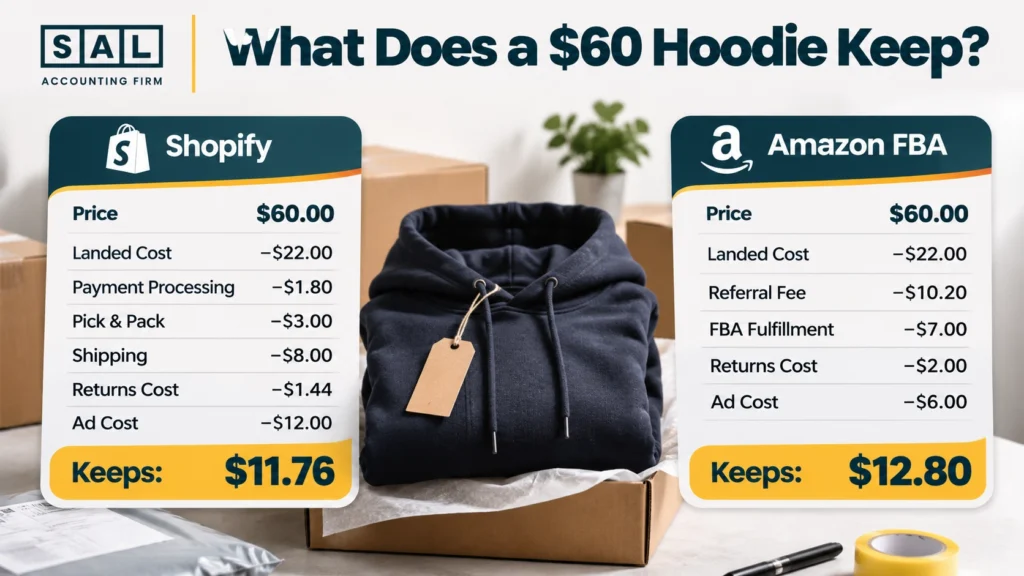
The returns line uses assumptions, not industry figures: a 12% return rate at $12 per return on Shopify, and 20% at $10 per return on Amazon.
In this example, the two channels end up close. Amazon’s referral fee is much bigger, but Shopify carries higher ad and shipping costs. Change your ad costs or return rates, and the winner can flip. That’s why the only fair comparison is what each order keeps, which is your ecommerce contribution margin by channel. Run it with your own numbers.
How Do Returns Differ on Amazon and Shopify for Clothing?
Clothing returns cost money on both channels, but who handles them and what you pay differs.
On Amazon, much of the returns process runs through Amazon’s system, under its rules and fees. On Shopify, you write the return policy and pay for each return yourself, including the return label and the time to inspect and restock the item.
There’s one cost on Shopify that’s easy to miss. When you refund an order in Shopify that was paid through Shopify Payments, you don’t get any of the credit card fees back.
Track return rates separately for each channel. Fit-driven returns can look very different on Amazon and on your own store, and a single blended rate hides that.
Case Study: How Ashley’s Clothing Brand in the Distillery District, Toronto Fixes Its Amazon Pricing1
Ashley sells basic tees and sweats online from a small studio in the Distillery District, Toronto. She lists her tees on Amazon at $20, the same price as on her own store.
The problem: Ashley doesn’t realize her $20 price puts her tees in Amazon’s 17% referral fee tier. After fees, fulfillment, and returns, each Amazon tee keeps only about $0.50.
What we do: We check every Amazon price against the CAD $20 line and compare what each order keeps on each channel.
The result: Repricing her tees to $19.99 drops the referral fee from $3.40 to $2.00. Each Amazon tee now keeps about $1.90, almost four times as much, for a one-cent price change.
What Do You Give Up by Selling Clothing on Amazon?
You trade some control over your brand, pricing, and customer data for Amazon’s reach.
On Amazon, you give up:
- Customer data: you get far less information about who’s buying, so it’s harder to build repeat sales
- Price control: other sellers can compete on the same listing
- Brand presentation: your products sit in Amazon’s layout, next to your competitors
- Independence: relying on one marketplace means its rule changes affect your whole business

For a clothing brand, these matter more than for most products. Your brand’s look, story, and customer relationships are often what let you charge more than a generic tee. Losing that control is one of the reasons many Amazon sellers fail to build a lasting brand.
Should an Online Clothing Brand Sell on Both Amazon and Shopify?
Often, yes, as long as you track profit, inventory, and returns separately for each channel.
Many clothing brands use the two channels for different jobs:
- Amazon for discovery: reaching shoppers who’ve never heard of your brand
- Shopify for your brand and repeat customers: building loyalty and owning the relationship
Running both takes care. Split your inventory by size between channels, so one channel doesn’t drain the sizes the other needs. Keep prices consistent, so customers don’t feel misled. And track what each order keeps on each channel every month.
A solid Amazon and Shopify integration keeps your inventory counts in sync. Following Amazon FBA accounting best practices keeps each channel’s sales and fees separate in your books.
Case Study: How Derek’s Clothing Brand in Port Credit, Mississauga Stops Selling Out on Shopify2
Derek sells hoodies and joggers online from a warehouse unit in Port Credit, Mississauga. Six months ago, he added Amazon to reach new shoppers.
The problem: His fast-selling medium and large sizes keep selling out on his own store. His FBA shipments pulled too much of those sizes to Amazon’s warehouses, so his Shopify customers keep hitting “sold out.”
What we do: We set inventory levels by channel and by size, based on each channel’s real sales. We also track what each order keeps on each channel every month.
The result: Derek stops losing sales on Shopify. The channel numbers also show that Amazon brings in new customers, while Shopify earns more from repeat buyers, so he now uses each channel for what it does best.
How Should a Clothing Brand Decide Which Channel Comes First?
Start where your numbers and your brand work best, then add the other channel once it’s tracking well.
Work through this checklist:
| Question | Points Toward Amazon | Points Toward Shopify |
|---|---|---|
| Where do your prices sit against CAD $20? | Many items under $20 (lower fee) | Higher-priced items |
| What are your return rates? | You’d rather not manage returns | You can manage returns well |
| What do ads cost you? | High ad costs on your own store | Ads that already convert well |
| How much does your brand matter? | Basics shoppers search for | A strong brand customers seek out |
| Can you manage inventory across channels? | You can split inventory by size | You want one pool of inventory |
| Can you get category approval? | Approved for Clothing and Accessories | Not approved yet |
Taxes can also work differently by channel, depending on your registration status. Confirm how GST/HST applies to your Amazon sales with your accountant before you launch.
Final Thought: Which Channel Fits Your Online Clothing Brand Best?
Neither channel wins for every clothing brand. Amazon brings you shoppers, but takes a bigger fee and more of your brand control. Shopify lets you own the brand and the customer, but you pay to bring every shopper in. In our example, each $60 hoodie kept about the same on both, so your own ad costs, return rates, and prices decide the winner.
Once you know what each channel keeps, our free roadmap for multichannel growth helps you plan where your next dollar of inventory and ads should go.