
Canadian ecommerce sellers rarely lose money because they crossed the border. They lose it because tax obligations were spotted after sales, inventory, and missed filings had already piled up.
SAL Accounting works with Canadian online stores at exactly this stage, when U.S. growth starts moving faster than the accounting behind it. Read this before your next sales spike or inventory move turns a manageable tax check into back taxes, penalties, and cleanup you have to fund yourself.
Start with your sales: Screen your state-level exposure with the U.S. Economic Nexus Threshold Checker.
Quick Takeaways
- Cross-border tax planning covers Canadian sales tax, U.S. sales tax, customs, income tax, and the records behind each one.
- A Canadian seller can create U.S. sales tax nexus without opening a U.S. office or company.
- Amazon collecting sales tax doesn’t necessarily cover Shopify, wholesale, or other direct sales.
- Late registration may force the business to pay customer tax from its own revenue.
- Inventory stored by Amazon FBA or a U.S. 3PL can create physical-presence questions.
- A monthly nexus review is usually safer than waiting until year-end.
- Clean platform, inventory, and tax records make corrections and audits far easier.
Keep the numbers ready for cross-border reporting: Ecommerce bookkeeping for online stores keeps sales, fees, tax, refunds, and payouts properly separated.
What Counts as Cross-Border Tax Planning Between the U.S. and Canada?
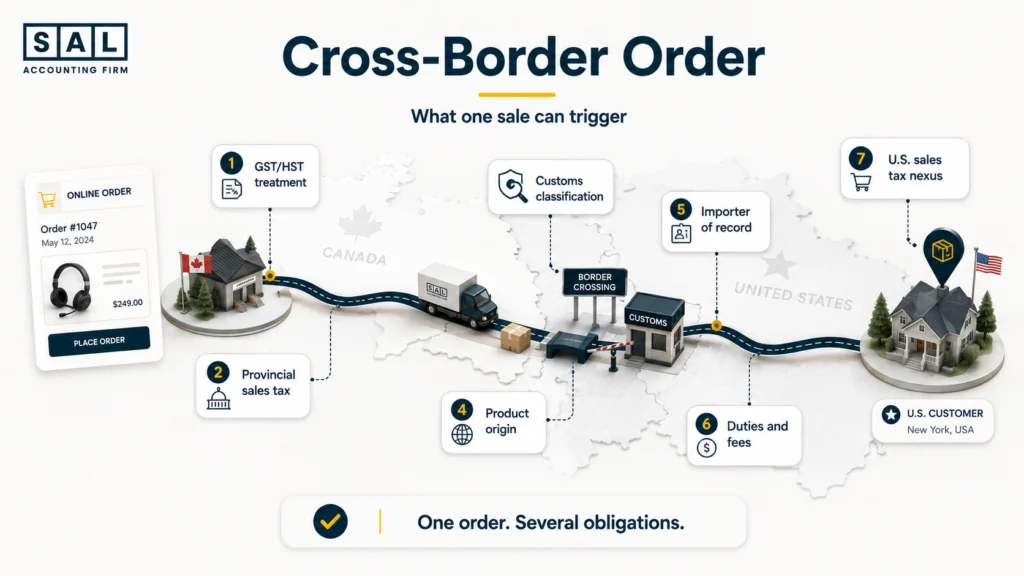
Cross-border tax planning means identifying what your ecommerce business must register for, collect, file, document, and pay before those obligations become overdue. It isn’t limited to filing a Canadian corporate tax return. A proper review considers:
- Canadian GST/HST and provincial sales taxes
- U.S. state sales tax nexus
- Marketplace facilitator rules
- Customs duties and import charges
- Inventory and fulfilment locations
- U.S. and Canadian income-tax exposure
- The records connecting sales, tax, payouts, and filings
The table below separates the main areas a Canadian ecommerce business may need to monitor.
| Tax area | Common trigger | What to track | Main risk | Review timing |
|---|---|---|---|---|
| GST/HST | Canadian registration rules | Taxable revenue and export records | Uncollected tax | Monthly or quarterly |
| Provincial tax | Sales into specific provinces | Customer location and product type | Provincial exposure | Quarterly |
| U.S. sales tax | Physical or economic nexus | State sales, inventory and channels | Back tax and filings | Monthly |
| Customs | Goods entering the U.S. | Origin, value, classification and importer | Duties and margin loss | Before shipping |
| Income tax | U.S. business activity | People, entities, facilities and contracts | Additional returns or tax | Before operational changes |
Canadian GST/HST and Provincial Sales Tax Obligations
Selling to U.S. customers doesn’t remove your Canadian tax responsibilities.
Under the CRA’s GST/HST registration rules, most businesses must monitor whether worldwide taxable supplies exceed the $30,000 small-supplier threshold in one calendar quarter or across four consecutive quarters.
GST/HST is only one part of the picture. B.C. PST, Saskatchewan PST, Manitoba RST, and Québec QST have separate registration and collection rules, so Canadian ecommerce sales tax obligations should be reviewed by province.
Some U.S. orders may be zero-rated for GST/HST, but you need proof that the goods actually left Canada. The CRA’s export rules require satisfactory supporting records.
Pro Tip: Keep invoices, tracking details, customs documents, and delivery confirmations organized by filing period.
Customs Duties and Import Costs
Customs planning decides what happens when your products physically enter the United States. Before shipping, establish:
- The product’s tariff classification
- Its country of origin
- The declared customs value
- Who acts as importer of record
- Who pays duties, brokerage, and import fees
- Whether USMCA preferential treatment may apply
- Which documents your carrier or customs broker requires
- Whether the customer receives a landed or surprise price
The import-versus-export setup for Canadian ecommerce brands affects responsibility for customs, tax, returns, and customer charges.
A product shipped from Canada isn’t automatically Canadian-origin. USMCA treatment depends on whether the product satisfies the relevant origin requirements, not simply where the parcel was mailed. CBP’s rules-of-origin materials explain why product sourcing and manufacturing inputs need to be reviewed before claiming preferential treatment.
There is another major pricing issue. Effective August 29, 2025, duty-free de minimis treatment was suspended for covered shipments entering the United States from all countries. Goods valued at or below US$800 may now be subject to applicable duties, taxes, fees, and entry requirements. That means the old “under $800 enters duty-free” assumption no longer belongs in a 2026 pricing model. CBP’s de minimis guidance sets out the change.
Pro Tip: Keep one product-level customs file showing classification, origin support, supplier location, landed cost, and broker instructions. Don’t rebuild it after a shipment has already been stopped.
What Happens When You Miss U.S. Sales Tax Nexus?
Missing nexus can make your business responsible for tax that should have been charged to customers. U.S. sales tax isn’t one federal system. Each state sets its own rules for:
- Nexus
- Registration
- Product taxability
- Marketplace sales
- Local rates
- Filing frequency
- Exemptions
- Threshold measurement periods
That’s why total U.S. revenue isn’t enough. You need state-level sales, inventory, and channel data. Here are the main nexus types ecommerce sellers should distinguish.
| Nexus type | Typical trigger | Ecommerce example | Threshold protection? | What to review |
|---|---|---|---|---|
| Physical | Inventory, staff or facilities | FBA stock in a state | Usually no | Locations and activity |
| Economic | State sales or transactions | Shopify sales cross a threshold | State-specific | Sales by state |
| Marketplace | Platform-facilitated sales | Amazon collects customer tax | Not for every obligation | Marketplace vs direct sales |
| Mixed | More than one connection | FBA inventory plus Shopify sales | No single test | All channels and locations |
Physical Nexus
Physical nexus can arise when your business has a meaningful physical connection with a state. Common ecommerce triggers include:
- Inventory stored by Amazon FBA
- Stock held by a U.S. 3PL
- Employees or contractors working in the state
- An office, warehouse, showroom, or other facility
- Trade show or temporary selling activity
- Installation, repair, or in-person services
The remote-seller guidance published by Streamlined Sales Tax distinguishes sellers with physical presence from remote sellers relying only on economic thresholds. A physical connection may create registration obligations even when sales remain below the economic threshold.
An Amazon tax setup covering Canadian and U.S. sales therefore needs more than a revenue report. It also needs historical FBA inventory locations.
Track where Amazon moves your stock: Bookkeeping for Amazon sellers in Toronto keeps settlements, inventory activity, and tax records tied together.
Economic Nexus
Economic nexus is based on sales activity rather than a traditional physical location. A Canadian business may therefore need to register in a state even when it has:
- No U.S. office
- No U.S. employee
- No U.S. company
- No bank account in that state
The U.S. sales tax requirements for Canadian sellers remain state-specific. Some thresholds use gross sales, others use taxable sales, and some consider marketplace transactions or order counts.
The point is simple: being Canadian doesn’t switch off state sales tax.
Marketplace Nexus and Facilitator Rules
Marketplace facilitator laws generally require qualifying platforms to collect and remit sales tax on marketplace transactions.
That reduces some collection work, but it doesn’t necessarily cover:
- Shopify orders
- WooCommerce orders
- Wholesale transactions
- Orders taken directly by your team
- Sales through smaller marketplaces
- Registration or reporting caused by physical presence
The marketplace-seller guidance notes that sellers using both a marketplace and direct channels may still need to register when their direct or combined activity satisfies the applicable state rules. Some states also require marketplace sellers to register or report even when the facilitator collects the customer tax.
Basically, “Amazon handles the tax” isn’t a complete nexus review.
Nexus Thresholds
There is no dependable nationwide $100,000 rule. States differ on:
- Revenue amount
- Gross versus taxable sales
- Inclusion of marketplace sales
- Transaction counts
- Current-year versus previous-year testing
- Rolling versus calendar-year periods
- When collection must begin
Pro Tip: Export sales by destination state every month. Add marketplace sales, direct sales, order count where relevant, and current inventory locations. Waiting until year-end can mean discovering a threshold months after the obligation began.
What Happens When You Register Too Late?
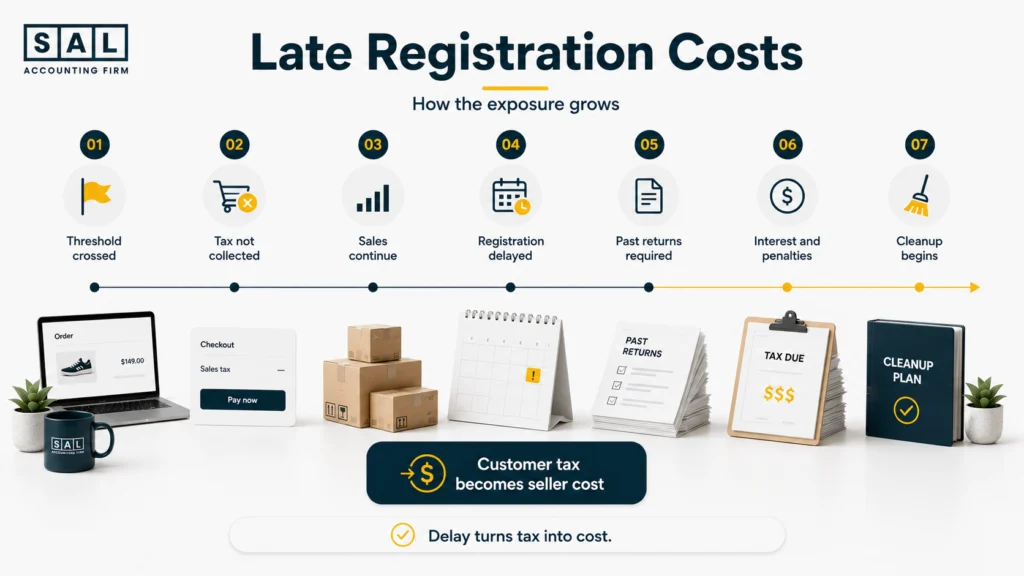
Late registration usually means the business continued making taxable sales after its collection obligation began.
Now the tax that should have been added at checkout may need to come from revenue the business has already spent.
You may also need to address:
- Historical sales calculations
- Past-due returns
- Interest and penalties
- Product-taxability errors
- Missing exemption certificates
- State correspondence
- Checkout corrections
- Voluntary disclosure options
A voluntary disclosure agreement may reduce the historical exposure for an eligible business. Under the Multistate Voluntary Disclosure Program, participating states may waive penalties and liabilities before the agreed lookback period in exchange for registration, returns, tax, and interest covering the specified period. Each state sets its own terms.
Don’t register in a rush before understanding the history. Registration, voluntary disclosure, and prospective collection aren’t always the same process.
Case Study: How Maya in Leslieville Catches Late U.S. Sales Tax Exposure1
Maya operates a Shopify skincare brand from Leslieville, Toronto. A successful creator campaign pushes U.S. orders up quickly. She then moves her bestselling products into a U.S. third-party warehouse to shorten delivery times. Her team watches total U.S. revenue, but no one records when inventory enters each state or separates state sales by channel.
The Problem
The warehouse activity creates physical-nexus questions while direct Shopify sales approach economic thresholds elsewhere. Sales tax isn’t activated consistently, and the historical reports combine website and marketplace activity.
What We Do
We map the inventory timeline, separate direct and marketplace orders, calculate sales using each state’s measurement period, and identify where registration or voluntary disclosure needs review. States are prioritized by exposure rather than handled randomly.
Result
Maya has a clear action list, a reserve for historical exposure, and a monthly report showing which states are getting close. The business knows what requires action now and what only needs monitoring.
What Happens When You Collect the Wrong Tax Rate?
Turning on sales tax doesn’t guarantee the correct amount is being charged. The rate may depend on:
- The customer’s delivery location
- State and local jurisdictions
- Product taxability
- Shipping charges
- Discounts
- Bundles
- Exemption status
- Marketplace involvement
Undercollection may leave the seller paying the difference. Overcollection may require a refund, adjustment, or remittance. It shouldn’t quietly become additional revenue.
Common ecommerce causes include:
- Applying one rate across an entire state
- Using the seller’s location instead of the customer’s destination
- Assigning the wrong product tax code
- Taxing exempt products
- Missing local or district tax
- Applying marketplace settings to direct sales
- Continuing to collect after an account closes
- Treating wholesale orders as normal retail sales
Start by identifying the affected orders, expected tax, actual tax, jurisdictions, and reporting periods. Don’t adjust every checkout setting before understanding where the error began.
What Happens When You Miss Filing Deadlines?
Registration creates an ongoing filing responsibility. Your assigned schedule may be monthly, quarterly, annually, or another state-defined frequency. The filing frequency may also change as sales increase.
More importantly, no sales doesn’t always mean no return. New York, for example, requires registered sellers to file by the due date even when there were no taxable sales or purchases during the period. Its sales tax filing requirements also include no-tax-due and final returns. A cross-border filing calendar should record:
- State account number
- Portal login
- Filing frequency
- Return deadline
- Payment deadline
- Required reports
- Responsible team member
- Filing and payment confirmation
- Notices changing the frequency
That calendar should sit inside your wider ecommerce tax-season preparation, not in an isolated spreadsheet no one checks.
Pro Tip: Save the confirmation number and filed return immediately. A calendar reminder proves that a task was planned. It doesn’t prove the return or payment was accepted.
What Happens When Your Records Aren’t Clean Enough?
Weak records make every cross-border tax problem slower and more expensive.
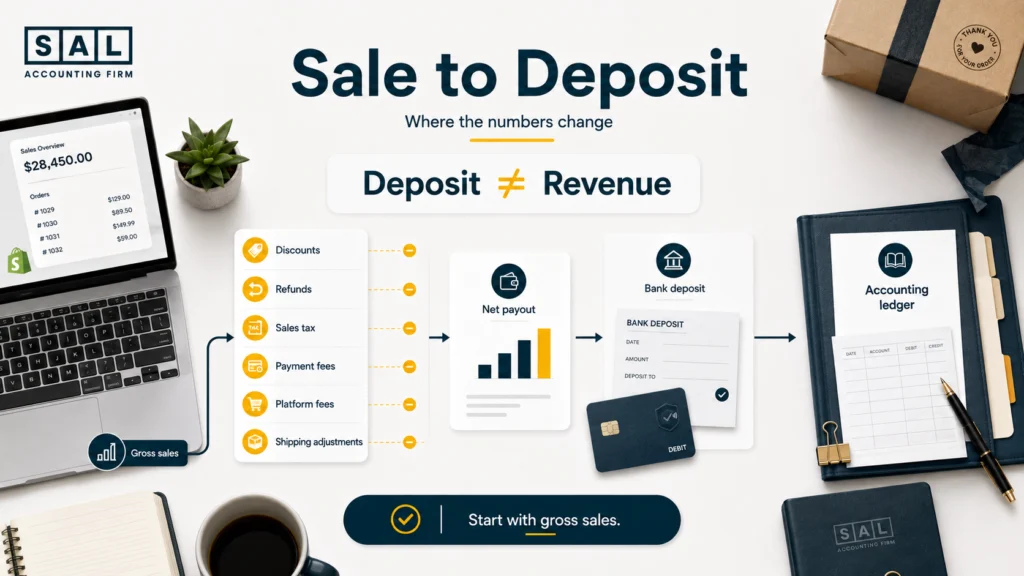
Let’s say your Shopify store processes $61,400 in customer orders during one month. After refunds, discounts, card fees, app charges, shipping adjustments, and withheld amounts, only $43,900 reaches the bank.
Recording $43,900 as revenue hides the information needed to explain:
- Gross sales
- Refunds
- Discounts
- Customer tax
- Processing fees
- Platform fees
- Shipping income
- State-level sales
- The final payout
That’s the bookkeeping gap behind poor ecommerce records. The bank deposit is the end of the transaction flow, not the starting sales figure.
Cross-border stores also need global ecommerce accounting practices that keep currencies, marketplaces, sales taxes, customs costs, and settlement deductions separate.
Your records should reconcile:
Store or marketplace sales → tax reports → processor activity → payouts → bank deposits → accounting ledger
Build the file before a notice arrives: Open the Ecommerce Tax Document Checklist.
For Shopify-heavy businesses, Shopify accounting services in Toronto create a clearer monthly connection between orders, fees, refunds, taxes, payouts, and the general ledger.
Pro Tip: Download and retain original monthly reports. Don’t rely only on a live dashboard that may change its filters, layout, or historical access.
Case Study: How Daniel in Port Credit Prepares His Records for a State Review2
Daniel runs an outdoor-accessories brand from Port Credit, Mississauga. He sells through Amazon and his own website, with inventory stored in Canada and several U.S. fulfilment locations. When a state requests information, his books show Amazon deposits as revenue and group refunds, fees, tax, and fulfilment costs into broad monthly adjustments.
The Problem
The sales reports don’t match the accounting ledger. Daniel can’t immediately separate Amazon-collected tax from tax collected through his website, and there is no historical report showing where inventory was stored.
What We Do
We rebuild gross sales by channel, reconcile marketplace settlements, separate platform-collected and seller-collected tax, document refunds, and connect historical inventory reports to the relevant state periods.
Result
Daniel can respond with supported totals rather than estimates. The business also gains a repeatable month-end process that makes future filings and nexus reviews easier to manage.
Why Nexus Changes as Your Store Grows
Nexus isn’t something you review once during a U.S. launch and forget. Your position can change when:
- A campaign increases sales in one state
- Inventory enters a new FBA or 3PL location
- A state changes its threshold
- You hire an employee or contractor
- You attend a trade show
- Wholesale sales begin
- A new marketplace is added
- Product taxability changes
- Direct sales overtake marketplace sales
- The business opens a U.S. entity
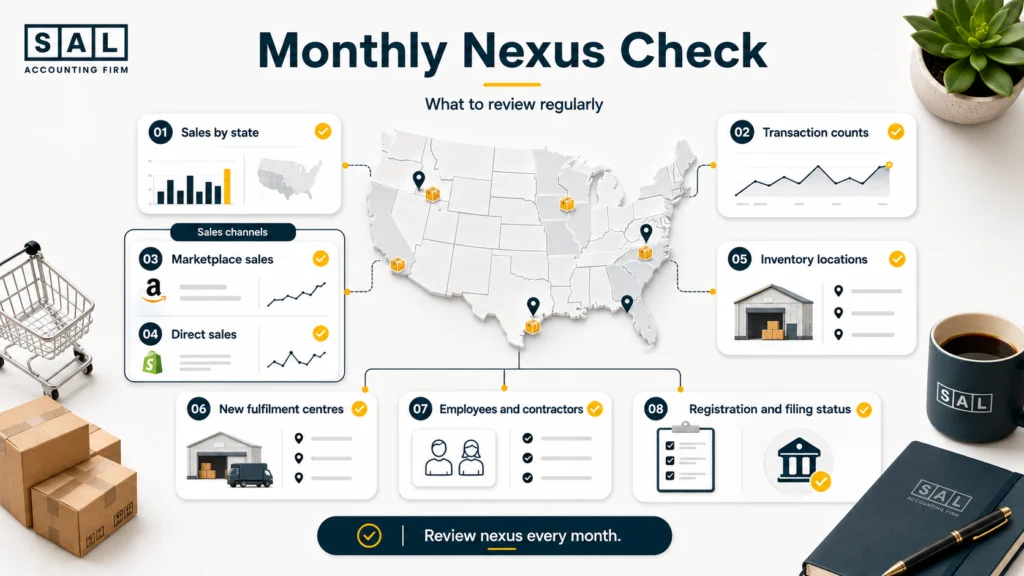
A monthly nexus review should show:
- Sales by state
- Relevant transaction counts
- Marketplace versus direct revenue
- Taxable and exempt sales
- Inventory locations
- Employees and other physical activity
- Distance from thresholds
- Registration and filing status
This is part of the stronger financial foundation described in the 3-Step Profit Boost Framework for Canadian Shopify Brands: growth works better when sales data, tax responsibilities, and decision-making move together.
A Cross-Border Tax Example, Walked Through
Assume a Canadian Shopify seller crosses a state’s economic-nexus threshold but doesn’t identify it for four months.
During those four months, the store makes US$96,000 in taxable direct sales. For this illustration, assume an average applicable sales tax rate of 7.25%.
That produces US$6,960 of sales tax that wasn’t collected at checkout.
Had the store registered on time, the customer would normally have paid that amount on top of the product price. Because the seller didn’t collect it, the state may still expect payment from the business.
Now add:
- Registration work
- Historical calculations
- Past-due returns
- Interest or penalties
- Accounting cleanup
- Professional support
- Time spent responding to notices
The exact assessment depends on the state, products, locations, and periods. But the cash-flow issue is clear: customer tax has become a business expense.
How Much Can Delayed Cross-Border Tax Planning Cost?
The original tax is only one layer. Accurate inventory and landed-cost accounting is also needed because customs duty, brokerage, freight, and import fees directly affect product margin.
The table below summarizes where the wider cost usually appears.
| Cost | How it starts | Who pays | Why it grows | How to reduce it |
|---|---|---|---|---|
| Uncollected tax | Registration begins late | Seller | More orders accumulate | Monitor nexus monthly |
| Penalties and interest | Returns are overdue | Seller | Time keeps running | Correct exposure early |
| Customs costs | Origin or classification is off | Seller or customer | Error repeats by shipment | Review products first |
| Cleanup work | Reports don’t reconcile | Seller | More periods need rebuilding | Close books monthly |
| Management time | Notices and filings overlap | Internal team | More states get involved | Use one compliance calendar |
These costs also distort ecommerce SKU profitability analysis. A product may look profitable until duty, uncollected sales tax, fulfilment, and compliance costs are allocated properly.
A clean tax history also protects the value of a Shopify business being prepared for sale. A buyer may reduce the offer, request an escrow, or walk away when the historical exposure can’t be measured.
At the end of the day, planning protects more than compliance. It protects margin, cash flow, and the decisions you make with those numbers.
Check Your Cross-Border Tax Risk
Before your next sales spike, answer these questions:
- Do we know our direct sales by state?
- Are marketplace sales shown separately?
- Do we know every state where inventory has been stored?
- Have we recorded when inventory first entered each state?
- Is tax activated only where we are registered?
- Are all registered states on one filing calendar?
- Can we reconcile platform sales to the general ledger?
- Do we retain resale and exemption certificates?
- Do we know who acts as importer of record?
- Are customs costs included in product margin?
- Have we reviewed U.S. income-tax exposure separately from sales tax?
- Can we support the treatment of exported Canadian sales?
A “no” doesn’t automatically mean something is wrong. It means that area needs to be checked before the business relies on an assumption.
What Kind of Cross-Border Support Do You Need?
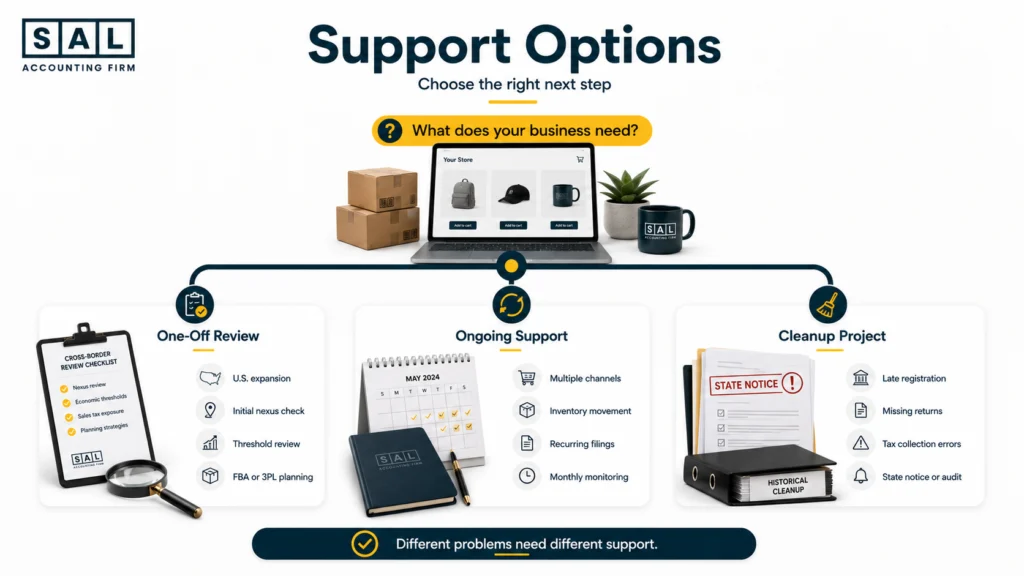
You may not need a large ongoing engagement. The right next step depends on the stage of the problem.
A One-Off Review May Be Enough When:
- You’re preparing to enter the U.S.
- Sales are approaching several thresholds.
- You need a state-by-state exposure assessment.
- You’re deciding whether to use Amazon FBA or a U.S. 3PL.
- You want to test the current setup before sales accelerate.
Ongoing Support May Be Better When:
- You sell through several platforms.
- Inventory regularly moves between states.
- Multiple registrations and filing dates are active.
- Shopify, Amazon, and accounting reports don’t stay aligned.
- Nexus monitoring needs to become part of the monthly close.
A Specific Cleanup Project May Be Needed When:
- You registered late.
- Historical returns are missing.
- Tax was collected at the wrong rate.
- A state has contacted you.
- Marketplace reports don’t reconcile.
- You’re considering voluntary disclosure.
- An audit or business sale is approaching.
Basically, planning, ongoing monitoring, and historical cleanup solve different problems. Treating them as one task usually makes the work larger than it needs to be.
Ready to Get Ahead of This Before It Becomes a Problem?
You don’t need to register everywhere just because you have U.S. customers. You do need a defensible way to identify where action is required, which states only need monitoring, and what can safely wait.
SAL Accounting works with Canadian ecommerce sellers whose tax, inventory, and reporting responsibilities have started crossing the border with their sales. Book a cross-border ecommerce tax consultation to turn the open questions into a practical action plan.